
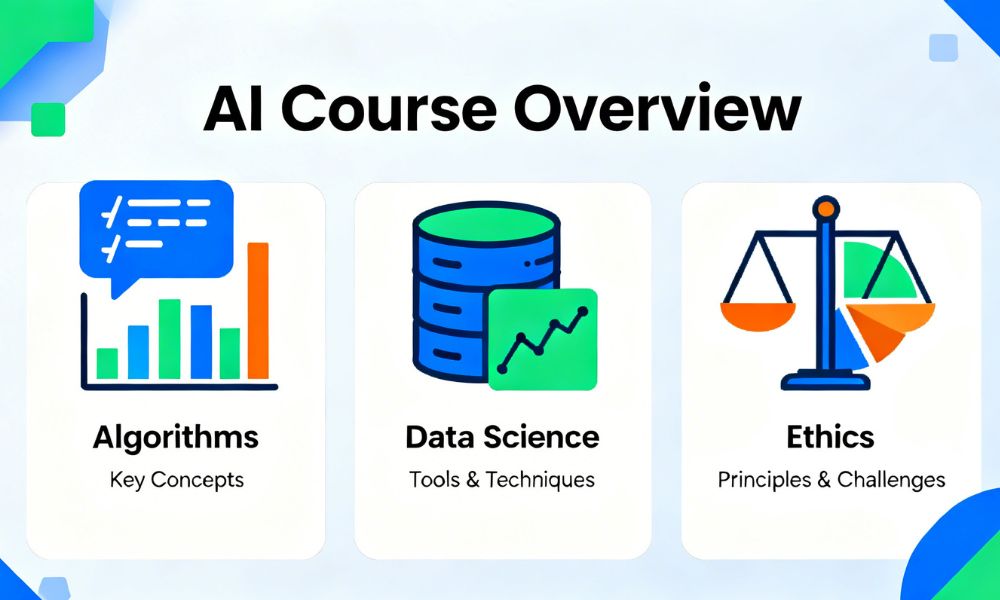
Artificial Intelligence (AI) is disrupting industries and changing the way we live and work. As its use cases multiply, AI is creating more and more jobs. If you’re thinking about taking an AI class, you might be curious: What will you learn?
In this guide, we will dissect the building blocks of AI courses and discuss what skills and topics are being taught. Whether you are an absolute beginner or want to improve your skills, we will present in this article what AI courses consist of.
What Is Artificial Intelligence? Understanding the Basics
Artificial Intelligence means that a machine has cognitive abilities to behave as human behaviors. AI, which ranges from recognizing speech to making predictions using data, performs tasks that have historically required human intelligence.
An AI course will let you know the different types of AI, such as machine learning, deep learning, natural language processing (NLP), and computer vision. Grasping these ideas is the prerequisite for all AI courses you will take!
Key Benefits of Learning AI
For beginners, learning AI opens up a world of opportunities. Here are the top reasons why AI is a valuable skill to acquire:
- High Demand for AI Professionals: AI is one of the fastest-growing fields, with a significant demand for AI experts across industries.
- Diverse Career Opportunities: With AI being used in healthcare, finance, education, and more, there are countless career paths available.
- Future-Proofing Your Career: AI technology is here to stay, making it a smart investment for long-term career growth.
By learning AI, you’ll be well-equipped for the future of work, positioning yourself for job security and higher earning potential.
What Does an AI Course Include?
An AI course is designed to equip you with both theoretical knowledge and practical skills to understand and apply AI technologies. Below are some of the essential topics typically covered:
Machine Learning: The Heart of AI
Machine learning is a subset of AI focused on building algorithms that allow systems to learn from and make decisions based on data. You’ll explore supervised learning, unsupervised learning, and reinforcement learning. These methods enable AI to identify patterns, make predictions, and improve over time.
Neural Networks: Simulating the Brain
Neural networks are computational models inspired by the human brain. In an AI course, you’ll learn how these networks work, how they process information, and how they are used in deep learning. Neural networks are at the core of many AI applications, from facial recognition to self-driving cars.
Natural Language Processing (NLP): Teaching Machines to Understand Language
NLP is a crucial area of AI that focuses on enabling machines to interpret, understand, and generate human language. In your course, you’ll discover how AI is used in chatbots, voice assistants, and language translation tools. Learning how NLP works will help you build intelligent systems that can interact with users in a natural way.
Computer Vision: Teaching AI to See
Computer vision allows machines to interpret and analyze visual information from the world, such as images and videos. In an AI course, you’ll learn how AI systems can recognize objects, detect faces, and even understand visual content, making it an essential part of technologies like autonomous vehicles and security systems.
Hands-on Experience: Building Real-World AI Projects
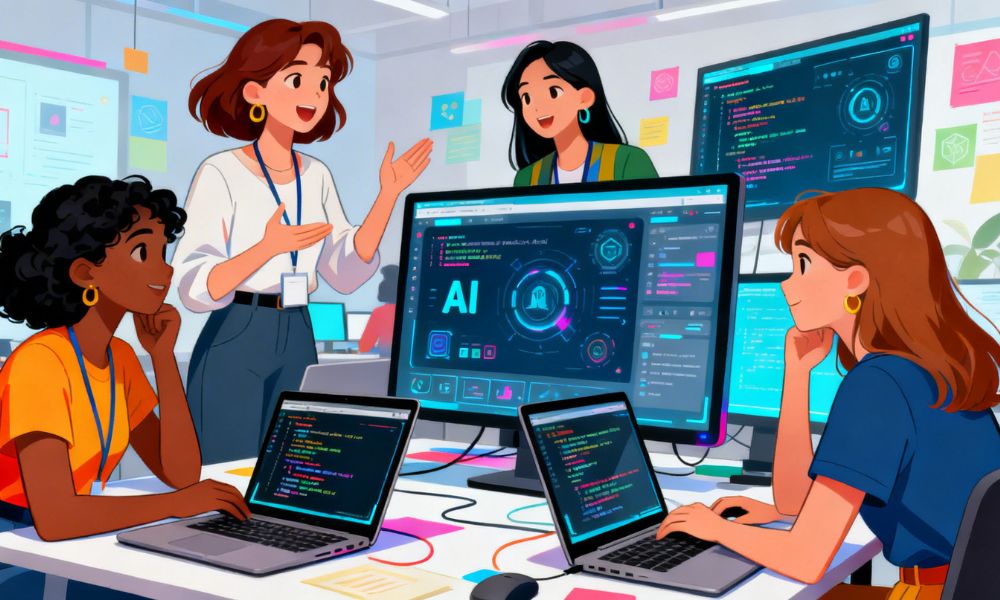
One of the most valuable aspects of an AI course is the opportunity to work on hands-on projects. These projects help you apply what you’ve learned to real-world problems, reinforcing your skills. Some common projects you might work on include:
- Recommendation Systems: Build systems that recommend products or services based on user behavior.
- Chatbots: Develop an intelligent chatbot that can carry on conversations and solve customer inquiries.
- Predictive Models: Create models that predict future trends, such as sales forecasts or stock market movements.
These practical applications ensure that you gain relevant experience and can showcase your skills to potential employers.
AI Tools and Technologies You’ll Use
To build AI applications, you’ll also need to master key tools and technologies used by professionals in the field. Some of the most common frameworks and libraries covered in an AI course include:
- TensorFlow: A popular open-source library for machine learning and deep learning.
- Keras: A high-level neural networks API designed for easy experimentation.
- PyTorch: A dynamic deep learning framework favored for research.
- Jupyter Notebooks: An interactive environment for writing and testing Python code.
These tools are widely used in AI development and will be essential in helping you implement AI solutions.
Programming Languages for AI: Python and R
To use AI technologies, you have to know programming languages. Python is the most loved language for AI development because of its simplicity and versatility as well as the plethora of libraries catering to machine learning, deep learning, and data science.
You may also come across R, another language that’s very popular for working with statistics and creating charts. You’re going to need to learn Python and R both are essential for constructing AI systems, and you’ll have to make peace with them as a part of your AI education.
AI Ethics: Focusing on Fairness and Accountability
As decision-making increasingly depends on AI systems, moral dilemmas have emerged. Some of these concerns will be addressed in an AI course, which we’ll discuss next, but not all AI courses relate to both the development and potential abuse or exploitation of AI.
You will discover how to prevent bias in AI models, how to make certain that decisions are transparent, and the societal implications of this artificial intelligence technology. These are all critically important ethical considerations when building AI systems that are fair, transparent and will benefit society.
Conclusion
AI is rapidly transforming the world, and learning about it can open the door to exciting career opportunities. Whether you’re a complete beginner or looking to expand your skills, an AI course offers the foundational knowledge and practical experience needed to thrive in the field.
By understanding key concepts like machine learning, neural networks, and natural language processing, as well as working on hands-on projects, you will be well on your way to mastering AI. Take the first step today and enroll in an AI course to begin your journey into this dynamic and rewarding field.




2 thoughts on “What You Learn in an AI Course: A Beginner’s Overview”
Comments are closed.