
Natural Language Processing (NLP) has quickly become one of the most transformative fields in artificial intelligence. As technology continues to advance, the demand for professionals who can harness the power of NLP to help computers understand human language is rising. However, the question remains: Is NLP a difficult course?
This article takes a closer look at the challenges and rewards of studying NLP, offering helpful tips and insights for beginners. If you’re considering diving into this field, read on to find out what you can expect and how to approach learning NLP.
What is Natural Language Processing (NLP)?
NLP is a subset of artificial intelligence that enables computers to interpret, understand, and generate human language. From voice assistants like Siri to automated customer service bots, NLP plays a crucial role in making machines more intuitive and capable of communicating in natural language.
At its core, NLP focuses on tasks such as language translation, sentiment analysis, and speech recognition. While NLP is undeniably complex, its impact on industries like healthcare, finance, and e-commerce makes it a valuable skill to learn.
The Growing Demand for NLP Experts
The demand for NLP professionals is skyrocketing as businesses and organizations seek to leverage machine learning and AI to handle large volumes of unstructured data. Social media monitoring, predictive text, and personalized content recommendations are just a few examples of how NLP is transforming industries.
As more companies recognize the value of NLP, the need for skilled professionals continues to grow, making it an attractive field for job seekers.
Key Components of NLP
Understanding NLP involves learning several key components. These include:
- Syntax and Parsing: The structure of sentences and their components.
- Semantics: Understanding the meaning of words and phrases in context.
- Machine Learning: Using data to train algorithms that improve over time.
- Pragmatics: Understanding the context and intent behind language use.
These components form the foundation of NLP and help machines interpret and respond to human language in a way that makes sense.
Is NLP a Difficult Course for Beginners?
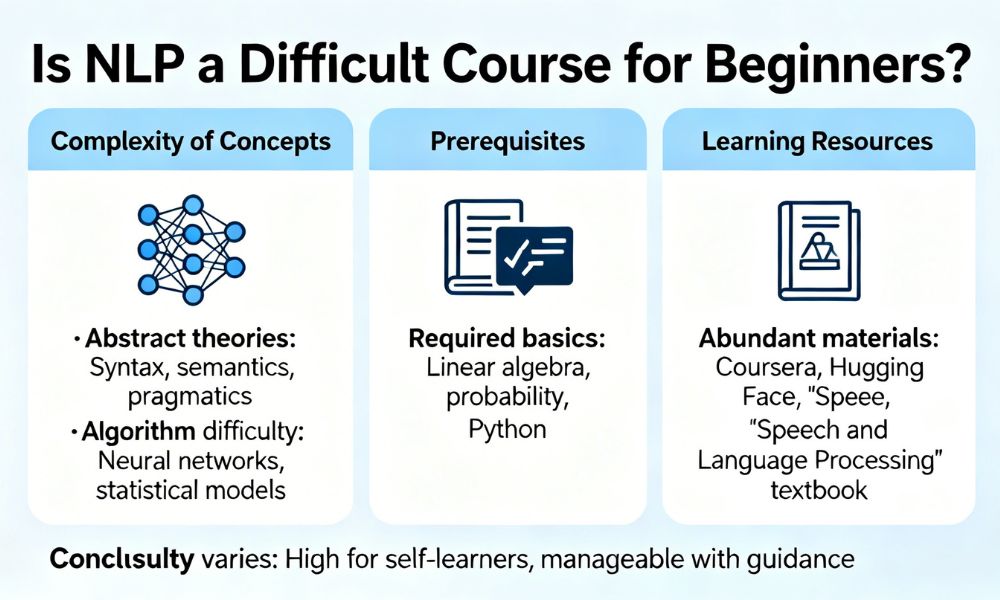
For many beginners, NLP can seem overwhelming due to its complexity. However, the difficulty largely depends on your background and prior knowledge. If you’re comfortable with programming and have some understanding of linguistics or mathematics, you may find the transition into NLP smoother.
For those new to programming or AI, NLP can be more challenging, particularly when dealing with machine learning algorithms and deep learning techniques. But don’t be discouraged—there are plenty of resources to help you build up your skills gradually.
How to Start Learning NLP
Here are a few tips for beginners who want to get started with NLP:
- Master the Basics of Python: Python is the most commonly used programming language for NLP. Familiarizing yourself with Python will help you get started with text analysis, data processing, and NLP libraries like NLTK and SpaCy.
- Learn Core Linguistic Concepts: Understanding the basic concepts of linguistics, such as syntax and semantics, will provide you with a solid foundation.
- Practice with Simple Projects: Start with simple NLP tasks like text classification or sentiment analysis to build your confidence before diving into more advanced topics.
Taking it one step at a time will help you build a solid understanding of NLP without feeling overwhelmed.
How Programming Fits into NLP
Programming is essential in NLP. In fact, the ability to write code is one of the most important skills for anyone learning NLP. With Python, you can work with libraries such as NLTK, SpaCy, and TensorFlow to manipulate text, build models, and solve real-world problems.
While programming can seem intimidating to beginners, there are many beginner-friendly tutorials and courses that will help you build the necessary skills.
Mathematics and Algorithms in NLP
Mathematics is an important part of NLP, especially when dealing with algorithms that power machine learning and deep learning models. Key areas of focus include linear algebra, probability theory, and statistics. While advanced math can pose challenges, it’s not necessary to be an expert before starting NLP.
Begin with the basics of machine learning, and as you advance, gradually work on strengthening your mathematical knowledge.
Real-World Applications of NLP
NLP is used in many real-world applications, such as:
- Chatbots: Automating customer service interactions.
- Text Analytics: Analyzing customer feedback or social media sentiment.
- Machine Translation: Translating text from one language to another (e.g., Google Translate).
- Voice Assistants: Enabling devices like Alexa and Siri to process and respond to speech.
These practical applications show how NLP is already being used in everyday technology, highlighting its relevance and importance.
Tips for Mastering NLP
To become proficient in NLP, follow these tips:
- Stay Consistent: Regular practice and continual learning are key to mastering NLP.
- Work on Projects: Apply your knowledge by working on hands-on NLP projects.
- Join Online Communities: Engage with NLP communities on platforms like Stack Overflow and Reddit to seek help, share insights, and learn from others.
- Leverage Resources: Use online courses, tutorials, and books to deepen your understanding of NLP concepts and algorithms.
By incorporating these strategies, you’ll be well on your way to mastering NLP.
Is NLP Worth the Effort?
While NLP may present some challenges, the effort is well worth it. NLP offers exciting career opportunities and is a valuable skill that can open doors to jobs in tech, data science, and AI. Additionally, as NLP is a rapidly evolving field, continuous learning is essential to stay ahead.
If you’re passionate about AI and want to work with cutting-edge technology, investing time and energy into learning NLP can lead to rewarding professional opportunities.
Conclusion
While Natural Language Processing can be challenging, it’s definitely a field worth exploring. By building a solid foundation in programming, linguistics, and machine learning, beginners can overcome initial hurdles and progress to more complex concepts. With the right resources and dedication, you’ll find that NLP is a highly rewarding area of study that has the potential to shape the future of technology. So, is NLP a difficult course? It can be, but with the right approach, it is absolutely achievable.




One thought on “NLP for Beginners: Challenges and Tips to Succeed”
Comments are closed.