

What is instructor led training vs e-learning for managers?
Instructor led training vs e-learning for managers is a decision about the skill you need applied at work, not a format preference. E-learning is strong for awareness, policy, and later reference. Live instructor led training is stronger when managers need practice, challenge, and feedback on judgement, which is why it remains the usual choice for people-heavy skills.
Managers rarely choose a format in the abstract. They choose it for a named problem: a supervisor who cannot run a difficult conversation, a project lead who cannot hold a plan, a team that treats a policy as optional. Self-paced modules can explain the model. They rarely put that person in the situation and correct the first attempt.
The useful comparison is therefore narrow. What must the manager do after the course that they cannot do now? If the answer is recall a process, e-learning often wins on cost and speed. If the answer is coach, decide, negotiate, or lead under pressure, a live room still does work that a screen does not.
When does e-learning work well for managers?
E-learning is a good fit when the goal is consistent information at scale.
Use it when you need every manager to hear the same policy, complete a compliance briefing, or review a process they will later look up. It is also useful as pre-work: a short module so classroom time is not spent on definitions.
It is a weak fit when the skill is social or situational. A manager who must give feedback, handle resistance, or choose between two imperfect options needs to practise, hear a peer’s approach, and get a correction in the moment. Those conditions are hard to build into a linear module.
Treat e-learning as the briefing layer, not as the whole development plan for people-management skills.
When should managers choose instructor led training?
Choose a live classroom when the outcome is behaviour, not awareness.
Instructor led training still works for adults because a skilled trainer can change the session in the room: slow down, pull a real case from a participant, and refuse a tidy answer that would not survive Monday morning. Peers from other teams raise the standard of the discussion. Presence also creates a kind of accountability that a paused video does not.
This is the format that fits project management courses for working professionals when delivery risk is real, and it is the format that fits how to train employees on risk management when judgement, not a checklist, is the point.
If you are sending managers away for five days, the test is simple. Will they leave with a practised method, or with a certificate and an unread slide deck?
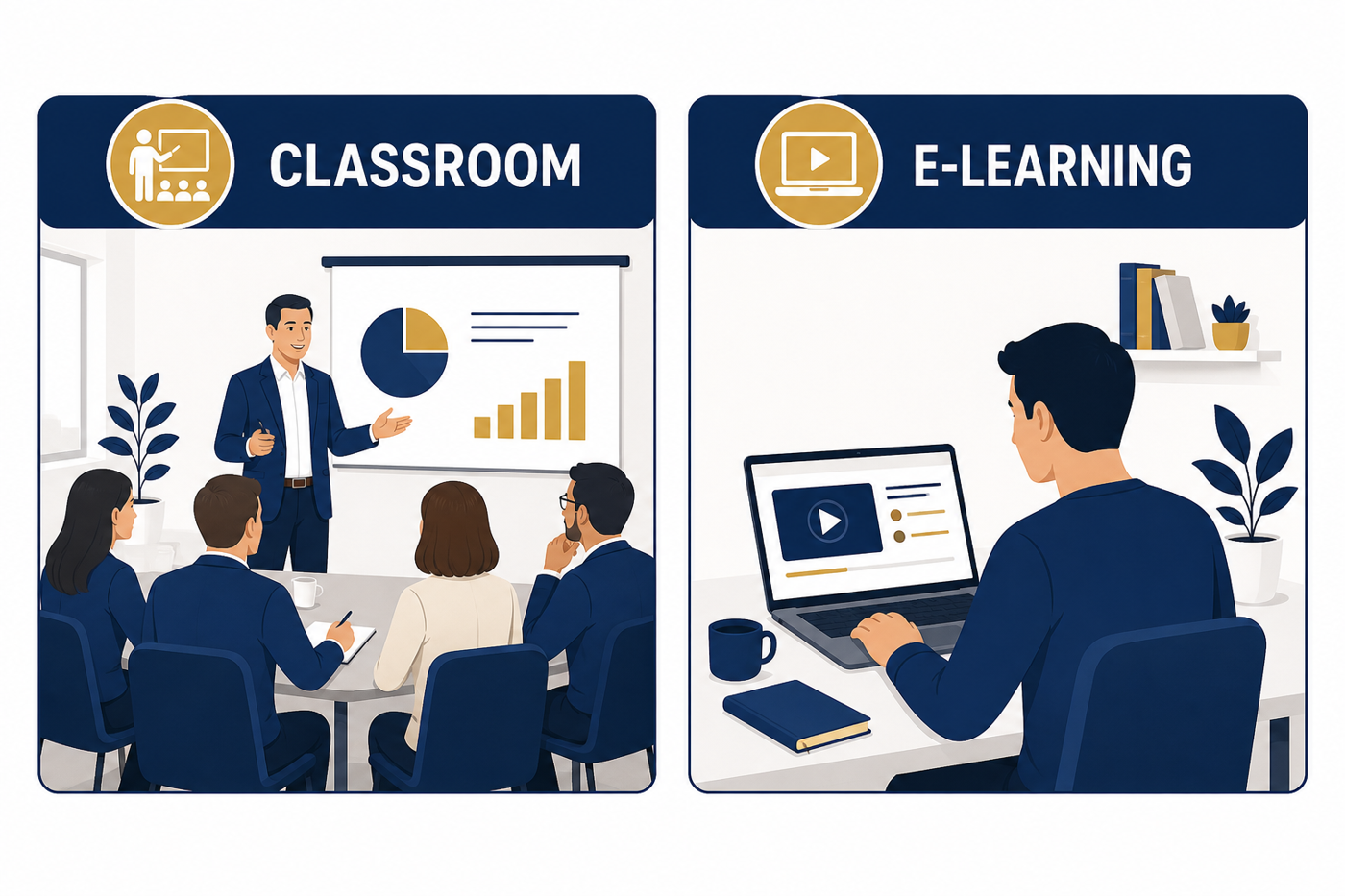
How should a manager compare the two formats?
Start with the skill, then the constraints.
Ask four questions:
- What should this person do differently in the next 30 days?
- How much live feedback do they need before that behaviour is safe?
- Is peer challenge part of the value, or a distraction?
- Will they actually complete a self-paced path, given their diary?
Then check cost honestly. Travel and five days out of the office are real. So is a cohort that “completes” e-learning without ever practising the conversation you paid for.
A blended sequence is often the practical answer: a short module for terms and policy, then instructor led training for application. That is also how procurement training tends to stick, when the classroom is used for negotiation and supplier cases rather than for reading a process map.
Do not treat “digital” as modern and “classroom” as legacy. Treat both as tools. The manager’s job is to pick the tool that changes the work.
What does good instructor led training look like for managers?
It is not a lecture with questions at the end.
A useful five-day course for managers is built around outcomes, cases, and feedback. Participants bring live issues. The trainer structures practice: short input, a scenario, a decision, a critique. The group compares methods. People leave with actions they can try in their own team, not with a stack of unused frameworks.
Look for:
- Outcomes written as actions (“run a 1:1 that names underperformance”) rather than as topics
- Cases close to the job, not generic leadership fables
- Time to fail and retry in the room
- A trainer who will challenge a sloppy answer
- A follow-through task after the course
If those pieces are missing, the classroom is only an expensive webinar.
If the skill you need is judgement, influence, and live practice rather than another self-paced module, review EPW’s five-day Advanced Management Skills for Senior Leaders course. It is instructor led, case-based, and built for managers who have to apply the work when they return.
FAQ
Is instructor led training better than e-learning for every management skill?
No. E-learning is often enough for policy, product knowledge, and reference. Use instructor led training when the skill needs practice, feedback, and discussion.
Can we blend instructor led training and e-learning for the same cohort?
Yes. Use e-learning for pre-work and later lookup. Keep the classroom for cases, role play, and decisions that need a trainer in the room.
How do we know the format worked?
Judge application, not attendance. Look for a named behaviour after the course: a better 1:1, a clearer plan, a decision that used the method taught.




4 thoughts on “Instructor Led Training vs E-Learning for Managers”
Comments are closed.