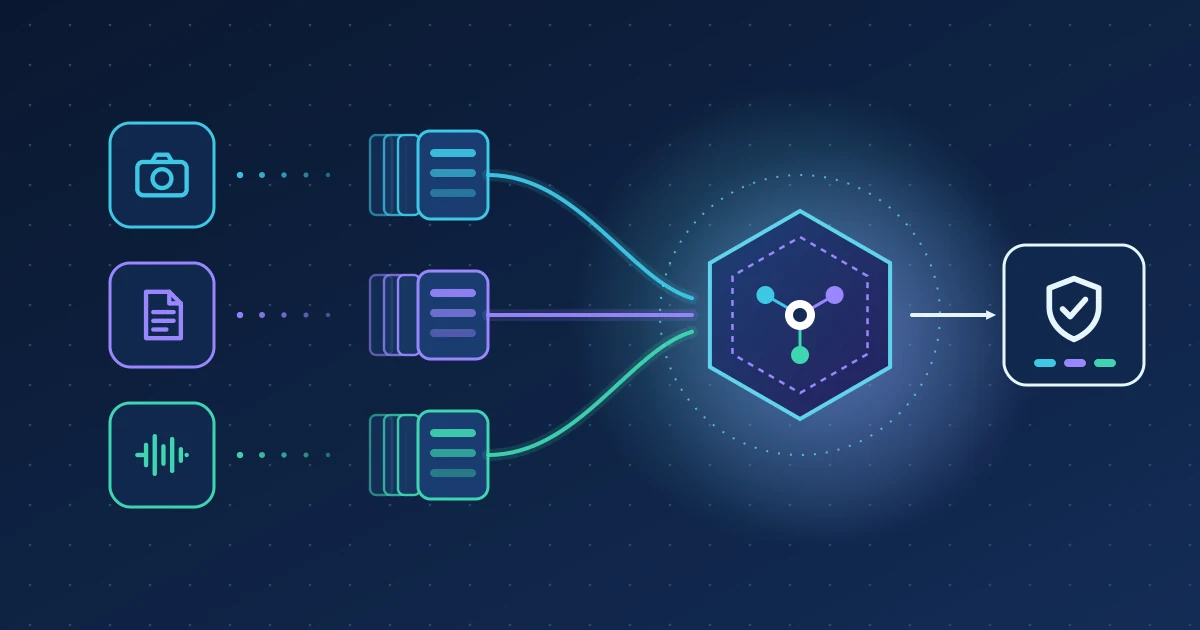
A photograph can show what happened, text can explain the context, and audio can reveal timing, speech or mechanical signals that neither of the other inputs contains. Multimodal artificial intelligence brings those sources together so that a system can reason over a fuller representation of the task.
The value does not come from simply attaching three data feeds to one model. A reliable multimodal AI architecture must encode each modality appropriately, align information that belongs together, fuse only useful signals, handle missing or contradictory inputs, and evaluate the complete system under realistic conditions.
This guide explains that architecture from raw vision, text and audio to a governed output. It also provides a design table, evaluation plan and worked example for teams moving from a promising demonstration to an operational system.
What is multimodal AI?
Multimodal AI is a system that learns from or operates on more than one type of data. Common modalities include images, video, text, speech, environmental sound, depth, thermal readings and sensor signals. A multimodal system may accept several inputs, produce several output types, or do both.
A unimodal image classifier might identify visible damage in a photograph. A multimodal inspection system could combine the photograph with a technician’s notes and the sound of the machine, then rank the maintenance priority. Each source contributes different evidence.
Foundational research demonstrates several ways to connect modalities. The CLIP paper trained image and text encoders to place matching concepts close together in a shared representation. Flamingo connected pretrained vision and language components to process interleaved visual and textual inputs. ImageBind extended shared representation learning across six modalities, including image, text and audio. These are design patterns, not universal recipes; production architecture must still reflect the organisation’s data, task and risk.
The multimodal AI architecture flow
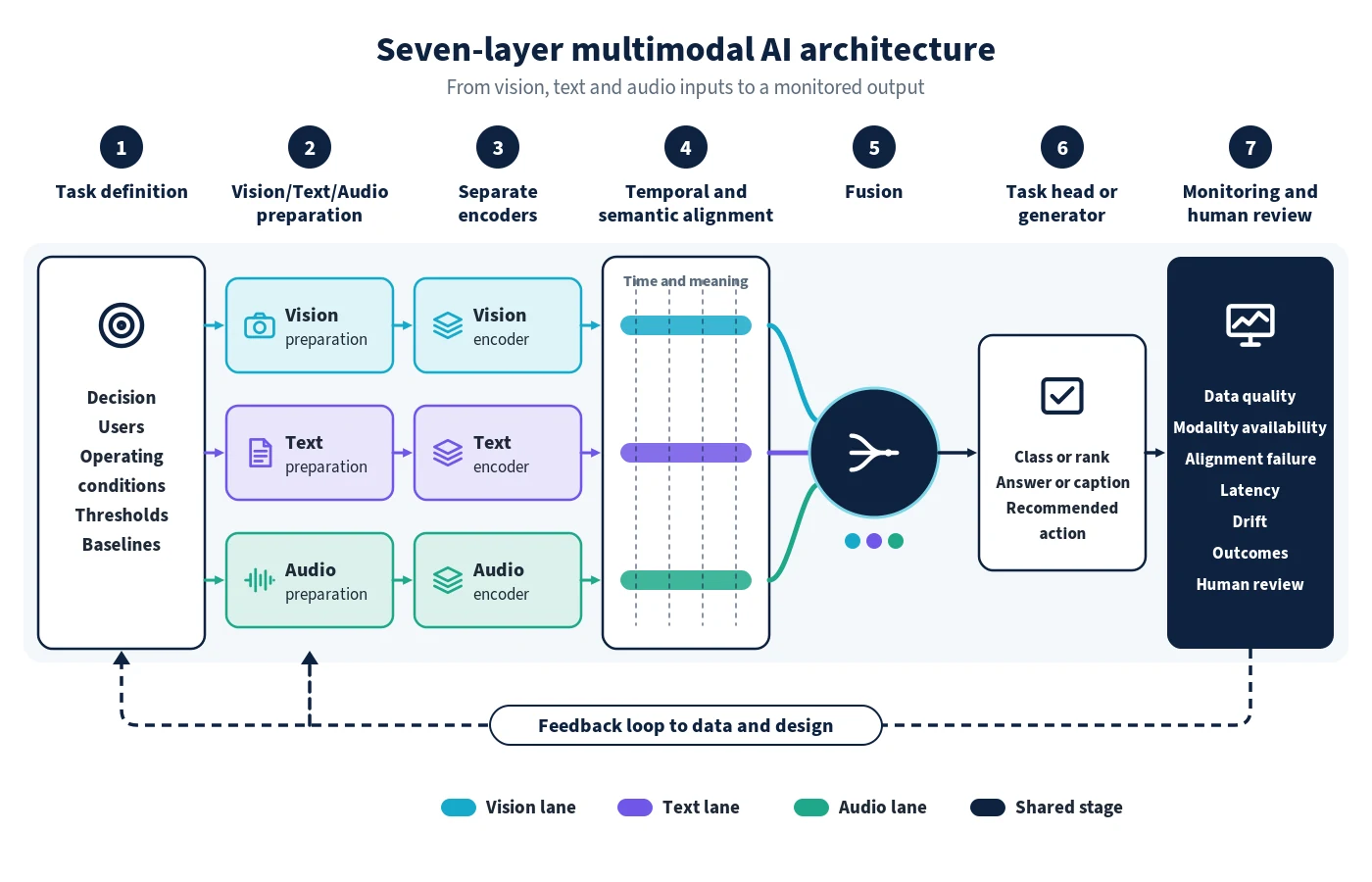
A practical architecture has seven layers: task definition, modality-specific preparation, encoders, alignment, fusion, task head or generator, and operational controls. The boundaries should be explicit so teams can test where information is gained, distorted or lost.
1. Define the task before the modalities
State the decision, user and operating conditions. Ask which evidence a competent person would use and whether each proposed modality changes the decision. Adding audio because it is available can increase cost and privacy risk without improving the outcome.
Set acceptance thresholds for quality, latency, safety and cost. Define consequences for false positives and false negatives. Establish a unimodal baseline for every input as well as a simple late-fusion baseline; otherwise, a complex model may appear impressive while adding little over the strongest single source.
2. Prepare each modality correctly
Vision pipelines may resize, crop, normalise or divide video into frames. Text pipelines may clean fields, preserve important structure, tokenise content and control context length. Audio pipelines may resample, remove unusable noise, segment recordings or convert sound into time-frequency features.
Preserve the raw source and transformation record where governance permits. A preprocessing choice can remove the very signal the model needs. Aggressive audio denoising may erase a faint fault sound; image cropping may remove environmental context; text cleaning may delete negation or units.
3. Encode modalities into useful representations
Each encoder converts raw data into numerical features. It may be trained from scratch, fine-tuned or frozen. Separate encoders respect the statistical structure of each source, while a shared component can reduce complexity once inputs are represented consistently.
Model ownership matters here. Record the encoder version, training data limitations, licence, expected input conditions and known failure modes. If an external model is updated, repeat the system-level evaluation rather than assuming the change is an improvement.
4. Align events and meaning
Alignment answers two questions: which items belong to the same case, and which parts refer to the same event? A timestamp can link a video frame to an audio segment. A work-order identifier can connect an image to a technician’s note. Semantic alignment places conceptually related representations close together even when their raw formats differ.
Poor alignment creates confident nonsense. A correct photograph paired with notes from another asset may be more dangerous than a missing photograph because the model receives plausible but contradictory evidence. Use lineage checks, time tolerances and identity validation before fusion.
5. Choose a fusion strategy
| Fusion approach | How it works | Strength | Main caution |
|---|---|---|---|
| Early fusion | Combines prepared features near the input | Can learn low-level interactions | Needs strong alignment and compatible scales |
| Intermediate fusion | Joins learned representations inside the model | Balances specialist encoders with cross-modal learning | Architecture and debugging are more complex |
| Late fusion | Combines separate predictions or scores | Modular, interpretable and resilient to missing inputs | May miss fine-grained interactions |
| Shared embedding | Maps modalities into one comparable space | Effective for cross-modal search and retrieval | Similarity is not the same as causal understanding |
| Cross-attention | Allows one modality to select relevant parts of another | Supports detailed contextual interaction | Can be compute-intensive and hard to audit |
Select the simplest approach that meets the task threshold. Late fusion is often a strong operational starting point because teams can inspect each component and continue when one source is unavailable. Intermediate fusion or cross-attention is justified when interactions between modalities materially improve the result.
6. Produce a bounded output
The fused representation feeds a task head, retrieval system or generator. Outputs may include a class, ranked result, caption, answer or recommended action. Define what the system may decide automatically and what requires human review.
Confidence should trigger a tested policy, not decorate the interface. Calibrate it against real outcomes, specify escalation thresholds and log which modalities influenced the result. For high-consequence decisions, preserve the source evidence so a reviewer can assess it.
7. Monitor the complete service
Track data quality, modality availability, alignment failure, latency, model drift and downstream outcomes. A system can degrade even when every individual model metric looks stable. For example, a clock change may shift audio timestamps, or a new form template may break the link between notes and images.
The NIST AI Risk Management Framework emphasises governing, mapping, measuring and managing AI risk. Applied here, that means documenting the context, testing the integrated service and assigning owners for intervention—not assessing encoders in isolation.
How to train a multimodal model
Training usually combines several objectives rather than relying on one loss function. The right sequence depends on data volume, label quality and the task.
- Pretrain or select encoders: begin with encoders that represent each modality under relevant conditions.
- Learn alignment: use paired examples and contrastive objectives so corresponding items become distinguishable from mismatched pairs.
- Train fusion: optimise cross-modal components for the operational task, using masks so the model encounters missing inputs.
- Fine-tune the task: use representative labelled cases and protect a truly independent test set.
- Calibrate and stress-test: test noisy audio, blurred images, ambiguous text, conflicting evidence and distribution shifts.
Dataset design is often harder than model selection. Confirm that paired items describe the same case, that timestamps use a common reference, and that labels do not leak the answer through one modality. Secure consent and minimise personal data, especially where recordings, faces or free-text notes are involved.
A multimodal evaluation scorecard
| Evaluation question | Useful test | Reason |
|---|---|---|
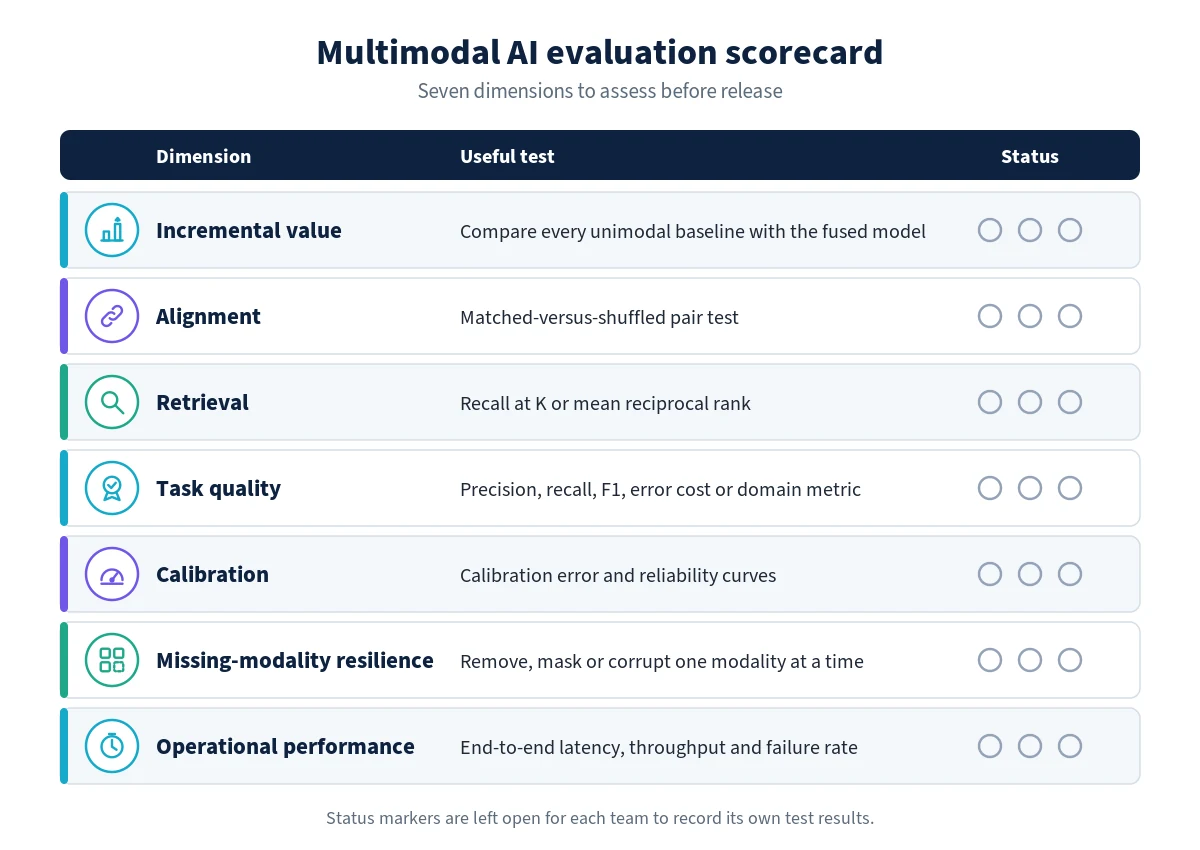
| Does fusion add value? | Compare every unimodal baseline with the fused model | Shows whether complexity is justified |
| Are modalities aligned? | Matched-versus-shuffled pair test | Detects identity and timing errors |
| Can the system retrieve across modalities? | Recall at K or mean reciprocal rank | Tests shared representations |
| Is the task output reliable? | Precision, recall, F1, error cost or domain metric | Connects evaluation to the decision |
| Is confidence meaningful? | Calibration error and reliability curves | Supports escalation policies |
| What happens when data are missing? | Remove, mask or corrupt one modality at a time | Measures graceful degradation |
| Does it work in operation? | End-to-end latency, throughput and failure rate | Captures system constraints |
| Are outcomes equitable? | Performance by relevant population and environment | Reveals uneven harm or access |
Report both average and worst-relevant-case performance. A small aggregate gain may hide severe failures when lighting is poor, an accent is under-represented or one sensor is unavailable. Define the release threshold before viewing the final test results.
Worked example: industrial equipment inspection
An inspection team wants to prioritise equipment faults. The vision input is a set of photographs, the text input is the technician’s observation, and the audio input is a ten-second recording of the running machine. The operational output is a priority level with supporting evidence, not an unrestricted diagnosis.
The system validates asset identity and timestamps, then prepares each source separately. Vision detects visible damage; text captures operating context; audio identifies abnormal frequency patterns. A late-fusion baseline combines the three component scores. The team tests an intermediate-fusion model only if the baseline misses interactions that matter.
Evaluation compares each single modality, the fusion baseline and the candidate architecture on the same held-out assets. The team deliberately masks audio, swaps notes between assets and introduces low-light images. High-priority recommendations require human confirmation, and the interface shows the source evidence rather than only a confidence number.
This design remains useful when a microphone fails, because the missing-modality policy was trained and tested. It also creates an audit trail showing which evidence supported the recommendation.
Common multimodal AI risks
- Modality dominance: the model ignores expensive inputs because one source contains an easy shortcut.
- False agreement: duplicated information makes confidence appear stronger without adding independent evidence.
- Misalignment: correct inputs from different cases are fused into an incorrect conclusion.
- Missing-modality collapse: performance falls sharply when a camera, microphone or field is unavailable.
- Expanded privacy exposure: images, voices and free text reveal more personal information when combined.
- Cross-modal attacks: hidden or misleading instructions in one input influence processing of another.
- Unclear accountability: teams cannot explain whether failure came from preprocessing, an encoder, fusion or the decision layer.
Multimodal AI design checklist
- Define the operational decision and consequence of error.
- Justify every modality with measurable incremental value.
- Create unimodal and simple-fusion baselines.
- Validate identity, timestamps, lineage and consent before fusion.
- Choose a fusion method appropriate to alignment and explainability needs.
- Train with missing and corrupted inputs.
- Evaluate integrated performance, calibration, latency and fairness.
- Specify escalation, fallback and human-review rules.
- Monitor modality availability and alignment drift after deployment.
- Version the data, encoders, fusion layer and decision policy together.
Develop practical multimodal AI capability
Multimodal systems can be more useful than single-source models, but only when architecture and evaluation prove that the additional evidence improves the decision. The strongest teams understand representation learning, alignment, fusion, data engineering and operational governance as one connected discipline.
EPW’s Multi Modal AI Combining Vision Text and Audio course covers multimodal data preparation, model architectures, attention, cross-modal learning, evaluation and applied project work. Explore the broader Artificial Intelligence and Machine Learning course portfolio for complementary programmes in deep learning, computer vision, audio processing and responsible AI.
Frequently asked questions
Is multimodal AI the same as generative AI?
No. Multimodal describes the data types a system processes or produces. Generative describes a system that creates content. A model can be multimodal and generative, multimodal and predictive, or generative but text-only.
Which fusion approach is best?
There is no universal best method. Start with separate unimodal baselines and simple late fusion. Use deeper fusion when representative evaluation shows that cross-modal interactions deliver a material, reliable gain.
How should a system handle a missing modality?
Define the policy during design. Options include a validated fallback model, an abstention, delayed processing or human review. Train and test with missing inputs so behaviour is known before deployment.
What is the most important multimodal data quality check?
Verify that inputs belong to the same case and time window. Perfectly cleaned data become harmful when an image, note and recording refer to different events.