

Strategic influence is the disciplined use of credibility, evidence, relationships, timing and communication to shape a decision while preserving the other party’s freedom to judge and choose. For leaders, it is not a polished speech or a method for securing agreement at any cost. It is a planned way to align legitimate interests, make a sound case and build commitment that can survive scrutiny.
The capability matters when managers must work across reporting lines, functions, organisations or stakeholder groups. Authority may open a meeting, but it rarely creates genuine ownership. Strategic influence helps a leader understand the decision system, choose an appropriate approach and distinguish ethical persuasion from pressure, concealment or manipulation.
Key takeaways
- Strategic influence begins with a legitimate decision objective, not a preferred tactic.
- Credibility depends on expertise, consistency, transparency and respect for the stakeholder’s interests.
- Ethical influence makes material facts, sponsorship, conflicts and realistic alternatives visible.
- Manipulation begins when a leader distorts evidence, conceals relevant information or removes meaningful choice.
- Success should be measured by decision quality and durable commitment, not by immediate compliance alone.
What does strategic influence mean?
Strategic influence means deliberately shaping the conditions in which another person or group evaluates an issue. The leader identifies who affects the decision, what those stakeholders value, which evidence they trust, what constraints they face and how commitment is likely to develop. The strategy may involve consultation, coalition building, reframing, demonstration, negotiation or a carefully sequenced proposal.
The word strategic is important. A single persuasive message can be effective, but strategic influence connects several decisions over time. It considers informal networks as well as formal authority, anticipated objections as well as stated positions, and implementation as well as approval. EPW’s Developing Leadership Presence and Influence course develops the personal credibility and communication skills that support this wider discipline.
Strategic influence, persuasion, authority and manipulation
These concepts overlap, but they are not interchangeable. A leader can use authority without persuading, persuade without having authority, or influence a decision through the environment in which choices are considered. Manipulation is not a stronger form of influence; it is influence that breaches important ethical boundaries.
| Concept | Primary mechanism | Appropriate use | Main risk |
|---|---|---|---|
| Strategic influence | Relationships, evidence, framing, timing and coalition | Aligning stakeholders around a defensible course of action | Allowing political success to displace decision quality |
| Persuasion | Arguments, language, examples and appeals | Helping an audience evaluate a proposition | Selective presentation or emotional pressure |
| Authority | Formal decision rights and accountability | Making decisions within an assigned mandate | Confusing compliance with commitment |
| Negotiation | Exchange, trade-offs and agreement | Resolving interests that cannot be aligned by explanation alone | Trading away non-negotiable duties or controls |
| Manipulation | Deception, concealment, exploitation or coercive pressure | Not an acceptable leadership method | Harm, invalid consent and loss of trust |
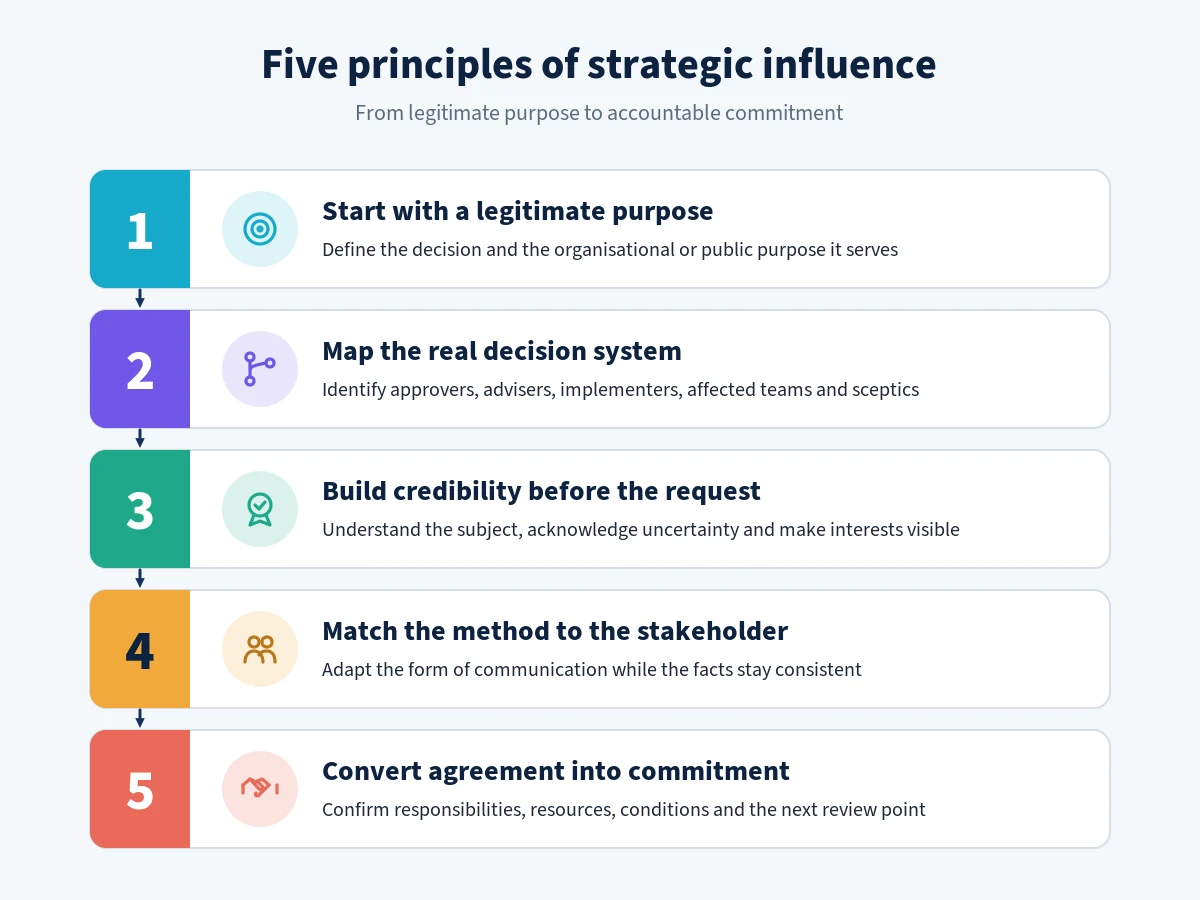
Five principles of effective strategic influence
1. Start with a legitimate purpose
Define the decision to be influenced and why the outcome serves an organisational or public purpose. “Get the board to approve my proposal” is not enough. A defensible purpose might be to reduce a material operational risk, improve service reliability or secure resources for a verified capability gap. The leader should be able to explain who benefits, who bears costs and which constraints must not be crossed.
2. Map the real decision system
Formal approvers are only part of the system. Identify advisers, technical experts, budget owners, implementers, affected teams, credible sceptics and people who can delay or legitimise the decision. Assess each stakeholder’s interests, influence, evidence needs, concerns and present level of commitment. Do not treat low-power groups as irrelevant when they may experience the greatest impact.
3. Build credibility before making the request
Credibility rests on more than confidence. It grows when a leader understands the subject, acknowledges uncertainty, behaves consistently and makes relevant interests visible. The UK Civil Service Code identifies integrity, honesty, objectivity and impartiality as core values. Although written for civil servants, these values provide a useful test for leaders whose recommendations must withstand challenge.
4. Match the method to the stakeholder and decision
A finance director may need assumptions and sensitivities. An operational team may need a workable transition plan. A regulator may require traceability and compliance evidence. A community group may need meaningful consultation rather than a completed decision presented as dialogue. Adapting the form of communication is ethical when the underlying facts remain consistent.
Leaders who need to structure concise messages for senior audiences can also explore Leadership Communication for Senior Executives.
5. Convert agreement into accountable commitment
Influence is incomplete when stakeholders say yes but do not understand their role. Confirm the decision, responsibilities, resources, unresolved conditions and next review point. Record dissent and material assumptions. A commitment that depends on different private interpretations will fail during implementation.
Where are the ethical boundaries?
Ethical boundaries protect the quality and legitimacy of the decision. They are especially important when one party controls information, access, rewards, status or employment consequences. The OECD Recommendation on Transparency and Integrity in Lobbying and Influence, revised on 3 May 2024, addresses transparency, conflicts of interest and risks of undue influence in public decision-making. Its public-governance focus also offers useful questions for corporate and not-for-profit leaders.
- Do not misstate or selectively distort evidence. Explain important limitations, assumptions and credible counter-evidence.
- Disclose relevant interests and sponsorship. Stakeholders should know who benefits and who shaped the proposal.
- Do not manufacture social proof. Genuine support may be described; invented consensus may not.
- Preserve meaningful choice. Do not use artificial deadlines, retaliation, humiliation or dependency to force agreement.
- Respect protected information. Influence does not justify breaching confidentiality, privacy, procurement rules or market controls.
- Separate incentives from improper inducements. The UK government’s Bribery Act 2010 guidance explains the importance of proportionate procedures, risk assessment, due diligence, communication and monitoring in preventing bribery.
- Avoid exploiting vulnerability. Emotional understanding should improve relevance and care, not be used to bypass reasoned judgement.
Robert Cialdini’s official code of ethics for persuasion similarly emphasises truthfulness, avoiding manipulation of people or facts, using naturally present principles and protecting relationships. A technique is not ethical simply because it has a familiar name; its use must remain truthful, proportionate and respectful.
The EPW influence integrity test
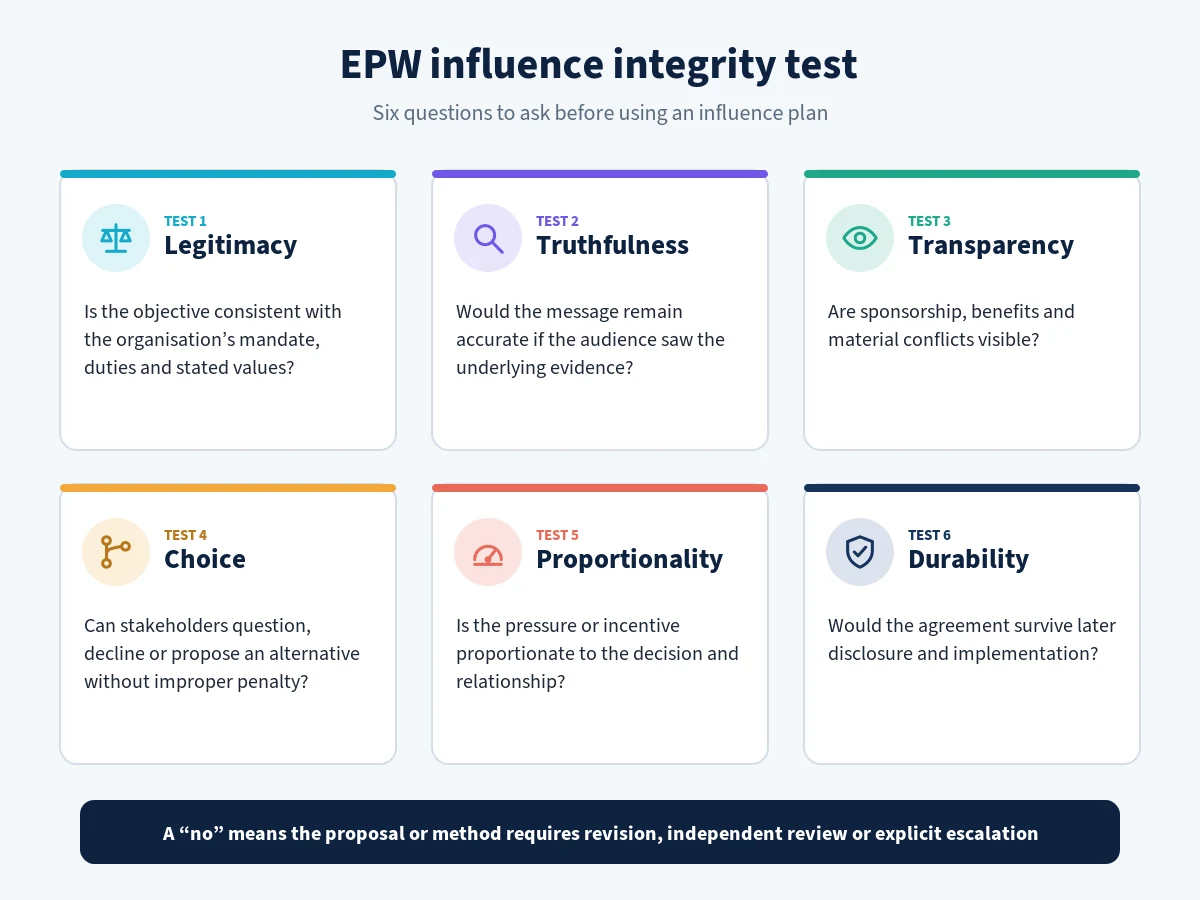
Before using an influence plan, leaders can test it through six questions. A “no” means the proposal or method requires revision, independent review or explicit escalation.
| Test | Question | Evidence required |
|---|---|---|
| Legitimacy | Is the objective consistent with the organisation’s mandate, duties and stated values? | Decision purpose, authority and affected interests |
| Truthfulness | Would the message remain accurate if the audience saw the underlying evidence? | Sources, assumptions, limitations and counter-evidence |
| Transparency | Are sponsorship, benefits and material conflicts visible? | Named interests and conflict-management actions |
| Choice | Can stakeholders question, decline or propose an alternative without improper penalty? | Consultation route and realistic alternatives |
| Proportionality | Is the pressure or incentive proportionate to the decision and relationship? | Rationale, safeguards and approval threshold |
| Durability | Would the agreement survive later disclosure and implementation? | Decision record, ownership and review plan |
Worked example: influencing a cross-functional investment decision
An operations director wants funding for predictive maintenance across several sites. The initial request focuses on technology features and is rejected because finance sees uncertain savings, information technology sees integration risk and site managers expect additional work. Repeating the same presentation more confidently would not solve the decision problem.
The director reframes the objective as reducing unplanned downtime within an agreed risk appetite. The team maps stakeholders, validates baseline failure and downtime data, separates proven benefits from estimates and asks sceptical site managers to help define implementation conditions. Finance receives scenarios and sensitivities; information technology receives architecture and control requirements; site managers receive a phased pilot with resource commitments.
The influence plan remains ethical because the sponsor, evidence gaps and alternatives are explicit. Stakeholders can challenge assumptions, and the pilot has exit criteria. Approval therefore represents an informed commitment rather than temporary compliance.
How should strategic influence be measured?
Immediate agreement is an incomplete measure. A stronger review considers decision quality, stakeholder understanding, implementation behaviour and trust after the decision.
- Were material stakeholders engaged before the decision became difficult to change?
- Did the decision record include assumptions, conflicts, alternatives and dissent?
- Did named owners complete agreed actions without repeated escalation?
- Were objections resolved, accepted as trade-offs or merely silenced?
- Did the relationship remain usable when the proposal was challenged?
- Would the same method be acceptable if disclosed to a board, regulator or affected workforce?
Organisations developing these capabilities across management roles can review EPW’s Management and Leadership Training Courses.
Conclusion
Strategic influence is a leadership discipline for shaping sound decisions across boundaries. It combines a legitimate objective, stakeholder intelligence, credible evidence, appropriate communication and accountable follow-through. Its ethical limit is clear: leaders may help people understand, compare and commit, but they should not secure agreement through deception, concealed conflicts, exploitation or improper pressure.
Ready to apply strategic influence in your organisation? Explore EPW’s Strategic Influence and Persuasion, review available dates and locations, or request tailored in-house training.
Sources and references
- OECD. Recommendation of the Council on Transparency and Integrity in Lobbying and Influence. Revised 3 May 2024.
- Cabinet Office. The Civil Service Code. Updated 16 March 2015.
- Ministry of Justice. Bribery Act 2010 Guidance. Official statutory guidance.
- Influence at Work. Cialdini Code of Ethics. Accessed 19 September 2026.
- EPW Training. Strategic Influence and Persuasion. Accessed 19 September 2026.