
AI-generated illustration created to represent the article’s subject. It does not depict an actual EPW course, trainer, participant, client, event or venue.
An NLP framework converts unstructured text into useful evidence through a controlled sequence: define the decision, assemble representative language data, establish domain meaning, prepare suitable representations, analyse and evaluate the output, then embed it in a monitored workflow. For professional teams, the value lies not in running a model once, but in producing an insight that is accurate enough, timely enough and governed well enough to support a named action.
Natural language processing (NLP) applies computational methods to human language. Text analytics uses those methods to classify documents, extract entities and relationships, identify themes, measure sentiment or intent, retrieve relevant passages and generate summaries. The same method can perform very differently across customer messages, maintenance notes, contracts or multilingual policies, so an effective framework must control both language and operational context.
Key takeaways
- Begin with the decision and user action, not a favourite model or software library.
- Treat corpus design, labels and domain terminology as part of the analytical system.
- Preserve meaning during cleaning; technical codes, negation and punctuation may carry evidence.
- Choose evaluation measures from the consequence of errors and the purpose of the output.
- Deploy an NLP result only with human-review rules, monitoring, feedback and accountable ownership.
Why NLP projects need an operating framework
An NLP project crosses several systems. The statistical system transforms text into a prediction, extraction or ranking; the language system contains ambiguity and domain-specific meaning; and the operational system determines who acts and what an error costs.
Google's official text-classification workflow moves from data gathering and exploration through preparation, model building, evaluation, tuning and deployment. SIGNAL adds decision ownership, corpus permissions, domain interpretation, acceptance gates and post-deployment learning.
Domain fit is especially important. NIST research on technical language processing shows why generic preprocessing can damage technical text: removing a negation can reverse meaning, while deleting numbers may erase asset identifiers. The correct pipeline therefore depends on the language used in the real decision environment.
The EPW SIGNAL framework
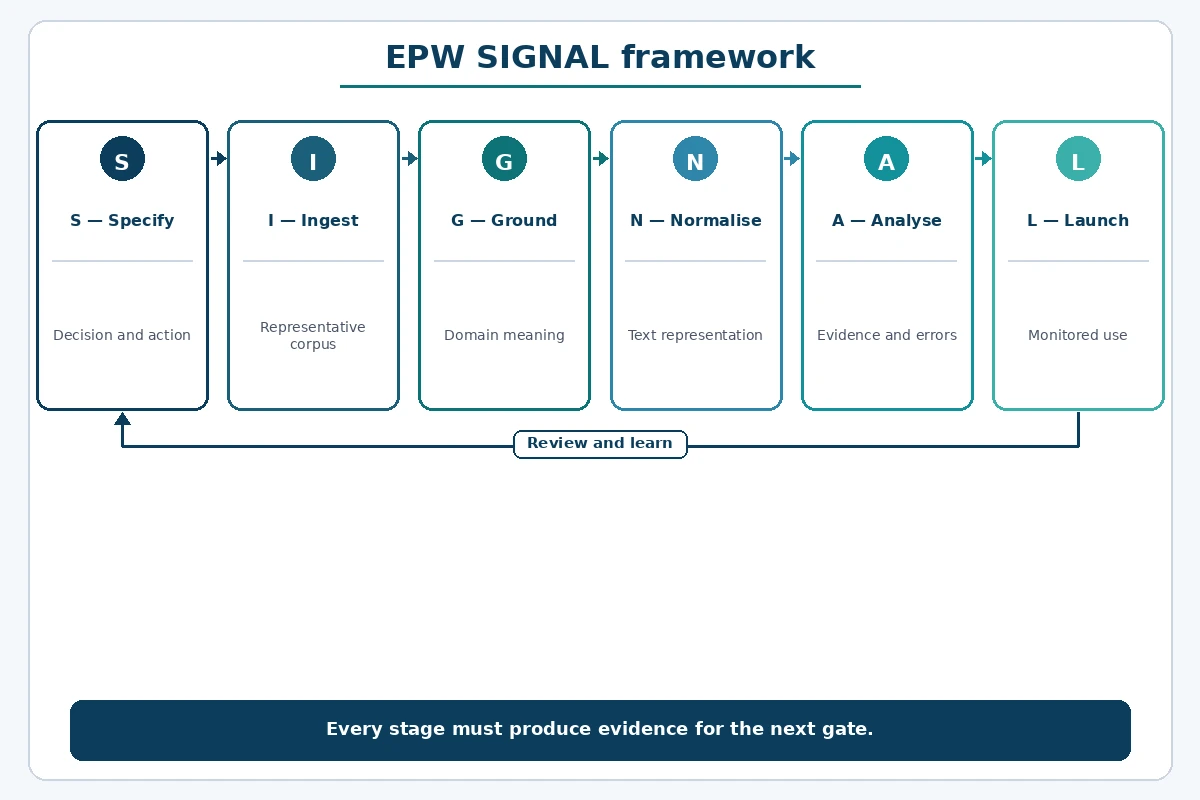
SIGNAL stands for Specify, Ingest, Ground, Normalise, Analyse and Launch. It is an original EPW professional decision aid, not an external technical standard. Each stage produces a required output and a gate that must be resolved before the project advances.
| Stage | Controlling question | Required output | Decision gate |
|---|---|---|---|
| S — Specify | Which decision or workflow should the text improve? | Task statement, user action and success measures | The output can lead to a defined, permitted action |
| I — Ingest | Which text represents the intended population and operating context? | Corpus inventory, sampling plan and permission record | The corpus is relevant, accessible and sufficiently representative |
| G — Ground | What do labels, terms, entities and exceptions mean in this domain? | Annotation guide, terminology map and quality review | Human interpretation is consistent enough to evaluate |
| N — Normalise | How should text become model-ready without losing useful meaning? | Versioned preparation and representation pipeline | Transformations preserve task-relevant evidence |
| A — Analyse | Which method produces reliable and useful evidence? | Baseline comparison, evaluation and error analysis | Technical and operational acceptance criteria are met |
| L — Launch | How will users act, review, monitor and correct the output? | Operating, feedback, monitoring and fallback plan | An accountable owner approves controlled use |
S — Specify the decision and language task
Write the task before choosing a model. State the text source, analytical output, intended user, action, timing and consequence of error.
“Analyse customer feedback” is too broad. A controlled task would be: “Classify new service complaints into six approved issue categories within five minutes so the service desk can route each case, while allowing staff to override uncertain results.” This wording reveals the need for category definitions, latency, confidence thresholds and human review.
Choose the task form deliberately. Classification assigns categories; named-entity recognition locates defined items; retrieval finds passages; clustering explores patterns; and summarisation produces a compressed account. Each output needs its own success criteria.
I — Ingest a representative and permitted corpus
A corpus is the body of text used to develop or evaluate the NLP system. Record each collection's source, owner, period, language, channel, access, retention rule and limitations.
Sampling must reflect intended use. If the workflow receives Arabic and English messages, brief mobile text, long emails and rare escalations, the corpus needs enough coverage to test those conditions. Volume from one channel does not create representativeness.
Text may contain names, contact details, commercial information or sensitive narratives. The NIST Privacy Framework is a voluntary tool for identifying and managing privacy risk. In practice, teams should minimise unnecessary fields, apply access controls, document the lawful or organisational basis for use, and decide whether de-identification is required before annotation or modelling.
G — Ground labels and meaning in the domain
Models learn from the operational meaning supplied by people and data. Define every category, entity, relationship and exclusion in an annotation guide. Include positive, negative and borderline examples, then test whether different reviewers apply the rules consistently.
Domain grounding also requires a terminology map. “Down” may describe service unavailability, sentiment or equipment position. Acronyms, spelling variation and code conventions need explicit treatment.
Human review is not merely a temporary labelling cost. NIST's 2024 work on human-in-the-loop technical document annotation studied supervised and unsupervised assistance for human text analysis rather than assuming that the machine should replace expert judgement. That principle is useful when the analysis affects specialist interpretation or ambiguous evidence.
N — Normalise and represent the text
Normalisation makes text consistent; representation converts it into model inputs. Options include sentence segmentation, tokenisation, lemmatisation, n-grams, term-frequency–inverse-document-frequency (TF–IDF) vectors, embeddings and contextual transformer representations.
Test every transformation against meaning. Lowercasing can destroy product codes; removing “not” can reverse a maintenance statement; and numbers, punctuation or layout may be essential in contracts and incident reports.
Modern transformer tokenisers often divide rare words into subwords. The official Hugging Face tokenisation documentation explains Byte Pair Encoding, Unigram and WordPiece approaches. The practical decision is not which method is most fashionable, but whether the representation handles the organisation's languages, specialist terms, document length and downstream task.
A — Analyse, compare and evaluate
Begin with a baseline such as a keyword rule, TF–IDF classifier or current manual-routing rate. Compare a justified set of candidates under the same data split and acceptance measures.
Make evaluation resemble future use. Time-based splits test later language, source-based splits test new channels, and group-based splits keep near-duplicates together. Reserve an independent test set until the pipeline and decision rule are fixed.
Metrics must match the output and error cost. For classification, precision measures how often a positive prediction is correct, while recall measures how many actual positive cases are detected. Google's classification metrics guidance explains why accuracy can be misleading for imbalanced data and why threshold choices change the trade-off between errors.
Retrieval needs relevance measures and review of missed evidence; extraction needs entity-appropriate matching; and summarisation needs factuality, coverage and usefulness checks. NIST's NLP measurement and evaluation work highlights human-generated corpora, common test collections and shared evaluation procedures.
L — Launch into monitored use
Deployment begins a controlled operating period. Define where the output appears, who may act, when human review is mandatory, how uncertainty is displayed and what happens if the service fails.
Monitor input quality, language mix, output distribution, overrides, latency, outcomes and confirmed errors. Establish triggers for review, retraining, rollback or retirement. New terminology, policy or document templates can reduce performance without a software change.
The NIST AI Risk Management Framework is intended to help organisations incorporate trustworthiness considerations into the design, development, use and evaluation of AI systems. SIGNAL applies that broader principle through named owners, evidence at each gate, human-review rules, limitations and fallback actions.
Completed example: routing service complaints
Consider a service organisation receiving multilingual complaints by email and web form. Staff choose one of six issue categories and send urgent cases for immediate review. The team wants faster routing without removing staff authority.
- Specify: At receipt, predict the issue category and need for urgent review. An adviser accepts or changes the route. Success includes urgent-case recall, category precision, routing time and review volume.
- Ingest: Assemble approved messages across languages, channels, periods and categories. Exclude post-routing notes, record access and retention requirements, and reserve recent messages for final testing.
- Ground: Service specialists define each category, urgent-review criteria and ambiguous cases. Two reviewers label a common sample, discuss disagreement and revise the guide. Terms that differ by location or product line are documented.
- Normalise: Preserve negation, product references and relevant numbers. Compare TF–IDF with a multilingual contextual embedding. Version the pipeline and fit learned transformations only on training data.
- Analyse: Compare the current routing rule, a linear baseline and a transformer-based classifier. Select thresholds from the cost of missed urgent cases and the capacity for manual review. Examine confusion between similar categories, results by language and performance on recent data.
- Launch: Present decision support, log overrides and retain a manual fallback. During the pilot, review weekly errors and pause for falling urgent-case recall, severe language imbalance or changed message types.
The insight is not simply a predicted label. It is a controlled recommendation linked to evidence, uncertainty, a user action and a feedback record.
How to interpret NLP results
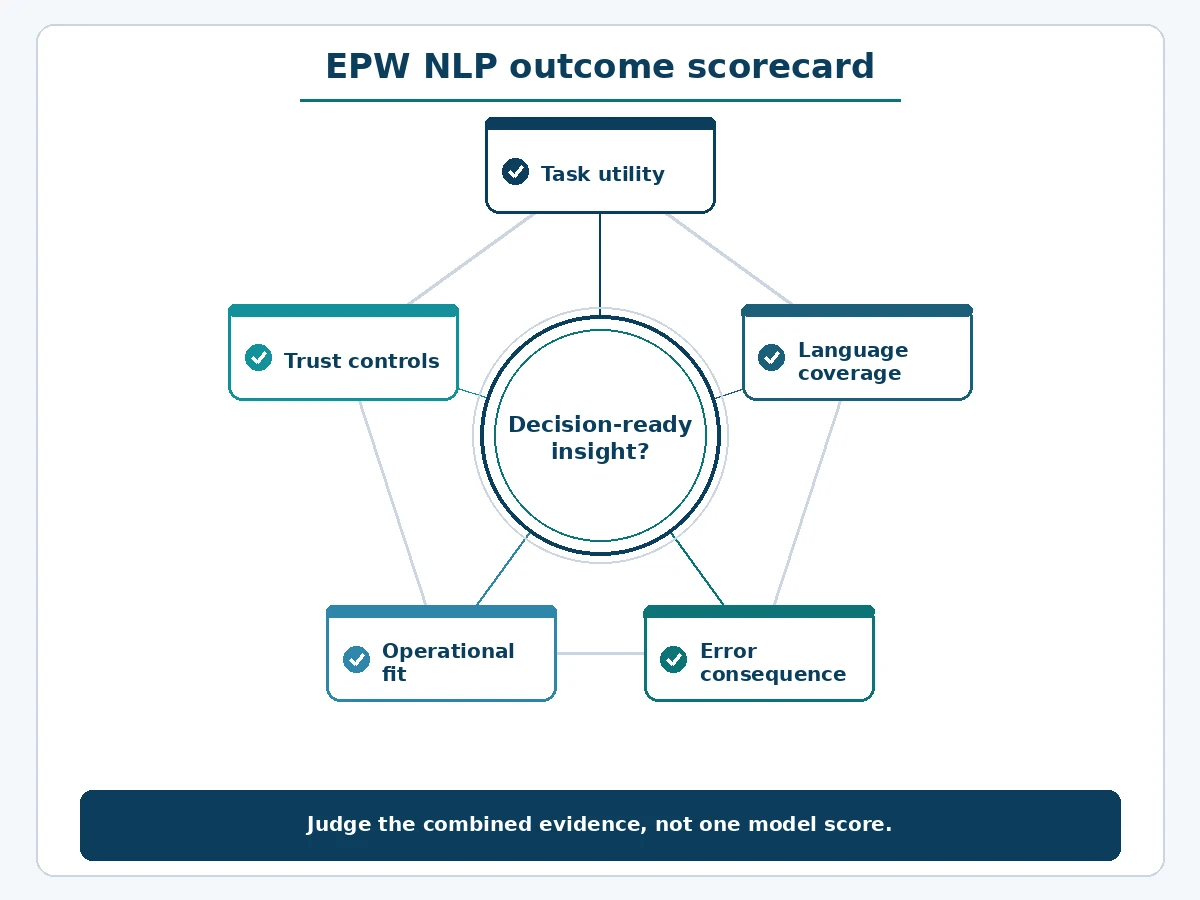
No single score establishes usefulness. Interpret a compact outcome scorecard against the acceptance criteria defined during Specify.
| Evaluation lens | Key question | Possible evidence |
|---|---|---|
| Task utility | Does the output improve the intended decision? | Routing time, relevant passages found, completed action or review effort |
| Language coverage | Does quality hold across relevant languages, sources and text forms? | Segment results, out-of-time tests and error categories |
| Error consequence | Are costly omissions and false alerts within agreed limits? | Precision, recall, threshold analysis and specialist review |
| Operational fit | Can users receive, understand and act on the output in time? | Latency, volume, override rate, availability and fallback tests |
| Trust controls | Are privacy, uncertainty, ownership and recovery addressed? | Access record, limitation statement, audit trail and pause criteria |
A stronger model score may still be the weaker operating choice if it performs unevenly across languages, creates excessive review work, cannot explain extracted evidence or lacks a safe fallback.
Advantages and limitations of SIGNAL
SIGNAL creates a shared language for analysts, domain specialists, data owners and operational managers. Its gates expose assumptions early, prevent model selection from dominating the project and connect evaluation with the actual decision. The structure also supports proportionate documentation and makes weak projects easier to stop before expensive deployment.
The framework does not prescribe an algorithm, cloud platform or regulatory assessment. It cannot make an unrepresentative corpus valid, resolve unlawful use, create reliable labels where experts disagree fundamentally or guarantee that a language model will remain accurate. High-impact uses may require legal, privacy, security, safety, ethical and specialist domain review beyond the controls described here.
Apply SIGNAL proportionately. A low-risk internal document search may use a concise evidence record. A system affecting employment, healthcare, legal rights, safety or access to services needs stronger validation, review and accountability.
SIGNAL gate checklist
Before controlled use, confirm that the team can answer yes to every item:
- The text source, output, intended user, action and timing are explicit.
- The corpus is permitted, representative and documented by source, language and period.
- Labels, entities and exceptions have consistent domain definitions.
- Preprocessing preserves task-relevant negation, identifiers, structure and terminology.
- A credible baseline and deployment-representative evaluation design are established.
- Metrics and thresholds reflect the consequences and capacity of the real workflow.
- Error analysis covers relevant languages, channels, periods and document types.
- Users can review, override and recover from an incorrect or unavailable result.
- Privacy, access, versioning, limitations and audit records are controlled.
- A named owner will monitor outcomes and act on review, pause and retirement triggers.
Build practical NLP judgement
A reliable NLP framework does not remove professional judgement. It places judgement at explicit gates: defining the action, testing corpus relevance, agreeing domain meaning, preserving language evidence, interpreting errors and controlling operational use.
EPW's five-day Natural Language Processing and Text Analytics course develops these capabilities across corpus design, classical and transformer-based methods, information extraction, semantic retrieval, evaluation and responsible deployment. Professionals focusing specifically on opinion and channel data can also review Sentiment Analysis and Social Media Intelligence, while teams developing generative text applications may find Generative AI Models and Applications relevant.
Explore EPW's Artificial Intelligence and Machine Learning Courses, the Artificial Intelligence and Machine Learning Articles hub and the overview of what professionals learn in an AI course. To apply SIGNAL to a real text-analysis problem, review the Natural Language Processing and Text Analytics course, available dates and locations, or request tailored in-house training.
Sources and references
- Google for Developers, Text Classification: Introduction, updated 25 August 2025.
- Michael P. Brundage et al., “Technical Language Processing: Unlocking Maintenance Knowledge”, National Institute of Standards and Technology, 2020.
- Hugging Face, Tokenization algorithms, Transformers documentation.
- Google for Developers, Classification: Accuracy, Recall, Precision and Related Metrics, updated 12 January 2026.
- National Institute of Standards and Technology, AI Measurement and Evaluation Projects: Natural Language Processing.
- Juan Fung et al., Human-in-the-loop Technical Document Annotation, NIST Technical Note 2287, 2024.
- National Institute of Standards and Technology, AI Risk Management Framework, AI RMF 1.0.
- National Institute of Standards and Technology, Privacy Framework.