
AI-generated illustration created to represent the article’s subject. It does not depict an actual EPW course, trainer, participant, client, event or venue.
An NLP career path is a progression from working reliably with language data to designing, evaluating and operating systems that classify, extract, retrieve or generate text. It is not a single job ladder. Data analysts, software engineers, linguists, product specialists and researchers enter through different routes, so the right skills, portfolio and training depend on the role you want to perform.
Natural language processing (NLP) combines computational methods with knowledge of language and machine learning. Text analytics is the practical extraction of patterns, categories and evidence from written material. Professionals may specialise in one area or combine both across customer communications, contracts, reports, knowledge bases and other document collections.
Key takeaways
- Choose a target role before choosing tools, certificates or projects.
- Build shared foundations in language data, Python, evaluation and responsible use, then deepen the skills your role needs.
- A portfolio should show a complete decision process, not only a model or notebook.
- Certificates can document structured learning, but employers also need evidence that you can define tasks, diagnose errors and communicate limitations.
- Research-heavy roles usually demand deeper mathematics and postgraduate study than applied analysis or implementation roles.
What does an NLP professional do?
NLP professionals turn a language problem into a testable system and a usable decision process. Depending on the role, they may design a corpus, write annotation rules, prepare text, train or adapt models, build retrieval services, analyse errors, deploy an application or help a business owner decide whether the result is reliable enough to use.
The US Department of Labor’s O*NET description of data scientists explicitly includes natural language processing and machine learning applied to structured and unstructured datasets. This is useful evidence that NLP capability often sits inside broader occupations rather than appearing under one universal job title.
The task range is also broad. Official Hugging Face documentation distinguishes, for example, text classification, which assigns labels to text, from token classification, which can identify named entities at word or subword level. Search, summarisation, question answering and generation create further specialisms.
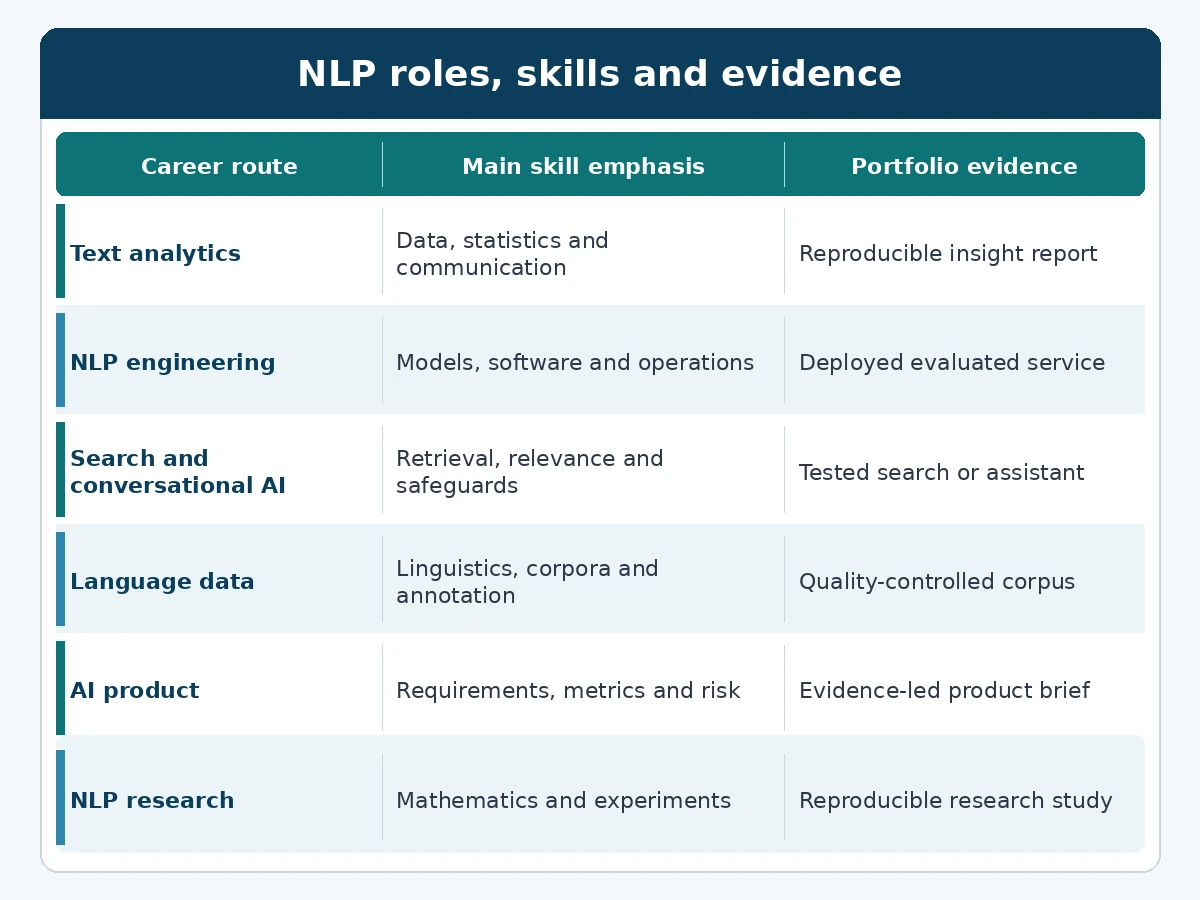
Six realistic NLP career routes
Job titles vary by employer. Use the work product and level of responsibility—not the title alone—to judge a vacancy.
| Career route | Typical responsibility | Skills to emphasise | Strong portfolio evidence |
|---|---|---|---|
| Text analytics or data analyst | Classify, explore and report patterns in document collections | Python or R, SQL, sampling, visualisation, statistics and stakeholder communication | A reproducible analysis that connects text findings to a defined operational question |
| NLP or machine-learning engineer | Build, test and operate language-model pipelines or services | Python, machine learning, APIs, software testing, containers, monitoring and cloud platforms | A deployed service with evaluation, latency, versioning and failure-handling evidence |
| Search or conversational-AI engineer | Develop retrieval, ranking, question-answering or dialogue systems | Embeddings, information retrieval, prompt and context design, relevance testing and security controls | A search or assistant prototype evaluated against a labelled question set |
| Computational linguist or language-data specialist | Design linguistic rules, taxonomies, corpora and annotation guidance | Syntax, semantics, pragmatics, corpus methods, annotation agreement and multilingual analysis | An annotation specification, quality study and error taxonomy for a real language task |
| AI product or solutions specialist | Translate user needs into feasible language-system requirements and acceptance criteria | Discovery, process analysis, metrics, risk, vendor assessment and technical communication | A product brief linking a user problem to data, tests, safeguards and an adoption plan |
| NLP research scientist | Create or rigorously test new methods | Advanced mathematics, experimental design, deep learning, scientific computing and research writing | A reproducible experiment, ablation study, publication or substantive research report |
Prerequisites for starting an NLP career
There is no single entrance requirement for every NLP role. An analyst may enter through statistics or business intelligence; an engineer through software development; a language-data specialist through linguistics or translation; and a product specialist through domain operations. The common requirement is the ability to connect language evidence to a defined task.
Develop five foundations:
- Programming and data handling. Use Python, notebooks, version control and structured data tools confidently enough to make work reproducible.
- Quantitative reasoning. Understand sampling, train-validation-test separation, uncertainty and task-appropriate metrics such as precision, recall and ranking measures.
- Language-data knowledge. Recognise ambiguity, context, domain variation, tokenisation, annotation choices and multilingual differences.
- Machine-learning judgement. Compare simple baselines with classical and transformer-based approaches rather than assuming the newest model is best.
- Responsible delivery. Consider privacy, harmful bias, security, human review, documentation and performance drift from the beginning.
The Google text-classification guide illustrates why this breadth matters: its workflow begins with gathering and exploring data before preparation, model building, evaluation, tuning and deployment. A credible career portfolio should demonstrate the same end-to-end reasoning.
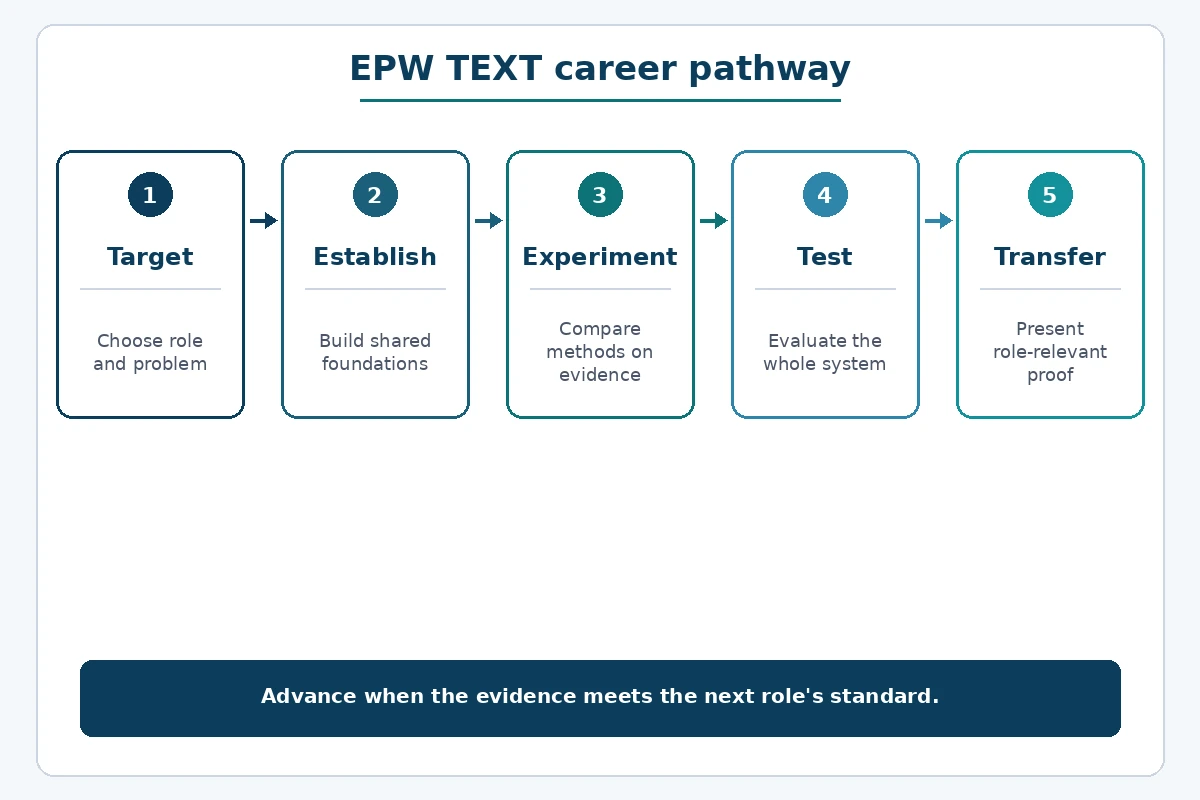
The EPW TEXT career pathway
Use the five-stage TEXT pathway to turn learning activity into evidence of professional readiness.
1. Target a role and a bounded problem
Read vacancies from several organisations and group the recurring work products. Choose one primary route and a bounded task—for example, routing service requests, extracting contract entities or retrieving approved policy passages. Do not begin with a tool list.
2. Establish foundations
Learn the minimum programming, data, linguistic and evaluation concepts needed to complete the task correctly. Build a simple rule-based or classical baseline before adapting a larger model. This creates a reference point and exposes whether model complexity produces useful value.
3. Experiment with representative evidence
Create or obtain a lawful, documented dataset. Define labels and splits, compare approaches and record errors by category. Transformer architectures became influential after the 2017 paper “Attention Is All You Need”, but knowing an architecture is different from proving that it suits a particular corpus and operating context.
4. Test the complete system
Evaluate more than an aggregate score. Examine relevant language varieties, rare but important cases, latency, privacy, unsafe inputs and human-review needs. For retrieval or conversational systems, test whether answers are supported by the permitted source material and define what the system should do when evidence is absent.
5. Transfer the work into professional evidence
Package the project so another person can inspect the objective, dataset, baseline, model, metrics, error analysis, limitations and operating plan. Tailor the presentation to the role: engineers should show deployment and testing; analysts should show decision relevance; language specialists should show annotation quality; product specialists should show adoption and risk controls.
What should an NLP portfolio contain?
A strong portfolio lets a reviewer inspect your decisions. One deep project is often more informative than several disconnected tutorials when it includes:
- a specific user or organisational problem;
- the origin, permission, coverage and limitations of the text data;
- a simple baseline and a justified alternative;
- metrics connected to the cost of different errors;
- qualitative error analysis, including difficult language cases;
- reproducible code, environment and model versions;
- a short model or system card explaining intended and excluded uses;
- a deployment, monitoring or human-review plan appropriate to the role.
For a classification project, do not report accuracy alone when classes are imbalanced. For a retrieval project, do not demonstrate only hand-picked queries. For a generative system, separate retrieval quality, answer support and user-facing behaviour so weaknesses are diagnosable.
Do you need a degree or NLP certification?
Requirements depend on the role and employer. Applied analyst, engineering and product routes may be accessible through a relevant degree, adjacent professional experience, structured training and demonstrable project work. Research-scientist positions are more likely to expect postgraduate study and evidence of rigorous experimentation.
The US Bureau of Labor Statistics says data scientists typically need at least a bachelor’s degree, while some employers require or prefer a master’s or doctorate. It projects US data-scientist employment to grow 35% from 2025 to 2035; this is a US occupational projection, not a forecast for every country or a guarantee for NLP specialists. See the BLS Occupational Outlook Handbook.
A training certificate can show that you completed a defined programme. It does not by itself prove that you can select data, choose metrics, diagnose failures or operate an NLP system. When comparing credentials, check the assessed work, instructor or provider transparency, technical depth and relationship to your target role rather than relying on the certificate title.
How to choose NLP training
Use provider-neutral criteria before making a time or budget commitment.
| Selection criterion | What to verify | Warning sign |
|---|---|---|
| Role fit | The syllabus develops capabilities used in your selected route | A broad tool tour with no defined professional outcome |
| Complete workflow | Corpus design, preprocessing, modelling, evaluation and deployment are connected | Training starts and ends with running a pretrained model |
| Practice and feedback | Learners complete realistic exercises and receive meaningful review | Attendance is the only evidence of learning |
| Evaluation depth | Metrics, baselines, error analysis and domain variation are taught | Success is demonstrated through a few attractive outputs |
| Responsible use | Privacy, security, bias, documentation and monitoring are included | Risk is treated as a final disclaimer |
| Currency without hype | Classical methods, transformers and generative NLP are placed in context | One fashionable tool is presented as the answer to every task |
The NIST AI Risk Management Framework is voluntary guidance for incorporating trustworthiness considerations into the design, development, use and evaluation of AI systems. Its govern, map, measure and manage functions reinforce why responsible evaluation and monitoring belong in professional NLP development, not only in specialist governance roles.
Training route for applied NLP capability
EPW’s five-day Natural Language Processing and Text Analytics course covers corpus design, annotation, linguistic preprocessing, classical text methods, embeddings, transformers, information extraction, semantic retrieval, generative NLP, evaluation and responsible deployment. It is most relevant to professionals who already understand basic data or programming concepts and want a structured applied workflow.
Beginners can first review EPW’s guide to mastering natural language processing and NLP challenges and study tips. Professionals seeking broader context can explore what an AI course includes and the benefits of AI and machine learning for organisations.
Choose your next career evidence
An effective NLP career path begins with a role and an inspectable work product. Select one route, identify the standard of evidence it demands and build a project that demonstrates the complete reasoning chain. Use training to close specific gaps, then revisit the target role and raise the quality of your proof.
Ready to develop applied NLP judgement? Explore EPW’s Artificial Intelligence and Machine Learning Courses, review the Natural Language Processing and Text Analytics course, available dates and locations, or request tailored in-house training.
Sources and references
- O*NET OnLine, Data Scientists, 15-2051.00, updated 2026.
- US Bureau of Labor Statistics, Data Scientists: Occupational Outlook Handbook, projections for 2025–2035.
- Google for Developers, Text Classification Guide, updated 25 August 2025.
- Hugging Face, Text classification and Token classification, Transformers documentation.
- Ashish Vaswani et al., “Attention Is All You Need”, NeurIPS, 2017.
- National Institute of Standards and Technology, AI Risk Management Framework, AI RMF 1.0.