

AI-generated illustration created to represent the article’s subject. It does not depict an actual EPW course, trainer, participant, client, event or venue.
A useful reinforcement learning course should teach more than algorithms. It should help professionals decide whether reinforcement learning fits a sequential decision problem, formulate states, actions and rewards, compare value-based and policy-based methods, evaluate behaviour across scenarios and design a controlled route from simulation to operational use.
The right course depends on the learner’s role and intended outcome. A conceptual overview may suit a decision-maker, a coding laboratory may suit a machine-learning practitioner, and an implementation course should also address reward misspecification, exploration risk, offline evidence, deployment gaps and fallback policies. Buyers should compare these outcomes before comparing course length or software tools.
Key takeaways
- Choose a course from the decisions you must make after training, not from an algorithm list alone.
- Reinforcement learning is most relevant when actions affect later states and rewards.
- Practical training should cover environment and reward design, evaluation and controlled implementation.
- Prospective participants benefit from Python, machine-learning and probability foundations, but role-specific depth should be stated.
- A credible provider should explain audience fit, exercises, prerequisites, evaluation methods and course limitations clearly.
Who should take a reinforcement learning course?
Reinforcement learning training is suitable for professionals who must understand or build systems that learn sequences of actions through interaction and feedback. OpenAI’s official Spinning Up introduction defines the central relationship among an agent, an environment, actions and reward signals. This makes the subject materially different from predicting one labelled outcome with supervised learning.
Likely participants include:
- machine-learning engineers and data scientists moving from predictive models to sequential decision systems;
- AI solution architects evaluating simulation, offline learning and production controls;
- operations-research, optimisation or analytics professionals working on scheduling, allocation or adaptive policies;
- robotics, autonomous-systems or control practitioners who need to compare value-based and policy-based methods;
- technical managers who must assess feasibility, evidence, safety and implementation risk.
A reinforcement learning course is not automatically the right choice for every AI learner. If the main requirement is classification, regression, forecasting or static optimisation with well-defined labels or constraints, supervised learning or mathematical optimisation may be more direct. A good buying decision begins by testing problem fit.
What outcomes should good training produce?
Course outcomes should be observable. “Understand reinforcement learning” is too vague for professional selection. A stronger course should enable participants to perform several specific tasks.
| Outcome area | What the participant should be able to do | Evidence in the course design |
|---|---|---|
| Problem formulation | Define the agent, environment, states, actions, rewards, constraints and horizon | Worked formulation exercise based on a realistic decision |
| Method selection | Compare tabular, deep value-based, policy-gradient, actor–critic and model-based approaches | Decision criteria and practical comparison, not a list of names |
| Environment design | Specify observations, action spaces, termination and simulation assumptions | Custom or adapted environment exercise |
| Evaluation | Use baselines, multiple scenarios, uncertainty and independent evaluation runs | Evaluation protocol and interpretation task |
| Risk control | Identify reward hacking, unsafe exploration, distribution shift and deployment gaps | Failure analysis, constraints and fallback design |
| Implementation | Plan a controlled transition from experiment to monitored use | Capstone roadmap with gates, owners and rollback rules |
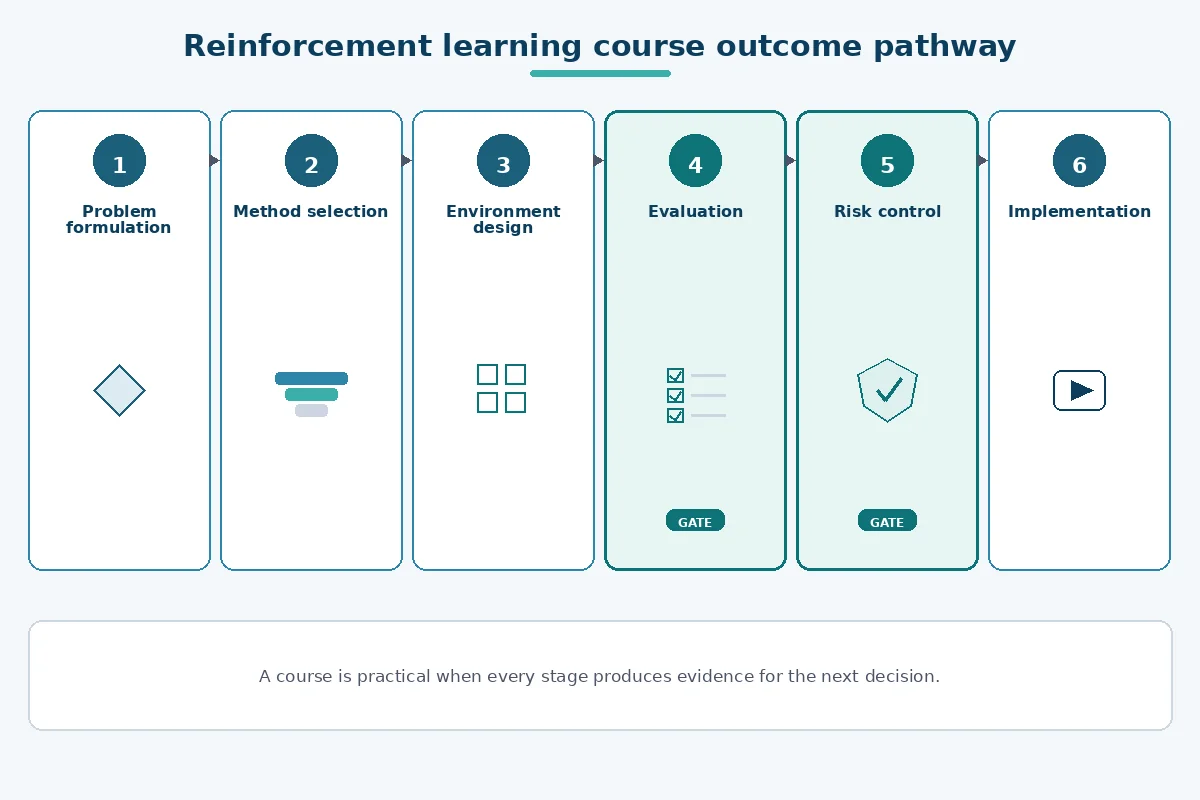
Professional training should link these outcomes. A participant who can run a notebook but cannot explain the reward, evaluation baseline or safe fallback is not yet ready to recommend operational use.
Prerequisites and preparation
Prerequisites should match the course depth. For implementation-focused training, participants normally benefit from basic Python programming, supervised machine-learning concepts, probability, vectors and functions. They do not need to arrive as reinforcement learning specialists, but they should be comfortable reading code and interpreting model results.
Before booking, ask whether the course assumes:
- the ability to write and debug Python;
- experience with NumPy, PyTorch, TensorFlow or an equivalent framework;
- knowledge of neural networks and optimisation;
- familiarity with probability, expected value and discounting;
- access to suitable computing during practical exercises.
The questions are not barriers; they prevent a mismatch between participant readiness and course pace. Where a mixed group is expected, the provider should explain how conceptual and coding activities are balanced.
How to compare reinforcement learning courses
Compare courses against the professional decision they are meant to support. The table below separates common training profiles without ranking particular providers.
| Course profile | Best suited to | Expected emphasis | Main limitation |
|---|---|---|---|
| Executive overview | Leaders and sponsors | Use cases, feasibility, risks and investment questions | Limited technical implementation depth |
| Algorithm and coding workshop | Developers and ML practitioners | Environments, algorithms, experiments and debugging | May understate governance and production integration |
| Implementation and governance course | Cross-functional technical teams | Problem formulation, methods, evaluation, safety and rollout | Requires a disciplined balance between theory and practice |
| Academic or research module | Researchers and advanced specialists | Mathematical foundations, proofs, papers and frontier methods | May not address organisational deployment decisions |
Delivery format also matters. A live instructor-led course can support discussion and immediate feedback; self-paced learning provides flexibility; a private organisational programme can use the team’s own decision context. Do not assume a provider offers a format unless the course page or proposal confirms it. Ask how exercises, computing access, feedback and assessment work in the selected format.
The EPW READY fit test
READY is an original EPW course-selection aid. It tests whether reinforcement learning is relevant to the learner’s problem and whether the organisation can benefit from implementation-focused training.
| Check | Question | Positive evidence |
|---|---|---|
| R — Repeated decisions | Do current actions influence future options, states or outcomes? | A sequential decision can be described over a horizon |
| E — Environment evidence | Can interactions be simulated, logged or otherwise evaluated safely? | A credible simulator, historical decision data or controlled test setting exists |
| A — Action and reward clarity | Can permitted actions, constraints and meaningful rewards be specified? | Domain owners can define desired and unacceptable behaviour |
| D — Development foundations | Do participants have the programming, ML and mathematical foundation for the course? | Prerequisites and preparation route are explicit |
| Y — Yardsticks and safeguards | Can policies be compared with baselines and stopped, reviewed or rolled back? | Evaluation measures, risk limits, human oversight and fallback rules are defined |
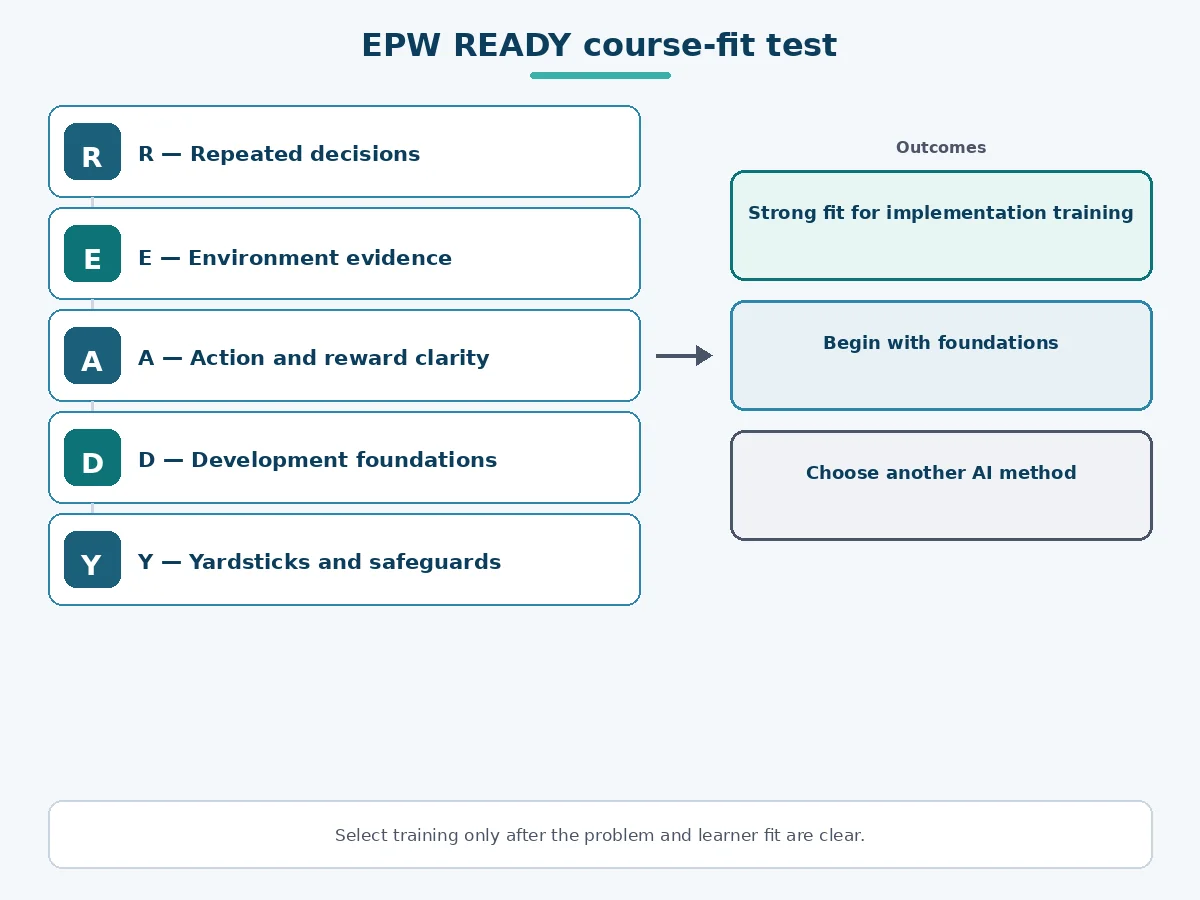
A strong result across READY indicates that implementation-focused reinforcement learning training can be useful. If the problem fits but prerequisites are weak, begin with Python, machine learning or mathematical foundations. If decisions are not sequential, the environment cannot be evaluated or rewards cannot be specified responsibly, another analytical method may be more appropriate.
Why practical evaluation must be part of the syllabus
Reinforcement learning results can vary across random seeds, environments and evaluation choices. The official Stable-Baselines3 guidance recommends separate test environments, periodic evaluation and multiple runs. Training should therefore teach participants to compare policies with baselines and interpret uncertainty rather than present one successful episode as proof.
Environment design is equally important. Gymnasium’s environment documentation distinguishes actions, observations, termination and truncation; these details affect learning and evaluation. A professional course should explain why a technically valid interface can still be a poor representation of the operational system.
Risk management cannot be an optional final slide. The NIST AI Risk Management Framework promotes continuous governance, mapping, measurement and management of AI risks. For reinforcement learning, practical implications include constraints on exploration, testing across scenarios, monitoring policy behaviour and maintaining an approved fallback.
What the EPW course covers
EPW’s verified five-day Reinforcement Learning Strategies and Implementation course is designed for practical sequential decision-making. The published outline progresses through:
- Sequential decision foundations: agents, environments, states, actions, rewards, Markov decision processes, returns and exploration.
- Value functions and tabular learning: Bellman relationships, policy and value iteration, Monte Carlo methods, temporal-difference learning, SARSA and Q-learning.
- Deep value-based reinforcement learning: function approximation, deep Q-networks, experience replay, target networks and stability.
- Policy optimisation and advanced strategies: policy gradients, actor–critic methods, proximal policy optimisation, model-based and offline learning, and risk-sensitive approaches.
- Evaluation, safety and implementation: baselines, off-policy evidence, reward hacking, simulation gaps, safe rollout, monitoring and fallback policies.
The course page states that participants formulate sequential decision problems, compare methods, evaluate agent behaviour and design a controlled implementation roadmap. A prospective participant should still review the current course page, available schedule and any delivery-specific proposal before booking.
Questions to ask before booking
- Which participant roles and prerequisite levels is the course designed for?
- How much time is spent on formulation, coding, evaluation and implementation?
- Do exercises require participants to design or modify an environment?
- How are baselines, multiple runs and uncertainty handled?
- Does the syllabus cover reward misspecification, unsafe exploration and deployment gaps?
- What computing environment, software and pre-course preparation are required?
- What evidence will participants produce by the end of the course?
Clear answers help distinguish a course that names popular algorithms from one that develops transferable professional judgement.
Select a reinforcement learning development route
Use the READY test to decide whether the problem, evidence and learner foundations support implementation training. Then compare course outcomes, exercises, evaluation methods and safeguards against the decisions participants must make after the course.
Explore EPW’s Artificial Intelligence and Machine Learning Courses, the existing guide to reinforcement learning strategies and the AI and machine learning article hub. To review the five-day syllabus, dates and locations, visit the Reinforcement Learning Strategies and Implementation course or request course details for your team.
Sources and references
- OpenAI. Part 1: Key concepts in reinforcement learning. Spinning Up documentation.
- Farama Foundation. Gymnasium environment API. Official documentation.
- Stable-Baselines3. Reinforcement learning tips and tricks. Official documentation.
- PyTorch. Reinforcement learning DQN tutorial. Official tutorial, last updated 16 June 2025.
- National Institute of Standards and Technology. Artificial Intelligence Risk Management Framework. AI RMF 1.0, 2023.
- Richard S. Sutton and Andrew G. Barto. Reinforcement Learning: An Introduction. Second edition, 2018.
- EPW Training. Reinforcement Learning Strategies and Implementation Course. Course outline accessed 31 August 2026.