

AI-generated illustration created to represent the article’s subject. It does not depict an actual EPW course, trainer, participant, client, event or venue.
Strategic human resource management matters because organisational plans depend on people having the capability, motivation and opportunity to deliver them. It translates business priorities into connected choices about workforce planning, recruitment, development, performance, reward, employee voice and change. Its value is not that every HR initiative becomes “strategic”, but that the organisation makes coherent people decisions and tests whether they improve relevant outcomes.
This article explains why strategic HRM matters for organisational performance, how the link works, what it cannot guarantee and how leaders can apply it responsibly. It also connects the concepts with EPW’s Strategic Human Resource Management for Modern Organizations Course.
Key takeaways
- Strategic HRM aligns people priorities with the capabilities and behaviours required by organisational strategy.
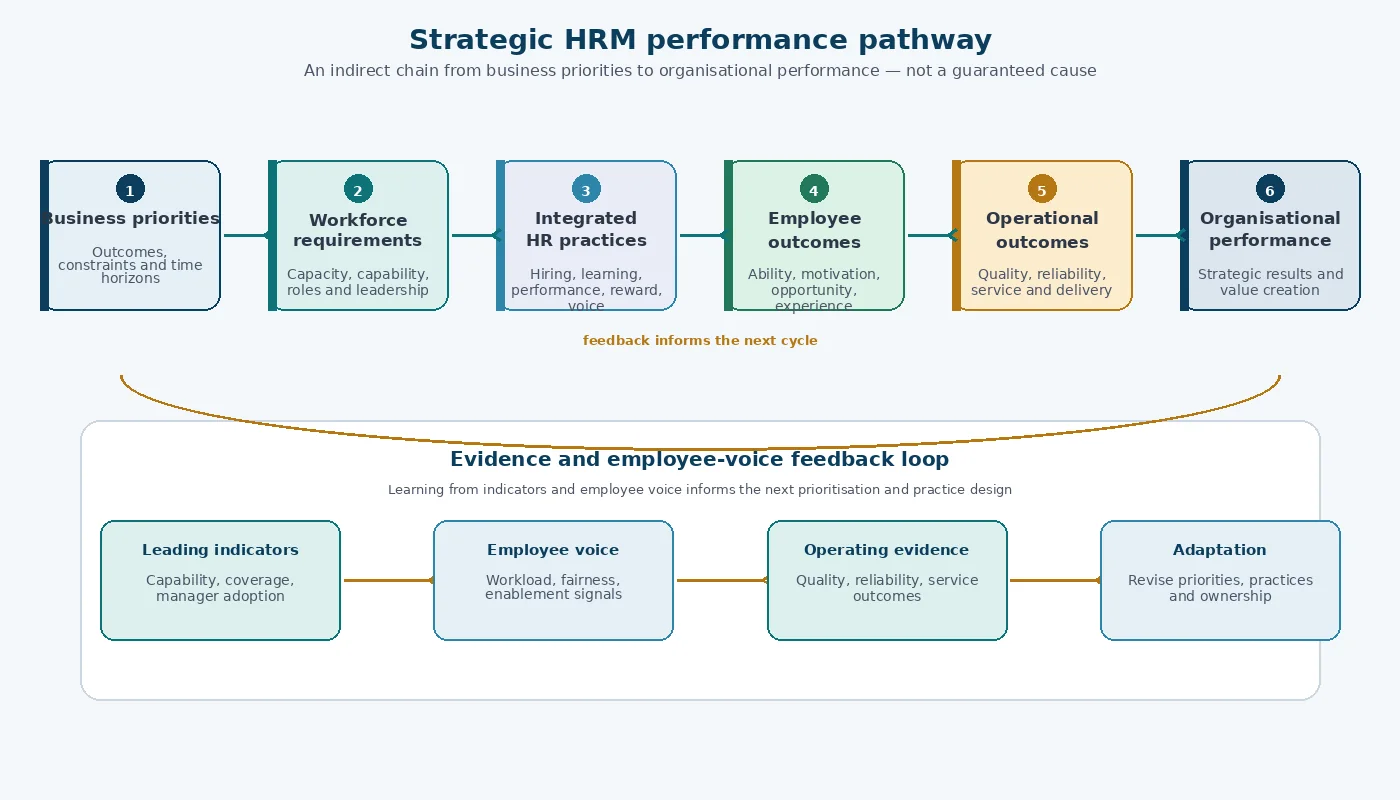
- Performance effects are usually indirect: HR practices influence workforce capability, motivation, opportunity, retention and operating processes.
- Coherent practices are more useful than disconnected programmes competing for attention.
- Employee wellbeing, fairness, voice and risk controls are part of sound strategy, not obstacles to it.
- Measurement should support decisions and learning; it should not confuse correlation with causation.
What is strategic human resource management?
Strategic HRM is a long-term, integrated approach to managing work and people in support of organisational direction. The CIPD strategic HRM factsheet places the concept in relation to business strategy, human capital management and performance. In practice, it asks three connected questions:
- What is the organisation trying to achieve, and under which constraints?
- Which workforce capabilities, capacity, behaviours and employment conditions will enable that direction?
- Which mutually reinforcing people practices can create those conditions, and what evidence will show progress?
This is different from merely relabelling an HR activity. A new appraisal form is not strategic by itself. It becomes part of a strategic system when it helps clarify performance expectations, supports useful feedback, informs development and works consistently with reward, job design and workforce plans.
Why strategic HRM matters for performance
1. It turns business choices into workforce requirements
A growth plan, digital transformation or service redesign creates specific people implications. Leaders may need new skills, different staffing levels, new leadership behaviours or redesigned roles. Strategic HRM exposes those implications early enough for action. The CIPD workforce planning factsheet describes workforce planning as a core business process that aligns changing organisational needs with people strategy.
Without that translation, the organisation can approve a strategy while assuming that the required capability will somehow appear. Recruitment then becomes reactive, learning budgets are spread thinly and critical-role risks remain hidden.
2. It creates coherence across people practices
Employees experience a system, not a collection of HR labels. An organisation that asks for collaboration while rewarding only individual output sends conflicting signals. One that recruits for innovation but limits voice and experimentation weakens its own objective. Strategic HRM helps leaders examine whether selection, job design, performance expectations, development, reward and employee relations reinforce the same priorities.
Research supports examining systems and mechanisms rather than isolated practices. A meta-analysis by Jiang, Lepak, Hu and Baer in the Academy of Management Journal analysed skill-enhancing, motivation-enhancing and opportunity-enhancing HR practices. It linked those dimensions with human capital and employee motivation, and with more distant outcomes through mechanisms including voluntary turnover and operational results. This does not prove that any single practice causes profit; it shows why the pathways between HR systems and outcomes deserve careful attention.
3. It improves prioritisation and resource allocation
HR teams face more possible initiatives than an organisation can implement well. Strategic alignment provides a basis for choosing. If service reliability is the priority, workforce capacity, role clarity, supervisor capability and retention in critical roles may deserve more attention than a fashionable programme with no clear operating link.
A practical portfolio review can classify work as mandatory, performance-enabling, capability-building or discretionary. It can then identify dependencies, owners, capacity and expected evidence. That discipline prevents the strategy from becoming a wish list.
4. It prepares the organisation for change
Change succeeds through roles, skills, decisions, incentives, communication and local leadership—not through a project plan alone. Strategic HRM identifies where work will change, whose capability must develop, which groups may be affected differently and how leaders will listen and respond. The Organizational Development and Change Management Course is a relevant companion when the main challenge is diagnosing and implementing organisational change.
5. It strengthens evidence-based decisions
Strategic people decisions combine organisational data, professional expertise, stakeholder perspectives and external evidence. Metrics are useful when they change a decision: for example, time to competence may be more informative than course attendance, and regretted turnover in a critical role may matter more than a single organisation-wide rate.
Analytics should begin with a decision question, define the population and time period, test data quality and acknowledge alternative explanations. EPW’s Advanced HR Analytics and Data-Driven Decision Making Course focuses on developing this deeper analytical capability.
6. It makes accountability clearer
Business leaders own workforce outcomes with HR; HR cannot deliver them alone. A strategic approach sets out who sponsors a priority, who manages implementation and who is accountable for decisions in the line. HR business partners can help leaders frame the issue, challenge assumptions and connect specialist expertise. The HR Business Partnering and Strategic Alignment Course develops that advisory connection.
7. It brings wellbeing and sustainability into performance thinking
A narrow performance model can encourage work intensification, short-term targets or avoidable harm. David Guest’s article on HRM and employee wellbeing argues for an analytical framework that gives wellbeing a central place. For leaders, the practical implication is to test both desired outcomes and possible workforce costs. Sustainable performance depends on employment practices that people can experience as credible, fair and workable.
What strategic HRM does not guarantee
Strategic HRM is not a formula for automatic performance. Organisational results are also shaped by market conditions, technology, capital, operating design, leadership execution, regulation and chance. Three cautions are especially important:
- Alignment can become rigidity. A people strategy must adapt when business assumptions change.
- Metrics can narrow attention. What is easy to count may not be what matters most; qualitative evidence and employee voice remain important.
- Implementation can alter intent. A well-designed policy can produce unequal or confusing experiences when managers lack time, skill or consistency.
Leaders should therefore treat the people strategy as a set of testable choices. They should state assumptions, watch for unintended effects and revise the approach when evidence changes.
A practical strategic HRM cycle
The following six-stage cycle keeps the work connected to real decisions.
- Clarify direction: identify the few organisational outcomes, constraints and time horizons that matter.
- Diagnose workforce implications: assess required capacity, capability, leadership, culture, roles and employee experience.
- Prioritise gaps: distinguish critical risks from desirable improvements and identify affected workforce groups.
- Design a coherent response: combine only the practices needed across hiring, deployment, learning, performance, reward, voice and change.
- Implement with ownership: assign decisions, resources, milestones, communications and manager support.
- Evaluate and adapt: review leading indicators, operating outcomes, employee effects and assumptions.
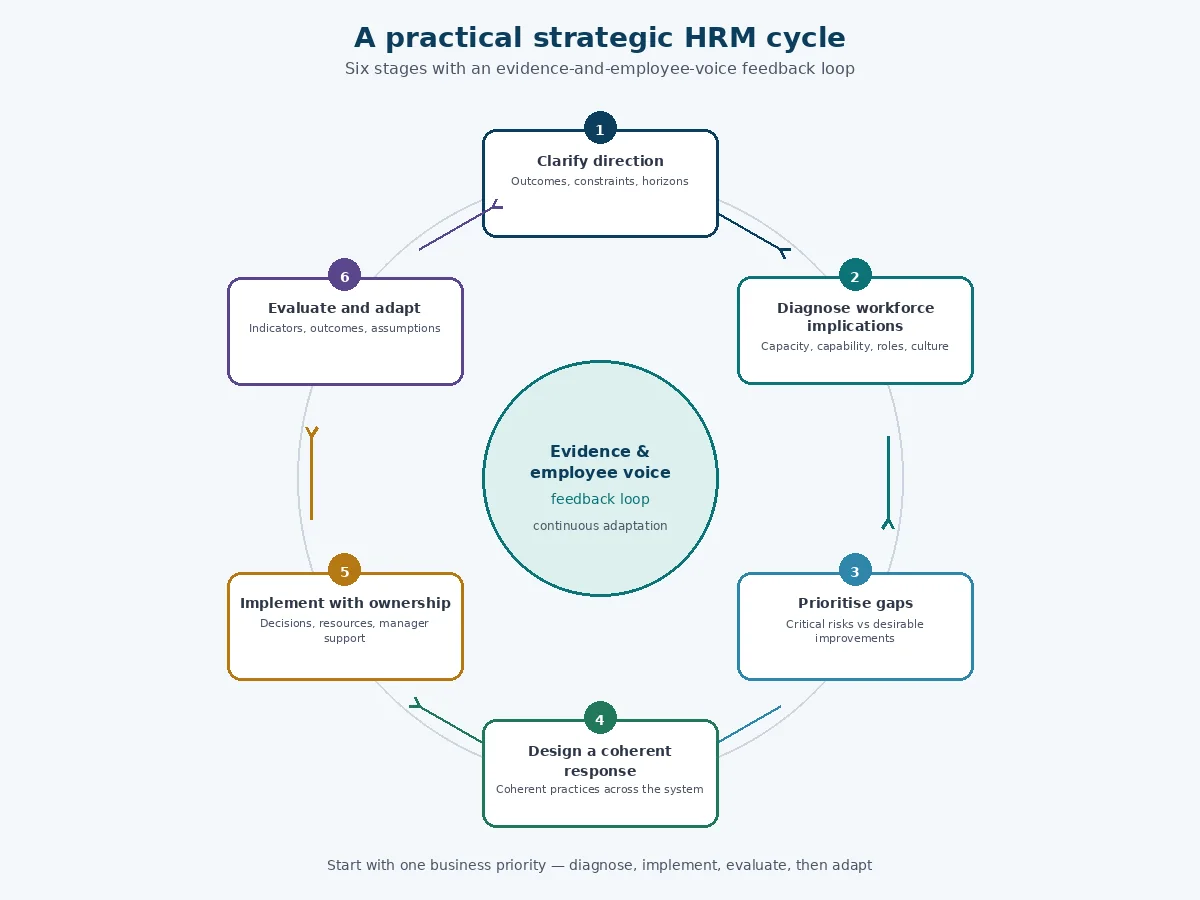
A team can begin this cycle with one business priority rather than attempting an enterprise-wide redesign. For example, a new service model might require demand forecasts, revised roles, targeted recruitment, supervisor development and measures for time to competence, service quality and workload. The Talent Acquisition and Workforce Planning Techniques Course is relevant when future capacity and hiring choices are central.
How to measure strategic HRM responsibly
A balanced measurement chain separates activity from results:
| Level | Example question | Illustrative evidence |
|---|---|---|
| Implementation | Was the agreed practice used as intended? | Coverage, timeliness, manager adoption and process quality |
| Workforce response | Did capability, motivation, opportunity or experience change? | Time to competence, internal movement, voice data and critical-role turnover |
| Operational result | Did the relevant work outcome improve? | Quality, cycle time, safety, customer service or delivery reliability |
| Organisational outcome | Did the priority advance without unacceptable costs? | Mission, financial or public-value results considered with wellbeing, equity and risk |
Before drawing a causal conclusion, consider timing, comparison groups, other interventions and external change. Report uncertainty plainly. A credible decision note is more valuable than a dashboard that implies precision the data cannot support.
Frequently asked questions
Is strategic HRM only for large organisations?
No. A smaller organisation may use a shorter process and fewer measures, but still benefits from linking its workforce choices to priorities and constraints. Proportionate strategy is better than unnecessary bureaucracy.
Who owns the people strategy?
Senior leaders own organisational direction and workforce outcomes. HR leads the people-strategy process, contributes professional expertise and supports implementation. Line managers, finance, technology, operations and employees provide essential evidence and delivery capacity.
How often should the strategy be reviewed?
Review timing should follow the volatility of assumptions and decisions. Leaders may monitor selected indicators regularly while conducting a deeper review when the business direction, labour market, operating model or risk profile changes.
Which metrics prove that strategic HRM works?
No single metric proves it. Use a chain of implementation, workforce, operational and organisational evidence, and test plausible alternative explanations. Select measures for the decision, not because they are commonly available.
Developing strategic HRM capability
Professionals who need to connect business goals, workforce choices, technology, change and analytics can review the published outline for EPW’s Strategic Human Resource Management for Modern Organizations Course. The wider Human Resources Training Courses category can help teams compare related development needs.
Final CTA: Choose one priority in your organisation and map the workforce capabilities, practices, owners and evidence required to deliver it. If the EPW course outline matches the gaps you identify, contact EPW through the course page to discuss the programme and delivery options.
Sources and References
- EPW, Strategic Human Resource Management for Modern Organizations Course, accessed 7 September 2026.
- CIPD, Strategic human resource management, 25 August 2025.
- CIPD, Workforce planning, accessed 7 September 2026.
- Jiang, K., Lepak, D. P., Hu, J. and Baer, J. C., How Does Human Resource Management Influence Organizational Outcomes? A Meta-Analytic Investigation of Mediating Mechanisms, Academy of Management Journal, 2012.
- Guest, D. E., Human resource management and employee well-being: towards a new analytic framework, Human Resource Management Journal, 2017.