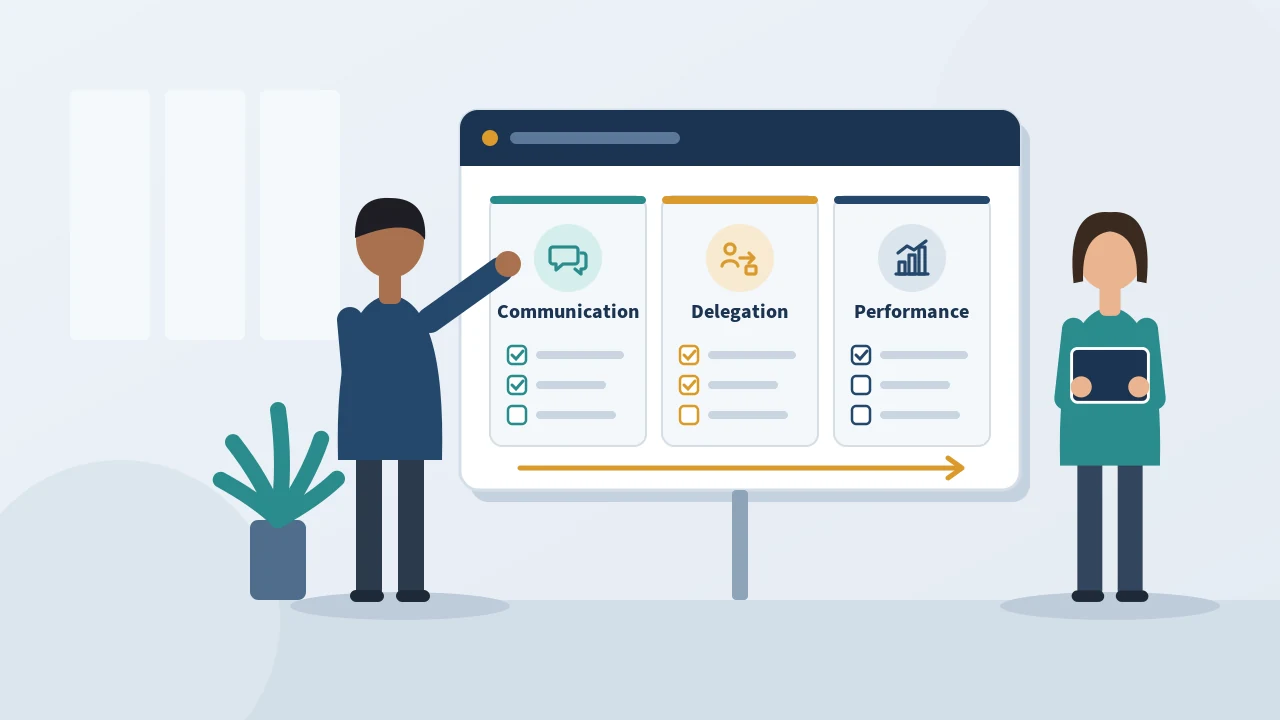
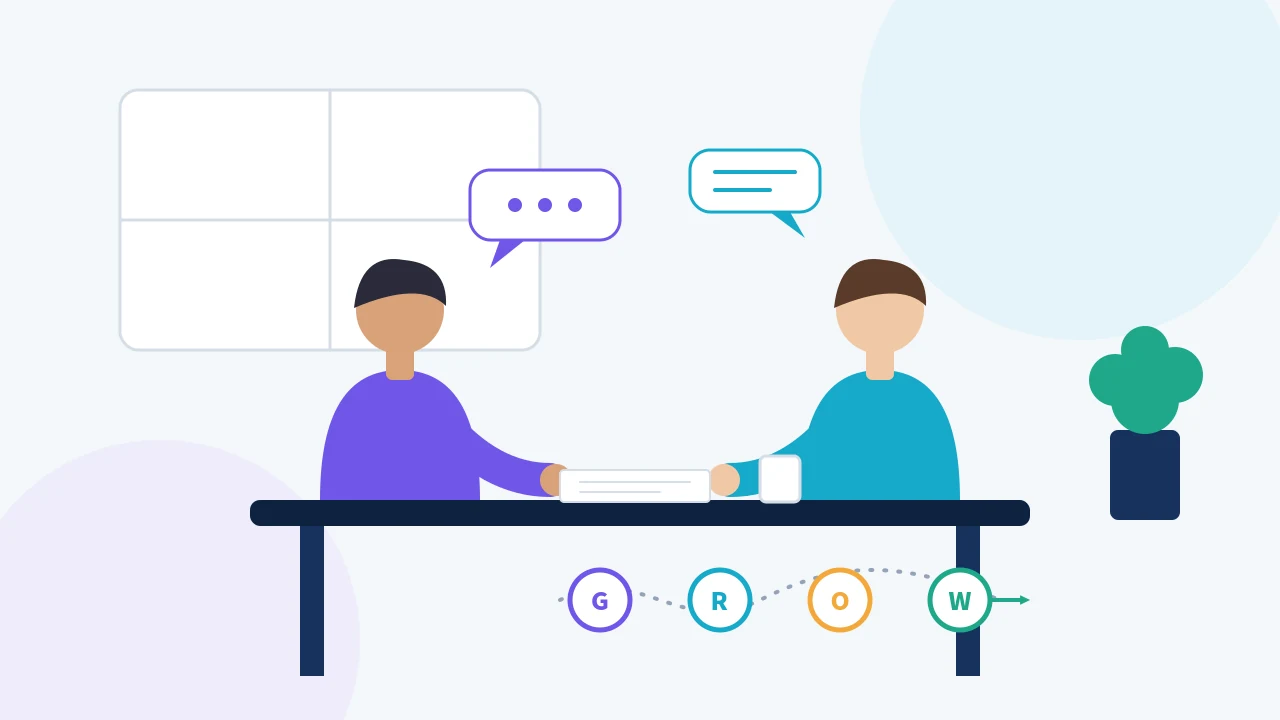
The GROW coaching model is a four-stage framework for helping a person clarify a Goal, examine current Reality, generate Options and commit to a Way forward or Will. It gives HR professionals and people managers a memorable structure for developmental conversations without requiring them to provide every answer.
GROW is most useful when an employee has a goal, decision or performance challenge that they can influence. The framework is not a script, disciplinary procedure or substitute for professional coaching competence. Its quality depends on trust, active listening, open questions and the other person’s ownership of the outcome.
What is the GROW coaching model?
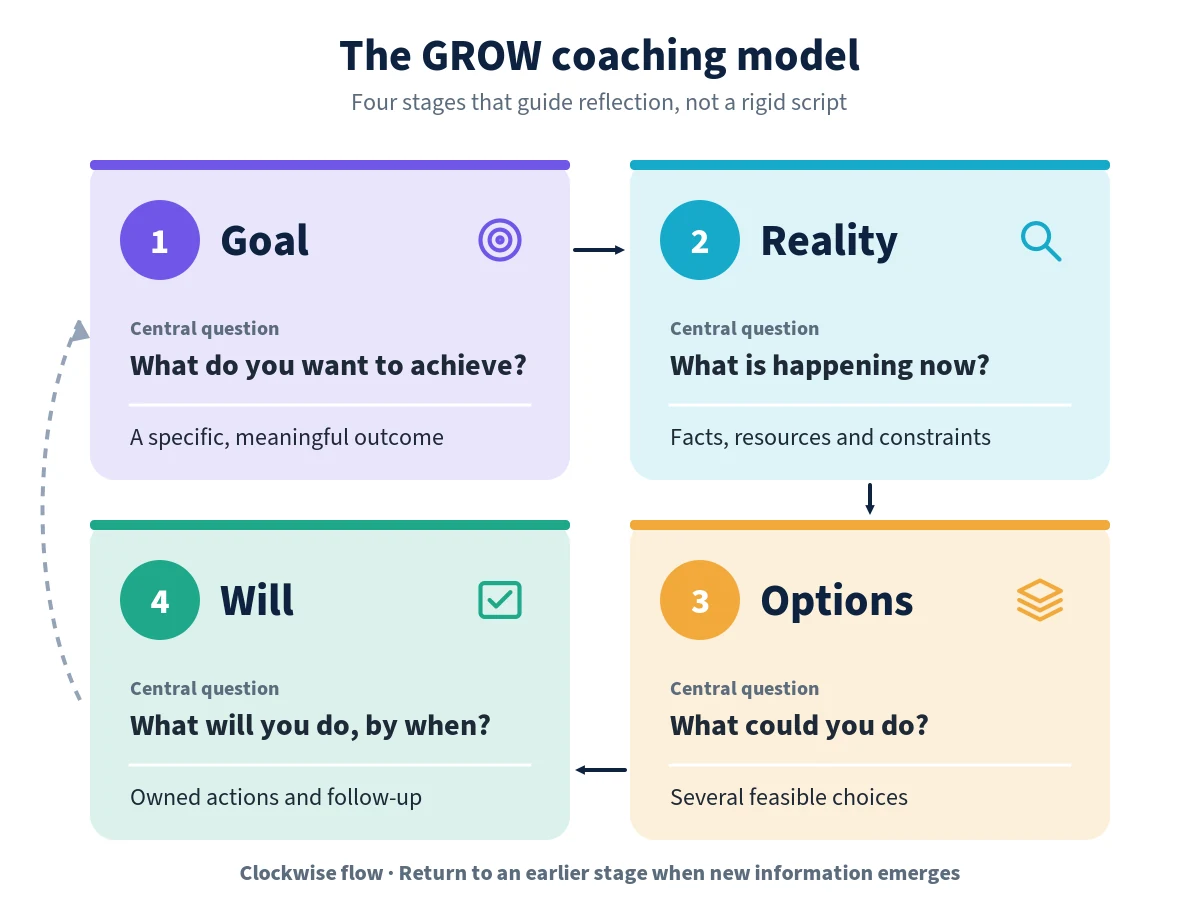
Performance Consultants describes GROW as a coaching and problem-solving framework developed with Sir John Whitmore and his peers, later popularised through Coaching for Performance. Its four stages create a natural movement from desired outcome to present facts, possible routes and a specific commitment. The stages may be revisited as new information emerges; effective conversations do not always proceed in a perfect straight line. See the organisation’s complete guide to the GROW model.
| Stage | Central question | Useful output |
|---|---|---|
| Goal | What do you want to achieve? | A meaningful, specific outcome and a purpose for the conversation. |
| Reality | What is happening now? | A balanced view of facts, perceptions, resources, attempts and constraints. |
| Options | What could you do? | Several feasible choices, with consequences and support needs considered. |
| Will / Way forward | What will you do, by when? | Owned actions, timing, evidence of progress and follow-up. |
Why GROW is useful for HR teams
HR work contains many conversations in which ownership matters: development planning, career choices, manager capability, return-to-performance discussions and problem solving. A framework helps the facilitator maintain direction while leaving room for reflection. It also creates a common language that HR can teach to managers and observe in practice.
However, structure alone does not make a conversation developmental. The International Coaching Federation’s 2025 Core Competencies emphasise active listening, evoking awareness and facilitating client growth. Applied to workplace coaching, this means hearing the employee’s language and context, testing understanding, allowing insight to emerge and translating learning into action.
How to use each stage well
1. Goal: agree the outcome before solving the problem
Begin by clarifying what the employee wants from the conversation. Distinguish the session goal from a longer-term performance or career goal. “I want to be more confident” may be meaningful but too broad; “I want a plan for leading next week’s client review” creates a clearer focus.
Useful questions include:
- What would make this conversation worthwhile?
- What do you want to be different?
- How will you recognise useful progress?
- Why does this matter now?
- Which parts of the outcome are within your influence?
HR should also make organisational boundaries explicit. A goal cannot override policy, safety, legal duties or legitimate role requirements. Agreement about the conversation is therefore both supportive and realistic.
2. Reality: establish facts without turning the session into an interrogation
Reality includes evidence, current behaviour, emotions, assumptions, stakeholders, resources and previous attempts. Ask for specific examples and listen for what is not yet clear. Avoid immediately correcting the employee’s account; first understand how they see the situation, then introduce relevant information transparently.
- What is happening now, and what evidence do you have?
- What have you already tried?
- What worked, even partly?
- Who else is affected?
- What assumption might need testing?
- What is the gap between the current position and the goal?
A balanced Reality stage includes strengths and resources, not only problems. It also separates observable facts from interpretations. “The report arrived two days late” is an observation; “the analyst does not care” is an inference that requires examination.
3. Options: expand choice before evaluating it
People often select the first acceptable answer, particularly when a senior manager is present. Keep idea generation open long enough to produce alternatives, then examine practicality, benefits, risks and support needs. The coach may contribute an option after the employee has generated their own, but should label it as an invitation rather than a disguised instruction.
- What could you try?
- What else?
- What would you advise a colleague in the same position?
- Which resource, relationship or strength could help?
- What are the likely advantages and disadvantages?
- Which option best fits the goal and constraints?
4. Will or Way forward: convert insight into an owned commitment
The final stage turns preference into action. Record the first step, owner, deadline, support and evidence of progress. Test commitment respectfully. If commitment is low, return to the goal, reality or options rather than forcing an artificial promise.
- What will you do first?
- When will you do it?
- What could prevent progress, and how will you respond?
- What support do you need, and from whom?
- How will you know the action helped?
- When should we review progress?
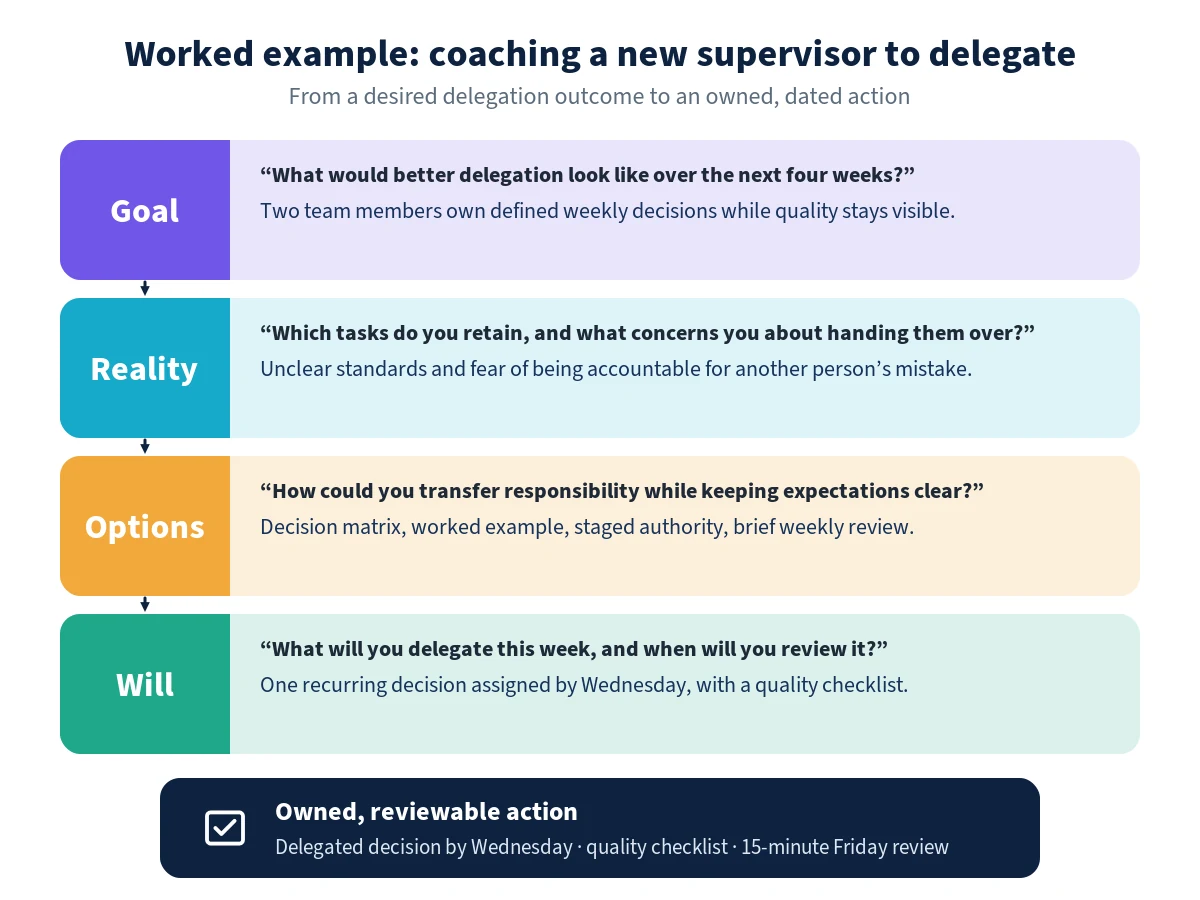
A worked HR example
Consider a newly appointed supervisor who avoids delegating and is working late. The HR business partner uses GROW during a developmental meeting.
| Stage | Conversation example | Result |
|---|---|---|
| Goal | “What would better delegation look like over the next four weeks?” | The supervisor wants two team members to own defined weekly decisions while quality remains visible. |
| Reality | “Which tasks do you retain, and what concerns you about handing them over?” | They identify unclear standards and fear of being accountable for another person’s mistake. |
| Options | “How could you transfer responsibility while making expectations and review points clear?” | Options include a decision matrix, worked example, staged authority and brief weekly review. |
| Will | “What will you delegate this week, and when will you review it?” | One recurring decision is assigned by Wednesday, with a quality checklist and a 15-minute Friday review. |
The value is not that GROW supplied a universal answer. It helped the supervisor diagnose the barrier, compare choices and own a testable next step. HR can support the manager without taking the work back.
Common mistakes and how to correct them
| Mistake | Why it weakens coaching | Better practice |
|---|---|---|
| Using GROW as a questionnaire | The employee feels processed rather than heard. | Follow the meaning in the answer and move between stages when needed. |
| Leading questions | The manager’s preferred answer is presented as discovery. | Ask open questions and disclose advice as advice. |
| Rushing Reality | Options are based on incomplete evidence. | Explore facts, prior attempts, strengths and constraints. |
| Stopping at Options | The conversation produces ideas but no change. | Agree a specific action, timing and review. |
| Ignoring power | An employee may agree because the coach controls appraisal or reward. | State purpose and choice clearly; distinguish coaching from management decisions. |
| Coaching every issue | Some situations require instruction, investigation or specialist support. | Select the method according to risk, competence and organisational duty. |
When GROW is appropriate—and when it is not
Use GROW when the employee has relevant knowledge, there is genuine room for choice and reflection can improve ownership. Suitable applications include development goals, career planning, stakeholder challenges, preparation for a difficult conversation and follow-up after learning.
Do not rely on a coaching framework when immediate safety direction is required, a formal grievance or misconduct allegation needs investigation, the employee requires legal or clinical advice, or the manager has already made a non-negotiable decision. In those cases, explain the process and boundaries directly. A manager may return to coaching later for learning or future action, provided that roles remain clear.
The CIPD’s 2026 performance management factsheet supports regular, improvement-focused conversations and notes that managers need the skill and organisational support to conduct them well. GROW can provide a structure within that broader system; it cannot repair unfair objectives, poor job design or weak accountability on its own.
How HR can embed GROW without reducing it to a template
- Define use cases and exclusions. Show managers where coaching fits and where policy, instruction or escalation takes priority.
- Teach the mindset with the structure. Practise listening, curiosity, summarising and non-leading questions alongside the four stages.
- Use realistic role plays. Base practice on delegation, development and performance situations managers actually face.
- Observe and coach the coaches. Provide feedback on power, question quality and follow-through, not merely whether all four letters appeared.
- Review transfer. Ask employees and managers whether conversations produced clarity, ownership and useful action.
HR teams building manager capability may connect GROW with EPW’s Performance Management Systems and Appraisal Methods course or Developing High Impact Training Programs course. Readers can also explore EPW’s article on leadership communication and the wider Human Resources Training Courses.
Key takeaways
- GROW organises a conversation around Goal, Reality, Options and Will or Way forward.
- The framework supports ownership; it should not become a disguised instruction script.
- Good use requires active listening, clear boundaries and awareness of workplace power.
- The final commitment should specify action, timing, support and evidence of progress.
- HR should define when coaching is suitable and evaluate the quality of application.
Ready to strengthen coaching capability in HR and people-management roles? Explore EPW’s Coaching and Development for HR Professionals course for its learning focus and available delivery options. For more related resources, browse the Human Resources Articles archive.
Sources and References
- Performance Consultants. The GROW Model: A Complete Guide to Goals, Reality, Options and Will. Accessed 14 September 2026. https://www.performanceconsultants.com/resources/the-grow-model/
- International Coaching Federation. 2025 ICF Core Competencies. 2025. https://coachingfederation.org/credentialing/coaching-competencies/icf-core-competencies/
- International Coaching Federation. 2025 ICF Core Competencies (PDF). 2025. https://coachingfederation.org/wp-content/uploads/2025/09/icf-cs-core-competencies-2025.pdf
- Chartered Institute of Personnel and Development. Performance management. Factsheet updated 29 January 2026. https://www.cipd.org/uk/knowledge/factsheets/performance-factsheet/