

AI-generated illustration created to represent the article’s subject. It does not depict an actual EPW course, trainer, participant, client, event or venue.
Employee engagement is the quality of an employee’s psychological connection to their work, team and organisation. It appears in sustained attention, discretionary effort, willingness to contribute ideas and commitment to doing good work. Engagement is not the same as happiness, satisfaction or loyalty: a person can be satisfied with comfortable conditions yet contribute little, or remain with an employer for practical reasons while feeling detached.
For HR leaders, the useful question is therefore not simply, “Are people happy?” It is: “Do people have the clarity, resources, relationships and opportunities that enable them to invest themselves in meaningful work?” This article defines employee engagement, explains its principal drivers and sets out a disciplined approach to measurement.
Employee engagement: meaning and scope
The Chartered Institute of Personnel and Development describes engagement as a multidimensional concept and recommends distinguishing engagement with the work itself from engagement with the organisation. Its employee engagement and motivation factsheet also warns practitioners not to treat the term as an imprecise label for every positive employee attitude.
A practical definition has three connected elements:
- Cognitive engagement: attention, concentration and understanding of how one’s work contributes to priorities.
- Emotional engagement: positive connection to the work, colleagues, manager or organisational purpose.
- Behavioural engagement: constructive effort, initiative, collaboration and persistence.
These elements are related but not interchangeable. Strong effort without recovery can become exhaustion. Positive feeling without role clarity may not translate into performance. Visible enthusiasm may also reflect personality or local norms rather than genuine engagement. A sound assessment therefore combines several indicators and interprets them in context.
What employee engagement is not
| Concept | What it describes | Why it differs from engagement |
|---|---|---|
| Job satisfaction | Contentment with pay, conditions or the job | A satisfied employee may not feel energised or willing to go beyond minimum requirements. |
| Motivation | The forces that direct and sustain effort | Motivation can be short-term, externally driven or focused on a single reward. |
| Commitment | Attachment to an organisation or intention to remain | People may stay because alternatives are limited, not because they are engaged. |
| Employee experience | The broader experience across the employment lifecycle | Experience creates conditions that can strengthen or weaken engagement. |
| Wellbeing | Physical, psychological, social and financial health | Wellbeing supports sustainable engagement, but neither measure can substitute for the other. |
Keeping these distinctions clear prevents inflated survey scores and poor interventions. A social event might improve mood for a day; it will not repair unclear priorities, unfair decisions or a manager who avoids meaningful conversations.
The principal drivers of employee engagement
Drivers are conditions that tend to support engagement. They are not universal levers with identical effects in every organisation. The relative importance of each driver will vary by role, workforce segment, culture and operating model.
1. Meaningful work and purpose
People are more likely to invest effort when they can see why their work matters and how quality is defined. Purpose should be translated into specific responsibilities and customer, public-service or operational outcomes. Abstract slogans are weaker than a credible line of sight between daily decisions and useful results.
2. Role clarity and adequate resources
Employees need to know what is expected, which priorities take precedence and what authority they possess. They also need the tools, information, staffing and access required to perform. Engagement initiatives cannot compensate for preventable operational friction.
3. Manager quality
Managers shape expectations, recognition, feedback, workload and psychological safety. Gallup’s current guidance identifies purpose, development, caring managers, ongoing conversations and strengths use as central engagement drivers. It also assigns managers a major role in differences between team engagement levels; this is a research finding, not a reason to ignore executive policy or working conditions. See Gallup’s explanation of how to improve employee engagement.
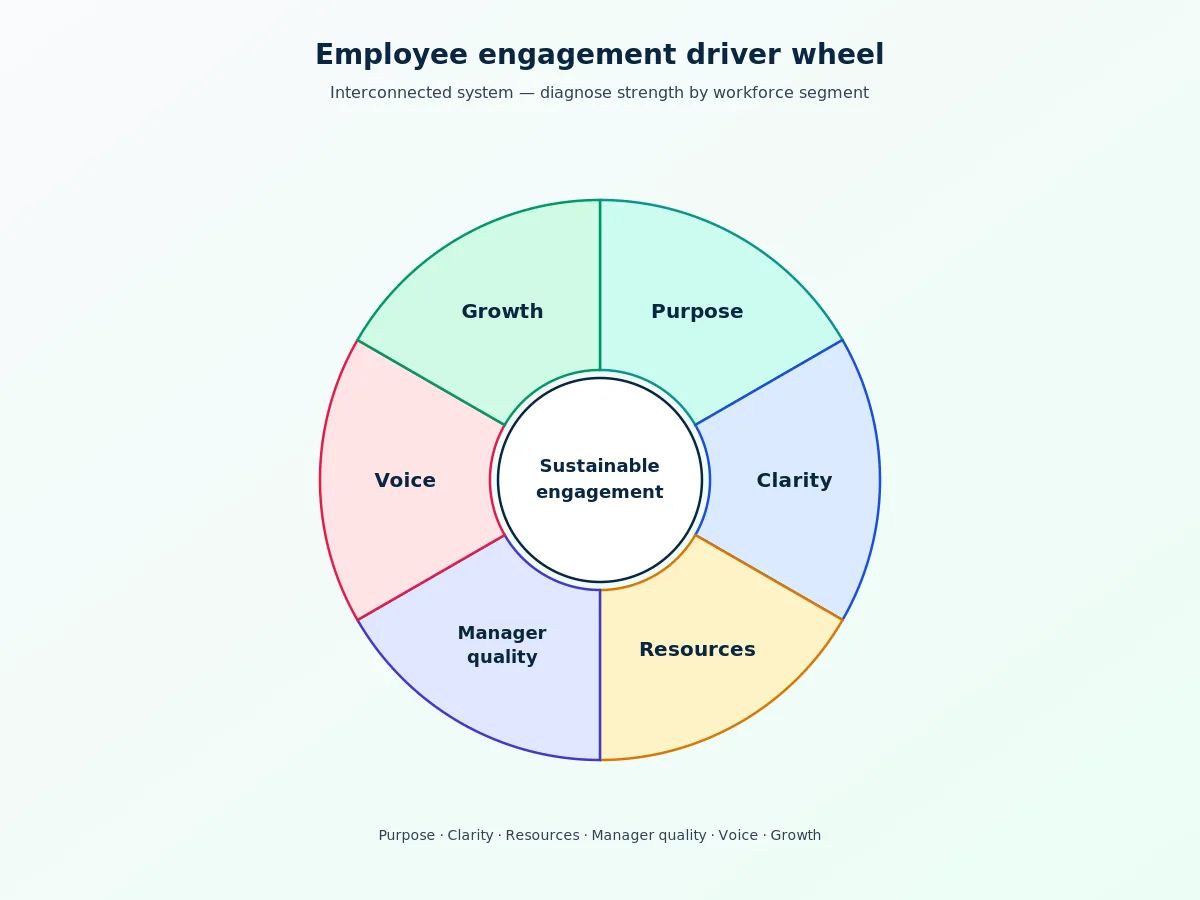
4. Employee voice and fair treatment
Voice means more than collecting comments. Employees need safe channels to express ideas and concerns, visible consideration of what they say and an explanation when a suggestion cannot be adopted. The CIPD’s 2026 employee voice factsheet emphasises both expression and influence. Fair procedures, respectful treatment and consistent explanations strengthen trust in those channels.
5. Recognition, feedback and growth
Specific recognition shows which contributions matter. Timely feedback helps people adjust before problems become embedded. Access to useful learning, stretch assignments and career conversations signals that the organisation is willing to invest in capability. HR should examine whether access is equitable, not merely whether programmes exist.
6. Sustainable workload and wellbeing
Intense effort is not automatically engagement. Persistent overload, conflicting demands and inadequate recovery can produce high activity alongside declining health. Sustainable engagement requires reasonable job design, supportive relationships and action on psychosocial risks. The CIPD wellbeing at work factsheet recommends integrating wellbeing with culture, leadership and people management rather than treating it as a separate benefit.
How should HR measure employee engagement?
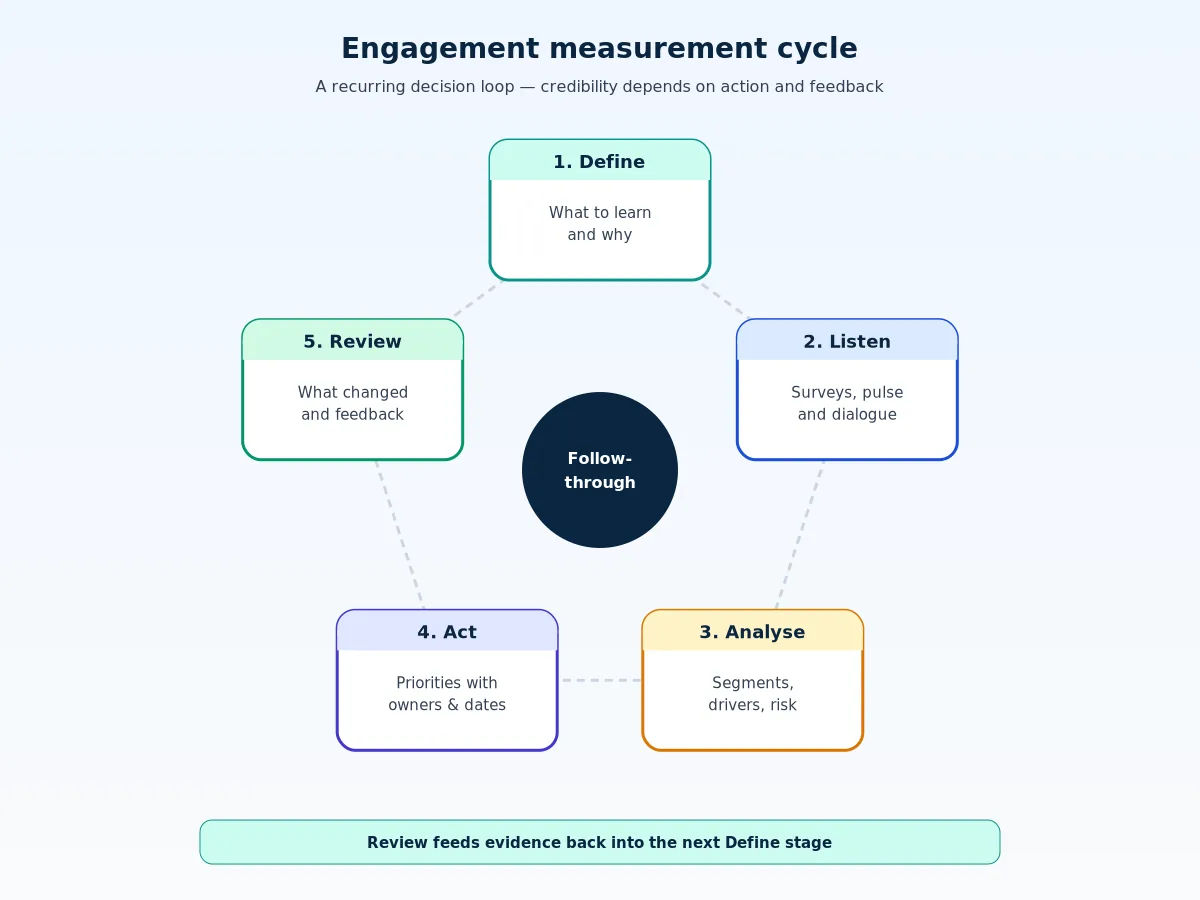
Measurement should support decisions, not produce a decorative score. A credible system begins with a clear construct, uses consistent questions and links findings to areas that leaders and managers can influence.
Use a balanced measurement architecture
| Evidence | What it can reveal | Main limitation |
|---|---|---|
| Validated engagement survey | Levels and patterns in reported engagement and its drivers | Self-report data are affected by wording, timing, trust and response patterns. |
| Pulse questions | Movement on a small number of current issues | Frequent surveying without action creates fatigue. |
| Listening groups and interviews | Reasons, language and local context behind scores | Small groups are not statistically representative. |
| Operational indicators | Absence, voluntary turnover, internal mobility, quality or safety patterns | These outcomes have multiple causes and do not directly measure engagement. |
| Manager follow-up evidence | Whether teams discussed findings and completed agreed actions | Activity counts do not prove that actions were effective. |
Follow six measurement disciplines
- Define the construct. State whether the survey measures work engagement, organisational engagement, drivers, outcomes or a combination.
- Choose reliable items. Avoid inventing a single question and calling it an engagement index. Use tested scales where possible and retain wording for trend analysis.
- Protect confidentiality. Explain who can access raw responses, apply minimum reporting thresholds and avoid exposing small groups.
- Segment responsibly. Compare functions, locations, tenure groups or manager populations only where sample sizes are sufficient and the comparison is ethically justified.
- Triangulate. Test whether survey patterns align with qualitative evidence and relevant workforce outcomes.
- Close the loop. Publish the priority themes, name accountable owners, set review dates and report what changed.
How to interpret engagement results responsibly
A percentage is not meaningful without its question set, scoring method, population, response rate and benchmark. Report those assumptions beside the result. Avoid ranking managers on tiny differences or presenting correlation as proof that engagement alone caused a commercial outcome.
Look for patterns that are both material and actionable. For example, a moderate overall score may conceal strong purpose but weak workload sustainability. A company-wide campaign would be less useful than clarifying priorities, reducing approval delays and equipping managers to redistribute work.
External benchmarks can provide context, but internal trends and differences in job design are often more actionable. Gallup’s State of the Global Workplace 2026 reports that 20% of employees worldwide were engaged in 2025. That global estimate describes a defined international study; it should not be treated as the target for every organisation or compared with a different survey instrument as if the methods were identical.
A practical HR action framework
Use the sequence diagnose, prioritise, co-design, act and review. Diagnose the strongest evidence, not the loudest anecdote. Prioritise one or two conditions with a clear connection to work. Co-design feasible action with employees and managers. Assign ownership and resources. Review leading indicators, employee feedback and relevant outcomes after an agreed period.
For example, if a service team reports unclear expectations and low recognition, its manager could establish weekly priority checks, define examples of quality work and recognise specific contributions. HR could support the manager with coaching, then review the same items alongside service quality and workload evidence after one quarter.
Readers who need to connect engagement with wider workforce choices may also find EPW’s guide to why strategic HRM matters useful. For capability building, explore the Coaching and Development for HR Professionals course and EPW’s Human Resources Training Courses.
Key takeaways
- Engagement is an active psychological connection to work, not a synonym for satisfaction or retention.
- Its drivers include meaningful work, clarity, resources, manager quality, voice, fairness, growth and sustainable workload.
- A survey is one evidence source; sound measurement combines quantitative, qualitative and operational information.
- Scores require transparent definitions, methods and safeguards.
- The value of measurement lies in focused action and visible follow-through.
Ready to turn engagement evidence into practical workforce action? Review EPW’s Employee Engagement and Retention Strategies course for its learning focus and available delivery options. Organisations can also discuss a tailored in-house programme without assuming unverified dates, fees or locations.
Sources and References
- Chartered Institute of Personnel and Development. Employee engagement and motivation. Factsheet, accessed 14 September 2026. https://www.cipd.org/uk/knowledge/factsheets/engagement-factsheet/
- Chartered Institute of Personnel and Development. Employee voice. Factsheet updated 6 April 2026. https://www.cipd.org/uk/knowledge/factsheets/voice-factsheet/
- Gallup. How to Improve Employee Engagement in the Workplace. Accessed 14 September 2026. https://www.gallup.com/workplace/285674/improve-employee-engagement-workplace.aspx
- Gallup. State of the Global Workplace 2026. 2026. https://www.gallup.com/workplace/349484/state-of-the-global-workplace.aspx
- Chartered Institute of Personnel and Development. Wellbeing at work. Factsheet updated 23 July 2026. https://www.cipd.org/uk/knowledge/factsheets/well-being-factsheet/