

Strategic human resource management matters in the public sector because government priorities can be delivered only when institutions have the right capabilities, leadership, workforce capacity and employment practices. It turns HR from a mainly administrative service into a disciplined link between public mandates, workforce decisions and outcomes for citizens. For public-sector HR leaders, the value lies in making recruitment, development, performance, mobility and workforce data work together within legal, ethical and accountability constraints.
Public organisations face a distinctive challenge. They must respond to elected priorities and changing public needs while preserving continuity, fairness, transparency and institutional knowledge. A strategic approach does not remove those constraints; it helps leaders make better long-term people decisions within them.
Key takeaways
- Strategic HR management connects public policy and service objectives with workforce capacity, skills and behaviour.
- Its benefits are strongest when HR practices operate as a coherent system rather than as isolated programmes.
- Public-sector value includes capability, continuity, fairness, adaptability, responsible stewardship and public trust.
- Benefits depend on lawful decisions, credible workforce evidence, accountable leaders and measures tied to service outcomes.
Contents
- What strategic HR management means in the public sector
- Why strategic HR management matters
- How the benefits are created
- Conditions that make strategic HR credible
- Practical actions for public-sector HR leaders
What strategic HR management means in the public sector
Strategic human resource management (strategic HRM) is a coherent approach to hiring, deploying, managing and developing people in support of long-term organisational goals. The CIPD’s strategic HRM factsheet, updated in August 2025, emphasises that people practices should connect with long-term goals and inform business strategy rather than simply follow it.
In government, the same principle applies to a public mandate. HR leaders translate policy priorities and service obligations into practical workforce questions: Which capabilities will be needed? Where are the critical shortages? Which roles require continuity? What behaviours and leadership standards support public value? Which employment controls protect merit, fairness and integrity?
This is broader than producing an annual HR plan. A plan lists activities; strategic HR management establishes the choices, principles and evidence that determine which workforce actions deserve priority. It also creates feedback: workforce constraints should inform policy delivery choices, budgets and implementation schedules.
Why strategic HR management matters in the public sector
1. It translates policy goals into workforce priorities
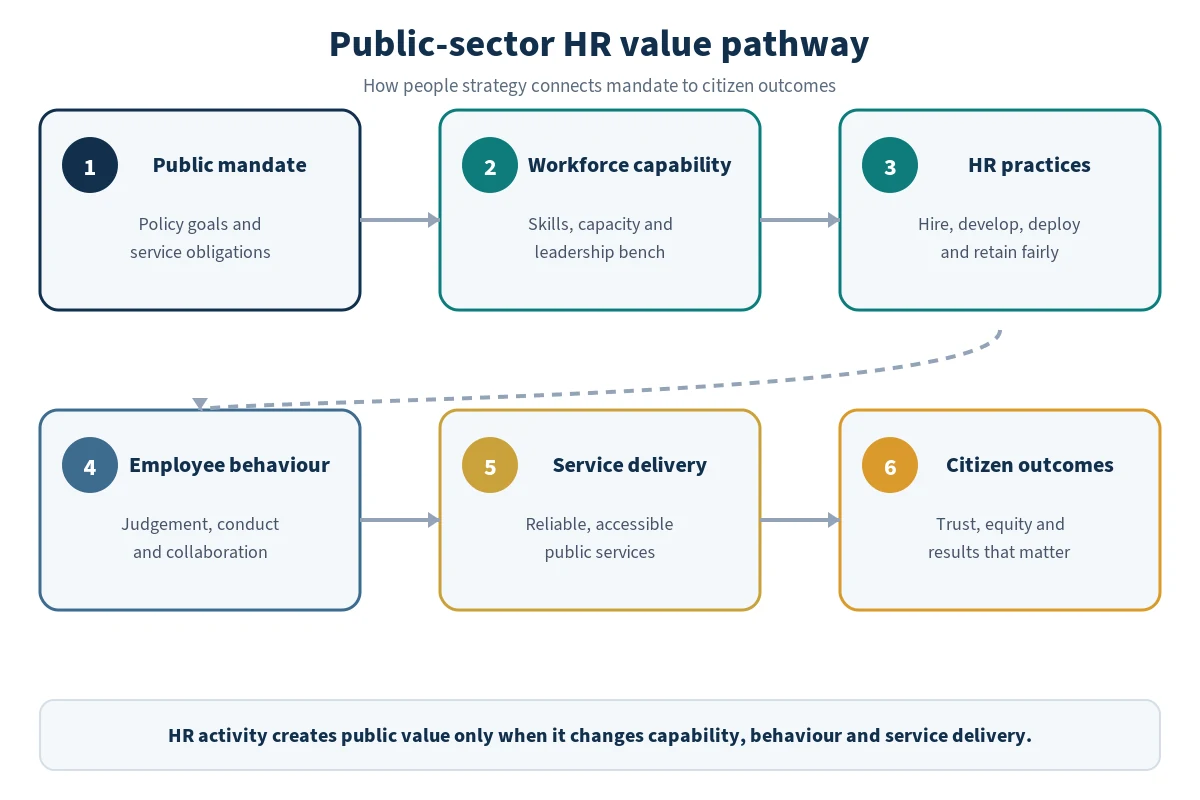
A public strategy can fail even when its policy logic is sound if agencies lack the roles, skills, capacity or leadership needed to execute it. Strategic HR gives executives a clear line of sight from the mandate to workforce requirements. Instead of treating every vacancy or training request as equally urgent, leaders can prioritise business-critical roles, scarce capabilities and service areas where workforce gaps threaten delivery.
The OECD’s public employment and management guidance identifies recruitment, continuous learning, internal mobility, performance management, strategic talent management and career development as tools for building a future-ready public workforce. The benefit comes from coordinating these tools around defined outcomes.
2. It strengthens capability and institutional continuity
Governments need specialist knowledge as well as general leadership and delivery skills. Some capabilities take years to build, and unplanned departures can weaken regulatory memory, programme continuity or emergency readiness. Strategic workforce planning makes these exposures visible early enough to act through succession, knowledge transfer, targeted recruitment, internal mobility or development.
This does not mean retaining every structure indefinitely. It means distinguishing capabilities that must be preserved from processes that should be redesigned. HR can then support renewal without losing essential institutional knowledge.
3. It supports merit, fairness and public trust
Public employers are expected to make defensible decisions. Clear role requirements, transparent selection criteria, consistent performance standards and documented development opportunities help reduce arbitrary treatment. They also make decisions easier to explain to employees, oversight bodies and the public.
The OECD Recommendation on Public Service Leadership and Capability, adopted in 2019, places a values-driven culture, capable leadership and effective people systems at the centre of a professional public service. Strategic HR makes those principles operational through everyday workforce decisions.
4. It improves adaptability without abandoning accountability
Public organisations must react to emergencies, demographic change, technology, new programmes and shifting demand. Strategic HR makes adaptation more deliberate by maintaining capability inventories, redeployment protocols, learning pathways and scenario-based workforce plans. The OECD notes that a flexible public service can move skills across organisational or programme silos and access labour-market capability more effectively.
Flexibility still requires governance. Emergency redeployment, accelerated hiring or new digital roles should have clear authority, selection principles, risk controls and review points. Strategy helps institutions move faster because the rules for responsible action are defined before pressure peaks.
5. It connects performance management with public value
Activity measures alone can reward volume without showing whether services improved. Strategic HR encourages a balanced line of sight between individual contribution, team capability, programme outcomes and the organisation’s mandate. Managers can set clearer expectations, give useful feedback and identify barriers that no individual employee can solve.
The aim is not to attribute complex social outcomes to one person. It is to define controllable contributions and examine whether workforce practices support quality, timeliness, accessibility, integrity and learning. This makes performance discussions fairer and more useful.
6. It improves stewardship of public resources
Workforce decisions have long-term financial and operational consequences. The OECD reports that OECD governments spend, on average, the equivalent of 9.2% of gross domestic product and 22.5% of total government expenditure on public-servant wages. That scale makes workforce design, capability investment and deployment material stewardship issues, not simply HR administration.
Strategic HR does not equate good stewardship with indiscriminate cost reduction. It asks whether the organisation has the appropriate workforce mix, spans of control, critical capability, deployment and productivity support to deliver its obligations sustainably.
How strategic HR benefits are created
| Public-sector benefit | HR mechanism | Evidence to monitor |
|---|---|---|
| Stronger service capability | Capability mapping, targeted recruitment and role-based development | Critical skill coverage, readiness and service-quality indicators |
| Greater continuity | Succession, knowledge transfer and workforce scenarios | Critical-role risk, time to readiness and dependency concentration |
| Fairer decisions | Transparent criteria, structured assessment and consistent review | Selection patterns, appeals, exceptions and audit findings |
| Faster adaptation | Internal mobility, flexible teams and reskilling pathways | Redeployment speed, vacancy duration and capability gaps |
| Better performance | Clear contribution expectations, feedback and barrier removal | Outcome quality, timeliness, employee experience and learning |
| Responsible stewardship | Workforce planning linked to demand, budget and service design | Capacity utilisation, workforce cost, risk and service outcomes |
This map prevents a common error: claiming value from an HR activity merely because it happened. A training programme, new appraisal form or recruitment campaign is an input. Leaders should test whether it improved capability or behaviour and whether that change contributed to the intended public outcome.
Conditions that make strategic HR credible
Strategic HR management creates benefits only when several conditions are present:
- A clear mandate: HR priorities must derive from verified organisational objectives, statutory duties and service demand.
- Executive ownership: senior leaders and line managers must own workforce outcomes; HR cannot compensate for weak management accountability.
- Reliable evidence: headcount data alone is insufficient. Leaders need role, capability, mobility, workload, employee-experience and performance evidence with clear definitions.
- Fair governance: strategic urgency must not become a reason to bypass lawful procedures, merit principles, consultation or data protection.
- Employee voice: workforce insight improves when employees and representative bodies can identify operational constraints and unintended effects.
- Review and adaptation: the people strategy should change when policy, demand, risk or evidence changes.
Practical actions for public-sector HR leaders
- Define the public outcomes and workforce assumptions. Record which services, reforms or risks are in scope and which workforce conditions could enable or obstruct delivery.
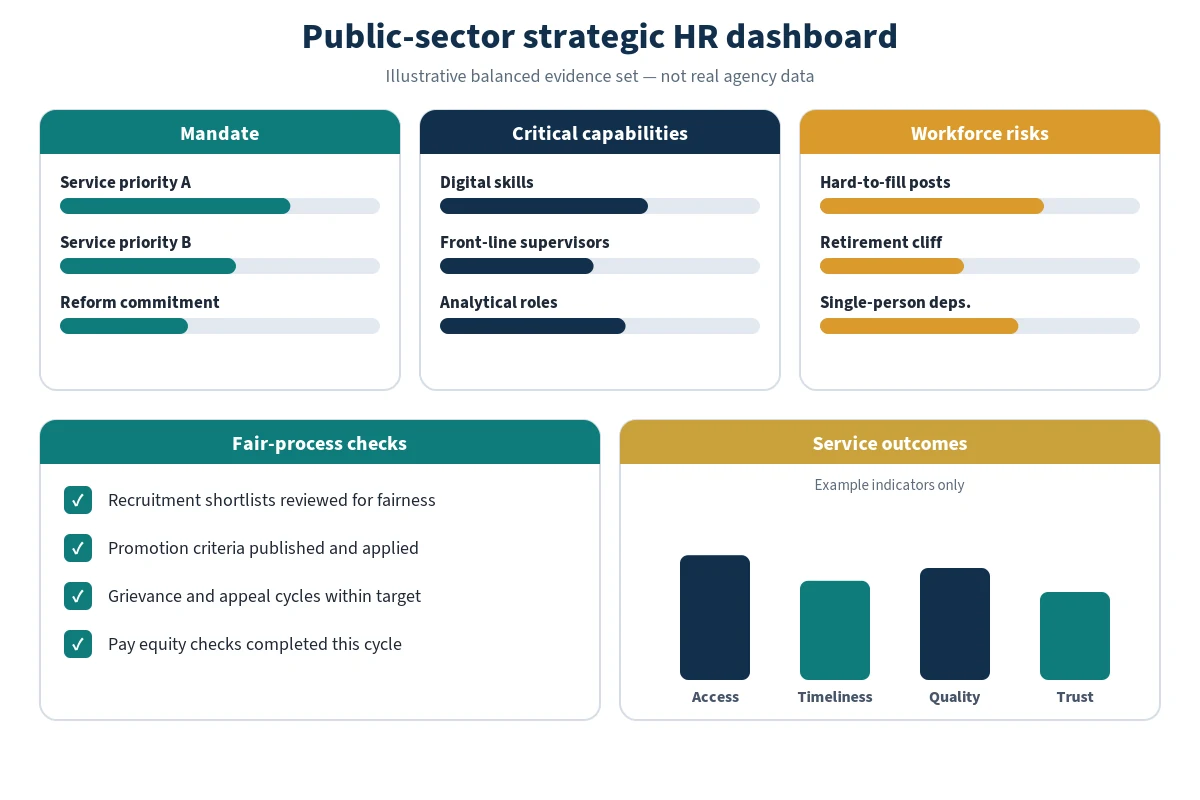
- Map critical roles and capabilities. Identify where scarcity, turnover, single-person dependency or long development lead times create material exposure.
- Choose a small set of integrated priorities. Connect resourcing, learning, performance, mobility and leadership actions rather than launching disconnected initiatives.
- Set fairness and integrity controls. Define decision authority, transparent criteria, documentation, consultation and review arrangements.
- Measure the value chain. Track implementation, capability or behaviour change, and relevant service outcomes. Separate correlation from proven causation.
- Review scenarios regularly. Test how workforce choices hold up under budget pressure, demand surges, technology change and critical-role departures.
HR teams that are strengthening the wider people function may also find value in EPW’s explanation of why strategic HRM supports organisational performance and its comparison of HR business partner operating models. The full Human Resources Training Courses category provides the broader development pathway.
Ready to strengthen workforce governance in a public-service context? Explore EPW’s Managing HR in the Public Sector Environment course for structured learning on public-sector HR, talent, change, leadership and strategic planning.
Conclusion
Strategic HR management matters in the public sector because people systems shape whether institutions can translate mandates into reliable, fair and adaptable public services. Its value is not a collection of HR projects. It is the coherence between workforce choices, leadership behaviour, employee capability, governance and public outcomes.
Public-sector leaders should therefore judge people strategy by practical questions: Does it protect critical capability? Improve readiness? Support fair decisions? Help managers remove barriers? Strengthen service delivery without weakening accountability? A strategy that answers those questions with evidence is far more valuable than an activity plan labelled strategic.
Explore the training course: Review EPW’s Managing HR in the Public Sector Environment programme, available for professionals responsible for government workforce strategy and HR delivery.
Sources and References
- Chartered Institute of Personnel and Development. Strategic human resource management. Updated 25 August 2025.
- Organisation for Economic Co-operation and Development. Public employment and management. Accessed 19 September 2026.
- Organisation for Economic Co-operation and Development. Recommendation of the Council on Public Service Leadership and Capability. Adopted 17 January 2019.