

AI-generated illustration created to represent the article’s subject. It does not depict an actual EPW course, trainer, participant, client, event or venue.
The ADDIE model is a five-phase framework for designing training: Analysis, Design, Development, Implementation and Evaluation. Its value is not the acronym alone. ADDIE gives HR and learning teams a disciplined way to confirm that training is the right response, define measurable outcomes, build relevant learning experiences, prepare delivery and use evidence to improve performance.
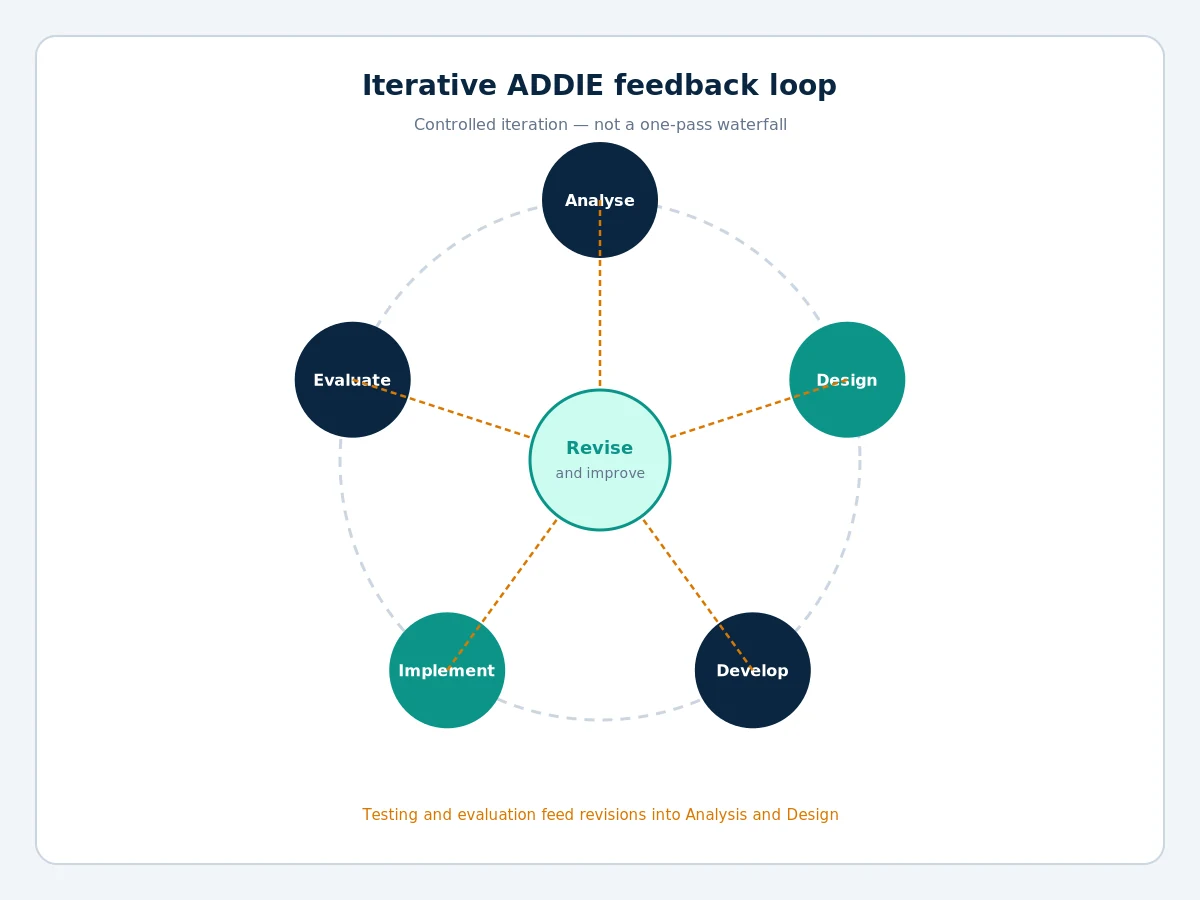
Although the phases are often drawn as a straight line, effective teams treat them as connected and iterative. Findings during development may expose a design weakness; an implementation pilot may reveal a learner-access problem; evaluation may trigger a new analysis. The framework creates control points without preventing revision.
What the ADDIE model is designed to achieve
ADDIE is an instructional design framework rather than a single lesson plan or delivery format. Robert Maribe Branch’s 2009 textbook on the ADDIE approach presents it as an organising framework linking instructional design concept, theory and practice. It can support classroom, virtual, blended and workplace learning when the methods fit the learners and the required performance.
The model helps a project team answer five governance questions:
- Analysis: What performance or capability problem are we solving, and is training appropriate?
- Design: What should learners be able to do, and how will learning and assessment enable that result?
- Development: What materials, activities and support must be built and tested?
- Implementation: How will facilitators, learners, managers, systems and logistics make delivery work?
- Evaluation: What evidence will show quality, learning, application and business contribution?
This structure connects naturally to a broader strategic HR approach: learning investment starts with organisational need and ends with evidence, not merely attendance.
The five ADDIE phases and their required outputs
1. Analysis: diagnose the need before proposing training
Analysis identifies the gap between current and required performance. Examine business outcomes, tasks, learner characteristics, prior knowledge, motivation, work context, language, technology, time and management support. Separate capability gaps from problems caused by unclear processes, missing tools, incentives, workload or accountability.
The CDC Quality Training Standards state that a needs assessment should confirm whether training is needed and should identify the training goal, learners, barriers, facilitators and suitable delivery methods. That principle applies well beyond public health.
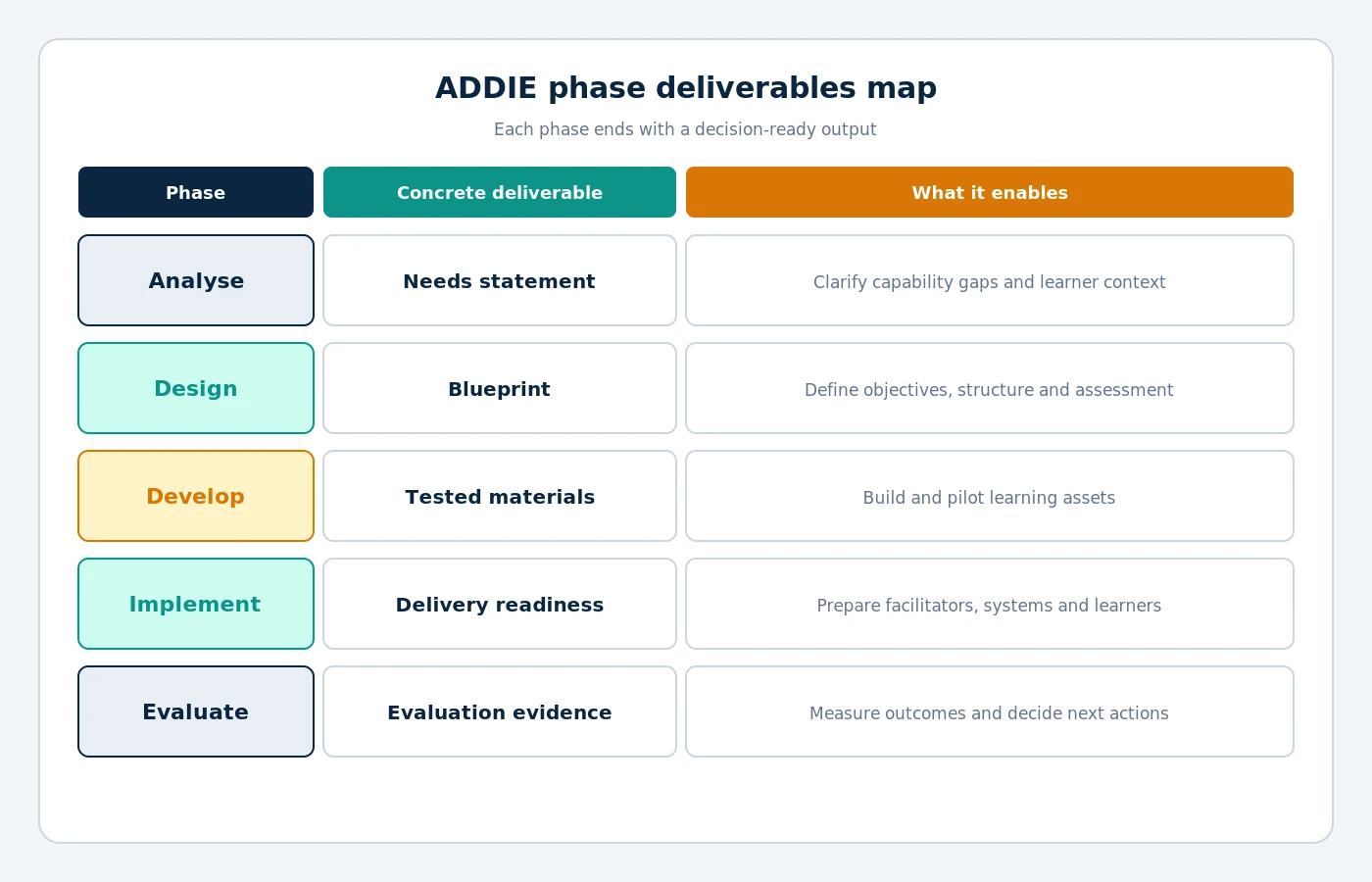
Required output: a concise needs statement, audience profile, target performance, constraints, baseline evidence and an agreed decision that training is an appropriate part of the solution.
2. Design: convert the need into a learning architecture
Design defines what the completed programme must do before the team starts producing slides or videos. Write measurable objectives using observable actions. Align each objective with an assessment method and learning activity. Decide sequence, delivery format, duration, facilitator role, accessibility, feedback and the support needed for transfer to work.
A useful alignment chain is: business need → required job behaviour → learning objective → practice activity → assessment → workplace evidence. If one link is missing, content may be interesting but unable to support the intended performance.
Required output: a design blueprint containing objectives, content map, methods, assessment plan, delivery plan, accessibility requirements and evaluation questions.
3. Development: build, review and test the experience
Development turns the blueprint into facilitator materials, participant resources, cases, exercises, assessments, job aids and digital assets. Subject-matter experts confirm accuracy; instructional reviewers test alignment and usability; representatives of the learner group test clarity and relevance.
Build the smallest testable version first. A pilot module can reveal confusing instructions, unrealistic timing or technology barriers before the full programme is produced. Version control and a documented approval route prevent teams from delivering conflicting materials.
Required output: reviewed learning materials, a facilitator guide, participant resources, assessments, accessible formats, quality records and a pilot-ready version.
4. Implementation: prepare the system, not only the session
Implementation includes more than booking a room or opening an online module. Prepare facilitators, brief line managers, enrol learners, test platforms, confirm accessibility, provide pre-work, organise attendance and support, and define how operational problems will be escalated.
Run a controlled pilot where risk or scale justifies it. Capture deviations from the design, technical issues, timing, questions and learner evidence. Decide whether to proceed, revise or pause. For a comparison of delivery choices, EPW’s published article on instructor-led training versus e-learning provides useful context; ADDIE itself does not prescribe one format.
Required output: trained facilitators, ready systems and venues, learner communications, manager support, support routes, pilot findings and an approved delivery plan.
5. Evaluation: use evidence throughout the cycle
Evaluation should be planned during analysis and design, not added after delivery. Use formative evaluation to improve objectives, materials and activities while they are being created. Use summative evaluation to assess the completed programme and its results.
Measure what the objectives require. Satisfaction can identify experience problems but cannot by itself prove learning or application. Depending on the programme, evidence may include assessment performance, demonstrated skill, quality or error measures, manager observation, workplace application, operational results and unintended consequences.
The CDC’s Quality Training Standards reference list treats evaluation as essential for understanding success and improving later iterations. It also highlights the importance of post-training support, including supervisor and peer support, opportunities to practise and job aids.
Required output: an evaluation report that distinguishes delivery quality, learning, application and organisational outcomes, with decisions, owners and improvement actions.
An ADDIE project-control table
| Phase | Decision gate | Evidence to review | Typical owner |
|---|---|---|---|
| Analysis | Is training justified and sufficiently defined? | Performance gap, audience, causes, baseline and constraints | Learning lead with business sponsor |
| Design | Will the architecture produce and test the required capability? | Objectives, alignment map, methods and evaluation plan | Instructional designer |
| Development | Are materials accurate, usable and ready to pilot? | Reviews, accessibility checks, test results and version record | Development lead |
| Implementation | Are people, systems and support ready for delivery? | Facilitator readiness, pilot evidence, logistics and risks | Programme manager |
| Evaluation | What should continue, change or stop? | Learning, application, outcome and experience evidence | Sponsor with evaluation lead |
The owner titles can change, but the decision rights should not be ambiguous. Smaller teams may combine roles; they should still preserve independent review for high-risk, regulatory or technically complex content.
Worked example: designing supervisor feedback training
Assume an organisation receives inconsistent employee feedback and frequent escalation of basic performance conversations.
Analysis
The team reviews case records, manager interviews and employee feedback. It finds that supervisors understand the policy but struggle to prepare evidence, structure the conversation and agree follow-up actions. Some delays also result from unclear escalation guidance, so the solution must include both training and a process clarification.
Design
The principal objective is: “Using a realistic case, supervisors will prepare and conduct a feedback conversation that states the issue, presents evidence, invites the employee’s perspective and agrees a documented action.” The assessment is a role-play scored against those behaviours. The design includes demonstration, guided practice, peer feedback and a workplace planning tool.
Development
The team builds two authentic cases, a conversation planner, facilitator notes and a scoring rubric. An HR policy specialist verifies accuracy, while a small group of supervisors tests realism and timing. Their feedback removes jargon and adds a case involving remote work.
Implementation
Facilitators rehearse the scoring method. Managers receive a briefing on how to support application after the session. The pilot runs with one business unit; the team records questions, timing and rubric consistency before wider delivery.
Evaluation
The team reviews assessment scores, confidence only as a supporting measure, use of the planner, case quality and escalation patterns over an agreed period. It also samples conversation records for evidence and follow-up. Findings lead to a revised job aid and an additional manager-coaching prompt.
This example shows why ADDIE is more than content production. It links diagnosis, performance, practice, delivery support and evidence in one controlled cycle.
How to keep ADDIE agile
A common criticism is that ADDIE becomes slow and linear. That is a project-management choice, not an unavoidable feature of the framework. Teams can preserve rigour and work iteratively by using the following practices:
- Time-box analysis and state what remains uncertain.
- Prototype the highest-risk activity or assessment first.
- Review alignment before polishing visual design.
- Test with representative learners in short cycles.
- Maintain one prioritised change log with owners.
- Use explicit gates for risk while allowing earlier phases to reopen.
- Release in controlled increments when the operating context permits.
Advantages and limitations of the ADDIE model
Advantages
- Creates a shared language across HR, subject experts, designers and sponsors.
- Connects training to a diagnosed performance need.
- Makes learning objectives, assessment and evaluation traceable.
- Provides quality gates for accuracy, accessibility and readiness.
- Works across delivery formats because it does not prescribe a specific medium.
- Supports continuous improvement when evaluation feeds the next cycle.
Limitations
- Can become bureaucratic if every phase produces unnecessary documentation.
- Does not by itself provide detailed learning theory or facilitation techniques.
- May give false confidence if teams complete templates without testing assumptions.
- Can be misused as a rigid sequence that delays learner feedback.
- Cannot repair workplace barriers such as poor systems, incentives or manager support.
Use another method when it better fits the work. Rapid prototyping is useful when uncertainty is best reduced through early artefacts. Design thinking can support exploration of complex learner experiences. Agile delivery can organise short production cycles. These approaches can sit inside an ADDIE governance structure rather than automatically replacing it.
ADDIE quality checklist
- The performance problem and non-training causes are documented.
- The learner group, context, barriers and baseline are understood.
- Every objective uses an observable action.
- Activities and assessments align with each objective.
- Materials have subject, instructional and accessibility review.
- A representative pilot tests realism, usability and timing.
- Facilitators, managers, systems and support routes are ready.
- Evaluation covers more than satisfaction.
- Post-training application support has named owners.
- Evidence leads to recorded decisions and revisions.
HR and learning professionals can strengthen these capabilities through EPW’s Developing High Impact Training Programs course. Explore the wider Human Resources training portfolio, and review EPW’s explanation of HR business partner operating models to understand how learning priorities can be governed with business stakeholders.
Sources and References
- Branch, Robert Maribe. Instructional Design: The ADDIE Approach. Springer, 2009. Publisher page.
- Centers for Disease Control and Prevention. Quality Training Standards. Updated 24 February 2025. CDC guidance.
- Centers for Disease Control and Prevention. Quality Training Standards Reference List. Updated 19 December 2024. CDC reference list.
Ready to turn training requests into measurable performance solutions? Review the course outline, available dates and locations, or contact EPW about tailored in-house delivery for your learning team.