
AI-generated illustration created to represent the article’s subject. It does not depict an actual EPW course, trainer, participant, client, event or venue.
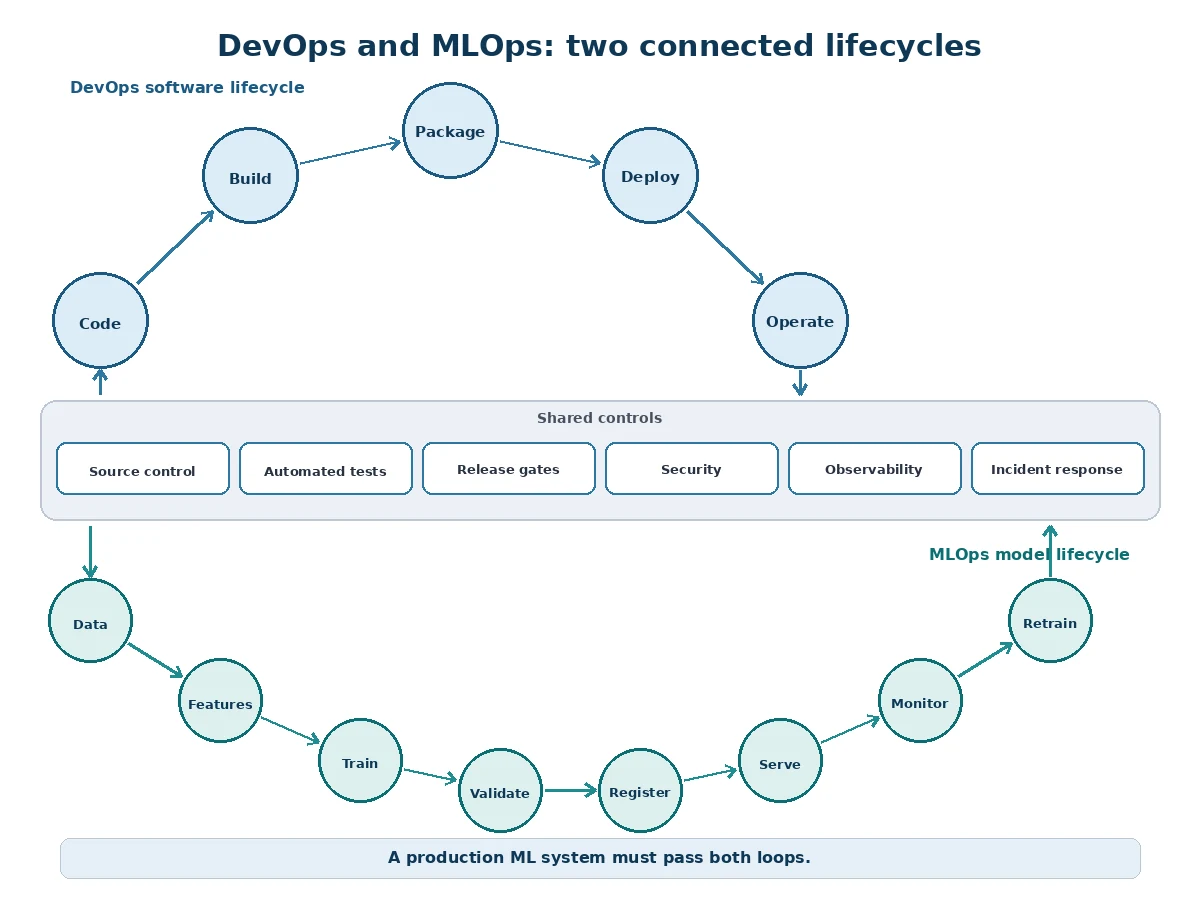
The difference between MLOps and DevOps is not that one replaces the other. DevOps improves how software is built, tested, released and operated. MLOps applies those disciplines to machine-learning systems and adds controls for data, features, experiments, training pipelines, model validation, registries, drift and retraining.
A prediction service still needs dependable application code and infrastructure. It also needs evidence that the model was trained on valid data, performs beyond a baseline, receives compatible features in production and remains useful as the environment changes. That second lifecycle is why ordinary continuous integration and deployment are necessary but not sufficient.
Key takeaways
- DevOps and MLOps share version control, automation, testing, deployment and observability.
- MLOps adds data and model artefacts, experimental reproducibility and statistical validation.
- CI tests more than code; CD can release pipelines and models; continuous training may create new model versions.
- Service health and model quality are different signals and need different owners.
- A team needs MLOps when model behaviour can change without an application-code defect.
What is DevOps?
DevOps is a collaborative approach to software development and operations built around shared responsibility, automation, continuous integration, continuous delivery, monitoring and feedback. The Microsoft DevOps overview describes it as the union of people, process and technology that enables continuous delivery of value.
In a conventional application, a source-code change triggers tests, a build creates a deployable artefact, and a controlled release moves it through environments. Teams monitor availability, errors, latency, capacity and security. A rollback normally restores a previous application version.
What is MLOps?
MLOps is the engineering and operating discipline for machine-learning systems. It retains the software pipeline but manages another set of changing artefacts: source data, labels, feature logic, training code, parameters, model binaries, evaluation results and production observations.
Google Cloud’s MLOps architecture guidance defines the practice as unifying ML system development and operations through automation and monitoring across integration, testing, releasing, deployment and infrastructure. It highlights that ML testing covers code, data schemas and models, and that production performance can deteriorate as data changes.
MLOps vs DevOps: the key differences
| Dimension | DevOps | MLOps | Operational implication |
|---|---|---|---|
| Primary product | Application or service | ML system, training pipeline and model service | More artefacts must move together |
| Source of behaviour | Mainly code and configuration | Code, data, features, objective and learned parameters | A code-stable model can still change after retraining |
| Development mode | Requirement-led implementation | Experimentation plus engineering | Runs, data and results need lineage |
| Testing | Unit, integration, security and acceptance tests | Those tests plus data, feature, model and segment validation | Passing code tests does not approve a model |
| Release unit | Built software artefact | Pipeline, preprocessing, model, schema and serving contract | Promotion gates need model evidence |
| Continuous process | CI and CD | CI, CD and conditional continuous training | New data may trigger a candidate model |
| Production monitoring | Availability, errors, latency, capacity | Those signals plus data quality, drift, calibration and outcomes | A healthy API can serve poor predictions |
| Rollback | Restore software version | Restore compatible model, code, feature and data contracts | Rollback must respect dependency lineage |
| Core collaboration | Developers, operations, security and product | Add data, ML, validation, risk and domain roles | Ownership spans two lifecycles |
How CI, CD and continuous training differ
Continuous integration
In DevOps, CI usually validates code and component integration. In MLOps, it also tests data schemas, feature calculations, training reproducibility, model interfaces and evaluation logic. A pipeline should fail before training if required fields disappear or preprocessing no longer matches its contract.
Model tests are statistical and contextual. They may require a candidate to exceed a baseline, remain within latency and size limits, perform acceptably across important segments and pass robustness or fairness checks. Tolerances must be defined before promotion.
Continuous delivery
DevOps CD moves a software artefact towards production through repeatable environments and approvals. MLOps may deliver the training pipeline, inference service, feature transformations and a validated model version. The model should be promoted through an accountable registry rather than copied from a notebook.
The MLflow Model Registry documentation illustrates registry capabilities such as versions, aliases, tags and traceable lifecycle management. The specific tool is optional; controlled identity and promotion are not.
Continuous training
Continuous training means that new data or another approved trigger can run a training pipeline and produce a candidate model. It should not mean that every new model automatically replaces production. Data validation, evaluation, comparison, approval and staged release still apply.
Triggers may be scheduled, based on new labelled data, linked to drift or started manually. Retraining without a clear problem can add cost and risk. Sometimes the correct response to deterioration is fixing a source, changing a feature, revising the decision process or suspending the model.
The EPW DUAL operating test
DUAL is an original EPW test for deciding whether a delivery design manages both the software and learning lifecycles.
- D — Defined contracts: APIs, schemas, features, outputs and service objectives are explicit.
- U — Unified lineage: code, data, pipeline, model, evaluation and deployment versions can be traced together.
- A — Approval on two axes: software reliability and model suitability each have evidence and owners.
- L — Live feedback: service signals, input changes and delayed outcome performance drive controlled responses.
A system fails DUAL if the platform team can prove that a container is healthy but nobody can identify its training data or current model quality. It also fails if a data scientist can reproduce a model score but the serving interface, capacity, recovery and security controls are undefined.
Worked example: deploying a demand forecast
Consider a weekly demand forecast used by planners. The prediction API and dashboard are software products; the forecast also depends on sales history, product hierarchy, promotions, preprocessing, a trained model and delayed evidence about actual demand.
| Change or event | DevOps control | Additional MLOps control | Release decision |
|---|---|---|---|
| API code change | Unit, integration, security and load tests | Model-interface compatibility test | Release if both pass |
| New source column | Application schema test | Data contract, feature logic and leakage review | Stop pipeline until approved |
| Retrained model | Package and serving tests | Back-test, segment results, calibration and baseline comparison | Register as candidate |
| Holiday pattern shift | Service remains available | Input drift and forecast-error investigation | Revise data or retrain deliberately |
| Production incident | Logs, alert, rollback and recovery | Identify affected predictions and restore compatible model-feature versions | Recover, document and review |
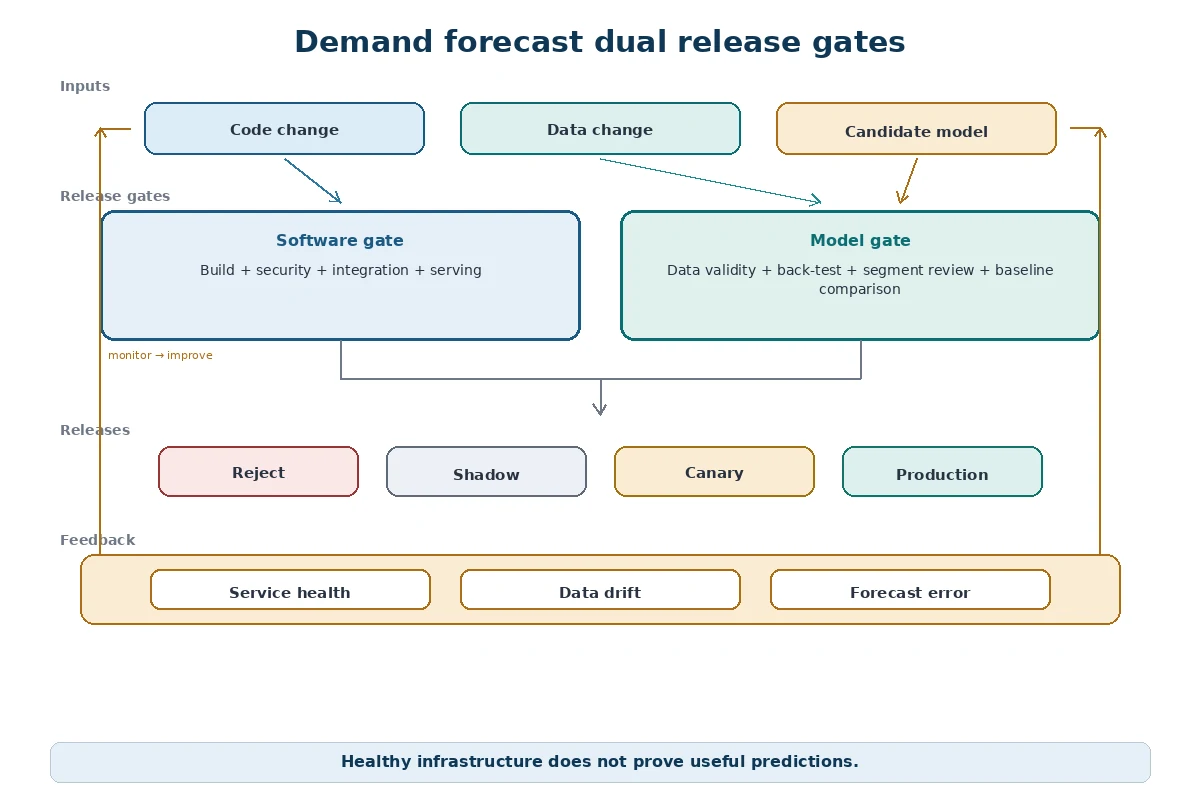
The example shows why ownership cannot end at deployment. Platform engineers may own service reliability, while data and ML teams investigate feature and model behaviour; planners define acceptable forecast error and business impact. Incident response must connect all three.
When DevOps practices are enough
Use conventional DevOps when the deployed component is deterministic software or when a fixed external model is consumed as a versioned dependency and the organisation does not train, validate or promote models. Even then, input and output monitoring may be needed for the surrounding application.
Add explicit MLOps controls when the organisation trains models, engineers production features, retrains from changing data, promotes candidates, relies on delayed outcome quality or must trace predictions to data and model versions. The need is driven by lifecycle risk, not by team size or a fashionable toolchain.
Common implementation mistakes
- Renaming CI/CD as MLOps: code automation alone does not validate data or models.
- Deploying only the model binary: preprocessing, schemas, features and dependencies form part of the release.
- Automating retraining too early: manual but controlled promotion is safer than an ungoverned automatic loop.
- Monitoring only the API: low latency and zero errors can coexist with useless predictions.
- Using drift as an automatic retraining command: drift is a diagnostic signal, not a root cause.
- Splitting responsibility at handover: production learning systems require shared ownership and feedback.
A practical adoption sequence
- Map the current system. List code, data, features, model, pipelines, environments, owners and decisions.
- Make one run reproducible. Version inputs, parameters, dependencies, artefacts and evaluation results.
- Define contracts. Set schemas, interfaces, prediction semantics and service objectives.
- Automate validation. Add code, data, feature, model and deployment tests with clear failure rules.
- Control promotion. Register candidates and use approval, shadow or canary stages before full traffic.
- Monitor two layers. Connect service health with data quality, drift, calibration and outcomes.
- Prepare recovery. Test rollback, feature fallback, incident ownership and audit evidence.
Maturity should follow operational need. A team with two stable low-risk batch models may not require a complex platform. It still needs reproducibility, validation, monitoring and accountable decisions. Automate the most frequent, risky and error-prone handoffs first.
Develop practical MLOps capability
EPW’s five-day MLOps and Machine Learning Model Deployment course covers production architecture, reproducibility, model packaging, inference services, containers, feature parity, CI/CD/continuous training, registries, staged releases, data and model monitoring, retraining, rollback, security, cost and lifecycle governance.
Professionals can also explore EPW’s Artificial Intelligence and Machine Learning Courses and the AI and machine learning article hub. To apply DUAL to a real deployment, review the course outline, available dates and locations, or request tailored course details.
Sources and references
- Google Cloud Architecture Center, MLOps: Continuous delivery and automation pipelines in machine learning, reviewed August 2024 and accessed 2 September 2026.
- Microsoft Learn, What is DevOps?, accessed 2 September 2026.
- MLflow, ML Model Registry, accessed 2 September 2026.
- National Institute of Standards and Technology, AI RMF Playbook, accessed 2 September 2026.
- EPW Training, MLOps and Machine Learning Model Deployment Course, accessed 2 September 2026.