

AI-generated illustration created to represent the article’s subject. It does not depict an actual EPW course, trainer, participant, client, event or venue.
To set up a PMO that supports project delivery, start with the delivery problems it must solve—not with templates, software or an organisational chart. Give the office a clear mandate, define a small service catalogue, establish proportionate decision rights, pilot the model and measure whether it improves decisions and outcomes. This eight-step method is designed for project sponsors, portfolio leaders and PMO practitioners.
A project management office can create clarity across a portfolio, but only when its authority, customers and evidence are explicit. The UK Government Functional Standard for Project Delivery treats governance as an integrated system of authority limits, decision roles, assurance, reporting and accountability. That is a useful design principle for any PMO: every control should help someone make or implement a better decision. Government Functional Standard GovS 002.
What you need before setting up a PMO
Secure three inputs before designing the office:
- An accountable sponsor: a senior leader able to define the PMO’s mandate, resolve boundary disputes and act on escalated information.
- Evidence of the delivery problem: examples such as late decisions, inconsistent status data, duplicated resources or unclear ownership.
- Access to delivery stakeholders: sponsors, project and programme managers, finance, risk, assurance and operational teams who will use or supply PMO services.
If these inputs are missing, pause the structural design. A PMO created without sponsorship or a defined problem often becomes a reporting function with little influence over delivery.
How to set up a PMO in eight steps
1. Diagnose the delivery problems
Interview a representative group of decision-makers and delivery teams. Review several current projects rather than relying on one difficult case. Look for recurring friction in selection, planning, dependencies, resources, risk, assurance, change control, benefits and reporting.
Turn complaints into testable problem statements. “Reporting is poor” is too vague. “The portfolio board receives different definitions of forecast completion, so it cannot compare projects or intervene early” identifies the user, the information defect and the decision affected.
2. Define the mandate, customers and boundaries
Write a one-page mandate that answers five questions: Why does the PMO exist? Whom does it serve? What decisions does it support? What authority does it have? What remains the responsibility of sponsors and delivery managers?
The UK Government’s project-delivery guidance distinguishes governance from day-to-day management and emphasises defined accountabilities, responsibilities and authority. A PMO can facilitate governance and provide evidence, but it should not quietly absorb the sponsor’s accountability for the business case or the project manager’s accountability for delivery. The Teal Book, Chapter 4.
3. Choose the operating model
Decide the PMO’s level and relationship to delivery. A project PMO may support one complex initiative; a programme PMO integrates connected projects; a portfolio or enterprise PMO supports investment decisions and organisation-wide standards. The correct choice follows the decisions and dependencies in scope, not the most impressive label.
Also decide where the office will sit, how it will be funded and whether specialists will be central, embedded or combined in a hub-and-spoke model. PMI’s guidance similarly frames the choice of PMO around organisational needs, intended value and the services required, rather than a single universal design. PMI: Which PMO Is Right for Your Organisation?.
4. Build a minimum service catalogue
Start with the smallest group of services that addresses the diagnosed problems. Describe each service as an outcome for a named customer, not as an internal activity.
| Service | Primary customer | Decision supported | Evidence of value |
|---|---|---|---|
| Portfolio intake and prioritisation | Investment or portfolio board | Start, defer or stop work | Comparable options and recorded decisions |
| Integrated planning and dependency control | Programme and project leaders | Sequence work and resolve conflicts | Visible dependencies, owners and dates |
| Performance reporting | Sponsors and governance boards | Intervene, tolerate or escalate | Timely, consistent forecasts and actions |
| Assurance coordination | Sponsor and accountable executive | Proceed through a decision gate | Independent findings and tracked responses |
| Methods and capability support | Delivery practitioners | Select proportionate controls | Adoption, competence and fewer avoidable defects |
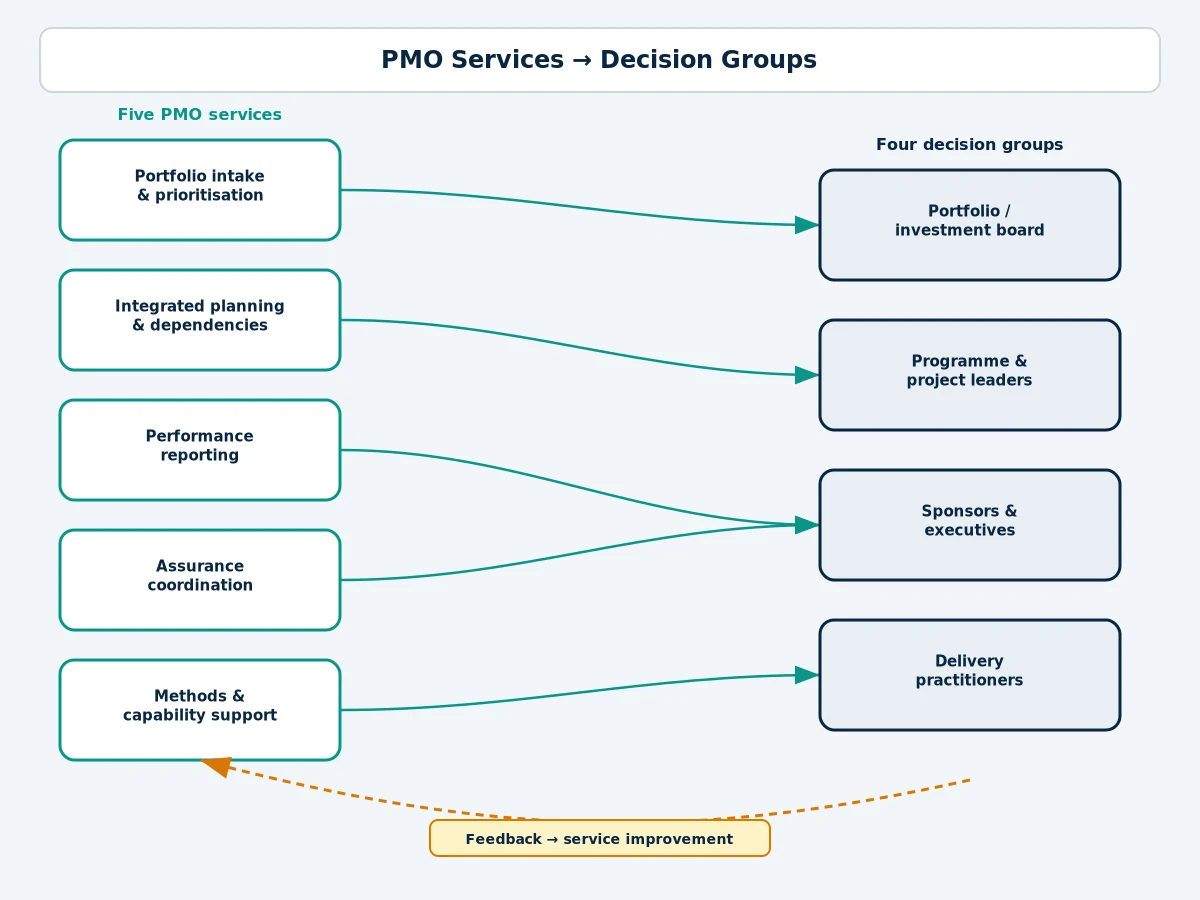
For teams that need stronger planning disciplines before centralising them, EPW’s Advanced Project Planning and Control Techniques course provides a relevant development route.
5. Map governance and decision rights
For every board, gate and escalation route, document the decision, accountable owner, required evidence, consultation roles and expected turnaround. Remove meetings that merely restate reports. Add clear thresholds for cost, schedule, scope, risk and benefit changes, while allowing projects to operate within agreed tolerances.
GovS 002 states that governance and management frameworks should include authority limits, decision-making roles and criteria, assurance needs, reporting structures and accountabilities. Use those elements as a completeness check, then tailor their formality to the portfolio’s risk and complexity. GovS 002 project-delivery standard.
6. Establish minimum data and control standards
Define a controlled minimum dataset: approved baseline, current forecast, milestones, dependencies, top risks and issues, decisions, changes, benefits and actions. Give each field an owner, definition, update rhythm and quality rule. Where possible, reuse source-system data rather than asking teams to retype it for a slide deck.
Reporting should communicate what decision is required, not just display traffic-light colours. EPW’s Project Communication and Reporting Techniques course is a relevant option for practitioners who need to strengthen this connection between evidence and stakeholder action.
7. Staff and pilot the PMO
Match roles to the service catalogue. A new office may need portfolio analysis, planning, risk and assurance coordination, information management, facilitation and capability development; it does not necessarily need a separate person for every discipline.
Pilot the model with a representative group of projects for a defined review period. Train participants, agree service-level expectations and record what the PMO will deliberately not do. The UK Government’s PMO Manager role profile describes the role as enabling effective decision-making through controls, reporting, assurance and specialist support—useful confirmation that PMO capability is broader than administration. Government Project Delivery Profession: PMO Manager.
8. Measure value, learn and scale
Measure the result of each service, not the volume of paperwork. Suitable indicators might include decision turnaround, forecast accuracy, unresolved cross-project dependencies, action closure, stakeholder confidence in data and adoption of proportionate standards. Establish the baseline before the pilot, inspect unintended effects and use several measures together.
Then retain, change or retire services based on evidence. PMI’s roadmap for PMO excellence likewise emphasises alignment with organisational strategy, an explicit value proposition and continued development rather than treating PMO launch as the finish line. PMI: Roadmap to PMO Excellence.
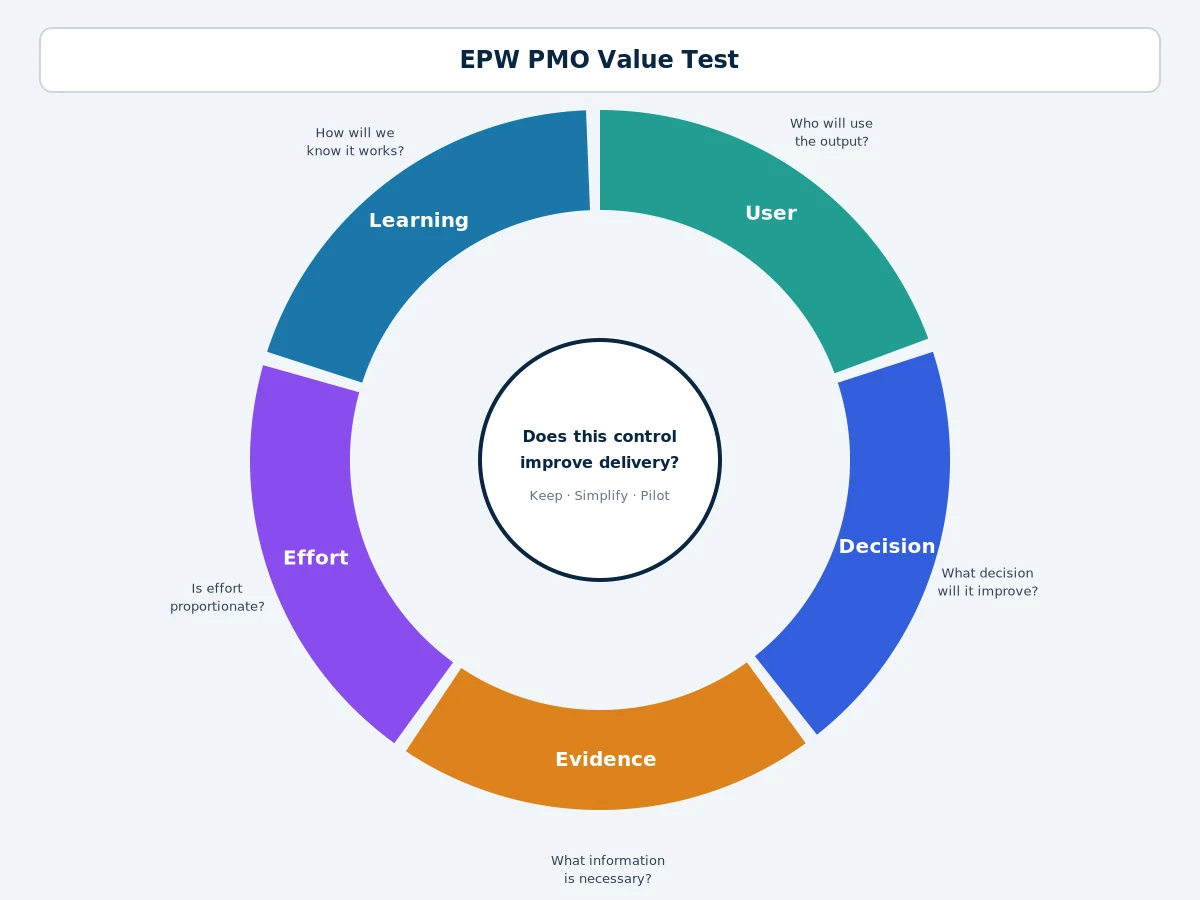
The EPW PMO Value Test
Before introducing any PMO requirement, apply this five-question decision rule:
- User: Who will use the output?
- Decision: What decision or action will it improve?
- Evidence: What information is genuinely necessary?
- Effort: Is the burden proportionate to the delivery risk?
- Learning: How will we know whether the requirement works?
If the team cannot answer the first two questions, do not make the requirement mandatory. If the evidence or effort is disproportionate, simplify it. If no learning measure exists, make it a time-limited experiment. This test helps prevent a PMO from accumulating controls whose original purpose has disappeared.
Common PMO setup errors and corrections
- Starting with tools: define decisions, information and users before configuring software.
- Copying another organisation’s PMO: use external models as prompts, then design for your own governance and risks.
- Equating compliance with value: track whether controls improve decisions and outcomes as well as whether teams follow them.
- Centralising every decision: set tolerances so routine delivery remains with the appropriate manager.
- Producing reports without action: give every exception an owner, decision route and due date.
- Scaling before learning: pilot services and correct the operating model before organisation-wide rollout.
Where the challenge spans several programmes, EPW’s Managing Multiple Projects and Portfolios Successfully course may also help leaders connect prioritisation, capacity and portfolio-level control.
PMO setup completion checklist
- The sponsor and purpose are documented.
- Priority delivery problems are supported by evidence.
- Customers, boundaries and decision rights are clear.
- Each service has an owner, consumer, output and value measure.
- Governance forums make defined decisions using defined evidence.
- Data definitions, sources and quality controls are agreed.
- Roles and capabilities match the service catalogue.
- A representative pilot and review date are agreed.
- Feedback can change or retire low-value requirements.
Set up the PMO around delivery value
A successful PMO is not the largest office or the one with the most templates. It is the one that helps the organisation make timely, informed and accountable delivery decisions. Diagnose the problem, establish the mandate, launch only necessary services, pilot them and use evidence to evolve the model.
For broader foundations before implementing the office, explore EPW’s Project Management Fundamentals and Best Practices course or browse the full Project Management Training Courses category.
Ready to design a PMO that supports accountable delivery? Explore EPW’s PMO Setup and Project Governance Frameworks course, review the available options or enquire about tailored in-house training.
Sources and References
- UK Government Project Delivery. Government Functional Standard GovS 002: Project Delivery.
- UK Government Project Delivery. The Teal Book, Chapter 4: Governance and Management.
- Project Management Institute. Which PMO Is Right for Your Organisation?.
- UK Government Project Delivery Profession. Project Management Office (PMO) Manager.
- Project Management Institute. Roadmap to PMO Excellence.