

AI-generated illustration created to represent the article’s subject. It does not depict an actual EPW course, trainer, participant, client, event or venue.
Succession planning tools help organisations identify critical roles, evaluate possible successors, build readiness and monitor leadership-pipeline risk. The most useful toolkit does more than place names on an organisation chart. It combines role analysis, transparent assessment, development planning and regular governance, so leaders can see where continuity is strong and where action is needed.
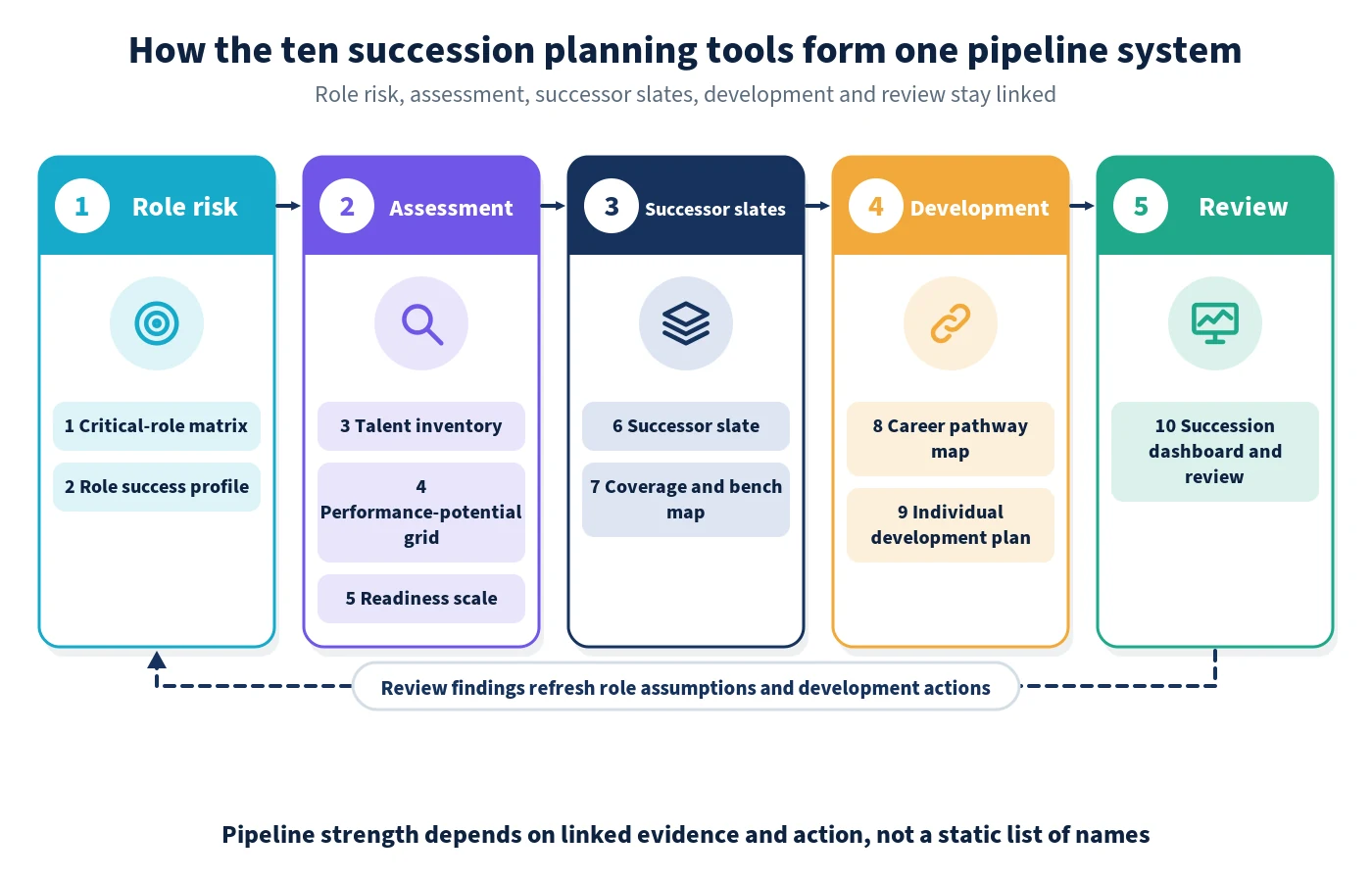
This article explains ten practical tools for leadership pipelines. They can be used separately, but they work best as a connected system: define the roles that matter, assess evidence consistently, develop people through real experience and review outcomes over time.
Succession planning tools at a glance
| Tool | Main question answered | Primary output |
|---|---|---|
| 1. Critical-role matrix | Where would a vacancy create the greatest risk? | Prioritised role portfolio |
| 2. Role success profile | What will future success require? | Evidence-based criteria |
| 3. Talent inventory | Which capabilities and aspirations exist now? | Searchable talent picture |
| 4. Performance-potential grid | Where should development attention begin? | Discussion map |
| 5. Readiness scale | How prepared is each possible successor? | Defined readiness levels |
| 6. Successor slate | Who could cover a specific role? | Diverse candidate slate |
| 7. Coverage and bench map | Where are pipeline gaps concentrated? | Portfolio risk view |
| 8. Career pathway map | Which experiences can lead towards key roles? | Multiple development routes |
| 9. Individual development plan | What will build readiness? | Owned development actions |
| 10. Succession dashboard and review | Is the system becoming stronger? | Governance rhythm and measures |
The CIPD succession planning factsheet, updated 5 December 2025, defines succession planning around identifying and growing talent for leadership and business-critical positions. It also notes the shift from narrow, confidential schemes towards broader, more open approaches connected to talent management.
1. Critical-role matrix
A critical-role matrix helps an organisation decide which positions deserve succession attention. Score each role against a small number of factors: impact of vacancy, scarcity of required capability, time to competence, concentration of knowledge and availability of temporary cover. Use ranges and supporting evidence rather than pretending that every factor can be measured precisely.
The result is a portfolio, not a ranking of people. A specialist technical role may be more critical than a senior management post. Review the matrix when strategy, technology, regulation or the operating model changes.
2. Role success profile
A conventional job description explains current duties; a success profile describes the outcomes, capabilities, behaviours and experiences likely to matter in the future. Build it with input from role holders, managers, customers and technical experts. Separate genuine requirements from habits inherited from the previous incumbent.
Keep the profile concise enough to assess. If it contains dozens of competencies, panels will select evidence inconsistently. EPW’s Performance Management Systems and Appraisal Methods course provides useful context for defining objectives, reviewing evidence and giving feedback fairly.
3. Talent inventory
A talent inventory records relevant skills, experience, mobility preferences, career interests and development history. It helps leaders look beyond the people they already know. Data should be current, proportionate and handled under applicable privacy and employment requirements.
Allow employees to validate important profile information. A qualification recorded years ago does not prove current competence, while valuable experience may never have entered the HR system. The inventory is a discovery aid, not an automatic succession decision.
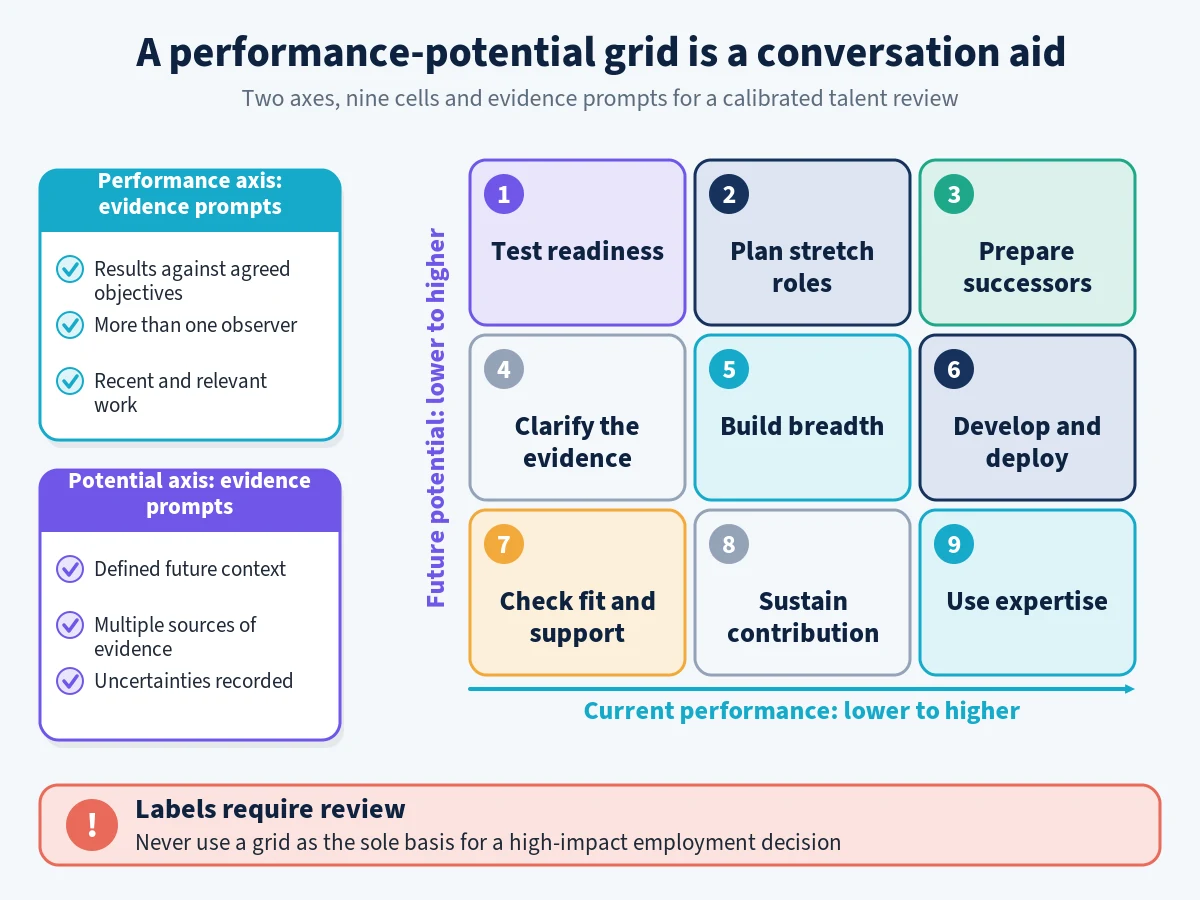
4. Performance-potential grid
A performance-potential grid, often presented as nine boxes, can structure a talent review by separating current contribution from future potential. Its value lies in disciplined discussion, not in the label assigned to a person.
Define both axes before the meeting. Use multiple sources of evidence, record uncertainties and challenge ratings across teams. Potential must relate to a specified future context; it is not a permanent personal trait. Never use a grid as the sole basis for high-impact employment decisions.
5. Readiness scale
A readiness scale creates shared language about preparation. Useful categories might be:
- Emergency cover: can maintain essential continuity for a short period.
- Ready now: can assume the role with normal transition support.
- Ready with targeted development: has defined gaps that can reasonably be closed.
- Longer-term prospect: needs broader experience before the role is realistic.
Avoid attaching fixed years to every level. Readiness depends on the role, the person, the operating context and the quality of evidence. State the assumptions and the development needed to move between levels.
6. Successor slate
A successor slate brings together credible candidates for a particular role or role family. Include evidence against the success profile, readiness, development needs, aspirations and material constraints. Where appropriate and lawful, review the diversity of the slate and ask whether informal networks have limited who was considered.
Keep internal and external options visible. CIPD notes that external appointments can bring new ideas, while internal successors may hold valuable organisation-specific knowledge. A slate should support a reasoned choice, not guarantee a promotion.
7. Coverage and bench-strength map
A coverage map aggregates individual slates into a portfolio view. For each critical role, show the number of credible candidates by readiness category, single points of failure and any shared dependency on the same person. This reveals false confidence: five roles may each appear covered while relying on one successor.
The ISO human-resource measurement series includes succession effectiveness, successor coverage and succession readiness among the measures described for succession planning. Organisations should define calculations consistently and interpret them with context rather than treating a percentage as a complete answer.
8. Career pathway map
A career pathway map shows experiences that can build readiness for a role family. Include lateral moves, project leadership, secondments, deputy assignments, technical depth and people-management routes. This avoids presenting promotion as the only form of progress.
Publish pathways at an appropriate level so employees can see possible routes and capability expectations. The CIPD talent management factsheet, updated 26 November 2025, identifies development, engagement, retention and deployment as connected parts of the talent-management loop.
9. Individual development plan
An individual development plan converts a pipeline discussion into action. For each priority gap, specify the experience or support required, the owner, the expected evidence and a review date. Use work-based development where possible: coaching, a stretch assignment, project responsibility, mentoring or a planned secondment.
Do not promise a future position. The plan should be valuable to the employee even if organisational needs change. EPW’s Coaching and Development for HR Professionals course explores how structured conversations can support capability and career growth.
10. Succession dashboard and review cadence
A dashboard should direct attention, not reward attractive reporting. A concise view might include critical-role coverage, readiness distribution, overdue development actions, movement between readiness levels, internal appointments and reasons that named successors withdrew or were not selected.
Combine the dashboard with a regular review involving senior leaders, HR and relevant managers. Challenge evidence, refresh role assumptions and follow up development commitments. Analyse patterns across relevant workforce groups where lawful and appropriate. EPW’s Human Capital Analytics and HR Metrics course supports the wider capability to interpret workforce measures responsibly.
How the tools work together: an example
Consider a hypothetical regional operations function. Its critical-role matrix identifies a plant leadership role with high continuity risk. A future-focused success profile highlights operational judgement, safety leadership and cross-functional influence. The talent inventory surfaces three possible successors, including one outside the current manager’s network.
A calibrated review uses the grid and readiness scale to identify different gaps. The successor slate records all three candidates, while the coverage map reveals that one candidate is also named for another critical position. Career pathways and individual plans then allocate a deputy assignment, a cross-site project and coaching. At the next review, leaders evaluate evidence from those experiences and revise readiness. No promotion is promised; the system builds options.
Selection rules for a credible toolkit
- Start with business-critical roles, not hierarchy alone.
- Define every criterion and rating before assessing people.
- Use evidence from more than one manager or event.
- Record aspirations; capability does not equal willingness.
- Challenge bias, opacity and talent hoarding.
- Connect every identified gap to an owned development action.
- Review the system when strategy or role requirements change.
For a wider view of inclusive assessment and progression, the Workforce Diversity, Equity and Inclusion Practices course is a useful related development route.
Build a stronger leadership pipeline
The right succession planning tools make risk, evidence and development visible. They help an organisation move from informal nominations towards a repeatable process that can be explained, challenged and improved. Technology may hold the data, but governance and high-quality conversations create the value.
To practise critical-role analysis, talent-pipeline design, potential assessment, career pathing and implementation, explore EPW’s Succession Planning and Career Pathing Models course. Browse the complete Human Resources Training Courses portfolio for related programmes.
Sources and References
- CIPD. Succession planning. Updated 5 December 2025.
- CIPD. Talent management. Updated 26 November 2025.
- International Organization for Standardization. People power. 12 July 2021.
- EPW. Succession Planning and Career Pathing Models course. Accessed 12 September 2026.