

AI-generated illustration created to represent the article’s subject. It does not depict an actual EPW course, trainer, participant, client, event or venue.
Strategic human resource management (HRM) differs from traditional HRM mainly in its starting point, time horizon and integration with business decisions. Traditional HRM usually focuses on reliable employment administration and current workforce processes. Strategic HRM starts with organisational direction and asks which workforce capabilities, capacity and people practices will be needed to deliver it. Effective organisations need both.
The distinction is useful for executives, HR leaders and line managers deciding how the people function should contribute. It should not become a false choice between “old” and “modern” HR. Payroll accuracy, employee records, policy administration and compliance remain necessary. Strategic HRM builds on that operational foundation and connects it with longer-term choices about work, skills, structure, culture and investment.
Strategic HRM vs traditional HRM at a glance
| Comparison criterion | Traditional HRM orientation | Strategic HRM orientation |
|---|---|---|
| Starting question | How should the current HR process be administered? | What people and organisational capabilities will the strategy require? |
| Time horizon | Current and near-term workforce needs | Current decisions considered across medium- and long-term scenarios |
| Primary focus | Consistency, service delivery, policy and compliance | Alignment, capability, organisational performance and sustainable value |
| Ownership | Often centred in the HR function | Shared by senior leaders, line managers, HR and other functions |
| Planning | Responds to vacancies, cases and scheduled HR cycles | Anticipates workforce demand, supply, risks and alternative responses |
| People practices | Managed as separate processes or specialist services | Designed as a coherent system supporting common priorities |
| Measures | Activity, completion, accuracy, cost and compliance | Implementation, workforce, operational and organisational outcomes |
| Role of evidence | Reports what has happened in HR processes | Combines workforce data, external evidence and stakeholder judgement to guide choices |
| Response to change | Adjusts policies and processes after a need becomes clear | Tests scenarios and prepares capability before or during strategic change |
This table describes two orientations, not two rigid organisational models. A small HR team may move between operational and strategic work during the same day. The important question is whether urgent administration consumes all available attention or whether leaders also make deliberate workforce choices.
What does “traditional HRM” mean in this comparison?
Traditional HRM is not one formally defined system. In this article, it is shorthand for an HR orientation centred on administering employment processes: maintaining records, recruitment transactions, contracts, attendance, employee cases, policies, pay inputs, benefits and compliance. These services protect employees and the organisation when they are accurate, accessible and fairly applied.
The limitation appears when administration becomes the whole operating model. HR then reacts to vacancies, turnover, disputes or skill shortages after the impact is visible. Specialist activities may each function properly while sending conflicting signals. For example, recruitment may select for collaboration while performance and reward remain narrowly individual.
What makes HRM strategic?
The CIPD strategic HRM factsheet, updated on 25 August 2025, defines strategic HRM as a coherent framework that links how people are hired, managed and developed with long-term organisational goals. It also stresses that there is no single HR strategy that suits every organisation; context, culture and objectives matter.
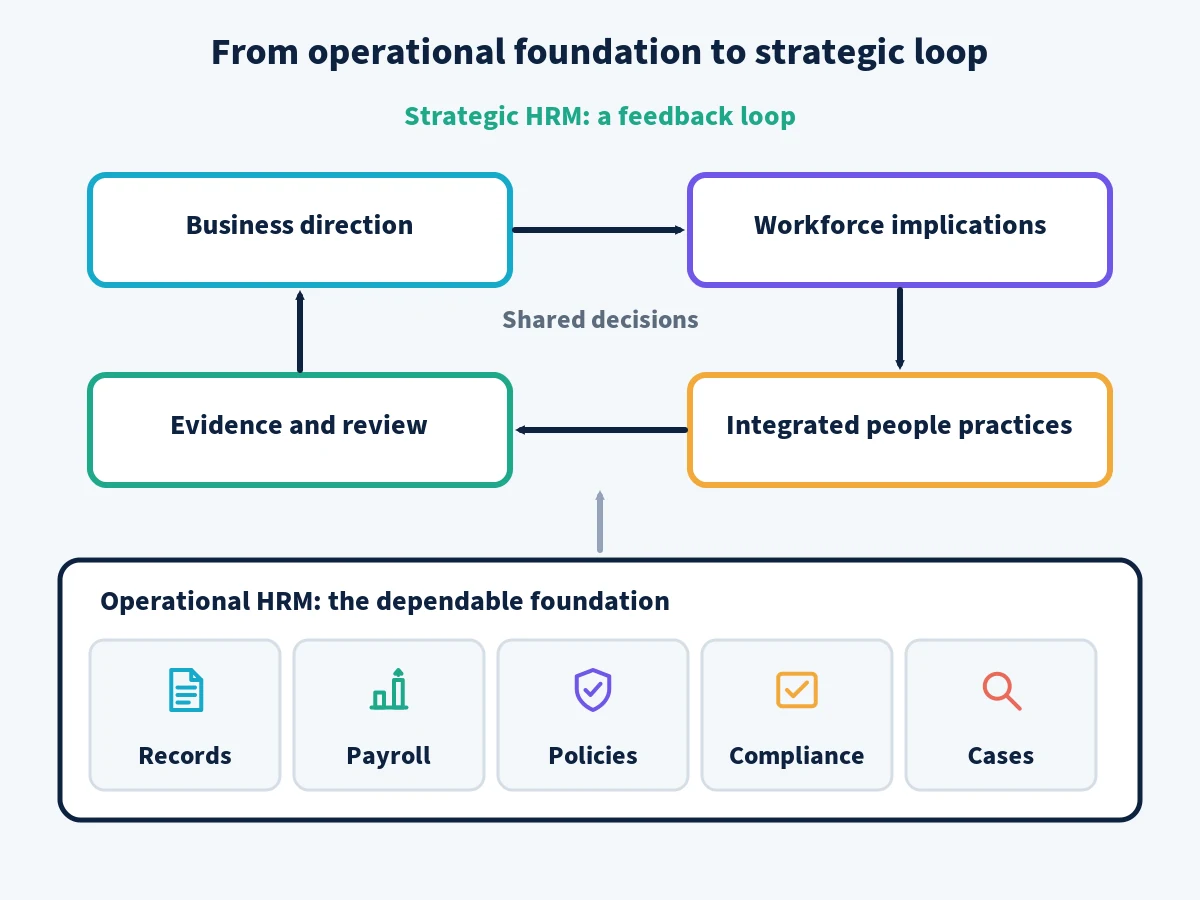
Strategic HRM therefore does more than attach the word “strategic” to an existing activity. It changes the decision logic. Leaders clarify the outcomes and constraints that matter, diagnose workforce implications, choose mutually reinforcing people practices, assign shared ownership and review evidence. Business strategy informs people strategy, but people capability and workforce risk should also shape what the business considers feasible.
Seven material differences
1. Process demand vs organisational direction
Traditional HRM commonly begins with a process trigger: a requisition, contract change, employee case, review cycle or policy requirement. Strategic HRM begins with organisational direction, such as growth, digital transformation, service redesign, cost pressure or a change in operating model. It translates that direction into questions about capacity, skills, roles, leadership and employee experience.
2. Reactive staffing vs workforce scenarios
An operational approach fills approved vacancies and manages immediate staffing demand. A strategic approach also examines future demand, internal supply, critical roles, alternative work designs and uncertainty. The CIPD workforce planning factsheet describes workforce planning as balancing skills supply with demand and linking the result to organisational goals.
Forecasting does not remove uncertainty. Its purpose is to make assumptions visible and identify decisions that need lead time. The response may include recruitment, reskilling, redeployment, succession, job redesign, technology or partnership, rather than recruitment alone.
3. HR ownership vs shared accountability
Traditional models can position HR as the owner and line managers as customers of a service. Strategic HRM treats workforce outcomes as a leadership responsibility supported by HR expertise. Finance contributes resource assumptions, operations clarifies work demand, technology explains automation and system constraints, and employees provide evidence about how work is experienced.
Shared ownership must still be explicit. EPW’s analysis of HR business partner operating models shows why structure, decision rights and stakeholder relationships should fit the organisation rather than follow a fashionable label.
4. Separate programmes vs coherent people practices
Operational excellence can exist inside individual HR processes while the overall employee experience remains inconsistent. Strategic HRM tests whether workforce planning, recruitment, job design, performance, learning, reward, employee voice and change support the same priorities.
Coherence does not mean uniformity. Different workforce groups may need different practices. It means that variation is intentional, explainable and connected to the result the organisation needs.
5. Activity reporting vs decision evidence
Traditional reporting often focuses on transactions: cases processed, time to hire, course attendance or appraisal completion. Those measures help manage service delivery. Strategic HRM extends the chain to ask whether the practice changed workforce capability or experience, whether relevant operations improved and whether the organisational priority advanced without unacceptable cost or harm.
The CIPD people analytics factsheet presents people analytics as using people data to solve business problems. Strategic measurement therefore begins with a decision question, not with the measures already available in the HR system.
6. Standard cycles vs adaptive review
Traditional HR work often follows fixed annual cycles for budgets, reviews, reward and learning. Strategic HRM preserves necessary governance but revisits assumptions when demand, regulation, technology, labour markets or operating conditions change. Review frequency should follow decision risk and volatility rather than habit.
7. HR outcomes vs sustainable organisational value
Operational HR aims for accurate, timely and compliant services. Strategic HRM also asks how people practices contribute to customer, service, safety, innovation, financial or public-value outcomes. This contribution is indirect and should not be overstated. Organisational performance is influenced by many factors beyond HR.
EPW’s article on why strategic HRM matters for organisational performance explains the pathway through workforce capability, motivation, opportunity, retention and operating processes. It also addresses wellbeing, fairness and risk as conditions of sustainable performance.
What strategic and traditional HRM have in common
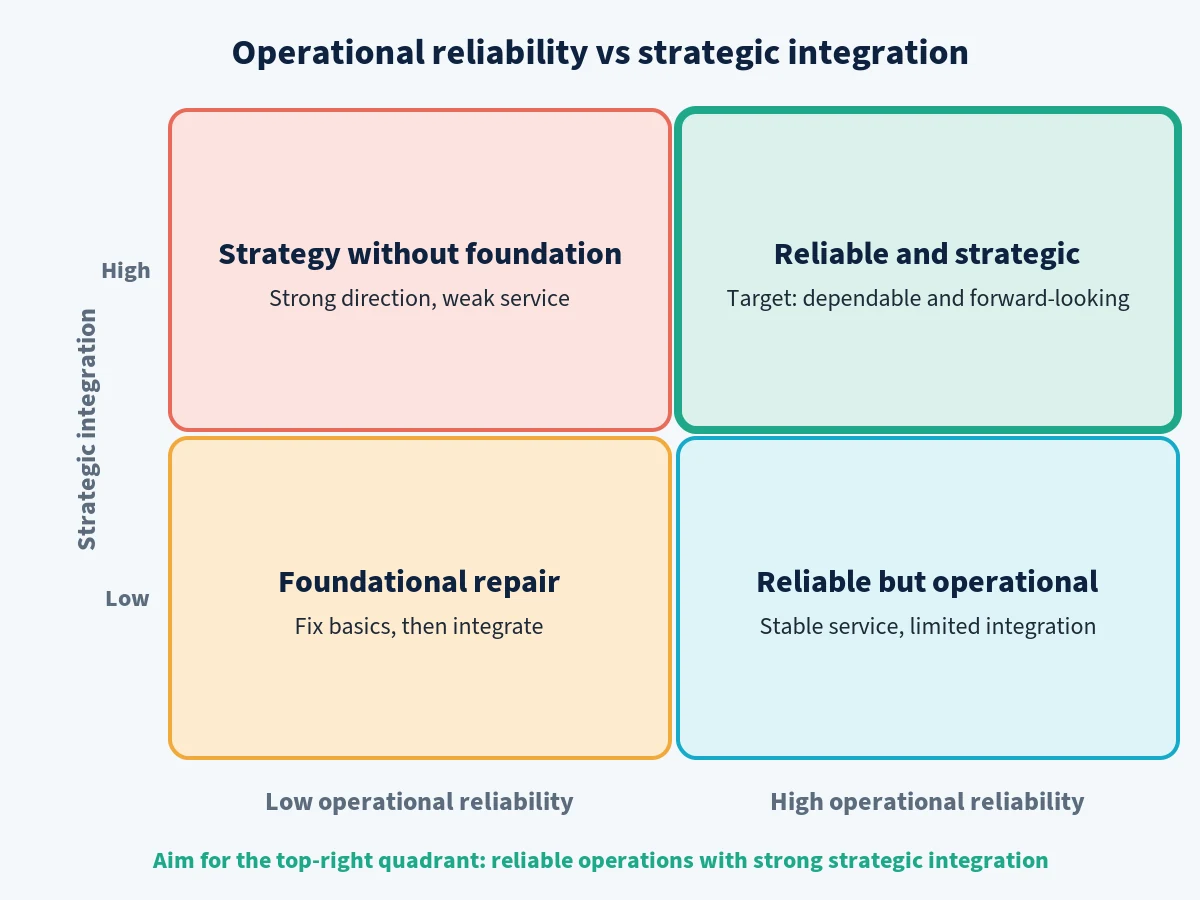
Both orientations deal with the employment relationship and need accurate information, professional judgement, clear policies, competent managers and fair implementation. Both must respect applicable law and organisational governance. Strategic ambition does not excuse weak administration, while reliable administration does not automatically create strategic value.
The strongest operating model treats operational HR as infrastructure. Accurate records, dependable pay inputs, consistent case handling and accessible services create the trust and data quality required for higher-level analysis and change. Strategy fails quickly when basic commitments to employees are not met.
When each orientation is useful
| Situation | Immediate requirement | Strategic extension |
|---|---|---|
| Payroll or contract error | Correct the record and employee impact promptly | Identify control, system or capability causes and prevent recurrence |
| Urgent vacancy | Run a fair, efficient recruitment process | Test whether the role, skills and sourcing choice fit future demand |
| New technology | Update roles, policies and training | Model work redesign, capability shifts, transition risks and employee voice |
| High turnover in a critical team | Stabilise workload and recruitment | Examine job design, leadership, reward, career paths and workforce alternatives |
| Annual appraisal cycle | Complete fair reviews and documentation | Connect goals, feedback, capability and recognition with strategic priorities |
The table shows why organisations should not abandon operational HR. They should extend each recurring process with the strategic questions that influence future capacity, risk and value.
Worked example: expanding a digital service
Assume an organisation plans to introduce a digital customer service channel within 18 months. A traditional HR response begins after roles are approved: write job descriptions, recruit staff, update policies and arrange training.
A strategic HRM response begins earlier. HR and business leaders estimate future demand, identify tasks that will change, assess current capability, examine redeployment options and test alternative operating models. They consider which leaders must manage hybrid workflows, how performance measures may change, which employee groups face transition risk and how experience will be monitored.
The strategic response still needs recruitment, contracts, policies and training. The difference is that those activities form one coordinated response to a defined business change. EPW’s published ADDIE model article offers a useful method for ensuring that any training component starts with the required job performance and workplace conditions.
A five-question decision test
Leaders can use the following EPW decision test to judge whether an HR initiative is merely well administered or genuinely strategic:
- Direction: Which organisational priority, risk or constraint makes this work necessary?
- Workforce implication: What must change in capacity, capability, roles, leadership, culture or employee experience?
- Coherence: Which connected people practices must reinforce one another?
- Ownership: Which decisions belong to executives, line leaders, HR specialists and employees?
- Evidence: What implementation, workforce and operational evidence will support continuation, adaptation or stopping?
If the team cannot answer the first or second question, the initiative may be an HR activity without a strategic rationale. If it cannot answer the fourth or fifth, the strategy is unlikely to translate into accountable execution and learning.
How to move from operational HRM to strategic HRM
- Protect the foundation. Stabilise high-impact services, data quality, employee access and compliance controls.
- Select one business priority. Avoid launching an abstract transformation programme disconnected from a real decision.
- Diagnose workforce implications. Analyse work, capacity, skills, structure, leadership, culture and employee effects.
- Build a coherent response. Choose only the people practices needed and make dependencies explicit.
- Clarify governance. Assign sponsors, decision owners, delivery roles and employee-input routes.
- Create an evidence chain. Separate activity measures from workforce, operational and organisational outcomes.
- Review assumptions. Adapt the response when strategy, evidence or operating conditions change.
Soft CTA: Teams developing this capability can compare the decision test with EPW’s Strategic Human Resource Management for Modern Organizations course. The outline connects business alignment, HR technology, change and people analytics across a five-day programme.
Conclusion
Traditional HRM and strategic HRM differ in orientation, not in whether ordinary HR work matters. Traditional HRM provides the operational discipline needed to manage current employment processes. Strategic HRM adds a forward-looking framework that connects organisational direction with workforce choices, integrates people practices, shares accountability and evaluates outcomes. Mature HR functions combine dependable service with strategic judgement.
Ready to connect people decisions with organisational direction? Explore EPW’s Strategic Human Resource Management for Modern Organizations course and the wider Human Resources Training Courses portfolio to review relevant dates, locations and development options.
Sources and References
- Chartered Institute of Personnel and Development. Strategic human resource management. Updated 25 August 2025.
- Chartered Institute of Personnel and Development. Workforce planning. Updated 29 July 2025.
- Chartered Institute of Personnel and Development. People analytics. Accessed 21 September 2026.
- EPW Training. Strategic Human Resource Management for Modern Organizations Course. Accessed 21 September 2026.