

AI-generated illustration created to represent the article’s subject. It does not depict an actual EPW course, trainer, participant, client, event or venue.
Strategic thinking and strategic planning are related but different. Strategic thinking explores how the energy environment could change, challenges assumptions and creates choices. Strategic planning selects a direction and converts it into objectives, initiatives, resources, milestones and measures. Energy leaders need both: thinking without planning produces interesting ideas without delivery, while planning without thinking can execute yesterday’s assumptions efficiently.
The distinction matters because energy decisions combine long-lived assets, uncertain prices, regulation, technology, safety, infrastructure and stakeholder expectations. A strong leadership process keeps inquiry and commitment separate long enough to improve the choice, then connects them through disciplined execution and learning.
Key takeaways
- Strategic thinking is divergent and exploratory; strategic planning is convergent and delivery-oriented.
- Thinking asks what may change and which choices create advantage; planning asks who will do what, with which resources and by when.
- Scenario analysis is not a forecast. It tests whether a decision remains credible under different conditions.
- Energy organisations should define decision triggers instead of treating one plan as permanently correct.
- Governance should protect challenge during option development and demand accountability after commitment.
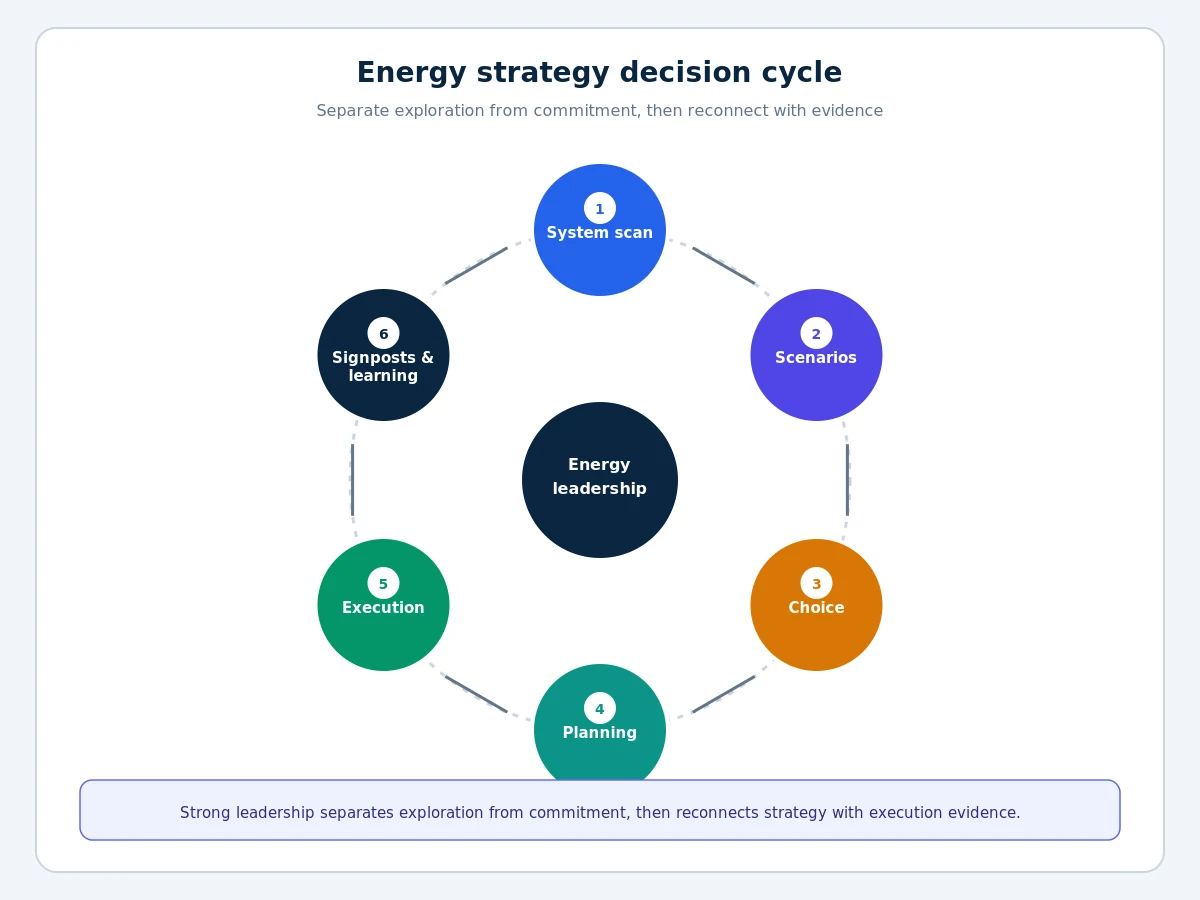
- A recurring think–choose–plan–execute–learn cycle is more resilient than an annual planning event.
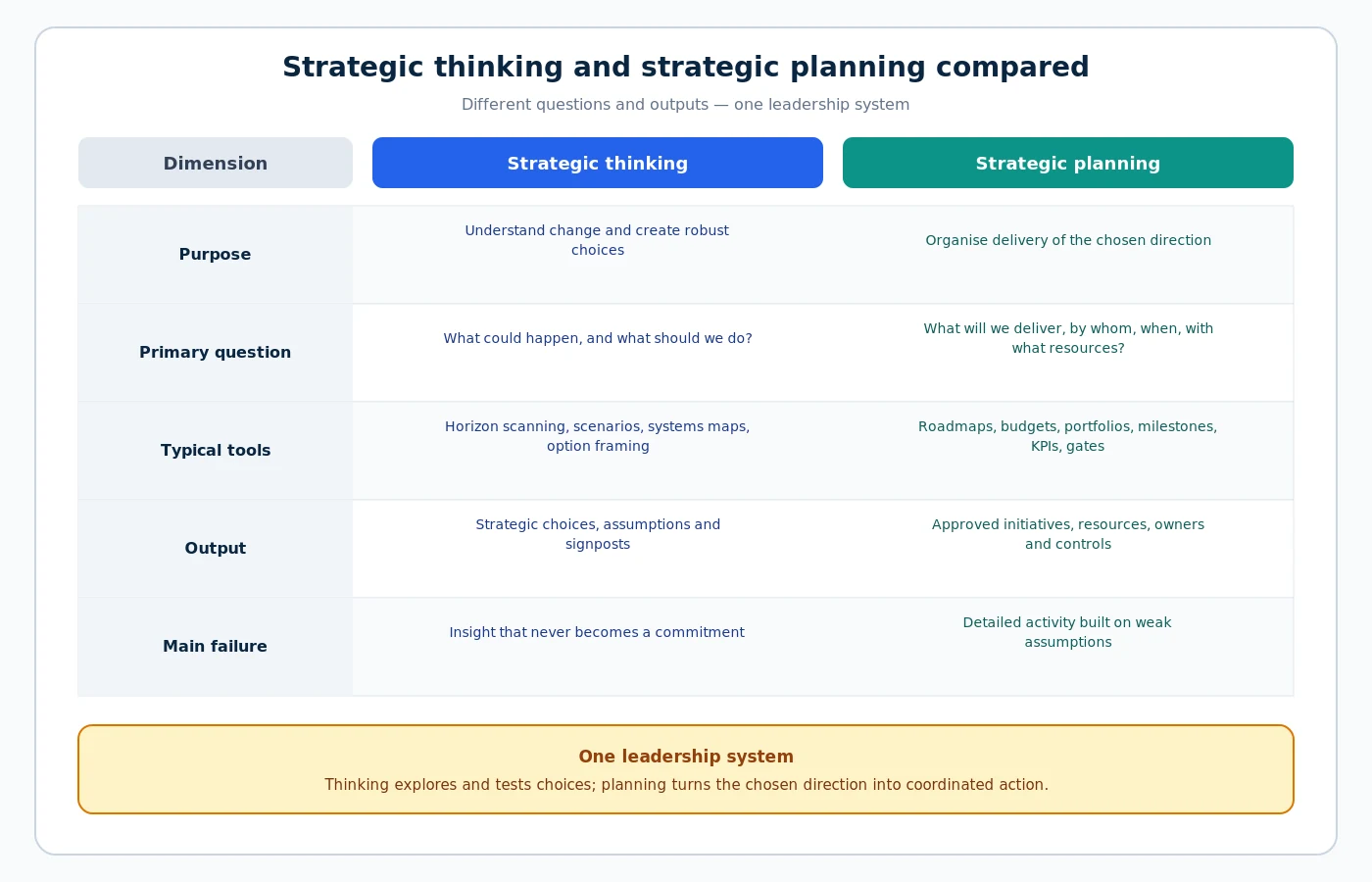
Strategic thinking vs strategic planning: the core differences
| Dimension | Strategic thinking | Strategic planning |
|---|---|---|
| Purpose | Understand change and create robust choices | Organise delivery of the chosen direction |
| Primary question | What could happen, and what should we do about it? | What will we deliver, by whom, when and with what resources? |
| Orientation | Outside-in and future-facing | Inside-out and execution-focused |
| Thinking mode | Exploratory, integrative and challenging | Sequenced, analytical and accountable |
| Typical tools | Horizon scanning, scenarios, systems maps and option framing | Roadmaps, budgets, portfolios, milestones, KPIs and governance gates |
| Output | Strategic choices, assumptions and signposts | Approved initiatives, resources, owners and controls |
| Main failure | Insight that never becomes a commitment | Detailed activity built on weak assumptions |
What strategic thinking means in energy
Strategic thinking is the disciplined examination of the organisation’s environment, purpose, capabilities and alternatives. It looks beyond the current operating plan. Leaders ask which forces could change demand, supply, economics or permission to operate; which assumptions matter most; where the organisation has a distinctive capability; and which choices remain valuable across several plausible futures.
Energy systems are exposed to interacting uncertainties. The International Energy Agency’s World Energy Outlook 2025 executive summary illustrates how energy security, affordability, investment, technology and emissions influence outlooks. The point for a leadership team is not to copy one forecast. It is to understand the drivers behind different outcomes and test decisions against them.
Strategic thinking therefore produces a point of view, not a large spreadsheet. Its evidence may include market structure, customer behaviour, regulation, asset performance, competitor moves, technology maturity, workforce capability and political or physical risk. EPW’s Energy Pricing Markets and Regulatory Frameworks course supports the market and regulatory side of that assessment.
What strategic planning means in energy
Strategic planning translates a selected direction into a coherent set of commitments. It defines objectives, investment priorities, operating initiatives, capabilities, dependencies, budgets, milestones, measures and decision rights. It should show not only what the organisation will do, but what it will stop, defer or decline.
A useful plan connects portfolio logic with execution. For example, a reliability strategy may require inspection changes, critical-spares policy, data quality, contractor capacity, shutdown windows and competence development. Each workstream needs an owner and evidence of progress. EPW’s Cost Estimation and Budgeting for Oil and Gas Projects course addresses the financial discipline that supports credible commitments.
Why energy leaders sometimes confuse them
Both activities use analysis, workshops and senior attention, so organisations often combine them into an annual planning cycle. Budget pressure then pulls discussion towards near-term numbers before the team has tested the strategic assumptions. The result may be a detailed plan that optimises the existing portfolio without asking whether the portfolio is still appropriate.
The opposite failure also occurs. Leaders may hold future-focused discussions about transition, digitalisation or new markets but avoid choices, trade-offs and resource commitments. Calling this “strategy” does not make it executable. A decision is strategic when it allocates scarce attention or capital and closes alternatives, at least provisionally.
When strategic thinking should dominate
Give greater space to strategic thinking when:
- the organisation faces a structural change in regulation, demand or technology;
- a major investment creates long-lived exposure or limits future options;
- market signals conflict or a single forecast would be unreliable;
- the current business model depends on a narrow assumption;
- leaders are choosing between capabilities, partnerships or operating models;
- performance remains weak despite repeated execution improvements.
The NGFS Scenarios Portal demonstrates how scenarios can combine alternative transition pathways, physical risks and economic variables. Its scenarios were designed for climate-risk analysis, but the leadership lesson is broader: clearly defined alternatives reveal sensitivities that a base case can conceal.
When strategic planning should dominate
Planning becomes the priority once leaders have selected a direction and need coordinated execution. It is especially important when work spans several assets or functions, regulatory commitments have fixed dates, shutdowns must be sequenced, capital is constrained or delivery requires partners.
The plan should contain a baseline, decision gates and tolerances. Teams need to know which deviations they can manage and which require escalation. Risk management should be embedded rather than added at the end. ISO 31000 frames risk management as principles, a framework and a process that can be integrated into governance and decision-making.
An integrated seven-stage leadership cycle
- Frame the decision. Define the decision owner, purpose, time horizon and constraints.
- Scan the system. Examine markets, policy, technology, stakeholders, operations and capabilities.
- Develop plausible scenarios. Select a few decision-relevant futures rather than trying to predict every event.
- Create and test options. Compare value, risk, reversibility, capability needs and performance across scenarios.
- Choose explicitly. Record the rationale, assumptions, rejected alternatives and conditions for reconsideration.
- Plan and execute. Translate the choice into initiatives, funding, owners, milestones and controls.
- Monitor and learn. Track operational KPIs and external signposts; adapt when evidence invalidates an assumption.
This cycle is continuous. A quarterly review may update signposts without reopening the whole strategy, while a major regulatory or market change may trigger a formal decision review.
How to use scenarios without creating false precision
A scenario is a coherent possible future, not a prediction or a disguised preferred case. Start with two or three uncertainties that materially affect the decision, such as demand growth, carbon cost, technology adoption, financing conditions or market access. Create distinct combinations, then test the same options against each.
Use ranges and thresholds where exact values are not supportable. Record which assumptions are externally sourced, internally estimated or dependent on management action. The UK government’s Green Book emphasises appraisal of costs, benefits, risks and alternative options rather than commitment to an unsupported single case.
Example: deciding whether to digitise a mature asset
Imagine a mature offshore asset with rising maintenance cost and incomplete data. Strategic thinking asks whether remote monitoring could extend safe economic life, which decisions better data would improve, whether systems can be integrated, and how cyber, workforce and vendor dependencies change the risk. It compares targeted monitoring, a broader digital twin, equipment replacement and managed decline.
Strategic planning begins after the option is selected. It defines the pilot scope, data architecture, instrumentation, cybersecurity controls, acceptance criteria, training, vendor responsibilities, shutdown interfaces, budget and benefits owner. EPW’s Digital Transformation and Smart Technologies in Oil and Gas course explores the implementation challenges behind such choices.
Common failure modes and corrections
| Failure | Why it matters | Correction |
|---|---|---|
| Strategy is only an annual budget | Near-term constraints crowd out structural choices | Hold assumption and option reviews before budgeting |
| One forecast drives every decision | Portfolio exposure to uncertainty stays hidden | Test options across distinct scenarios |
| Every initiative is called strategic | Priorities and trade-offs disappear | Limit strategic commitments and state what will stop |
| No owner for assumptions | Invalid premises survive unnoticed | Assign signposts, thresholds and review dates |
| KPIs measure activity only | Delivery may not create the intended outcome | Pair milestones with operational and value measures |
| Challenge continues after commitment | Teams cannot execute consistently | Define when debate closes and when evidence reopens it |
Leadership routines that connect thinking and planning
Use a small set of recurring routines: a monthly external-signals review, quarterly portfolio discussion, pre-investment assumption challenge, post-decision review and annual capability assessment. Invite operational, commercial, finance, technical, legal and HSE perspectives early enough to affect the option, not only to approve it later.
Leaders should also separate facts, estimates and preferences in decision papers. Ask what evidence would change the recommendation. This encourages constructive challenge without turning every meeting into unstructured debate. Programmes such as EPW’s Energy Transition Pathways from Fossil Fuels to Renewables and Emerging Technologies and Innovation in the Oil and Gas Sector can widen the evidence base for future-facing choices.
Conclusion
Strategic thinking determines whether an energy organisation is asking the right question and considering credible alternatives. Strategic planning determines whether the selected answer can be delivered responsibly. Treating them as different phases of one learning system improves clarity, resilience and accountability.
Energy managers and senior specialists can explore EPW’s Leadership and Strategic Thinking for Energy Professionals course, review available dates and locations, or discuss an in-house programme. Related options appear under Oil, Gas and Energy Training Courses.
Sources and references
- International Energy Agency. World Energy Outlook 2025: Executive summary.
- International Organization for Standardization. ISO 31000:2018 Risk management—Guidelines.
- Network for Greening the Financial System. NGFS Scenarios Portal.
- HM Treasury. The Green Book: appraisal and evaluation in central government.
- EPW Training. Leadership and Strategic Thinking for Energy Professionals. Accessed 20 September 2026.