
AI-generated illustration created to represent the article’s subject. It does not depict an actual EPW course, trainer, participant, client, event or venue.
Effective gas processing and conditioning improves product quality, protects pipelines and equipment, enables recovery of valuable natural gas liquids, supports stable plant operation and helps operators control safety and environmental risks. These benefits arise only when the processing train is matched to feed composition, sales specifications, downstream constraints and the facility’s operating envelope.
Raw natural gas is not automatically ready for a transmission system, liquefaction plant or end user. It can contain water, carbon dioxide, hydrogen sulphide, nitrogen, heavier hydrocarbons, solids and liquids. Processing separates marketable streams and conditioning adjusts composition and properties so the gas can be handled safely and consistently. The U.S. Energy Information Administration explains that processing removes water vapour and non-hydrocarbon compounds and separates natural gas liquids from wet gas [1].
Processing and conditioning: a useful distinction
The terms overlap, but they can be separated for decision-making. Processing describes the broader sequence of separation, treating, recovery and fractionation that creates dry sales gas and liquid products. Conditioning focuses on making a stream suitable for its next duty—for example, controlling water content, acid gases or hydrocarbon dew point before pipeline export.
A typical train may include inlet separation, compression, acid-gas removal, dehydration, mercury or contaminant removal where required, hydrocarbon dew-point control, natural gas liquids recovery and final measurement. Not every plant needs every step. A sound design begins with representative feed data and explicit product specifications.
Seven operational and commercial benefits
1. Consistent sales-gas quality
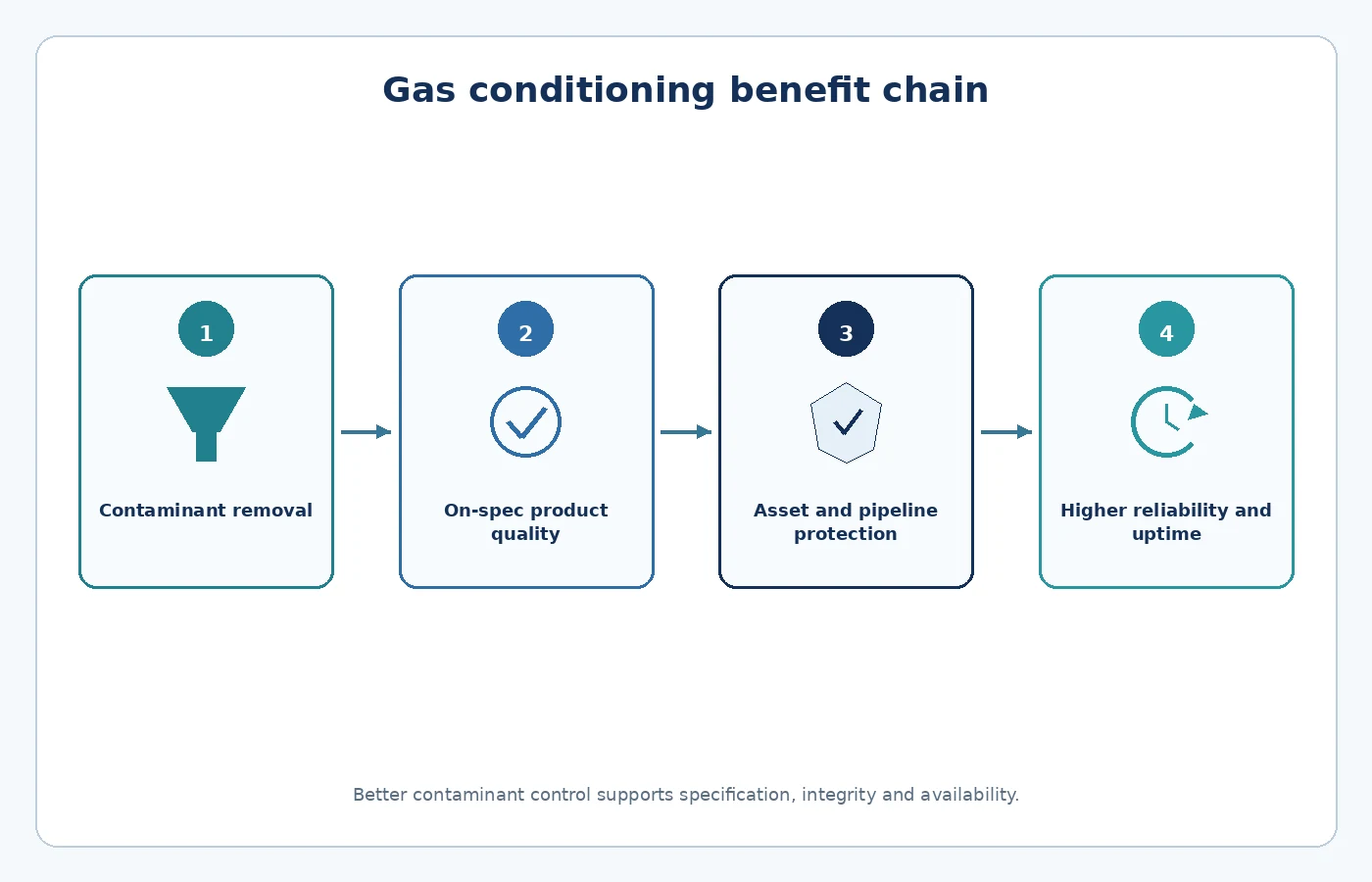
The first benefit is a gas stream that meets the receiving system’s requirements. Water and heavy hydrocarbons can condense as pressure and temperature change, while acid gases and other contaminants can breach contractual or technical limits. Conditioning reduces this variability and helps the facility deliver a predictable heating value, dew point and composition.
The exact specification is contractual and jurisdiction-specific. Operators should not copy a generic value from another system. They should translate the applicable agreement into measurable control limits, analyser requirements, alarm responses and diversion logic.
2. Protection against corrosion, hydrates and blockage
Removing water and acid gases protects downstream equipment. The EIA defines natural gas sweetening as removal of hydrogen sulphide, carbon dioxide and mercaptans, noting that hydrogen sulphide is highly toxic and that hydrogen sulphide and carbon dioxide can corrode pipelines [2]. Dehydration also reduces the conditions in which water can form free liquid, contribute to corrosion or combine with light hydrocarbons to form hydrates.
This benefit depends on control across the train. Poor inlet separation can overload treating units; solvent contamination can reduce sweetening performance; and a regeneration problem can allow wet gas to pass downstream. Effective processing therefore includes monitoring, maintenance and response—not only installed equipment.
3. Recovery of valuable liquid products
Wet gas may contain ethane, propane, butanes and natural gasoline. Separating these components can create additional saleable products while producing a dry gas stream. EIA distinguishes natural gas plant liquids from the processed dry gas and describes further fractionation into individual commodities [3].
More recovery is not always better. Refrigeration, compression and fractionation consume energy and add capital and maintenance requirements. The optimum recovery level depends on product prices, residue-gas value, specification, plant constraints and contractual allocation.
4. Better reliability and equipment life
A well-conditioned stream reduces liquid carryover, contaminant deposition and off-spec excursions that can disrupt compressors, exchangers, control valves and pipelines. Stable feed preparation also allows downstream equipment to operate nearer its intended envelope.
Reliability comes from the whole operating system: feed surveillance, separator level control, chemical and solvent quality, heat-exchanger performance, compressor condition, analyser availability and disciplined alarm management. A plant that reaches specification only under ideal conditions has not captured the full reliability benefit.
5. Safer handling of hazardous components
Hydrogen sulphide, flammable hydrocarbons and high-pressure inventories require engineered containment, detection, ventilation, isolation and emergency response. Processing does not remove risk; it concentrates some hazards into acid-gas, condensate, sulphur or relief streams that must be managed deliberately.
Safe operation therefore links process design to operating procedures, competency, permits, maintenance and barrier testing. Training should make the flow of hazardous materials visible so personnel understand where composition and pressure change across the facility.
6. More controlled environmental performance
Processing creates opportunities to recover products and reduce routine losses, but it can also create emissions from combustion, venting, flaring and equipment leaks. The U.S. Environmental Protection Agency identifies pumps, valves and connectors as important equipment-leak sources at gas plants [4].
The practical benefit is therefore improved control, not an assumption of zero impact. Operators need accurate inventories, leak detection and repair, flare governance, energy-efficiency monitoring and compliant handling of acid gas, condensate, wastewater and spent materials.
7. Greater commercial flexibility
A capable processing train can produce multiple saleable streams and accommodate reasonable feed variation. It may support tie-backs, phased field development or changes in recovery strategy. Flexibility must be designed and tested: turndown, contaminant swings, ambient conditions and equipment bottlenecks can all narrow the real operating window.
Teams evaluating these trade-offs benefit from linking process fundamentals with economic and operational judgement. EPW’s Gas Processing and Conditioning Technologies course develops that integrated view across separation, sweetening, dehydration, advanced treatment and operational optimisation.
How the benefits connect to common process units
| Process unit | Main duty | Benefit enabled | Key assurance question |
|---|---|---|---|
| Inlet separator | Remove bulk liquids and solids | Protect downstream equipment | Can it handle expected slugs and turndown? |
| Acid-gas removal | Reduce hydrogen sulphide and carbon dioxide | Specification, safety and corrosion control | Is solvent condition and circulation adequate? |
| Dehydration | Reduce water content | Hydrate and corrosion prevention | Are dew point and regeneration performance verified? |
| Dew-point control or NGL recovery | Remove heavier hydrocarbons | Liquid value and pipeline operability | Does recovery remain economic across feed cases? |
| Compression | Raise pressure for treatment or export | Throughput and delivery | Are surge, liquids and availability controlled? |
| Metering and analysis | Verify quantity and quality | Custody transfer and early warning | Are analysers maintained and data validated? |
What determines whether processing is effective?
Effectiveness means delivering the required outcomes over the expected operating range—not maximising one unit’s performance in isolation. Five inputs deserve particular attention:
- Feed characterisation: composition, contaminants, liquid loading, pressure, temperature and variability.
- Product and export requirements: sales-gas, NGL, condensate, sulphur and disposal specifications.
- Operating cases: start-up, turndown, peak production, upset, seasonal conditions and future tie-backs.
- Utilities and disposal routes: fuel, power, cooling, heating, water, chemicals, flare and waste capacity.
- Lifecycle economics: capital, energy, maintenance, availability, product value and off-spec exposure.
A multidisciplinary review prevents local optimisation. For example, deeper NGL recovery may increase liquid revenue but also increase refrigeration duty and residue-gas compression. More stringent dehydration may improve margin to specification but require additional regeneration energy. The decision should reflect the whole facility.
How to sustain the benefits in operation
Define a small set of outcome measures
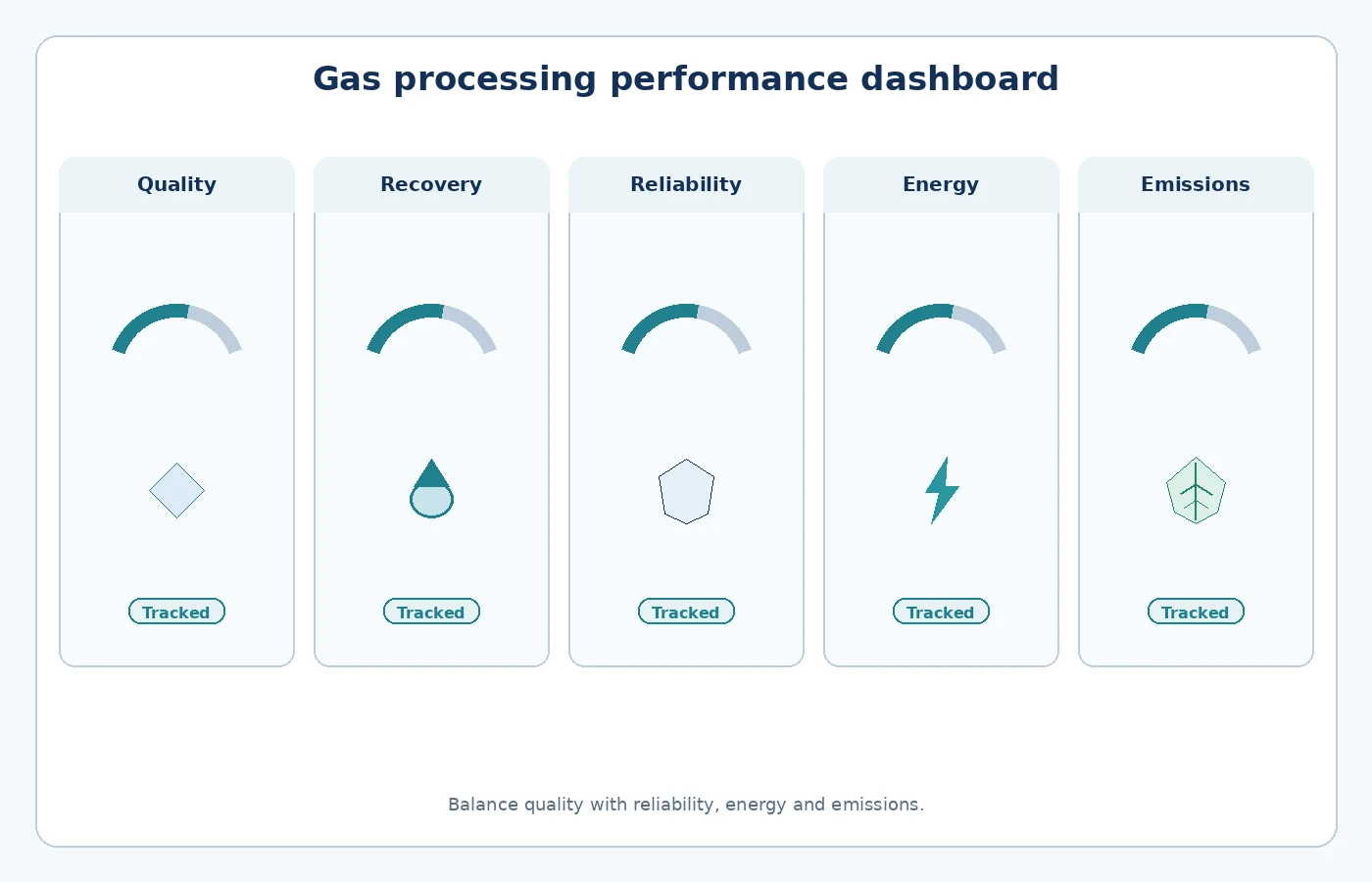
Useful measures include sales-gas specification compliance, product recovery, specific energy consumption, planned and unplanned unavailability, solvent or glycol losses, analyser uptime, leak findings and flare performance. Each measure needs a definition, owner, data source and response threshold.
Manage feed changes proactively
Reservoir depletion and new wells can change pressure, water, acid gas and heavy-end content. Periodic composition reviews, performance tests and calibrated process models help teams anticipate bottlenecks before they become production constraints.
Connect integrity to process performance
Corrosion, erosion, fouling and vibration are not separate maintenance topics. They affect separation efficiency, heat transfer, pressure drop and containment. The Asset Integrity and Corrosion Management course provides a complementary lifecycle perspective.
Control emissions and waste at source
Operating teams should investigate recurring venting, flaring, leaks and chemical losses as process deviations. Environmental review also belongs in project change management; EPW’s Environmental Impact Assessment in Oil and Gas Projects course covers the wider assessment and mitigation context.
Frequently asked questions
Why is raw natural gas processed?
To remove liquids and unwanted components, control water and hydrocarbon dew points, separate valuable natural gas liquids, and produce a stream suitable for transport or further use.
Are gas sweetening and dehydration the same?
No. Sweetening principally removes acid gases such as hydrogen sulphide and carbon dioxide; dehydration removes water. Both may be required, but they solve different problems.
Does every gas plant recover NGLs?
No. Recovery depends on feed composition, downstream specification, equipment and economics. Some facilities perform limited field conditioning, while larger plants include deep recovery and fractionation.
What is the best measure of gas-processing performance?
No single measure is sufficient. A balanced view combines specification compliance, recovery, energy, reliability, safety and environmental indicators.
Turn process knowledge into better operating decisions
The value of gas processing is realised when chemistry, equipment, control, integrity and economics are considered together. Explore EPW’s Gas Processing and Conditioning Technologies course to strengthen that practical decision framework, or view the broader Oil, Gas and Energy training portfolio.
Sources and references
- U.S. Energy Information Administration, Natural gas explained.
- U.S. Energy Information Administration, Natural gas sweetening glossary definition.
- U.S. Energy Information Administration, Natural gas plant liquids production and processing.
- U.S. Environmental Protection Agency, Oil and Natural Gas Sector Climate Review.