

Hydrogen is not simply “more dangerous” or “safer” than natural gas: it presents a different risk profile. Hydrogen is lighter, disperses rapidly in open air, has a wider flammable range and lower ignition energy, and can burn with a difficult-to-see flame. Natural gas is also highly flammable, can accumulate in enclosed areas, and brings established gas-detection, pressure and combustion hazards. Safe design starts by matching controls to the fuel, pressure, space and credible release scenarios.
This comparison focuses mainly on gaseous hydrogen and methane-rich natural gas. Cryogenic liquid hydrogen and liquefied natural gas add cold-temperature, boil-off and phase-change hazards that require separate analysis. Actual projects must follow their jurisdiction’s codes, standards, hazardous-area rules and emergency requirements.
Hydrogen safety vs natural gas safety at a glance
| Property or issue | Hydrogen | Natural gas | Safety implication |
|---|---|---|---|
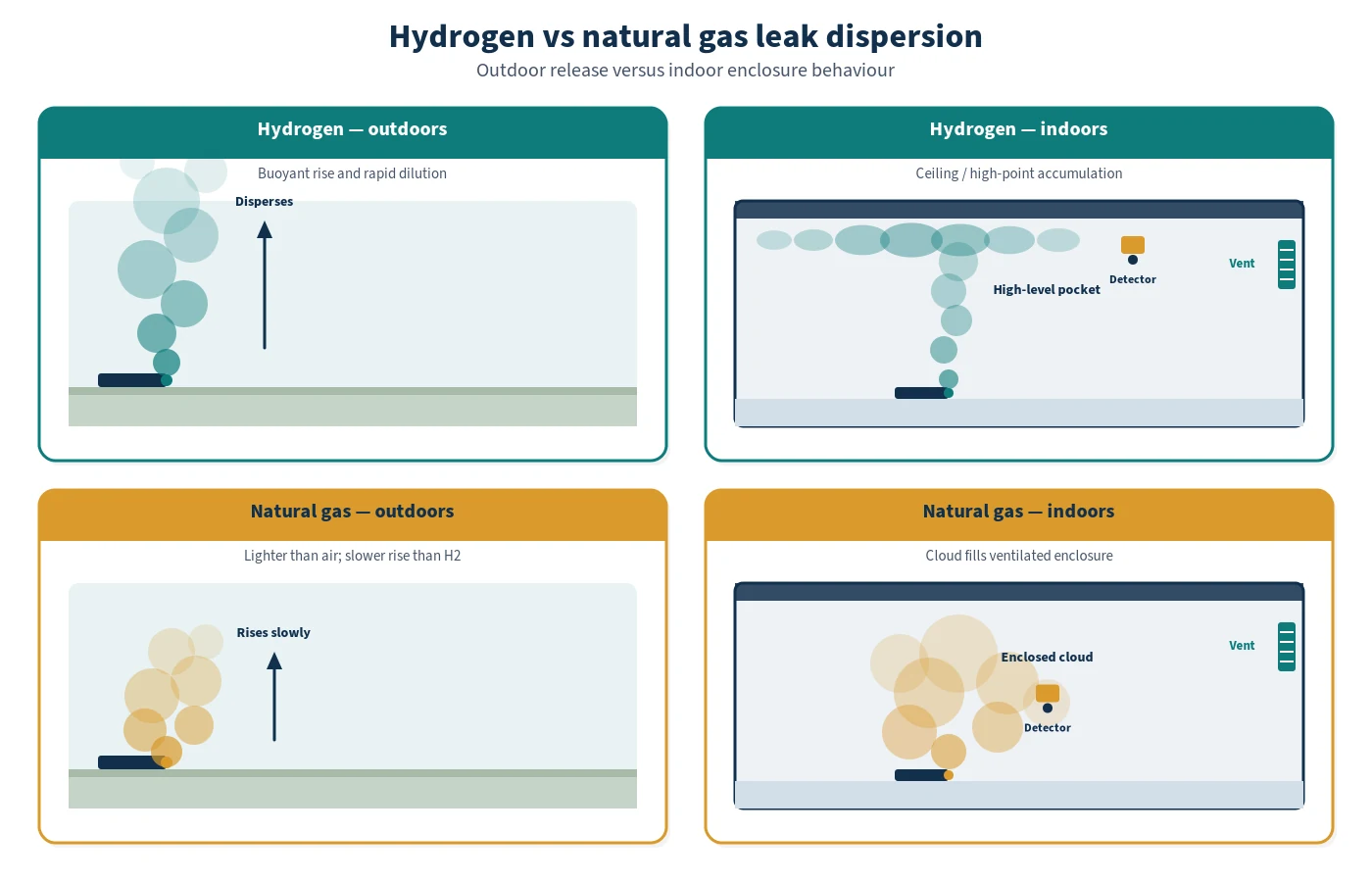
| Buoyancy | Very light; rises and can disperse quickly outdoors | Lighter than air but denser than hydrogen | Both need ventilation; hydrogen can collect beneath roofs or inside high pockets |
| Flammable range in air | Approximately 4–75% by volume | Narrower, commonly around 5–15% for methane | Hydrogen releases can remain flammable across a broader concentration range |
| Ignition | Lower minimum ignition energy | Higher than hydrogen but readily ignitable | Ignition-source control is critical for both and especially sensitive for hydrogen |
| Flame visibility | Pure hydrogen flames can be hard to see | Usually more visible, depending on composition and conditions | Hydrogen may require suitable optical flame detection and response procedures |
| Leak behaviour | Small molecule; leakage and permeation require careful joint and material selection | Established component practices, but leaks remain a major fire and explosion hazard | Do not assume equipment suitable for natural gas is automatically suitable for hydrogen |
| Material compatibility | Some metals can suffer hydrogen-assisted degradation | Different corrosion and compatibility issues apply | Materials, welds, seals and pressure cycles must be qualified for the service |
| Odour | Pure hydrogen has no odour; odorisation is application-dependent | Distribution gas is commonly odorised, but industrial streams may not be | Instrumented leak detection remains essential; smell is not a universal safeguard |
H2Tools publishes comparative fuel-property data, including flammability range, ignition characteristics and flame behaviour [1]. These values are useful inputs, but risk also depends on inventory, pressure, confinement, ventilation, release orientation and congestion.
Why hydrogen releases behave differently
Rapid buoyant dispersion
Hydrogen’s low density can be advantageous outdoors: an unobstructed release may rise and dilute quickly. The same buoyancy can create a problem indoors if gas travels upwards and accumulates under ceilings, canopies, cable trays or other high points. Ventilation openings and detector locations must reflect likely flow paths.
Broad flammability and easy ignition
Hydrogen’s wide flammability range and low ignition energy increase the range of mixtures and sources that can produce ignition. The US Department of Energy highlights adequate ventilation, leak detection and special flame detection because hydrogen can ignite more easily than natural gas and its flame may be nearly invisible [2].
High-pressure release effects
Many hydrogen systems store gas at high pressure to obtain useful energy density. A release can create a high-velocity jet, noise, impingement and a flammable plume. If ignited, the result may be a jet fire; if unignited gas accumulates in a confined or congested area, deflagration and overpressure become concerns.
Flame detection and visibility
A pure hydrogen flame produces little visible radiation and no smoke. Operators should not rely on sight. Detector technology, placement and response logic must match the application, background radiation and environmental conditions. Thermal imaging or suitable optical detection may support emergency response, subject to design validation.
Natural gas hazards remain substantial
Natural gas can form flammable clouds, create explosions in confined spaces, produce jet or pool fires depending on phase, and displace oxygen. Transmission, processing and distribution systems also contain large inventories and high pressures. Familiarity can lead to complacency; mature codes and experience do not remove the need for hazard analysis and asset integrity.
Odorisation is often associated with natural gas distribution, but it is not universal across production, processing and industrial systems. Odour can fade, be masked or be unavailable to a person wearing respiratory protection. Fixed and portable gas detection, isolation and ventilation remain primary controls.
For teams working across gas processing and hydrogen projects, EPW’s Gas Processing and Conditioning Technologies course provides useful context on gas properties, treatment and plant operations.
Materials and equipment compatibility
Hydrogen can interact with metallic materials and contribute to loss of ductility or cracking under particular stress, microstructure, pressure and cycling conditions. Compatibility is not a single yes/no property: base metal, welds, heat treatment, surface condition, loading and operating environment all matter. Seals, valves, compressors and instruments also need hydrogen-qualified performance.
Natural-gas equipment cannot be converted by changing a label. A reuse assessment should review materials, design pressure, fatigue, leak tightness, metering, flame detection, ventilation, electrical classification, relief disposal and emergency isolation. The Department of Energy’s hydrogen safety review notes differences in leakage, flame visibility and material behaviour compared with natural gas [3].
Control priorities for both fuels
| Control layer | Hydrogen emphasis | Natural-gas emphasis |
|---|---|---|
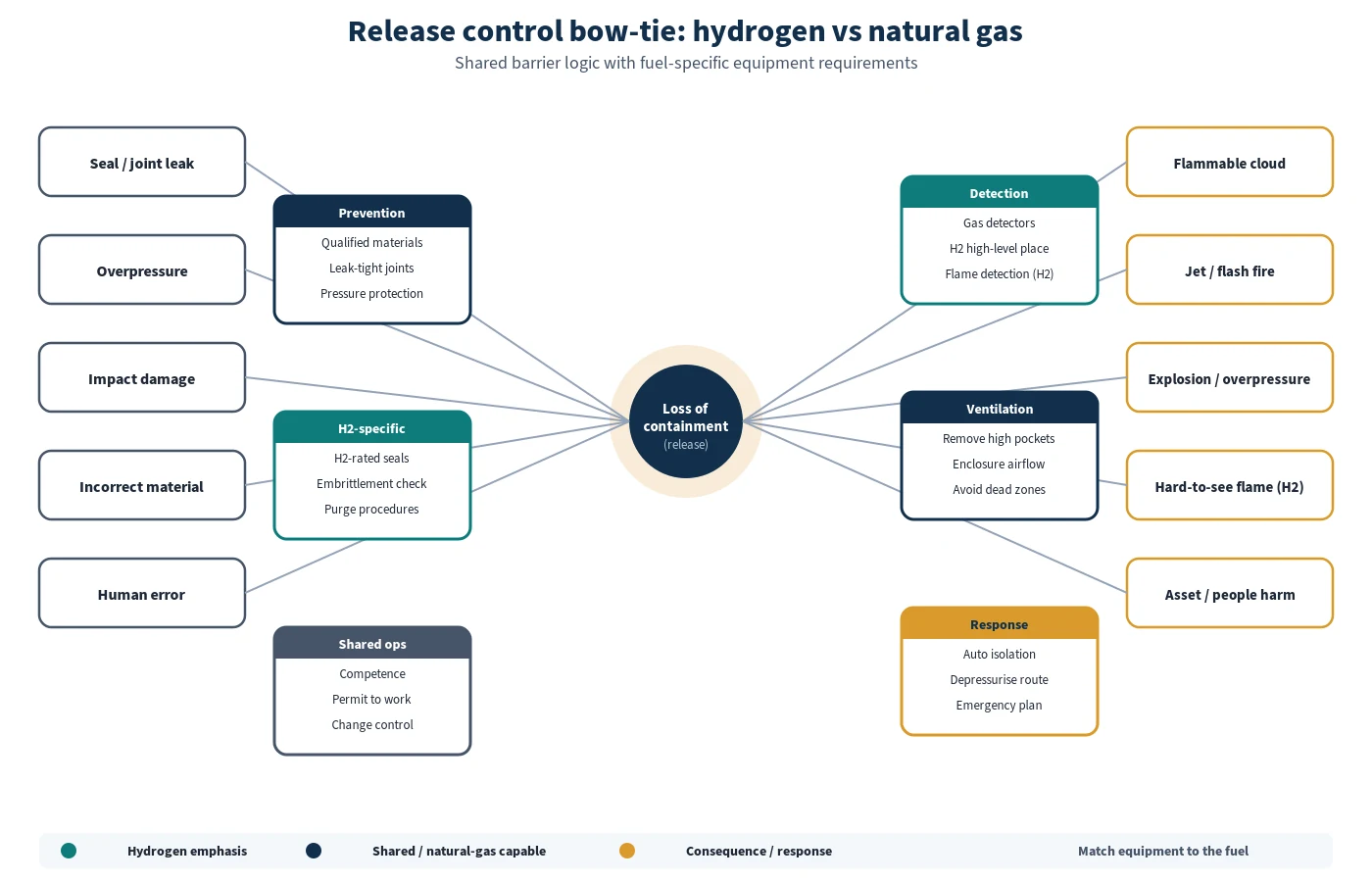
| Prevention | Qualified materials, leak-tight connections, compatible seals, controlled purging | Corrosion control, joint integrity, excavation damage prevention, process containment |
| Detection | High-level gas detectors and suitable flame detection | Gas detectors located for release and ventilation patterns; odorisation where applicable |
| Ventilation | Remove high-level pockets and avoid trapping buoyant gas | Prevent accumulation in enclosed and low-air-change spaces |
| Isolation | Rapid automatic isolation with safe depressurisation route | Sectional isolation, emergency shutdown and inventory management |
| Ignition control | Strict control because very low-energy sources may ignite a mixture | Hazardous-area classification and control of hot work, static and electrical sources |
| Emergency response | Account for hard-to-see flames, plume direction and stored pressure | Account for cloud migration, ignition, fire exposure and distribution interfaces |
The hierarchy of controls still applies: eliminate unnecessary inventory, reduce pressure or quantity where feasible, engineer containment and ventilation, automate isolation, then support those barriers with procedures, competence and personal protective equipment.
A risk-assessment approach that avoids false equivalence
- Define the system. Identify fuel composition, phase, pressure, temperature, inventory, operating modes and interfaces.
- Identify credible releases. Include seals, connections, instruments, relief systems, maintenance activities and vehicle or impact scenarios.
- Model dispersion and consequences. Consider indoors and outdoors, ventilation failures, congestion, ignition timing and occupancy.
- Verify material compatibility. Review piping, pressure vessels, welds, valves, compressors, elastomers and cyclic duty.
- Map safeguards. Confirm independence, set points, testing, failure response and human actions.
- Plan emergency actions. Define isolation, evacuation, firefighting strategy, re-entry and communication.
- Manage change. Reassess blending, pressure changes, new users, equipment reuse and altered ventilation.
H2Tools’ best-practice material stresses that hydrogen’s wider flammability range must be considered alongside its rapid dispersion and application conditions [4]. A single property cannot determine total risk.
Common mistakes when converting natural-gas systems
- Assuming an existing detector responds correctly to hydrogen.
- Keeping detector and vent locations designed for a different dispersion pattern.
- Ignoring welds, seals and fatigue when assessing material compatibility.
- Using natural-gas flame visibility assumptions in emergency procedures.
- Failing to assess the higher flow or pressure needed to deliver equivalent energy.
- Treating a blend as unchanged natural gas across composition and operating range.
EPW’s Hydrogen Safety and Risk Management course develops the property-to-control reasoning needed for risk assessment, handling, storage and emergency planning. The HSE Management in the Energy Sector course provides the wider management-system and assurance context.
Frequently asked questions
Does hydrogen always rise safely away?
No. It can disperse quickly outdoors, but obstructions and enclosed high points can trap it. Release momentum, wind and ventilation determine the actual plume.
Can standard natural-gas detectors detect hydrogen?
Not necessarily. Sensor technology, calibration, range and location must be verified for hydrogen and the expected environment.
Is hydrogen odorised?
Not universally. Odorant suitability can be constrained by applications and fuel-cell purity. Instrumented detection should not be replaced by an assumption that people will smell a leak.
Can natural-gas pipelines carry hydrogen?
Some assets may support blends or conversion after assessment and modification. Suitability depends on materials, welds, pressure, compressors, valves, meters, end users and applicable regulation.
Build fuel-specific safety judgement
The right conclusion is not that one gas is universally safer. It is that credible releases and control performance must be reassessed for hydrogen’s properties and the project’s conditions. Explore EPW’s Hydrogen Safety and Risk Management course for a structured treatment of hazards, risk assessment and emergency response, or view the wider Oil, Gas and Energy training portfolio.