

AI-generated illustration created to represent the article’s subject. It does not depict an actual EPW course, trainer, participant, client, event or venue.
Commercial contract insurance requirements should transfer only the insurable risks that the contract genuinely allocates to a supplier. Good drafting identifies the exposure, selects suitable policy classes, sets proportionate limits and periods, specifies acceptable evidence, and creates controls for renewal, material change and claims. Copying a standard insurance schedule without testing it against the scope can leave material gaps or impose cost without useful protection.
This best-practice guide is for contract, procurement, legal and risk professionals. Insurance law, compulsory cover and policy availability differ between jurisdictions and sectors, so proposed wording and limits should be reviewed by qualified legal and insurance advisers before signature.
Key takeaways
- Start with contractual risk allocation. Insurance cannot correct an unclear scope, unsuitable indemnity or unmanageable liability.
- Specify outcomes, not policy names alone. State the relevant exposure, insured parties, limit basis, territorial scope and required period.
- Keep requirements proportionate. Excessive limits, endorsements or evidence demands can reduce competition and raise price.
- Verify cover throughout the contract. A certificate at award is not a substitute for policy review, renewal controls and claims cooperation.
- Address subcontractors and the tail. Flow-down, completed operations and claims-made reporting periods must match the delivery model.
Begin with the risk allocation, not an insurance template
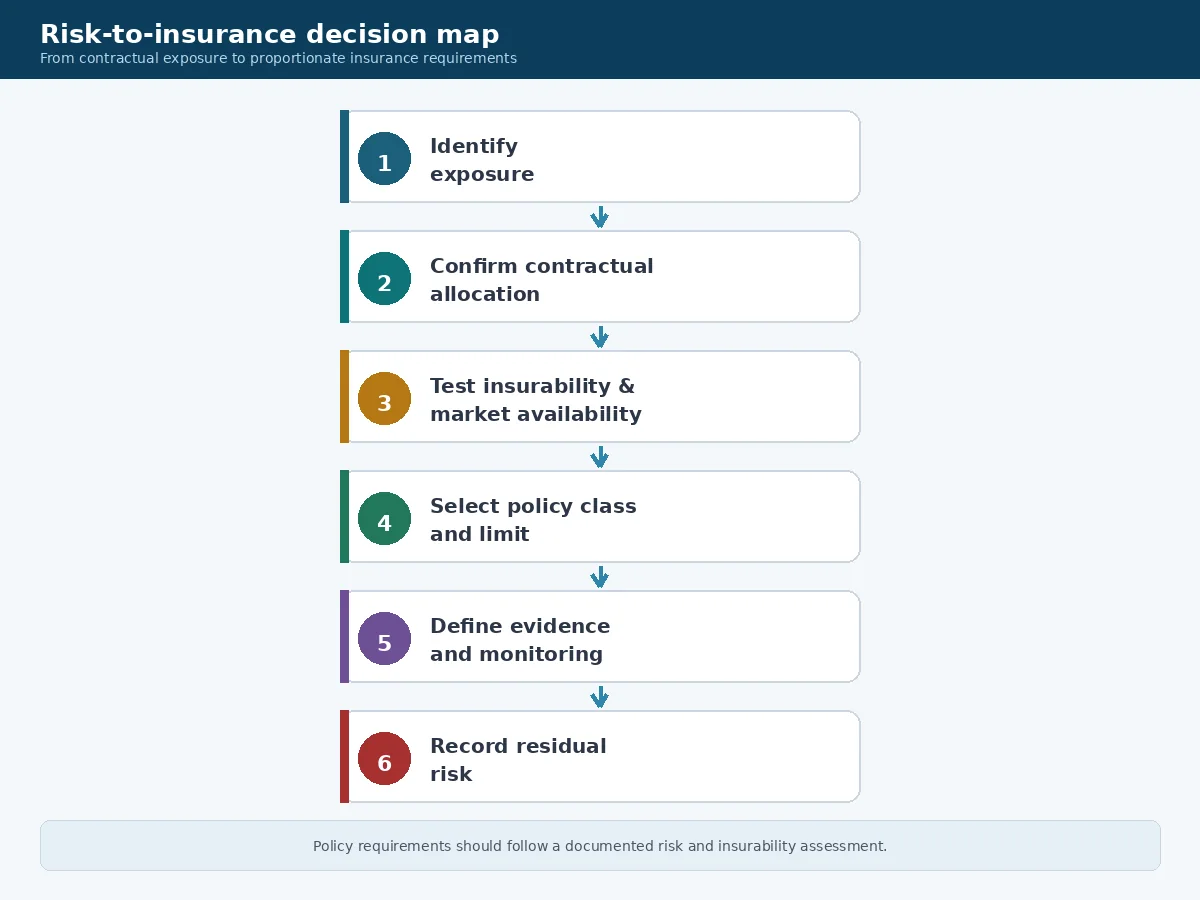
Insurance is one method of financing loss; it is not the same as allocating responsibility. The contract first needs a clear scope, responsibility boundaries, indemnities, liability exclusions and caps. The insurance schedule should then support that allocation where suitable cover is commercially available.
A useful starting question is: what event could cause loss, who controls it, who is contractually responsible, and can that exposure be insured on workable terms? The answer determines whether the control should be insurance, a performance security, a technical control, a contingency, a liability allocation or a combination.
The risk-based principle is visible in public procurement guidance. The US Federal Acquisition Regulation states that fixed-price contracts do not ordinarily require the Government to prescribe contractor insurance, but identifies special circumstances where agencies may do so. This illustrates why requirements should respond to exposure rather than habit. See FAR 28.306.
Commercial contract insurance requirements matrix
| Contract exposure | Potential policy response | Drafting questions | Evidence to consider |
|---|---|---|---|
| Injury or property damage arising from operations | Public or general liability | Who may be harmed, where will work occur, and are completed operations relevant? | Certificate plus relevant schedule, limit, territory and exclusions |
| Injury to workers | Employers’ liability or workers’ compensation | What cover is compulsory in the place of employment and performance? | Statutory evidence and policy details where permitted |
| Professional error, advice or design | Professional indemnity or errors and omissions | Is the policy claims-made, and how long can claims arise after completion? | Retroactive date, limit basis, renewal undertaking and run-off evidence |
| Cyber event, privacy incident or technology failure | Cyber or technology errors and omissions | Which first-party and third-party losses matter, and what exclusions affect the service? | Coverage summary, limit, retention and material exclusions |
| Goods, equipment or works in transit or construction | Cargo, property or construction all-risks cover | When does title and risk pass, and who insures each stage? | Insured values, locations, transit basis, deductibles and loss-payee terms |
| Vehicle use in performance | Motor or automobile liability | Are owned, hired and non-owned vehicles included? | Policy scope and applicable statutory evidence |
| Fraud or dishonesty involving entrusted assets | Crime or fidelity cover | Whose employees and which assets or funds are within scope? | Insuring clauses, sublimits and discovery period |
Eight best practices for drafting insurance requirements
1. Map each requirement to a defined exposure
Record the cause, event, potential consequence, responsible party and proposed insurance response. If a requested policy cannot be linked to an allocated exposure, challenge it. Conversely, if the contract allocates a material exposure but no policy or alternative control addresses it, record the residual risk for approval.
2. Select policy classes by scope and legal duty
Policy names and compulsory insurance rules vary. Use terminology appropriate to the governing jurisdiction and location of performance. The UK Cabinet Office Mid-Tier Contract, for example, maintains a dedicated Schedule 22 for insurance requirements, updated on 21 February 2025. It is a useful public-sector reference, not wording to copy automatically into every commercial arrangement.
Check whether the supplier provides advice or design, handles personal data, transports goods, uses vehicles, employs staff across borders, controls client property or performs work after completion. One policy may address several exposures, while another may contain exclusions that make its title misleading for the contract.
3. Set proportionate limits and deductibles
Limits should reflect plausible severity, contract value, aggregation across sites or users, legal requirements, the liability regime and market capacity. The contract price alone is not an adequate proxy: a low-fee professional service can create a loss much larger than its fee, while a high-value supply may involve tightly controlled exposure.
State whether limits apply per occurrence, per claim or in the annual aggregate. Consider erosion by defence costs, sublimits and other claims under a portfolio policy. Define who bears deductibles and whether a large self-insured retention could undermine performance after a loss.
4. Align the coverage period with when claims can arise
Occurrence-based policies generally respond by reference to when the insured event occurred, while claims-made policies depend on when a claim is made and reported, subject to the policy wording. Professional indemnity and some cyber covers are commonly written on a claims-made basis. The contract may therefore need a retroactive date, continuous renewal obligation and a post-completion or run-off period.
Do not state a tail period mechanically. Align it with the governing limitation rules, expected defect or claim emergence, contract records and market availability, and obtain jurisdiction-specific legal advice.
5. Define the protected parties and required endorsements
Clarify the named insured, additional insureds, principals, lenders or loss payees only where the policy structure and exposure justify them. An additional-insured requirement is not interchangeable with a waiver of subrogation, primary-and-non-contributory wording or a cross-liability provision.
Require only endorsements that can be obtained in the relevant market. The insurance adviser should confirm how the requested status interacts with indemnities, negligence, joint insurance and the parties’ own policies.
6. Specify meaningful evidence of cover
A certificate is convenient but may summarise rather than amend the policy. Define what must be delivered before work starts and on renewal: insurer identity, policy number, period, limits, deductibles, relevant insured parties, territorial scope and requested endorsements. For higher-risk contracts, permit targeted review of policy schedules and material exclusions subject to confidentiality.
Under English law, the Insurance Act 2015 includes rules governing commercial insurance contracts, including the duty of fair presentation. Contract teams should avoid asking suppliers to make unsupported coverage assurances and should involve the insured’s broker or adviser where interpretation is needed.
7. Build renewal, cancellation and material-change controls
State when renewal evidence is due, who reviews it, how exceptions are escalated and what happens if cover lapses. Require the supplier to notify the customer of cancellation, non-renewal or material reduction where the supplier becomes aware of it and where the policy and law permit. Do not rely on an insurer to notify a third party unless the relevant endorsement actually creates that obligation.
Use a contract register with policy expiry dates, notice lead times and responsible owners. The control should begin before expiry, leaving time to resolve unavailable cover, changed limits or new exclusions without an accidental service interruption.
8. Connect subcontracting, incidents and claims
Decide whether subcontractors must maintain equivalent cover, whether the prime supplier’s policy responds, and how evidence will flow up the chain. A blanket flow-down clause may be disproportionate for low-risk subcontractors; a tiered model based on activity and access is more defensible.
Set duties to notify circumstances and claims, preserve evidence, cooperate with insurers, avoid prejudicing recovery and coordinate communications. Insurance proceeds should not be treated as the sole remedy unless the contract deliberately says so. For English-law liability insurance, the Third Parties (Rights against Insurers) Act 2010 provides a statutory route in defined insolvency circumstances; its application requires legal analysis.
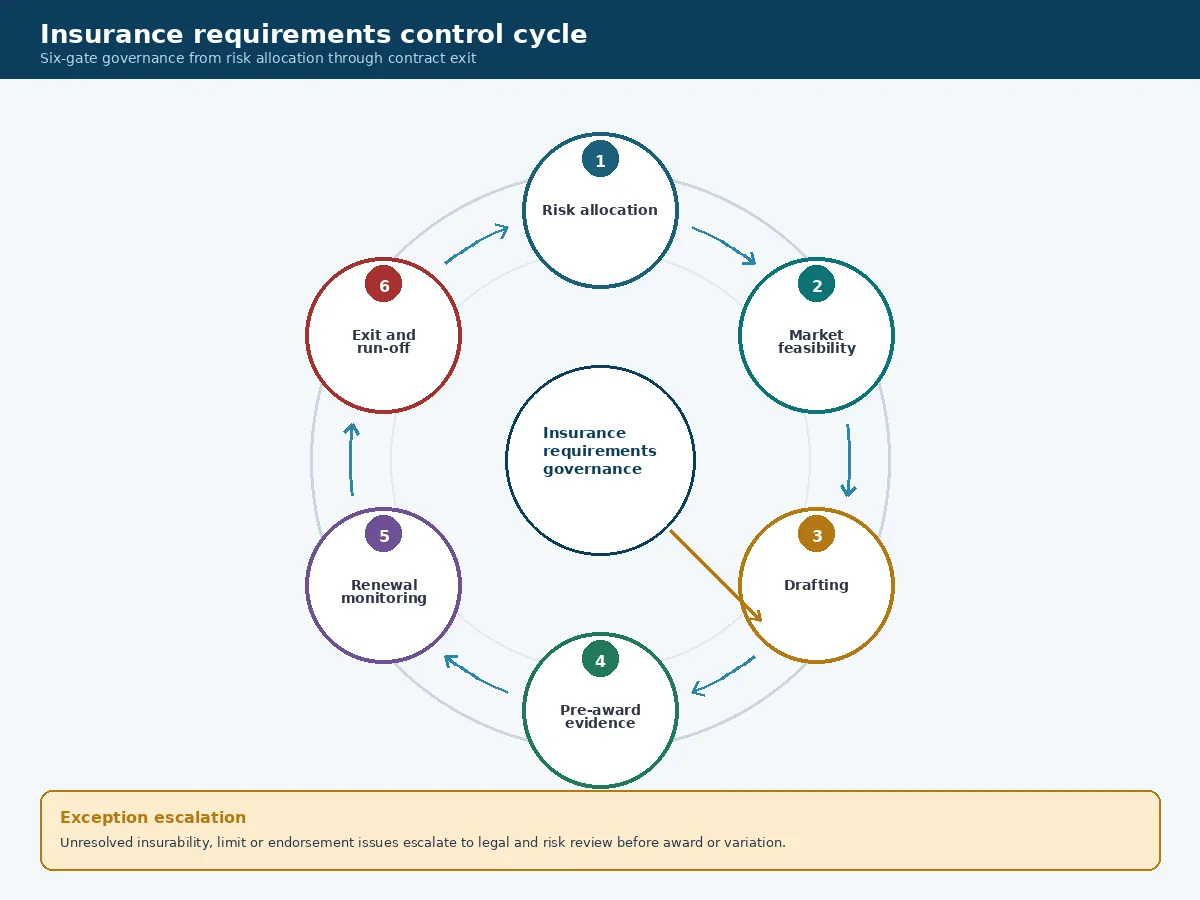
EPW insurance-requirements control model
| Control gate | Owner | Required output | Escalation trigger |
|---|---|---|---|
| Risk and allocation review | Commercial lead with legal and risk advisers | Approved exposure-to-control map | Unallocated or uninsurable material exposure |
| Market feasibility check | Insurance adviser or broker | Available policy structure, limit and indicative constraints | Unavailable endorsement, material exclusion or excessive cost |
| Drafting review | Legal and contract teams | Aligned insurance, indemnity and liability provisions | Conflict between policy response and contractual liability |
| Pre-award verification | Contract owner | Accepted evidence and documented exceptions | Missing cover, expired policy or unapproved retention |
| Ongoing monitoring | Contract manager | Renewal record, changes and incident log | Lapse, cancellation, material reduction or claim |
| Exit and record retention | Contract owner and legal team | Run-off evidence and retained claim records | Claims-made cover ends before residual exposure |
Worked example: outsourced facilities services
Assume a supplier will provide maintenance at several occupied sites, employ technicians, use vans, handle keys and occasionally design minor modifications. The customer first maps bodily injury, property damage, worker injury, vehicle use, entrusted property and professional-design exposures.
The resulting schedule may require public liability, compulsory employer and motor cover, and professional indemnity for the design activity. Limits are assessed against site occupancy, potential severity, aggregation across sites and the agreed liability framework. Evidence is due before mobilisation and before each renewal, with a named contract owner and escalation path.
If professional indemnity is claims-made, the parties also consider the retroactive date and a proportionate post-completion period. A specialist subcontractor performing design work must provide suitable evidence or be demonstrably covered by the prime supplier. Residual exclusions and deductibles are recorded rather than assumed away.
Common drafting failures
- Requiring every supplier to carry the same policies and limits.
- Using contract value as the only measure of potential loss.
- Failing to align insurance with indemnities, caps and exclusions.
- Ignoring claims-made wording, retroactive dates and run-off periods.
- Treating a certificate as conclusive evidence of all requested terms.
- Requiring unavailable endorsements without a market check.
- Omitting renewal ownership, exception approval and lapse consequences.
- Assuming insurance removes the need for operational controls or supplier solvency.
Pre-signature checklist
- Every policy requirement maps to an allocated and credible exposure.
- Compulsory insurance and local terminology have been checked.
- Limits, deductibles, aggregate basis and defence-cost treatment are understood.
- Territory, jurisdiction, insured parties and subcontractor arrangements are defined.
- Occurrence or claims-made basis and any tail period are addressed.
- Evidence requirements are feasible and proportionate.
- Renewal, cancellation, material change and claims duties have owners.
- Exceptions and residual risks are documented and approved.
- Legal and insurance specialists have reviewed the final wording.
Developing contract insurance capability
Professionals responsible for these decisions need to connect risk allocation, policy structure, limits, endorsements, evidence, claims and renewal governance. EPW’s Commercial Insurance Requirements in Contracts Course develops this practical capability for commercial, procurement, contract and legal teams.
For the wider allocation context, review EPW’s Contract Risk Assessment and Mitigation Strategies Course or explore the full Contracts Management and Law Training Courses category.
Ready to make insurance requirements more proportionate and auditable? Review the course content, available dates and locations, or request tailored in-house training.
Conclusion
Effective commercial contract insurance requirements are a controlled extension of the contract’s risk allocation. They identify insurable exposures, define workable policy and evidence requirements, and remain monitored until residual claims can no longer reasonably arise.
The best schedule is not necessarily the longest. It is the one whose policies, limits, periods and governance can be traced to real exposure, checked in the market and administered throughout the relationship.
Sources and References
- UK Cabinet Office. The Mid-Tier Contract, including Schedule 22 (Insurance Requirements). Updated 21 February 2025.
- UK Cabinet Office. Risk Allocation and Pricing Approaches Guidance Note. Updated 15 June 2026.
- US General Services Administration. Federal Acquisition Regulation, Subpart 28.3 — Insurance. Current version accessed 1 September 2026.
- UK Parliament. Insurance Act 2015.
- UK Parliament. Third Parties (Rights against Insurers) Act 2010, Section 1.