

AI-generated illustration created to represent the article’s subject. It does not depict an actual EPW course, trainer, participant, client, event or venue.
Executive leaders drive business results by converting strategic intent into a small number of defined outcomes, assigning accountable owners, reviewing meaningful evidence and removing barriers that operating teams cannot resolve alone. The work is not simply to demand higher performance. It is to create the conditions, decisions and management rhythm through which people can deliver it.
This seven-step method is designed for executives, transformation sponsors and functional leaders who need to move from broad ambitions to measurable results. It separates outcomes from activity, keeps accountability visible and gives senior teams a practical rule for deciding when to intervene.
What you need before starting
- A strategic priority: one important result that requires coordination across several teams.
- A defined decision horizon: the period within which evidence and action must change the outcome.
- Named senior ownership: one executive accountable for the result, supported by responsible delivery owners.
- Reliable baseline information: enough evidence to describe current performance without pretending that every variable is known.
- Authority to remove constraints: access to the people who can settle priorities, resources, policies and cross-functional conflicts.
The UK Government’s Government Functional Standard GovS 002: Project Delivery, updated on 17 September 2025, sets expectations for the direction and management of portfolios, programmes and projects. Its emphasis on governance, roles, planning, control and benefits illustrates a wider leadership principle: outcomes require an operating system, not slogans.
Seven steps for driving business results
1. Define the result in operational terms
Start with the change that should be observable in the organisation, customer experience or public service—not with the initiative intended to produce it. “Launch a new platform” is an output. “Reduce the time required to resolve priority customer cases while maintaining control quality” is an outcome.
Write the result using four elements: the affected group, the required change, the measure and the relevant period. If leaders cannot agree those elements, they are not yet ready to hold teams accountable for delivery.
2. Build a results chain from strategy to benefits
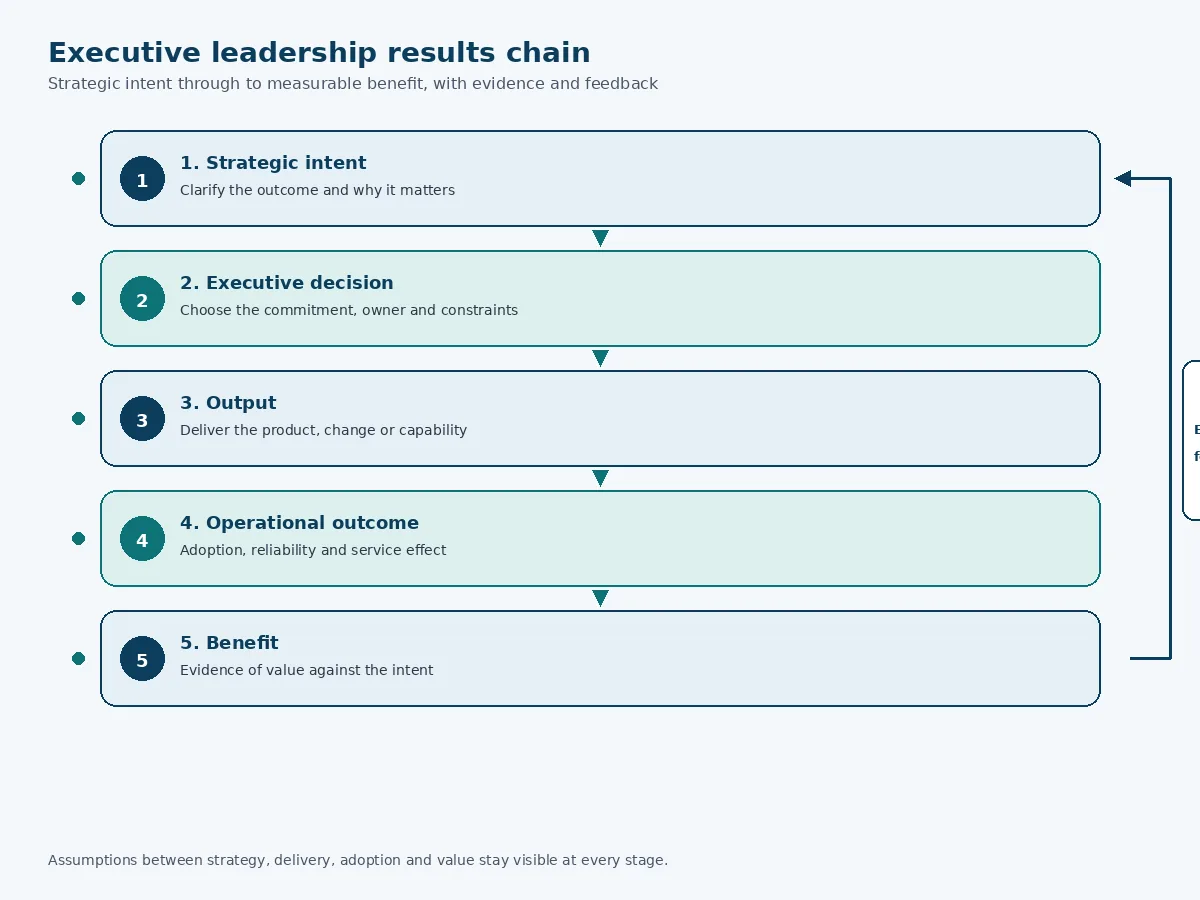
Map the logic from executive decision to activity, output, operational outcome and final benefit. Challenge every assumed connection. A completed project creates value only when people use its outputs and the resulting behaviour improves performance.
The Association for Project Management defines benefits management as identifying, defining, planning, tracking and realising benefits. It also notes that accountability for benefits realisation normally rests with the sponsor because benefits may appear after transition into use.
| Results-chain level | Executive question | Illustrative evidence |
|---|---|---|
| Strategic intent | Why does this matter now? | Customer, financial, regulatory or service need |
| Executive decision | What priority or trade-off must leaders settle? | Approved direction, funding or policy boundary |
| Output | What will the organisation deliver? | New process, capability, product or system |
| Operational outcome | What will people do differently? | Adoption, cycle time, quality or compliance behaviour |
| Benefit | What measurable value follows? | Revenue, cost, resilience, satisfaction or public value |
3. Assign accountability and decision rights
Name one accountable executive for the result. Then distinguish accountability from responsibility: the accountable person owns the outcome and escalation path; responsible people carry out defined work. Avoid shared accountability language that allows every leader to assume another will act.
The UK Government Project Delivery Function’s guidance on the senior responsible owner, published on 13 August 2025, states that accountabilities and responsibilities should be defined, mutually consistent and traceable across management levels. Use a short decision-rights record stating who recommends, decides, executes and must be consulted.
4. Select a balanced set of measures
Choose a small group of measures that help leaders act. Combine lagging indicators, which confirm the final result, with leading indicators that show whether delivery and adoption are moving in the right direction. Add guardrails so that improvement in one measure does not damage safety, quality, ethics or another important outcome.
For example, a faster approval cycle should be reviewed alongside error rates and customer rework. Measures should have an owner, source, frequency, baseline and decision threshold. If a metric cannot change a decision, question whether it belongs in the executive pack.
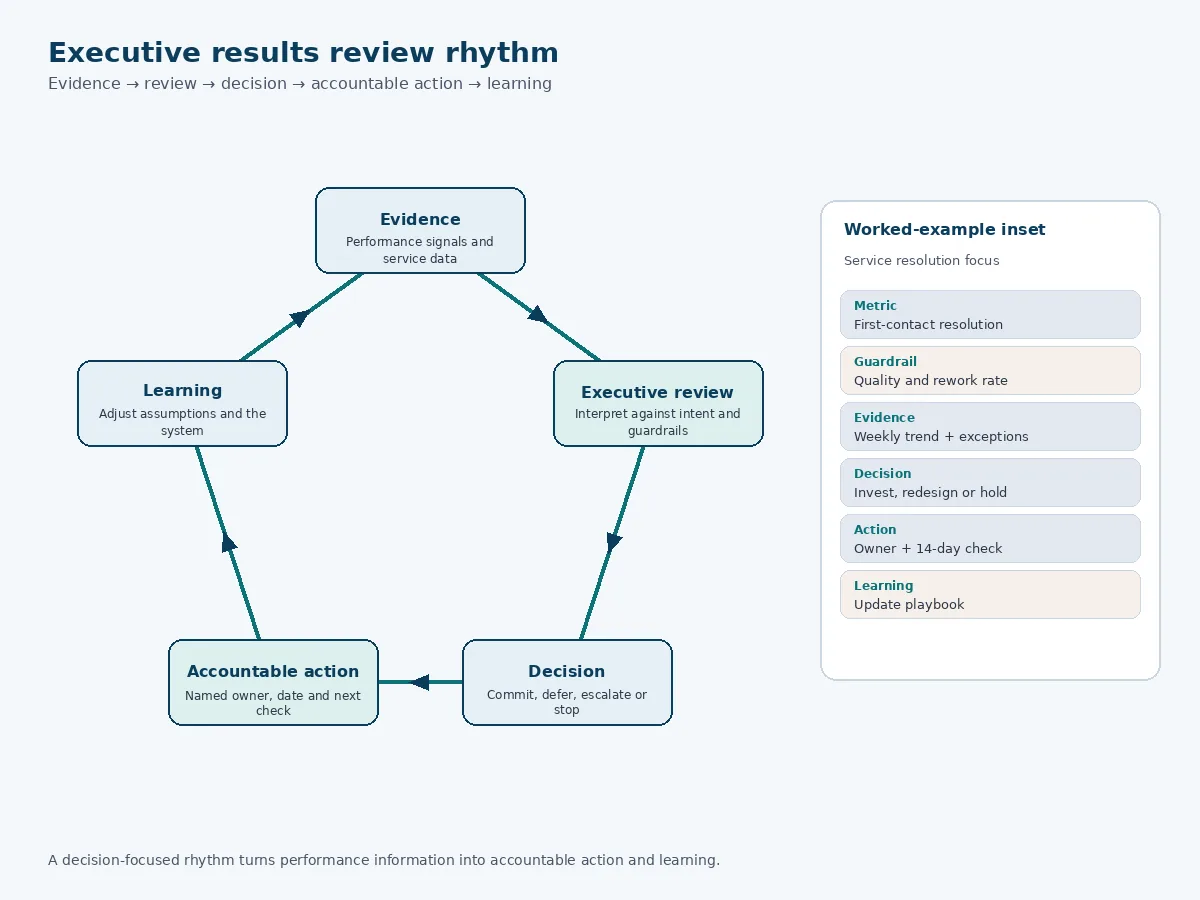
5. Establish an executive operating rhythm
Use a regular review that is designed for decisions rather than presentations. Circulate current evidence in advance. During the meeting, concentrate on variances, assumptions, dependencies and actions that require senior authority.
Each review should end with a clear decision, owner, deadline and evidence required at the next review. The cadence should match the speed of the outcome: a crisis may need daily review, whereas a multi-year capability programme may require monthly executive governance supported by weekly delivery controls.
6. Remove constraints across organisational boundaries
Executive intervention is most valuable when the obstacle crosses functions or exceeds the delivery owner’s authority. Common constraints include competing priorities, inconsistent incentives, delayed approvals, incompatible policies, scarce specialist capacity and unresolved supplier dependencies.
Ask: “What can this team not solve within its mandate?” Then act at that level. Do not take over work that belongs with operational managers; doing so weakens accountability and fills the executive agenda with detail.
7. Reinforce learning and capability
Use performance evidence to improve the system, not merely to reward or blame individuals. The Chartered Institute of Personnel and Development’s performance management factsheet, reviewed in 2026, describes performance management as a continuous cycle involving objectives, feedback, learning and development as well as reviews.
When results differ from plan, test whether the cause lies in the assumption, capability, resource, decision or execution. Preserve what works, correct the constraint and update the results chain. Sustainable performance comes from repeatable organisational capability, not a final-period push.
Decision points for executive intervention
| Evidence observed | Likely executive response | Avoid |
|---|---|---|
| Outcome is unclear or leaders use different definitions | Reset the result, boundary and measure | Adding more activities |
| Output is complete but adoption is weak | Investigate capability, incentives and local ownership | Declaring success at launch |
| Measures improve while guardrails worsen | Rebalance targets and address unintended behaviour | Rewarding one-dimensional performance |
| Dependency spans several functions | Make the trade-off at the accountable level | Sending the issue back unchanged |
| Evidence is incomplete but delay is costly | Approve a bounded experiment with review and stop rules | Demanding false certainty |
| Delivery owner can solve the issue | Hold that owner to the agreed action and deadline | Executive micromanagement |
Worked example: improving service resolution
Consider an illustrative business with rising customer complaints and slow resolution of priority cases. The executive team initially launches a “service excellence programme”, but progress reports count workshops and system features rather than customer outcomes.
The accountable executive redefines the result: reduce median priority-case resolution time from five working days to two within six months, while keeping rework below the existing baseline. The results chain shows that a new case-routing tool will create value only if teams classify work consistently and specialist approvals are available when needed.
Three leading measures are selected: correct first-time classification, age of cases waiting for specialist review and use of the new routing process. Reviews reveal that one policy forces unnecessary escalation. The executive sponsor resolves the policy conflict, assigns specialist capacity and monitors the rework guardrail. The result improves because leadership removed a structural constraint; it did not simply intensify pressure on case handlers.
Common errors and corrections
- Managing activity instead of value: trace every initiative through adoption to a measurable benefit.
- Using too many priorities: identify the few outcomes that genuinely require executive attention and sequence the rest.
- Assigning committees instead of owners: name one accountable executive and document supporting responsibilities.
- Relying only on final indicators: add leading evidence and guardrails that allow earlier action.
- Turning reviews into reporting theatre: pre-read routine information and reserve meeting time for decisions, assumptions and constraints.
- Intervening at the wrong level: remove cross-boundary obstacles while preserving operational ownership.
- Ignoring capability: connect performance gaps to coaching, resources, process design and development.
Executives can strengthen the strategy-to-delivery connection through EPW’s Strategic Thinking and Leadership Execution course. Leaders responsible for evidence and review systems may also find the Managing Performance at Executive Level course relevant.
Executive results checklist
- The outcome describes a measurable change, not the completion of an initiative.
- The result has one accountable executive and traceable responsibilities.
- The results chain identifies the assumptions between outputs, adoption and benefits.
- Measures combine leading indicators, lagging outcomes and guardrails.
- Every executive review is designed to produce decisions and owned actions.
- Escalated constraints are matched to the authority required to resolve them.
- Performance evidence informs learning and capability improvement.
- Benefits remain owned after the project or launch is complete.
Develop results-driven executive leadership
Leaders who practise this method can make priorities more concrete, improve accountability and focus senior attention on decisions that change outcomes. Related development is also available through EPW’s Business Intelligence and Data-Driven Decision Making course.
Ready to apply results-driven executive leadership in your organisation? Explore EPW’s Driving Results through Executive Leadership, review available dates and locations, or request tailored in-house training.
Conclusion
Executive leadership drives results when strategy is translated into observable outcomes, accountable ownership and a disciplined decision rhythm. Define the result, map the benefit logic, select useful measures, remove constraints and learn from evidence. This approach replaces general pressure with a system that makes execution visible and actionable.
Review EPW’s wider Management and Leadership Training Courses. To develop the method through structured practice, explore the Driving Results through Executive Leadership training course and review dates, locations or in-house delivery options.
Sources and references
- UK Government Project Delivery and Cabinet Office. Government Functional Standard GovS 002: Project Delivery. Published 10 October 2018; updated 17 September 2025.
- Association for Project Management. What Is Benefits Management and Project Success?. Definition from the APM Body of Knowledge, eighth edition. Accessed 3 September 2026.
- UK Government Project Delivery Function. The Role of the Senior Responsible Owner. Published 13 August 2025.
- Chartered Institute of Personnel and Development. Performance Management Factsheet. Reviewed in 2026; accessed 3 September 2026.
- Association for Project Management. Benefits Realisation Management and Its Influence on Project Success and the Execution of Business Strategies. Accessed 3 September 2026.