

AI-generated illustration created to represent the article’s subject. It does not depict an actual EPW course, trainer, participant, client, event or venue.
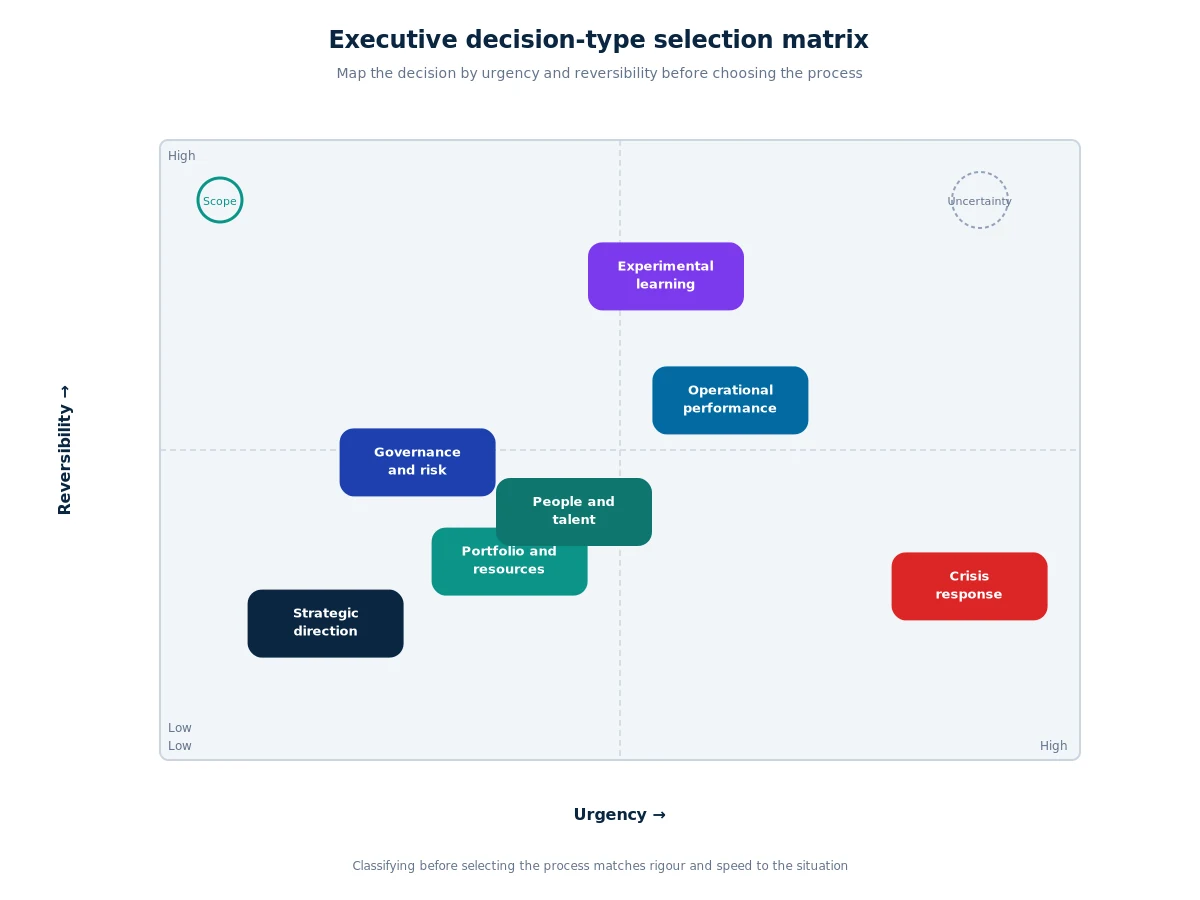
Executive decisions can be classified into seven practical types: strategic direction, portfolio and resource allocation, governance and risk, operational performance, people and talent, crisis response, and experimental learning. The correct approach depends less on a leader’s preferred style than on the decision’s scope, urgency, uncertainty, reversibility and effect on stakeholders.
This classification helps executives avoid using the same process for every issue. A multi-year investment choice needs explicit options and appraisal; a reversible pilot may need speed and safeguards; a crisis requires clear command, current evidence and review points. The sections below apply one consistent test to each type.
How the seven decision types are classified
EPW’s taxonomy uses four factors:
- Scope: whether the decision affects one team, several functions or the whole organisation.
- Urgency: how long leaders can reasonably spend gathering evidence and consultation.
- Uncertainty: how much is known about causes, options, consequences and stakeholder responses.
- Reversibility: the cost, time and harm involved in changing course after action begins.
The 2026 edition of HM Treasury’s Green Book requires risk and uncertainty to form part of balanced judgement during appraisal. HM Treasury’s Orange Book, updated on 29 July 2026, similarly treats risk management as an integral part of informed decision-making across policy, projects and everyday service delivery.
Overview of executive decision types
| Decision type | Typical horizon | Dominant question | Suitable approach |
|---|---|---|---|
| Strategic direction | Long term | Where will the organisation compete, serve or create value? | Scenario-informed choice with explicit assumptions |
| Portfolio and resources | Medium to long term | Which priorities receive scarce capital, people and attention? | Comparative appraisal and sequencing |
| Governance and risk | Ongoing | What exposure is acceptable, and who may decide? | Risk-based judgement with authority limits |
| Operational performance | Immediate to medium term | What must change to restore or improve delivery? | Evidence-led diagnosis and controlled action |
| People and talent | Medium to long term | Who should lead, develop, move or be held accountable? | Structured criteria, multiple evidence sources and fairness checks |
| Crisis response | Minutes to days | What action protects people, continuity and control now? | Clear command, rapid evidence and frequent review |
| Experimental learning | Short, bounded cycle | What is the cheapest safe way to test an important assumption? | Pilot with measures, safeguards and stop rules |
1. Strategic direction decisions
Purpose: to choose the organisation’s future position, outcomes and boundaries. Examples include entering a market, redesigning a public service, changing an operating model or committing to a major sustainability goal.
Advantages: a clear direction aligns investment and allows lower-level decisions to become faster. Limitations: long horizons create uncertainty, and apparent precision can hide fragile assumptions. Use scenario analysis, define what would change the choice and set strategic review points. This type is appropriate when the decision shapes many later decisions and is costly to reverse.
2. Portfolio and resource-allocation decisions
Purpose: to allocate scarce capital, specialist capacity and leadership attention across competing priorities. Examples include funding transformation programmes, sequencing product investments or deciding which initiatives to stop.
Advantages: comparative appraisal exposes opportunity cost and prevents every proposal from being assessed in isolation. Limitations: scoring systems can create false objectivity when criteria, evidence quality or weights are weak. Use common criteria, make dependencies visible and record why one option outranks another. This type is suitable when several worthwhile options cannot all proceed.
The Government Functional Standard GovS 010: Analysis, updated on 26 August 2025, sets expectations for analytical work that supports organisational outcomes. Executive leaders should specify the decision that analysis must inform, rather than commission data without a decision question.
3. Governance and risk decisions
Purpose: to define risk appetite, authority, controls, exceptions and accountability. Examples include accepting residual cyber exposure, approving a policy exception or setting delegated financial limits.
Advantages: explicit boundaries improve consistency and allow decisions to be made at the appropriate level. Limitations: excessive controls can suppress opportunity, while vague appetite statements fail to guide action. Use evidence about threats and opportunities, invite constructive challenge and document both the decision and conditions. This type is required when exposure affects legal duties, safety, reputation or organisational objectives.
4. Operational performance decisions
Purpose: to correct or improve recurring delivery. Examples include changing capacity, redesigning a workflow, addressing a quality failure or reallocating demand between teams.
Advantages: timely operational decisions can produce rapid benefits and generate direct evidence. Limitations: leaders may treat symptoms, optimise one measure at the expense of another or intervene below their level of authority. Diagnose the constraint, examine leading and lagging indicators, and use guardrails for quality, safety and customer impact. Use this type when performance varies from an agreed standard or outcome.
5. People and talent decisions
Purpose: to appoint, develop, deploy, reward or hold people accountable. Examples include succession choices, leadership appointments, restructuring roles and deciding how to address sustained underperformance.
Advantages: high-quality people decisions strengthen capability and signal organisational standards. Limitations: judgement can be distorted by proximity, affinity, recency and inconsistent evidence. Define criteria before comparing candidates, obtain more than one relevant evidence source, distinguish current performance from future potential and check procedural fairness. Use this type whenever the outcome materially affects a person’s role, development or career.
6. Crisis-response decisions
Purpose: to protect life, service continuity, assets, trust or control when time and information are constrained. Examples include responding to a safety incident, major cyber disruption, supply failure or fast-moving reputational event.
Advantages: a clear command structure enables rapid co-ordination and prevents paralysis. Limitations: urgency can narrow attention, suppress challenge and lock temporary assumptions into long-term choices. Define the immediate objective, appoint the decision owner, establish a verified information picture and schedule frequent review. Use crisis mode only while delay creates material harm; return to normal governance as soon as conditions permit.
Research summarised by the Association for Project Management describes critical project decisions as involving time pressure, incomplete information, shifting goals and multiple stakeholder perspectives. The practical implication is to make assumptions visible and preserve a route to reassessment.
7. Experimental-learning decisions
Purpose: to reduce important uncertainty through a controlled test. Examples include piloting a service channel, testing a pricing proposition or trialling a new operational process in one location.
Advantages: a reversible experiment can create evidence faster and more cheaply than extended debate. Limitations: poorly designed pilots may expose participants to harm, measure the wrong outcome or continue without a decision threshold. State the assumption, define success and guardrail measures, limit exposure, appoint an owner and set scale, stop or redesign rules. Use this type when uncertainty is high but a bounded test is feasible and ethically acceptable.
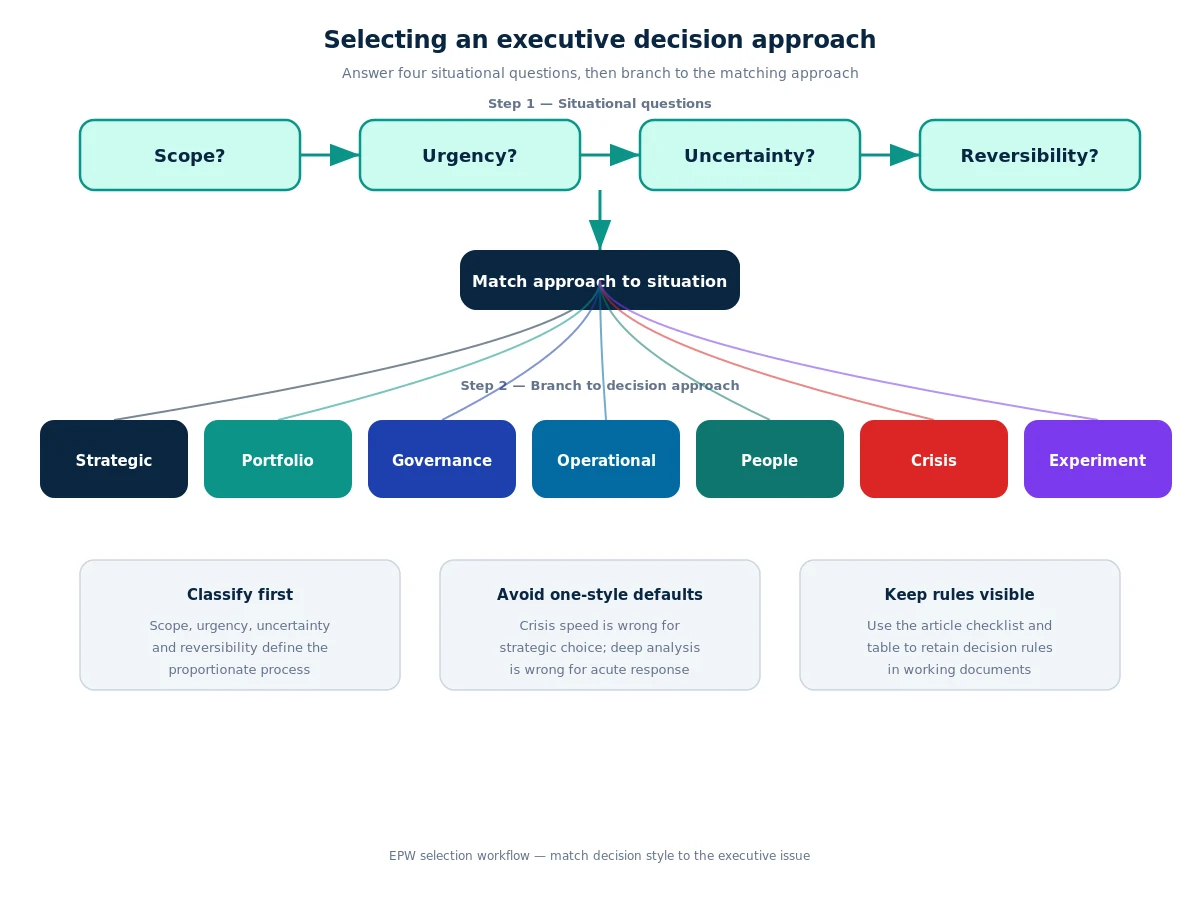
How to select the right executive decision approach
- Classify the consequence. Identify the organisational scope, affected stakeholders and potential harm or value.
- Assess urgency honestly. Distinguish a real deadline from impatience or poor planning.
- Estimate reversibility. Consider money, time, trust, legal exposure and disruption required to change course.
- Locate the main uncertainty. Is the gap about facts, causal relationships, stakeholder behaviour or future conditions?
- Choose the decision owner. Match authority and accountability to the consequence, not merely to organisational seniority.
- Select participation and evidence. Decide who must provide expertise, who is affected and who has a formal right to be consulted.
- Set review conditions. Record the decision, assumptions, measures, review date and trigger for reconsideration.
Worked example: a constrained transformation portfolio
Consider an illustrative organisation with funding for only two of four transformation proposals. The executive team first treats the issue as a strategic direction decision: which outcomes are most important over the next three years? It then treats funding as a portfolio decision, comparing benefits, dependencies, deliverability and opportunity cost.
One proposal relies on an untested customer behaviour. Instead of approving full investment, the team makes an experimental-learning decision: a three-month pilot with adoption, service-quality and cost guardrails. A separate proposal has a known information-security exposure, so the relevant executive makes a governance and risk decision within documented appetite and authority.
The example shows why a single meeting can contain several decision types. Each decision should still be labelled and governed separately. Mixing them into one undifferentiated “approve the programme” vote hides assumptions and weakens accountability.
Common classification mistakes
- Treating every senior decision as strategic: identify whether the real issue is operational, people-related or risk-based.
- Using crisis methods after urgency has passed: restore consultation, evidence and normal authority limits.
- Running a pilot without a decision rule: define what evidence leads to scale, redesign or stop.
- Using scoring as a substitute for judgement: test the criteria, weights, evidence quality and distributional effects.
- Ignoring reversibility: apply more challenge and appraisal where choices are costly or harmful to unwind.
- Leaving assumptions implicit: record what must remain true and the trigger for reassessment.
Leaders dealing with interdependent, ambiguous situations can extend these skills through EPW’s Leadership Strategies for Complex Environments course. The Strategic Thinking and Leadership Execution course supports longer-horizon choices and implementation.
Executive decision-quality checklist
- The decision type and intended outcome are stated explicitly.
- The owner has authority proportionate to the consequence.
- Options include a credible baseline or “do minimum” where relevant.
- Evidence quality, uncertainty and assumptions are visible.
- Affected stakeholders and specialist expertise are included appropriately.
- Risks include both threats and foregone opportunities.
- Reversible choices are tested at a proportionate scale.
- Irreversible or high-harm choices receive stronger appraisal and challenge.
- The decision, rationale, owner, conditions and review trigger are recorded.
Strengthen executive decision-making capability
Classifying a decision is only the start. Executives must also frame the problem, test evidence, recognise bias, facilitate challenge and communicate a defensible choice. EPW’s Driving Results through Executive Leadership course supports the follow-through from choice to accountable action.
Ready to apply executive decision-making and critical thinking in your organisation? Explore EPW’s Executive Decision Making and Critical Thinking, review available dates and locations, or request tailored in-house training.
Conclusion
Executive decisions differ in purpose and consequence. Strategic, portfolio, governance, operational, people, crisis and experimental choices each require a proportionate balance of evidence, participation, speed and control. Leaders improve decision quality by classifying the situation first, then matching the process to scope, urgency, uncertainty and reversibility.
Review EPW’s wider Management and Leadership Training Courses. To practise the selection framework and related critical-thinking techniques, explore the Executive Decision Making and Critical Thinking training course and review dates, locations or in-house delivery options.
Sources and references
- HM Treasury. The Green Book 2026. Published 5 February 2026.
- HM Treasury. The Orange Book: Management of Risk—Principles and Concepts. Updated 29 July 2026.
- UK Government Analysis Function. Government Functional Standard GovS 010: Analysis. Updated 26 August 2025.
- Association for Project Management. How to Make Better Critical Project Decisions. Published 5 May 2021.
- UK Government Project Delivery Function. The Teal Book, Chapter 20: Risk Management. Accessed 3 September 2026.