

AI-generated illustration created to represent the article’s subject. It does not depict an actual EPW course, trainer, participant, client, event or venue.
Executive communication in a difficult conversation should make the issue clear, preserve procedural fairness and produce an agreed next step. The strongest practice is to prepare evidence, choose the right setting, state the purpose without accusation, listen before judging, distinguish facts from interpretations, agree actions and document only what is necessary. Seniority does not reduce the need for care; it increases the effect of every word.
This article is for senior executives, directors, department heads and managers handling performance concerns, conflict, strategic disagreement, conduct issues or high-stakes feedback. It presents practical communication practices, explains when each should be used and provides an EPW conversation brief for consistent preparation.
Key takeaways
- Define the business issue and intended outcome before deciding what to say.
- Use specific, verifiable observations rather than labels about attitude, personality or motive.
- Explain impact without exaggeration and invite the other person’s account before reaching conclusions.
- Separate informal coaching from formal disciplinary, grievance or safeguarding procedures.
- End with explicit actions, owners, dates, support and a review point.
When a conversation becomes difficult
A conversation is difficult when the subject creates a material risk of defensiveness, loss, conflict or perceived unfairness. Typical triggers include missed commitments, repeated underperformance, executive disagreement, unacceptable behaviour, role changes, resource decisions and feedback about leadership impact.
The difficulty may come from the issue, the power difference or the history between participants. A technically correct message can still fail if it is delivered without context, evidence or an opportunity to respond. Conversely, excessive caution can leave the employee unsure what must change. Effective executive communication balances candour with dignity and procedural discipline.
Some matters should not be handled as an ordinary management conversation. Allegations of discrimination, bullying, fraud, harassment, threats, serious safety breaches or other potential misconduct may require Human Resources, legal, compliance, safeguarding or formal investigation support. The relevant organisational policy and local law take precedence over a generic communication technique.
Best-practice selection guide
| Situation | Primary communication objective | Useful practice | Important boundary |
|---|---|---|---|
| One missed commitment | Understand cause and restore delivery | Evidence-impact-question-action | Do not imply a pattern from one event |
| Repeated performance concern | Clarify the gap, support and accountability | Documented improvement conversation | Follow capability or performance policy |
| Strategic disagreement | Test assumptions and make a decision | Separate interests, evidence and decision rights | Do not personalise legitimate challenge |
| Interpersonal conflict | Reduce harm and restore workable behaviour | Neutral facilitation or mediation where suitable | Do not force mediation in unsafe or serious cases |
| Potential misconduct | Protect fairness and establish facts | Formal procedure with appropriate advice | Do not pre-judge the outcome |
| Organisational change | Explain decision, impact and available choices | Structured briefing plus genuine questions | Do not present consultation as a completed decision |
Eight executive communication practices
1. Define the issue and desired outcome
Write one sentence describing the issue in observable terms and one sentence describing what should be different afterwards. “We need to discuss the two missed client approvals and agree how decisions will be escalated” is actionable. “We need to discuss your poor attitude” is vague, personal and likely to provoke argument.
Identify whether the meeting is exploratory, corrective, consultative or formal. If the executive is still gathering information, the opening must not sound like a final judgement. If a decision has already been made within lawful authority, do not create false consultation.
2. Prepare evidence, context and uncertainty
Bring the relevant dates, commitments, results, policies and prior agreements. Separate what is verified from what was reported by others. Note gaps and alternative explanations. Evidence should support the conversation, not overwhelm it.
Ask whether the evidence is consistent across comparable people and situations. A difficult conversation can expose bias when one person is criticised for behaviour that is accepted from another. If protected characteristics, health, disability or workplace adjustments may be relevant, obtain appropriate advice before making assumptions.
3. Choose a private and proportionate setting
Use a setting that protects confidentiality, allows adequate time and avoids unnecessary status displays. For a virtual meeting, confirm privacy and stable access. Do not surprise someone with a serious issue in a corridor, group call or public chat.
The UK Health and Safety Executive’s Management Standard on relationships expects organisations to promote positive behaviours, have procedures for unacceptable behaviour and enable managers to deal with concerns. The setting and process are therefore part of responsible management, not cosmetic etiquette.
4. Open with purpose, facts and respect
A strong opening has four elements: purpose, evidence, impact and invitation. For example: “I want to discuss the delayed approvals on 8 and 15 September. The project team could not release the work as planned. I would like to understand what happened, then agree how future approvals will be handled.”
Avoid long preambles that make the other person anxious. Avoid praise that is unrelated to the issue and then abruptly reverses direction. Respect means being clear enough that the person can respond to the real concern.
5. Listen without surrendering accountability
Ask open questions, allow the answer to finish and summarise what you heard. Test understanding with neutral language: “Have I understood correctly that the approval depended on data you did not receive?” This can reveal workload, role ambiguity, conflicting instructions or a reasonable disagreement.
Listening does not require agreement. The executive can acknowledge the person’s experience while retaining responsibility for standards and decisions. If new material facts emerge, pause the conclusion and verify them rather than defending the original assumption.
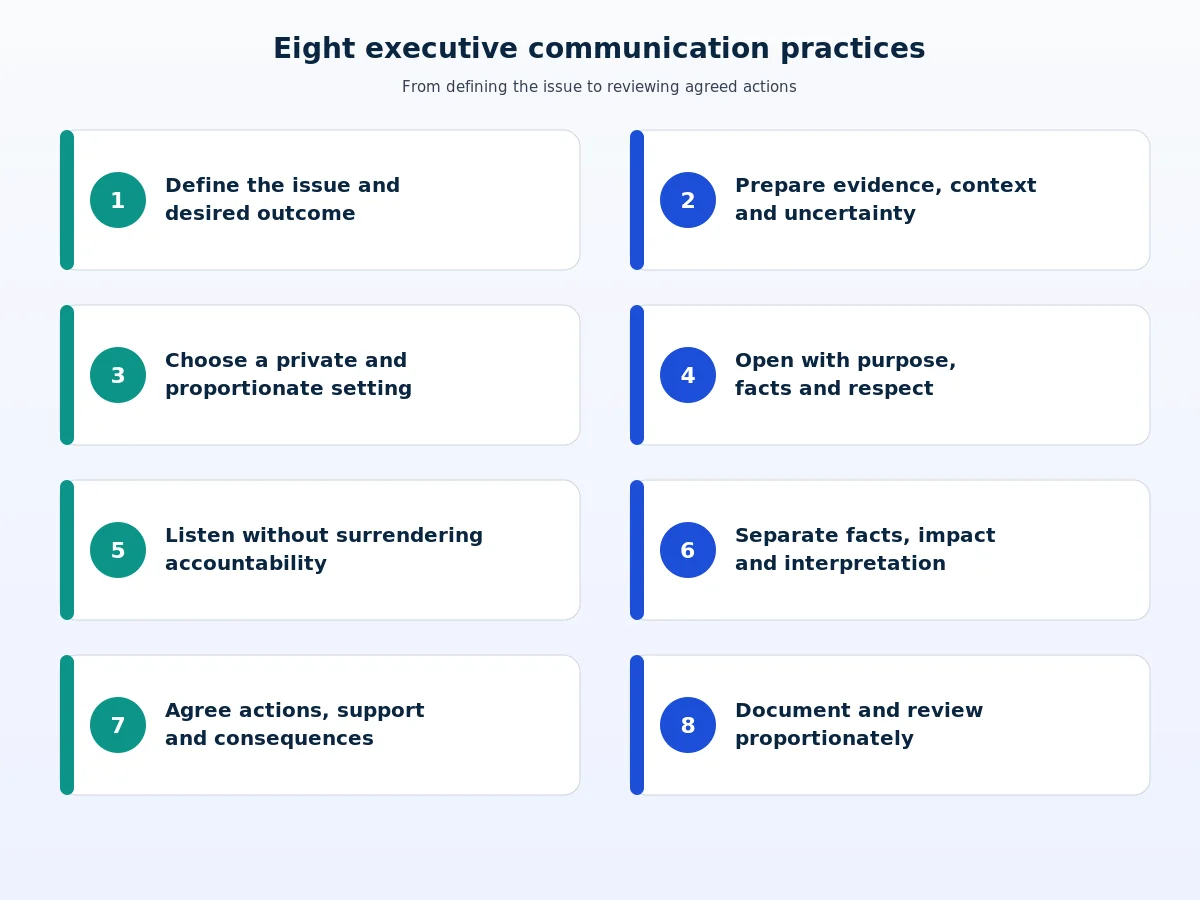
6. Separate facts, impact and interpretation
Facts are observable: a deadline, statement, result or recorded decision. Impact describes a consequence: rework, risk, delay or loss of trust. Interpretation is the meaning a person assigns, such as “careless” or “resistant”. Executives should be explicit about which is which.
This separation reduces argument about motive and keeps the discussion anchored to work. It also prevents a single behaviour from becoming a broad character judgement. When interpretation matters, present it as a perception to test: “Several colleagues experienced the interruption as dismissive; how did you see the exchange?”
7. Agree actions, support and consequences
Close the discussion by stating what will happen next. Define the required behaviour or result, accountable owner, support, deadline, evidence of completion and review date. Where consequences apply, explain them accurately and proportionately without making threats.
Acas guidance on disciplinary procedures advises employers to consider whether an issue can first be resolved informally through private discussion, listening, agreed improvements and, where relevant, training or development. It also makes clear that serious matters still require investigation and a fair procedure.
8. Document and review proportionately
Record the issue, material evidence, the other person’s response, decisions, actions and review date. Keep the language factual. Do not add speculation, emotional commentary or irrelevant personal detail. Store records according to policy and applicable data-protection rules.
Review both outcome and relationship. Has the agreed performance changed? Were support and resources provided? Did the conversation produce unforeseen effects? If the issue persists, decide whether further coaching, a changed work design or formal action is appropriate.
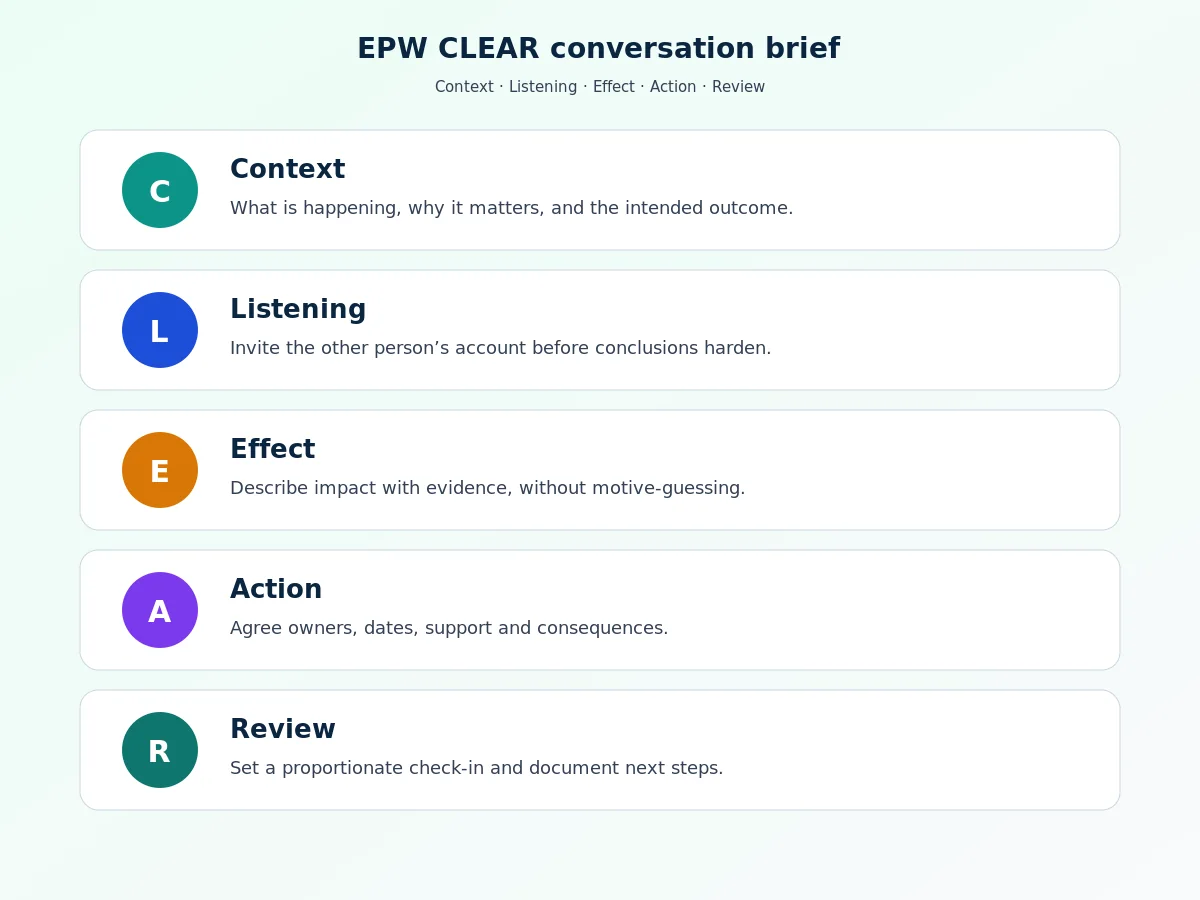
The EPW CLEAR conversation brief
EPW’s CLEAR brief gives executives a reusable one-page preparation structure:
| Element | Preparation question | Output |
|---|---|---|
| C — Context | What happened, when and under which agreement or standard? | Two or three verified observations |
| L — Listening | What do I need to understand before deciding? | Open questions and possible evidence gaps |
| E — Effect | What business, team, customer or risk impact followed? | Specific, proportionate impact statement |
| A — Action | What decision, behaviour or support is required? | Owner, action, support and deadline |
| R — Review | How will we know the issue is resolved? | Measure, review date and escalation route |
The brief does not replace organisational policy. It helps the executive enter the conversation with a clear purpose while remaining open to new evidence.
Worked example: repeated failure to escalate risk
A director has twice learned late that a project dependency threatened a regulatory milestone. The first instinct is to accuse the project lead of withholding information. Using CLEAR, the director records the two dates, the agreed escalation threshold and the resulting delay. The opening states the purpose and impact, then asks how the lead understood the threshold and what prevented escalation.
The discussion reveals that two executives gave conflicting instructions: one requested immediate escalation, while another asked the project lead to resolve issues within the team. The project lead still accepts responsibility for not seeking clarification. The agreed action is a single written escalation rule, a named decision owner, a weekly risk review for six weeks and coaching on upward communication.
The conversation remains accountable without treating an ambiguous system as an individual character failure. If the evidence had shown deliberate concealment, the director would have moved to the appropriate formal procedure.
Practices to avoid
- The “feedback sandwich”. Unrelated praise can obscure the real message and weaken trust.
- Public correction. It raises defensiveness and creates unnecessary reputational harm.
- Mind-reading. Claims about motive should not substitute for observable evidence.
- Evidence dumping. A long list of minor incidents can feel prosecutorial and distract from the material pattern.
- False urgency. Do not force an immediate answer when the person reasonably needs to check facts or seek representation.
- Premature resolution. A calm meeting is not proof that the underlying issue has changed.
- Ignoring formal boundaries. Serious allegations require fair, confidential and policy-compliant handling.
Acas guidance on bullying and discrimination complaints emphasises seriousness, fairness, sensitivity, open-minded listening, confidentiality and the need to choose an appropriate informal or formal route. Executives should apply these principles whenever the subject may involve protected rights or unacceptable behaviour.
How to measure whether the practice works
Do not measure success only by whether the meeting ended without conflict. Track clarity of agreed actions, completion by the review date, recurrence of the behaviour, time to resolve the issue, employee understanding, appeal or grievance patterns and any impact on team reporting.
Psychological safety does not mean avoiding accountability. Amy Edmondson’s original team-learning research defined it around a shared belief that a team is safe for interpersonal risk-taking. Executives can support both safety and standards by inviting relevant challenge, acknowledging uncertainty and responding consistently when people raise concerns.
Senior leaders developing broader influence skills may also review EPW’s Developing Leadership Presence and Influence and Emotional Intelligence for Executive Leadership programmes. The complete portfolio is available under Management and Leadership Training Courses.
Conclusion
Difficult conversations become manageable when executives treat them as a disciplined leadership process. Preparation creates clarity; neutral evidence protects fairness; listening improves diagnosis; explicit action preserves accountability; and proportionate follow-through determines whether the issue actually changes. The aim is not comfort. It is a truthful, respectful and procedurally sound route to a better decision or behaviour.
Ready to strengthen executive communication for high-stakes discussions? Explore EPW’s Leadership Communication for Senior Executives, review available dates and locations, or request tailored in-house training.
Sources and references
- Acas. Disciplinary Procedure: Step 1 — Understanding the Options. Updated 4 December 2025.
- Acas. Handling a Bullying or Discrimination Complaint. Updated 29 August 2025.
- Health and Safety Executive. Management Standards — Relationships. Updated 11 May 2021.
- Edmondson, A. C. Psychological Safety and Learning Behavior in Work Teams. Administrative Science Quarterly, 44(2), 1999.
- Safe Work Australia. Mental Health. Accessed 20 September 2026.
- EPW Training. Leadership Communication for Senior Executives. Accessed 20 September 2026.