

AI-generated illustration created to represent the article’s subject. It does not depict an actual EPW course, trainer, participant, client, event or venue.
A warranty clause management framework turns written promises about quality, performance and defects into operational controls. The contract team must know what is covered, when protection starts and expires, how non-conformance is proved, who must act, which remedy applies and how recovery is closed. Without that structure, valuable rights can be lost through unclear records, late notices or unmanaged interfaces.
This article presents EPW’s five-part COVER framework for commercial contracts. It is designed for contract managers, procurement teams, engineers, facilities professionals and project managers. The framework supports administration; it does not determine the legal meaning or enforceability of a clause, which depends on its wording, governing law and facts.
What should a warranty-management framework control?
Commercial warranties may address title, conformity with specifications, materials, workmanship, service standards, regulatory compliance, performance or the accuracy of stated facts. A separate guarantee or security instrument may support another party’s obligations, but terminology is not consistent across jurisdictions or industries. The signed documents must therefore be analysed rather than relying on labels.
In UK business sales of goods, section 14 of the Sale of Goods Act 1979 addresses implied terms concerning satisfactory quality and fitness for purpose in defined circumstances. Express warranties should be reviewed alongside applicable statutory rights, exclusions and remedies; they should not be administered as if they exist in isolation.
| Control field | Question to answer | Required record |
|---|---|---|
| Coverage | Which goods, services, standards and defects are covered? | Clause map and asset or deliverable register |
| Period | What event starts the period, and what extends or ends it? | Acceptance evidence and expiry calendar |
| Conditions | What maintenance, use, notice or access conditions apply? | Compliance checklist and operating records |
| Claim evidence | How will non-conformance and causation be demonstrated? | Inspection, test, photographs, logs and expert findings |
| Remedy | Who chooses repair, replacement, re-performance, refund or another response? | Claim decision and corrective-action plan |
| Recovery | Can cost and liability be passed through to another supplier? | Back-to-back clause map and recovery file |
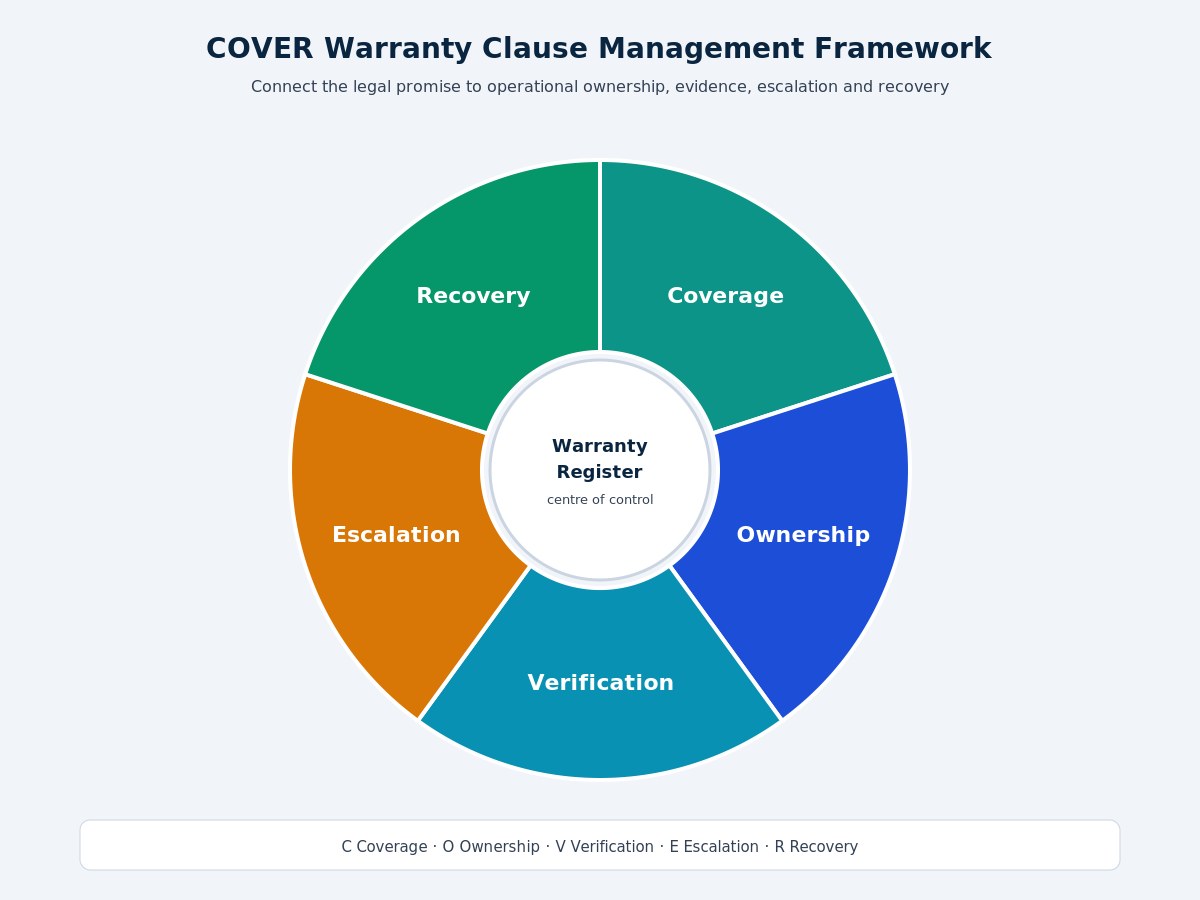
The EPW COVER warranty clause management framework
C — Define coverage and boundaries
Start by extracting each warranty into a structured register. Record the covered product, service or deliverable; required standard; exclusions; geography; start event; duration; extension rules; claim deadline; and available remedies. Link the clause to specifications, acceptance criteria, service levels, manuals and maintenance duties.
Coverage should be measurable. “High quality” is difficult to administer without defined performance, tolerance, test or outcome criteria. The UK Government’s Public Sector Contract Core Terms v1.0 provide a useful public example: goods warranties are linked to satisfactory quality, fitness for purpose and freedom from defects, while specified remedies include repair, replacement, refund or substitution. The article does not recommend copying those terms; it illustrates how standards and remedies can be connected.
O — Assign ownership and interfaces
Allocate an owner for every warranty group and identify technical reviewers, contract authority, site or operations contact, supplier lead and legal escalation point. Clarify who accepts delivery, starts the warranty clock, reports a defect, approves access and confirms closure.
Map interfaces carefully. A main supplier’s warranty may depend on equipment provided by a subcontractor, maintenance performed by the buyer or data supplied by another vendor. Back-to-back periods and remedies should be compared so that the organisation does not promise more downstream than it can recover upstream.
V — Verify performance and preserve evidence
Verification should begin before handover. Establish inspection and test plans, acceptance evidence, serial or asset identification, baseline condition, operating records and defect-classification rules. When a problem occurs, capture the date, symptoms, affected output, safety implications, photographs, logs, samples, witness accounts and immediate containment.
Do not wait for a dispute before organising evidence. The Australian Government’s Contract Management Guide emphasises planned governance, performance monitoring, records and issue management throughout the contract lifecycle. Those disciplines are directly relevant to proving a warranty claim and evaluating the supplier’s corrective action.
E — Escalate claims and select remedies
Create severity levels and response times. A minor cosmetic defect may follow a routine repair route; a recurring performance failure, safety concern or service outage may require immediate containment, formal notice, executive escalation and legal advice. The notice must satisfy the contract’s recipient, address, method, content and time requirements.
Then assess the remedy matrix. Consider repair, re-performance, replacement, refund, price reduction, service credit, third-party completion, extension of the warranty period, recovery of documented costs and any applicable liability limit. The contract may give the remedy choice to one party or make a remedy exclusive, so teams should not improvise a settlement without authority.
R — Recover, close and learn
Closure requires more than marking the defect “fixed”. Confirm the remedy against acceptance criteria, identify replaced parts or re-performed services, update the warranty expiry where the contract provides an extension and reconcile recoverable cost. Obtain formal evidence of completion and preserve the audit trail.
Analyse trends across suppliers, assets and defect types. Recurring failures may justify root-cause review, design change, supplier development, revised inspection, stronger specifications or a different risk allocation in the next procurement. Recovery data should inform commercial decisions without turning every minor defect into an adversarial claim.
Worked example: repeated failure of a critical component
A newly commissioned facility experiences three failures of the same control component within four months. The contract provides a 12-month warranty from acceptance, repair or replacement obligations and an extension for corrected items. The immediate operational priority is safe containment and service restoration.
Using COVER, the manager confirms that the component and failure mode fall within coverage; assigns engineering, contract and supplier owners; preserves installation, maintenance and fault-log evidence; issues the required notice; and requests root-cause analysis. The remedy decision compares replacement, redesign and third-party support against the clause, urgency and operational risk.
Closure occurs only after testing confirms performance, costs are reconciled and the revised expiry date is recorded. The team then checks whether the same component appears elsewhere and whether the failure signals a systemic defect. This prevents an isolated repair from concealing a portfolio-level exposure.
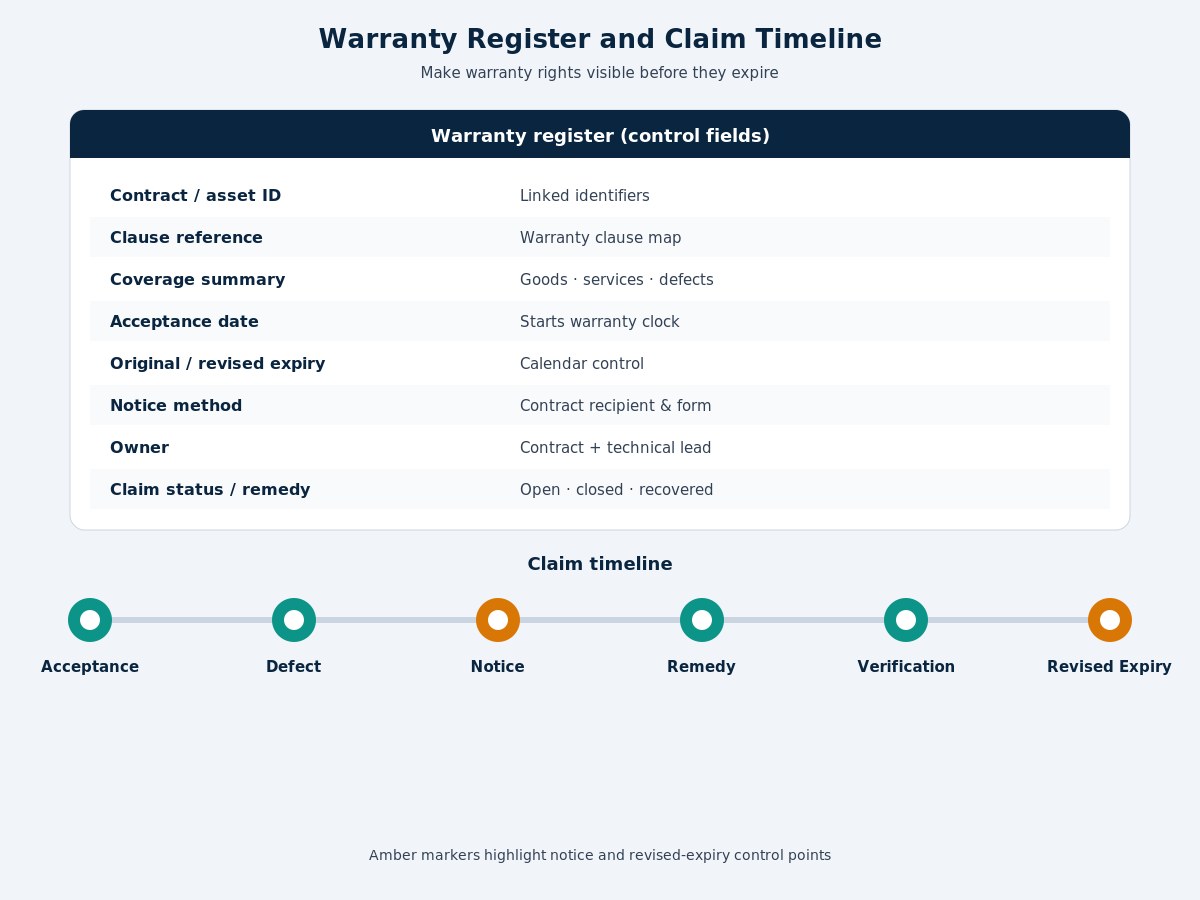
Warranty register fields and useful measures
A proportionate register should include contract and asset identifiers, clause reference, supplier, coverage summary, acceptance date, original and revised expiry, notice method, owner, open claim status, remedy, cost, evidence link and closure approval. High-volume environments may integrate these fields with enterprise asset management or contract lifecycle management systems.
Measures should support action rather than inflate reporting. Useful indicators include:
- open defects by severity and age;
- claims approaching a notice or expiry deadline;
- supplier acknowledgement and remedy cycle time;
- first-time repair or re-performance success;
- repeat failures by component, service or root cause;
- recoverable cost identified, agreed and received; and
- items closed without complete acceptance evidence.
Targets must reflect contract terms and operational context. A fast closure rate is not positive if defects are closed prematurely or recurring causes remain unresolved.
Governance gates before warranty expiry
- At handover: reconcile deliverables, acceptance records, asset data, manuals, spares, guarantees and security instruments.
- During the period: review defects, notices, remedies, extensions, costs and repeat-failure trends at an agreed cadence.
- Before expiry: perform a targeted inspection or performance review early enough to investigate and notify defects properly.
- Before releasing security: confirm outstanding defects, claims, documentation and any continuing obligations.
- At closeout: record residual issues, lessons and improvements for future specifications and supplier evaluation.
UK Infrastructure and Projects Authority guidance for PFI contract managers similarly highlights monitoring defects so they are resolved before the applicable defects period expires. The specific allocation in a PFI arrangement should not be generalised to other contracts, but the control principle—active review before rights lapse—is widely useful.
Build stronger warranty and guarantee controls
EPW’s Warranty and Guarantee Clauses Management course covers coverage and duration, exclusions, remedies, claim evidence, parent-company guarantees, bonds, supplier recovery, expiry control and closeout. Explore related programmes in EPW’s Contracts Management and Law training portfolio.
Professional review flag: Warranty, guarantee, implied-term, limitation and remedy rules vary by jurisdiction, contract type and sector. Qualified legal counsel should review the final article before publication and advise on live claims, notices, exclusions, security instruments or release decisions. This article is general information, not legal advice.
Sources and References
- EPW — Warranty and Guarantee Clauses Management Course
- UK Parliament — Sale of Goods Act 1979, section 14
- UK Parliament — Supply of Goods and Services Act 1982
- UK Government — Public Sector Contract Core Terms v1.0
- Australian Government Department of Finance — Contract Management Guide
- UK Infrastructure and Projects Authority — NISTA Contract Management Guidance: PFI Foundations