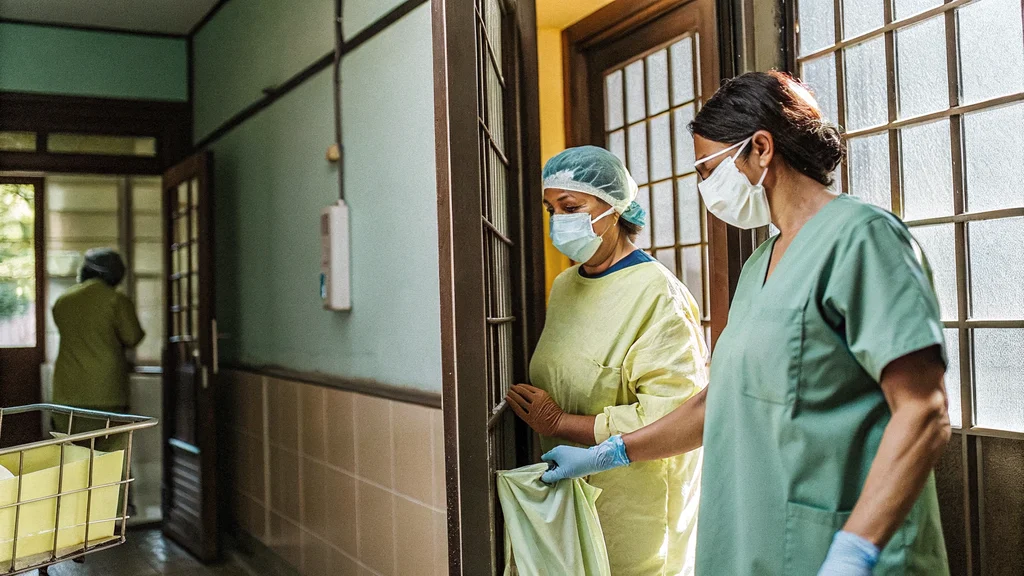
AI-generated illustration created to represent the article’s subject. It does not depict an actual EPW course, trainer, participant, client, event or venue.
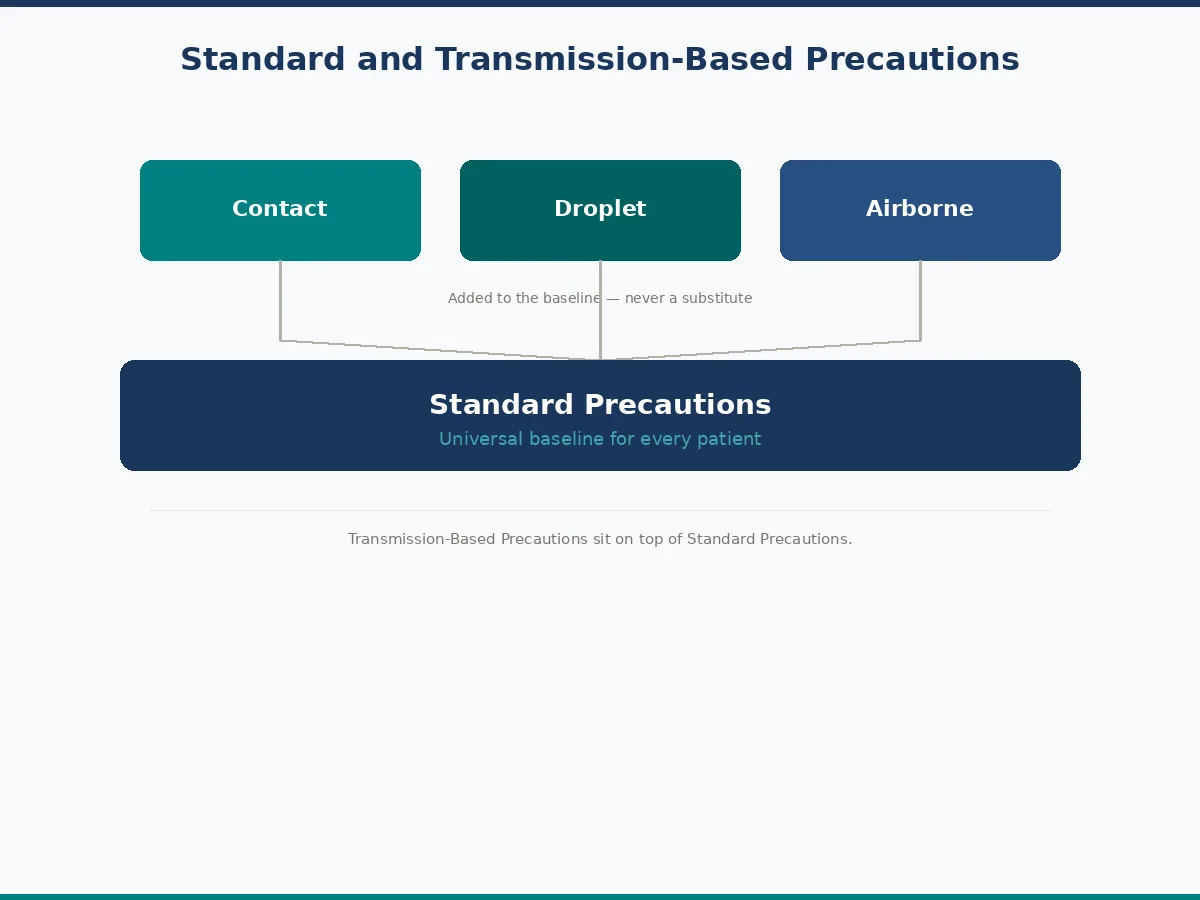
Standard Precautions apply to every patient, in every care setting, regardless of diagnosis. Transmission-Based Precautions are additional measures used when a patient is known or suspected to carry an infectious agent that requires Contact, Droplet or Airborne controls. Healthcare teams therefore do not choose one system instead of the other: they use Standard Precautions as the permanent baseline and add transmission-specific controls when the risk assessment indicates them.
This distinction matters to infection-prevention leaders, nurses, physicians, environmental-services teams and hospital managers because the two tiers affect patient placement, personal protective equipment (PPE), movement, equipment and cleaning. Confusing them can produce either insufficient protection or unnecessary isolation.
Key takeaways
- Standard Precautions are universal. They are used for all patient care and are selected according to the anticipated exposure.
- Transmission-Based Precautions are additional. They supplement, rather than replace, the standard tier.
- The additional categories are Contact, Droplet and Airborne Precautions; more than one may be required.
- The correct decision depends on the suspected or confirmed pathogen, route of transmission, clinical procedure, care setting and local or national guidance.
- Good implementation requires clear triggers, accessible supplies, staff competence, communication, auditing and prompt review.
Contents
- Standard vs Transmission-Based Precautions
- What Standard Precautions include
- Types of Transmission-Based Precautions
- How to select the correct precautions
- Implementation and common errors
Standard Precautions vs Transmission-Based Precautions
| Comparison point | Standard Precautions | Transmission-Based Precautions |
|---|---|---|
| Who they apply to | Every patient, regardless of diagnosis or infection status | Patients known or suspected to have an infection or colonisation needing additional controls |
| Relationship | The first, universal tier of infection prevention | The second tier, added to Standard Precautions |
| Decision basis | Risk assessment of the task and anticipated exposure to blood, body fluids, secretions, excretions, non-intact skin or mucous membranes | Likely or confirmed route of transmission, clinical syndrome, pathogen and setting |
| Main categories | Hand hygiene, risk-based PPE, respiratory hygiene, safe injections, sharps safety, environmental cleaning, equipment reprocessing, linen and waste controls | Contact, Droplet and Airborne Precautions |
| Patient placement | Appropriate placement according to the ordinary clinical and risk assessment | May require a single room, cohorting or an airborne infection isolation room, depending on the category and setting |
| Duration | Continuous throughout care | Maintained and reviewed according to the infection, symptoms, test results and applicable guidance |
| Signage and communication | Embedded in routine procedures and point-of-care practice | Usually supported by specific signage, handover information and transfer controls |
The US Centers for Disease Control and Prevention (CDC) describes Standard Precautions as practices used for all patient care, based on a risk assessment, to protect healthcare personnel and prevent patient-to-patient spread.1 The CDC defines Transmission-Based Precautions as the second tier, used in addition to the standard tier when particular infectious agents require more controls.2
What do Standard Precautions include?
Standard Precautions are not a single fixed PPE set. Staff select measures after assessing the activity, the likely contact with infectious material and the possibility of splash, spray, sharps injury or contaminated surfaces. The baseline system normally includes:
- hand hygiene at the appropriate moments;
- gloves, gowns, masks and eye or face protection when the anticipated exposure requires them;
- respiratory hygiene and cough etiquette;
- safe injection and sharps practices;
- appropriate patient placement;
- cleaning and disinfection of the environment;
- safe handling and reprocessing of patient-care equipment;
- safe management of textiles, laundry and waste.
The important management principle is consistency. A patient without a recognised infection can still present a transmission risk, which is why the standard tier cannot depend on a positive test or a warning label. WHO explains that Standard Precautions are intended to reduce transmission from both recognised and unrecognised sources and to protect patients as well as health workers.3
Organisations should connect these practices to the wider governance system. EPW’s Clinical Governance and Patient Safety Systems course examines how policy, accountability, assurance and learning support reliable clinical controls.
What are the types of Transmission-Based Precautions?
Contact Precautions
Contact Precautions reduce spread through direct contact with a patient or indirect contact with the patient’s environment. CDC guidance includes appropriate placement, gloves and gown for relevant interactions, limiting medically unnecessary transport, dedicating equipment where possible and prioritising cleaning of frequently touched surfaces.2
Droplet Precautions
Droplet Precautions address pathogens transmitted through respiratory droplets. Controls may include source control for the patient, prompt placement, a mask for staff on entry to the room or care space, respiratory-hygiene measures and limits on movement. The exact PPE and placement rules must follow current jurisdictional and facility guidance.
Airborne Precautions
Airborne Precautions address pathogens capable of airborne transmission. They may require an airborne infection isolation room and a fit-tested, approved respirator for healthcare personnel. The CDC lists tuberculosis, measles, chickenpox and disseminated herpes zoster as examples in its current guidance.2
A patient may need a combination of categories. The label should therefore follow a documented assessment rather than an assumption that every infection fits only one box. Leaders can strengthen this decision discipline through Healthcare Risk Management and Compliance training and EPW’s supporting article on healthcare risk management.
How should healthcare teams select the correct precautions?
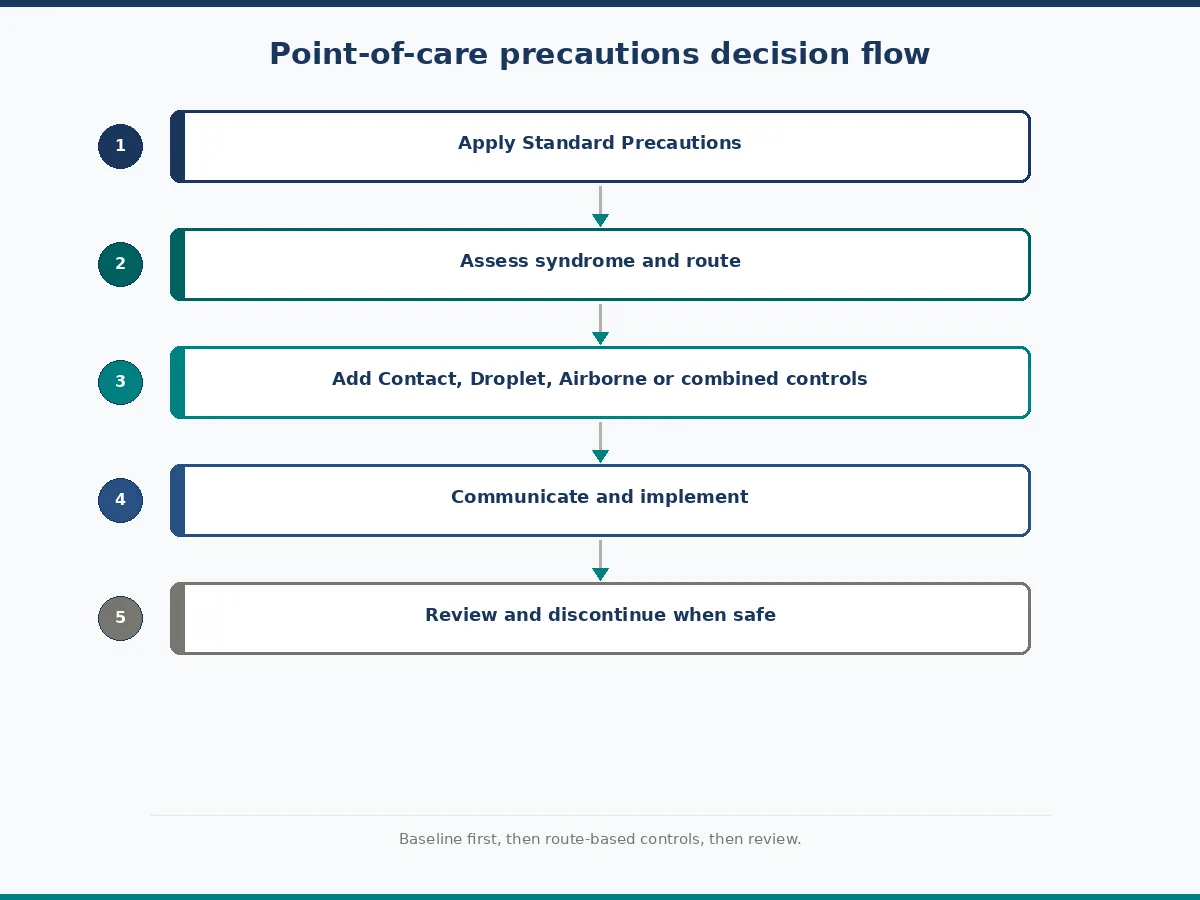
Use a short, auditable decision sequence:
- Apply Standard Precautions first. Assess the procedure and anticipated exposure before contact begins.
- Identify the clinical syndrome or known agent. Do not delay necessary additional controls while awaiting confirmation when suspicion is sufficient under current guidance.
- Determine the likely transmission route. Consider contact, droplet, airborne or a combination.
- Select the additional controls. Specify placement, PPE, equipment, cleaning, transport and communication requirements.
- Check operational feasibility. Confirm that the required room, supplies, fit testing and trained staff are available, and escalate gaps.
- Document and communicate. Use approved signage and include the precautions in handovers and transfers without disclosing unnecessary personal information.
- Review continuation and discontinuation. Reassess when clinical information, laboratory results or applicable public-health advice changes.
A practical example
A patient arrives with fever, cough and a clinical history that raises concern about an airborne infection. Staff continue all Standard Precautions, including hand hygiene and risk-based PPE. They also initiate the facility’s Airborne Precautions pathway, arrange suitable placement, use the required respirator, control transport and alert the receiving team. If another route is relevant, the team adds those controls too.
This example shows why “standard versus transmission-based” is not an either-or choice. The operational question is: which additional measures must sit above the universal baseline for this patient, task and setting?
Common implementation errors
- Treating Standard Precautions as optional: a known diagnosis is not required before routine controls apply.
- Using a fixed PPE bundle for every task: Standard Precautions require task-specific risk assessment.
- Replacing the baseline with isolation signage: additional precautions do not cancel hand hygiene, safe injections or equipment controls.
- Waiting too long for confirmation: suspected transmissible infection may justify prompt additional precautions under approved guidance.
- Over-isolating without review: unnecessary restrictions can consume resources and affect care, so continuation should be reassessed.
- Weak handover: transport and receiving teams need clear, proportionate information about current controls.
- Training without observation: knowledge checks should be complemented by competency assessment, supply checks and audit feedback.
Reliable precautions depend on workflow design as well as individual knowledge. EPW’s Hospital Operations and Quality Improvement course helps managers connect safety requirements with patient flow, staffing and continuous improvement.
Ready to strengthen infection-control decision-making in your organisation? Explore EPW’s Infection Prevention and Control Best Practices course for practical work on governance, surveillance, precautions, outbreak response and sustained implementation.
Frequently asked questions
Are Standard Precautions the same as universal precautions?
No. “Universal precautions” is an older, narrower concept focused principally on blood and certain body fluids. Standard Precautions are broader and include measures such as respiratory hygiene, environmental controls and equipment handling.
Can Transmission-Based Precautions be used without Standard Precautions?
No. They are designed as an additional tier. The standard controls continue while the transmission-specific measures are in place.
Does every patient on Transmission-Based Precautions need the same PPE?
No. PPE depends on the category, task, anticipated exposure and applicable guidance. Contact, Droplet and Airborne Precautions have different requirements, and some situations require combined controls.
Who decides when additional precautions end?
The responsible clinical and infection-prevention teams should follow current national, public-health and facility criteria. The decision may depend on the pathogen, symptoms, treatment, test results and patient factors.
Conclusion
Standard Precautions are the universal foundation of safe care. Transmission-Based Precautions add targeted Contact, Droplet or Airborne measures when the infection risk demands more protection. Hospitals should make the relationship explicit in policies, training, signage, handovers and audits so staff can act promptly without confusing the two tiers.
Explore EPW’s Healthcare and Hospital Management Training Courses to build wider capability in patient safety, risk, quality and hospital operations.
Sources and references
- Centers for Disease Control and Prevention. Standard Precautions for All Patient Care. Updated 3 April 2024.
- Centers for Disease Control and Prevention. Transmission-Based Precautions. Updated 3 April 2024.
- World Health Organization. Core components for infection prevention and control. Includes 2022 aide-memoires on Standard and Transmission-Based Precautions.