

AI-generated illustration created to represent the article’s subject. It does not depict an actual EPW course, trainer, participant, client, event or venue.
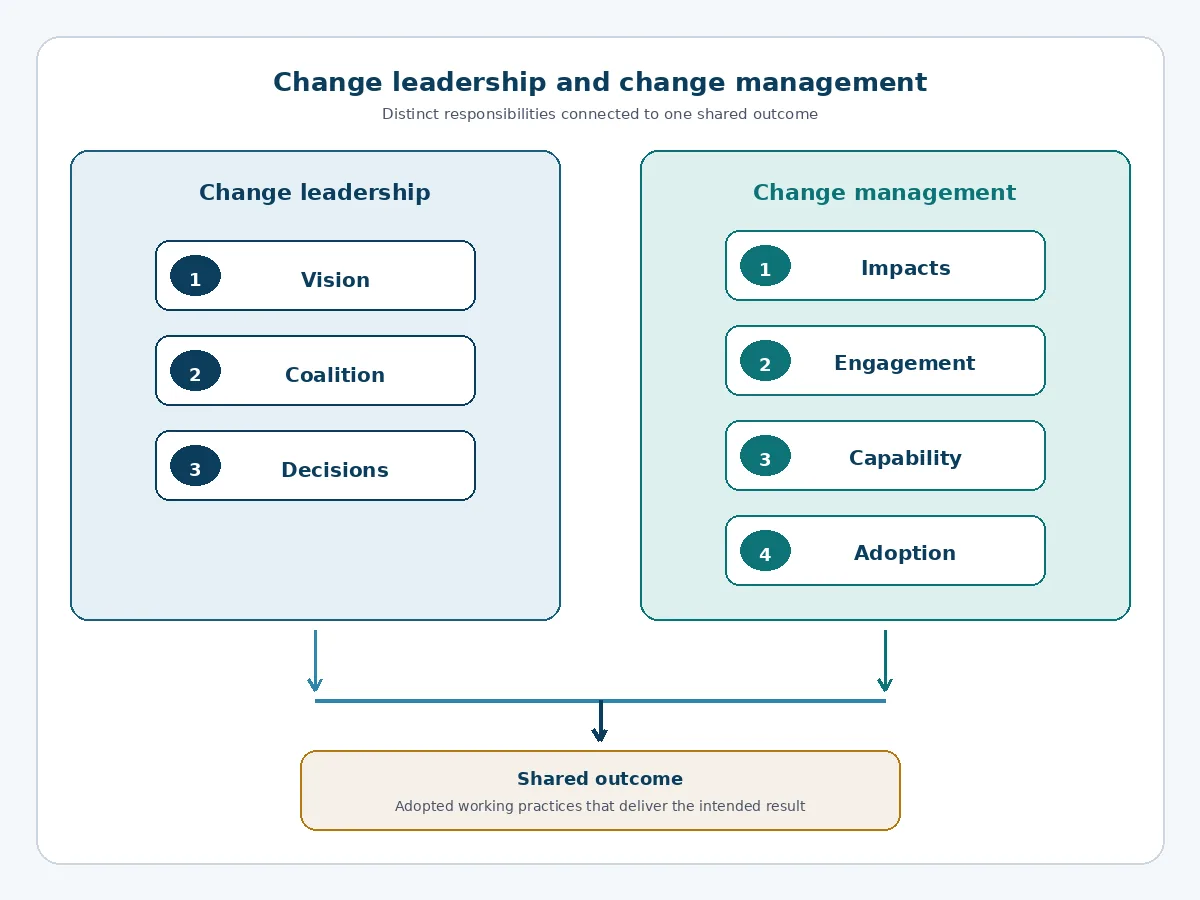
Change leadership sets direction, builds commitment and mobilises people around a different future; change management provides the structured work needed to move people, processes and systems from the current state to that future. Senior sponsors therefore should not choose one instead of the other. They should distinguish the accountabilities, then connect them.
The terms are often used interchangeably, which obscures decisions about sponsorship, governance and delivery. This comparison gives transformation sponsors, programme leaders and change professionals explicit criteria for deciding what each discipline must contribute.
The immediate distinction
Change leadership answers: Why must we change, what future are we creating, and who must commit to it? Change management answers: Who is affected, what must change for them, and how will adoption be planned, supported and measured?
The Association for Project Management defines change management as a structured approach for moving an organisation from its current state to a desired future state. UK government guidance similarly describes it as a systematic approach to planning, implementing and embedding change so that intended outcomes and benefits are realised, not merely outputs delivered.
Change leadership and change management compared
| Criterion | Change leadership | Change management |
|---|---|---|
| Primary purpose | Create strategic direction, urgency and collective commitment | Enable people and the organisation to adopt defined changes |
| Core question | What future should we pursue, and why now? | What will change for each affected group, and how will adoption occur? |
| Typical owners | Executive sponsor, senior leadership coalition and accountable business leaders | Change lead or manager, workstream owners, line managers and change agents |
| Time horizon | Strategic and often longer than an individual project | Aligned to the change life cycle, transition and embedding period |
| Main methods | Vision, narrative, role modelling, coalition-building and strategic decisions | Impact and readiness assessment, stakeholder engagement, communications, learning, transition and reinforcement |
| Primary evidence | Clarity of direction, visible sponsorship, decision alignment and sustained commitment | Readiness, participation, adoption, capability, use of new practices and benefits realisation |
| Common failure | Compelling language without operating decisions or resources | Well-run activity plans without credible purpose or senior ownership |
What the two disciplines have in common
Both are concerned with achieving a future state through people. Both require stakeholder understanding, communication, decisions, feedback and reinforcement. Both also fail when they are treated as isolated communications exercises.
The UK Government Project Delivery Function’s Teal Book chapter on organisational and societal change, published on 29 July 2024 and updated on 1 July 2026, connects a compelling vision with impact assessment, readiness, planning, embedding and outcome validation. In practice, vision and implementation belong in one governance system even when different roles lead them.
Where the differences matter
Direction versus transition
A change leader frames the strategic problem, chooses the direction and makes trade-offs visible. A change manager translates that direction into the practical transition for affected groups. If a public body introduces a new case-management service, leadership must define the intended service outcome and non-negotiable principles; management must determine how roles, skills, workflows, measures and support will change.
Authority versus orchestration
Senior leaders can allocate resources, settle competing priorities and hold business owners to account. Change managers often work through influence rather than positional authority. Government’s Project Delivery Capability Framework describes the change manager as a bridge between a project and business users, coordinating activities that help the organisation implement the agreed change and realise benefits.
Commitment versus adoption
Commitment is the willingness of influential people to support a direction and make consistent decisions. Adoption is the observable use of new behaviours, processes or systems. A sponsor’s town-hall message may demonstrate commitment, but it does not prove that frontline teams can use a new system accurately under normal workload.
Strategic signals versus operational measures
Leadership measures include the consistency of executive decisions, speed of issue resolution and strength of the guiding coalition. Management measures include readiness by stakeholder group, training completion where it predicts capability, process use, proficiency, exceptions and realised benefits. Activity counts alone—emails sent or meetings held—do not demonstrate either success.
Worked example: a cross-sector service transformation
Consider an illustrative organisation replacing fragmented approval processes with one digital workflow. The executive sponsor states the outcome: faster, more transparent decisions with a complete audit trail. The sponsor also resolves a disputed policy issue and requires every business unit to adopt one set of decision rights. Those are change-leadership actions because they create direction, authority and alignment.
The change manager maps affected roles, identifies where local practices conflict with the new workflow, assesses readiness and builds a transition plan. Line managers rehearse new approval scenarios, subject specialists validate guidance, and adoption data are reviewed by unit. Those are change-management actions because they convert the strategic intent into capability and routine practice.
The distinction improves accountability. It does not create a hand-off. When adoption data show that one unit still bypasses the workflow, the change manager diagnoses the barriers; the sponsor removes conflicting incentives and reinforces the decision. Leadership and management operate as a loop.
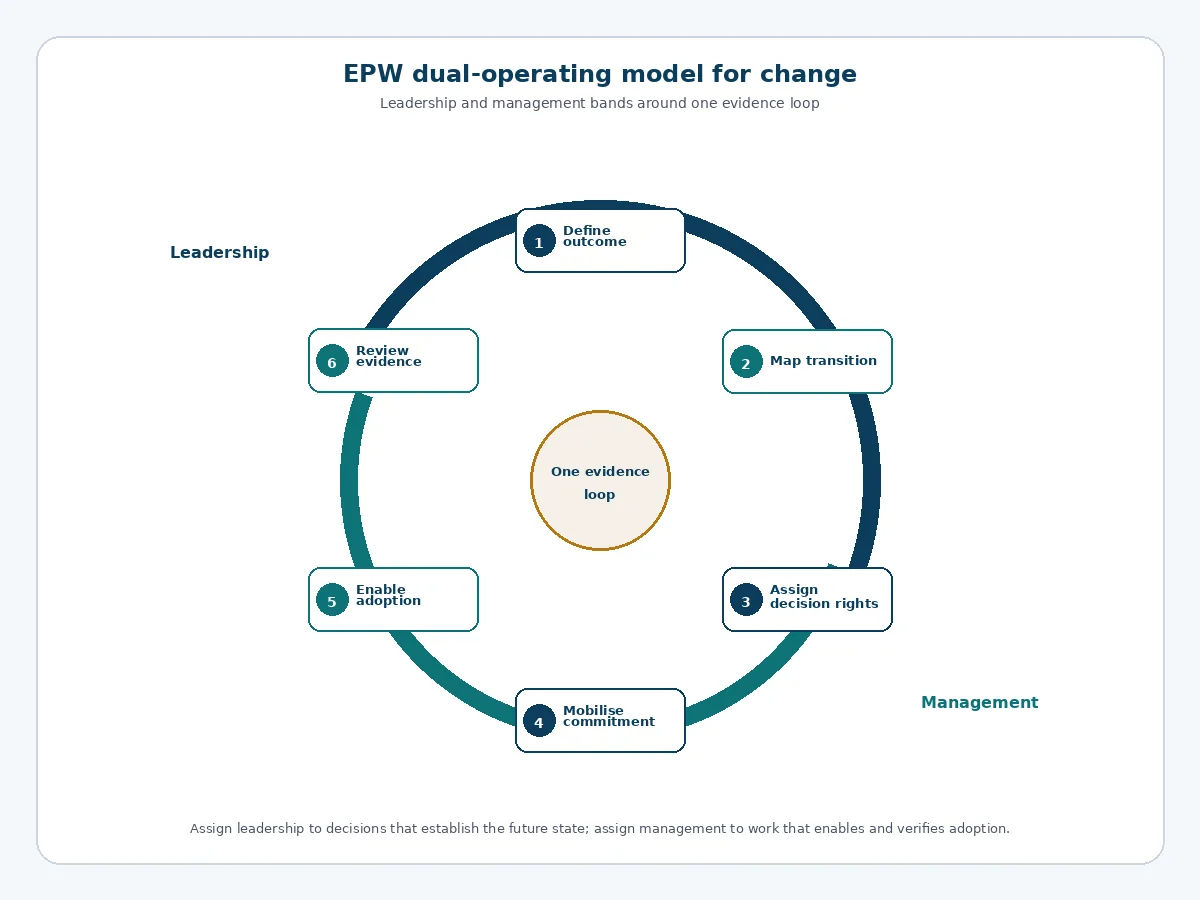
EPW’s dual-operating model for change
Use the following decision rule: assign leadership to the decisions that establish or protect the future state, and assign management to the work that prepares, enables and verifies adoption. Connect the two through a single outcome review.
- Define the outcome. The sponsor states the intended organisational result, the case for change and the boundaries that will not move.
- Map the transition. The change lead identifies affected groups, impacts, dependencies, readiness and capability requirements.
- Assign decision rights. Record which issues require sponsor authority, business-owner action or change-team coordination.
- Mobilise commitment. Leaders align their messages, decisions, resources and role-modelling with the stated future.
- Enable adoption. Managers provide involvement, communications, learning, local support and process controls suited to each affected group.
- Review one evidence set. Combine leadership indicators, adoption measures and benefit measures so governance can act on causes rather than symptoms.
For organisations operating across government and commercial settings, the Local Government Association’s transformation capability framework is a useful reminder that change capability spans culture, structures, process, people and technology. A narrow workstream plan cannot resolve misalignment across all of those dimensions without leadership decisions.
When should each be used?
Use explicit change leadership when the future direction is contested, cross-functional trade-offs are unresolved, senior behaviour is inconsistent, or people do not believe the case for change. The work may begin before a formal programme and continue after project closure.
Use formal change management when specific groups must work differently, implementation involves multiple dependencies, readiness varies, capability must be built, or benefits depend on sustained adoption. The need rises with the scale, diversity and operational risk of the transition.
Use both for almost every material transformation. Small, low-risk adjustments may need only proportionate management and visible local leadership. Large policy, operating-model, technology or culture changes require a coordinated system.
Responsibility and readiness checklist
- Is the future outcome specific enough to guide trade-offs?
- Is one accountable sponsor visibly making the decisions only that role can make?
- Have affected groups and material impacts been identified?
- Are business owners accountable for adoption rather than leaving it to a central team?
- Do communications explain decisions and consequences, not merely announce activity?
- Can teams demonstrate capability in realistic work conditions?
- Do governance reports combine commitment, adoption and benefit evidence?
- Is there a response when evidence shows local incentives or policies contradict the change?
These questions also help leaders decide where development is required. EPW’s Strategic Thinking and Leadership Execution course supports the connection between direction and delivery, while Strategic Influence and Persuasion training develops the stakeholder judgement needed when authority alone is insufficient.
Common errors and how to correct them
- Treating sponsorship as ceremonial: give the sponsor a decision calendar, named outcomes and visible responsibilities.
- Calling every activity leadership: distinguish strategic choices from coordination so important management work has clear ownership.
- Reducing change management to communications and training: include impacts, readiness, stakeholder involvement, transition controls, reinforcement and benefits.
- Separating the teams: use shared governance, dependencies and evidence instead of parallel status reports.
- Measuring sentiment without behaviour: combine qualitative feedback with evidence that new practices are used correctly.
The APM Competence Framework describes transition management as integrating change outputs into business as usual so they enable intended value. That reinforces the practical test: the organisation must operate differently, not simply complete a launch plan.
Develop the capability to lead and manage change
Leaders who understand the distinction can commission better plans, provide stronger sponsorship and intervene at the right level. Change professionals can also escalate decisions more precisely when barriers sit outside their authority.
Ready to apply change leadership in your organisation? Explore EPW’s Change Leadership in Government and Private Sectors, review available dates and locations, or request tailored in-house training.
Conclusion
Change leadership and change management are not rival labels. Leadership establishes direction, commitment and authoritative choices; management prepares people and systems, enables adoption and verifies that the change works. The strongest transformations define both sets of responsibilities and govern them through shared outcomes.
For related development options, review EPW’s Management and Leadership Training Courses. To turn the comparison into practical action, explore the Change Leadership in Government and Private Sectors training course and review dates, locations or in-house delivery options.
Sources and references
- UK Government Project Delivery Function. The Teal Book, Chapter 35: Management of Organisational and Societal Change. Published 29 July 2024; updated 1 July 2026.
- Association for Project Management. What Is Change Management and Organisational Change?. Accessed 2 September 2026.
- UK Government Project Delivery Function. Project Delivery Capability Framework: Change Manager G6. Accessed 2 September 2026.
- Local Government Association. Transformation Capabilities: Change Management. Accessed 2 September 2026.
- Association for Project Management. APM Competence Framework: Preparing for Change. Accessed 2 September 2026.