
Think for example about how computer vision will completely change our world. Increasingly, computers won’t need to be told anything– they will already know it as soon as they see it. As tech companies race to build smarter machines that can process and understand visual data with the same finesse that humans have, they push themselves further towards AGI. If you’re new to AI and want to get started with computer vision, this beginner’s guide introduces the basics, main tools and real-life applications, helping you lay a solid foundation for further study in this direction.
What is Computer Vision?
Computer vision is a subset of AI allowing computers to interpret visual information in the world around them – say by processing photos and videos. Through building machines that see the world as our eyes do, in which objects are recognized, imagery has been made machine-readable, and decisions based on what a camera “sees” you will find this technology applied everywhere. It is now widely used in robotics, healthcare industries, car business and more: applications that range from face recognition to surveillance are all dependent on computer vision.
Core Concepts in Computer Vision
- Image Processing: The manipulation and enhancement of images to make them suitable for analysis.
- Object Detection: Identifying and locating specific objects within images or videos.
- Feature Extraction: Extracting meaningful patterns from images, like edges, textures, and shapes.
- Machine Learning: A subset of AI used to train computers to recognize and classify objects based on visual data.
Why Learn Computer Vision?
Learning computer vision opens up numerous career opportunities in AI, robotics, and beyond. With the increasing reliance on automation, industries across the globe are adopting computer vision to improve processes, enhance user experiences, and drive innovation. As a beginner, taking a computer vision course for beginners will help you gain the essential skills needed to leverage this technology, whether you’re pursuing a career in AI or just exploring the possibilities.
Key Tools and Technologies for Beginners in Computer Vision
In any computer vision course for beginners, you’ll encounter a variety of tools and technologies designed to help you implement visual data analysis. Below are some of the essential tools that will help you get started:
Python
Python is the most widely used programming language in computer vision due to its simplicity and the vast array of libraries available for visual data processing.
OpenCV
OpenCV (Open Source Computer Vision Library) is an open-source library that provides over 2,500 optimized algorithms for real-time computer vision tasks, such as image processing, face detection, and object recognition.
TensorFlow and Keras
These deep learning frameworks are essential for more complex tasks, including image classification and object detection. TensorFlow, along with Keras, simplifies the process of building and training neural networks for computer vision applications.
Matplotlib
A Python library for creating static, animated, and interactive visualizations. Matplotlib is useful for plotting and visualizing images and the results of computer vision models.
Common Applications of Computer Vision
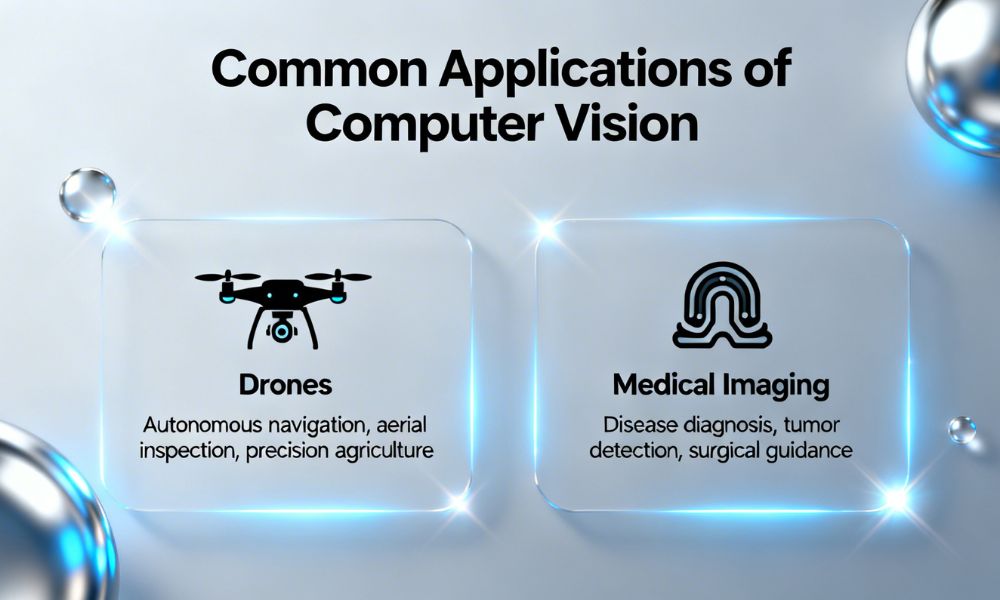
Computer vision has applications across various industries. As a beginner, understanding these real-world use cases will help you grasp the practical implications of the technology.
Healthcare
Medical Imaging: Computer vision algorithms help analyze medical images (such as X-rays, MRIs, and CT scans) to detect abnormalities like tumors and fractures.
Surgical Assistance: Augmented reality (AR) and computer vision help guide surgeons in performing precise surgeries by overlaying relevant data onto their field of view.
Autonomous Vehicles
Self-driving cars utilize computer vision to detect objects, pedestrians, road signs, and navigate complex environments safely.
Retail and E-commerce
Computer vision is used to track inventory, improve customer experiences with virtual try-ons. And analyze customer behavior in physical stores or on e-commerce websites.
Security and Surveillance
Surveillance cameras equipped with computer vision can detect intruders, monitor crowd movement, and even perform facial recognition for security purposes.
Essential Skills You Will Learn in a Computer Vision Course for Beginners
A beginner’s course in computer vision will teach you essential skills and techniques that lay the groundwork for mastering the field. Key learning outcomes include:
- Programming: Python is the go-to language for computer vision, and learning its libraries is crucial for implementing visual data analysis.
- Computer Vision Algorithms: You’ll learn how to apply image processing techniques like filtering, edge detection. And image segmentation to solve real-world problems.
- Machine Learning Models: You’ll get hands-on experience in training and deploying machine learning models for image classification, object detection, and more.
- Practical Projects: A strong beginner’s course provides real-world projects like facial recognition systems and object tracking, allowing you to apply what you’ve learned.
Overcoming Challenges in Computer Vision for Beginners
Beginners in computer vision often face challenges such as understanding complex algorithms, data preprocessing, and grasping the mathematical foundations. To tackle algorithm complexity, break them down into smaller, manageable steps and practice consistently.
Data preprocessing can be tricky, but learning to clean and format image data properly is essential for building effective models. Additionally, understanding mathematical concepts like linear algebra, calculus, and probability is crucial for more advanced tasks. Fortunately, many beginner courses simplify these topics, making them easier to grasp and apply in real-world computer vision projects.
How to Choose the Best Computer Vision Course for Beginners
When selecting a computer vision course for beginners. It’s important to choose one that provides both theoretical knowledge and practical experience. Consider these factors when evaluating courses:
- Course Structure: Look for a course that covers both the theoretical aspects of computer vision and offers hands-on projects to apply what you’ve learned.
- Instructor Experience: Ensure that the course is taught by experienced instructors who have real-world expertise in computer vision applications.
- Comprehensive Content: The course should include fundamental concepts like image processing and machine learning. As well as more advanced topics such as deep learning for computer vision.
Getting Started with Your First Computer Vision Project
One of the most effective ways to reinforce your learning in computer vision is by working on hands-on projects. For beginners, starting with a face detection system using OpenCV is a great introduction, where you can build a model that identifies faces in images.
Another excellent project is creating an image classifier. Which allows you to develop a model capable of recognizing and categorizing different objects within images. Lastly, working on an object tracking program that follows objects in a video stream, like tracking a moving ball in sports footage, can deepen your practical understanding.
Conclusion
Computer vision is a fascinating field that combines the power of artificial intelligence and machine learning to enable machines to see and interpret the world. A computer vision course for beginners provides you with the foundational skills needed to embark on this exciting journey.
By learning the core concepts, tools, and real-world applications. You can unlock a world of opportunities in industries like healthcare, automotive, and security. Whether you’re aiming to break into AI or simply exploring a new field. Mastering computer vision can open up endless possibilities in technology and innovation.