

AI-generated illustration created to represent the article’s subject. It does not depict an actual EPW course, trainer, participant, client, event or venue.
Effective control self-assessment facilitation turns operational knowledge into a disciplined view of objectives, risks, controls, evidence and improvement actions. The best facilitators define scope before the meeting, involve the people who perform and oversee the process, use consistent scoring criteria, challenge unsupported confidence, document disagreement and finish with named owners and dates.
This article is for internal auditors, risk and compliance professionals, control owners and managers who lead workshops, interviews or questionnaire-based assessments. It focuses on practical facilitation methods that preserve management ownership while producing information that audit planning and governance teams can use.
Key takeaways
- Begin with process objectives and failure scenarios, not a generic control checklist.
- Separate control design from evidence that the control operates consistently.
- Use a neutral facilitator who can challenge without taking ownership away from management.
- Make scoring criteria visible and capture dissent instead of forcing artificial consensus.
- Convert every material gap into an action with an accountable owner, due date and verification method.
What a control self-assessment should achieve
A control self-assessment (CSA) is a structured evaluation performed with the people responsible for achieving objectives and operating controls. It can use facilitated workshops, interviews, questionnaires or a combination. Its value lies in making operational assumptions visible and connecting them to evidence and action.
CSA is not a substitute for independent assurance. Management assesses its own risks and controls; internal audit may facilitate, advise, use the results to inform planning or later test selected areas. The IIA’s 2024 Global Internal Audit Standards, effective from 9 January 2025, require effective engagement planning, evidence-based work, collaboration on recommendations or action plans, communication and monitoring. Those principles are useful safeguards when CSA results feed into audit decisions.
The assessment should answer five questions:
- What objective or obligation is the process expected to achieve?
- What events could prevent or impair that outcome?
- Which controls address each risk, and who performs them?
- What evidence shows the controls are appropriately designed and operating?
- What residual exposure and actions remain?
Prepare the assessment before inviting participants
Good facilitation begins before the workshop. Define the business process, legal entities, systems, locations, period and decision to be supported. A scope such as “procure-to-pay controls for UK and UAE entities during the current financial year” is more workable than “assess procurement risk”.
Gather existing material: process maps, policies, risk registers, audit findings, incidents, complaints, loss data, regulatory obligations, key performance indicators and prior action plans. Treat these as inputs, not proof that controls work.
| Preparation item | Facilitator decision | Output |
|---|---|---|
| Objective and scope | What decision must the CSA support? | One-page scope statement |
| Participants | Who performs, supervises, depends on and challenges the process? | Balanced participant list |
| Risk information | Which incidents, changes and external obligations matter? | Evidence pack and initial risk hypotheses |
| Method | Workshop, interviews, questionnaire or hybrid? | Assessment plan and timetable |
| Scoring | How will likelihood, impact, design and operation be rated? | Defined scales with examples |
| Governance | Who approves actions and accepts residual risk? | Escalation and sign-off route |
The HM Treasury Orange Book frames effective risk management around governance, integration, collaboration, processes and continual improvement. A CSA should therefore be connected to real decisions and governance rather than run as an isolated compliance exercise.
Ten best practices for facilitating effective control self-assessments
1. Use a neutral facilitator with a clear mandate
The facilitator manages the process, tests clarity and keeps discussion evidence-based. They should not dominate the risk judgement or write management’s answers for it. If the facilitator also owns a control, disclose the conflict and assign another person to lead that portion.
2. Put the objective before the risk
Participants assess risk more precisely when they first agree what the process must achieve. Use a simple formula: objective, possible event, cause and consequence. “Supplier onboarding is delayed” is an issue; “incomplete due diligence allows a prohibited supplier to be approved, causing legal and reputational harm” is an assessable risk statement.
3. Include operational knowledge and independent challenge
A workshop of senior managers alone may miss workarounds and control failures. Include people who execute transactions, supervise the process, manage systems, receive the outputs and provide second-line or assurance challenge. Keep the group small enough for genuine discussion; use targeted interviews for specialist or sensitive evidence.
4. Establish ground rules for candour
State that the purpose is to understand exposure and improve controls, not to assign blame. Require participants to distinguish fact, experience, assumption and opinion. Explain how sensitive matters, allegations or personal data will be escalated outside the group if necessary.
5. Describe controls as observable actions
“Policy”, “training” and “system” are not complete control descriptions. Record who performs what action, on which population, at what frequency, using what criteria, with what evidence and escalation. For example: “The procurement manager reviews all high-risk supplier due-diligence files before activation; exceptions require compliance approval and are recorded in the onboarding system.”
6. Separate design from operating effectiveness
A well-designed control may fail because it is bypassed, performed late, applied to only part of the population or reviewed superficially. Ask two separate questions: would this control address the risk if performed as designed, and what evidence shows it operated consistently during the assessed period?
The COSO Internal Control—Integrated Framework organises internal control around the control environment, risk assessment, control activities, information and communication, and monitoring. That structure helps facilitators look beyond a single approval and consider the surrounding information, accountability and monitoring needed for it to remain effective.
7. Use evidence before confidence
Ask participants what records would convince an informed reviewer. Useful evidence may include system logs, reconciliations, exception reports, approvals, sampled transactions, access reviews, complaints, incident records and completed corrective actions. A statement that “we have never had a problem” is not evidence of control effectiveness.
8. Make scoring criteria visible
Provide examples for each score before discussion begins. Avoid averaging fundamentally different views too quickly. Record the reason for the final rating, the evidence considered and any material dissent. If information is missing, use “not assessed” or “evidence required” rather than inventing precision.
9. Explore change, dependencies and failure modes
Ask what happens during staff absence, peak volume, system outage, urgent exceptions, new product launch or third-party failure. Identify controls that depend on the same person, data source or system. A process with several controls may still have one common point of failure.
10. End each issue with an executable action
Actions should address root cause and specify deliverable, owner, due date, priority and verification. “Improve monitoring” is not an action. “By 30 November, the compliance monitoring manager will implement a monthly exception report covering all high-risk supplier activations; the head of procurement will review and retain sign-off” is testable.
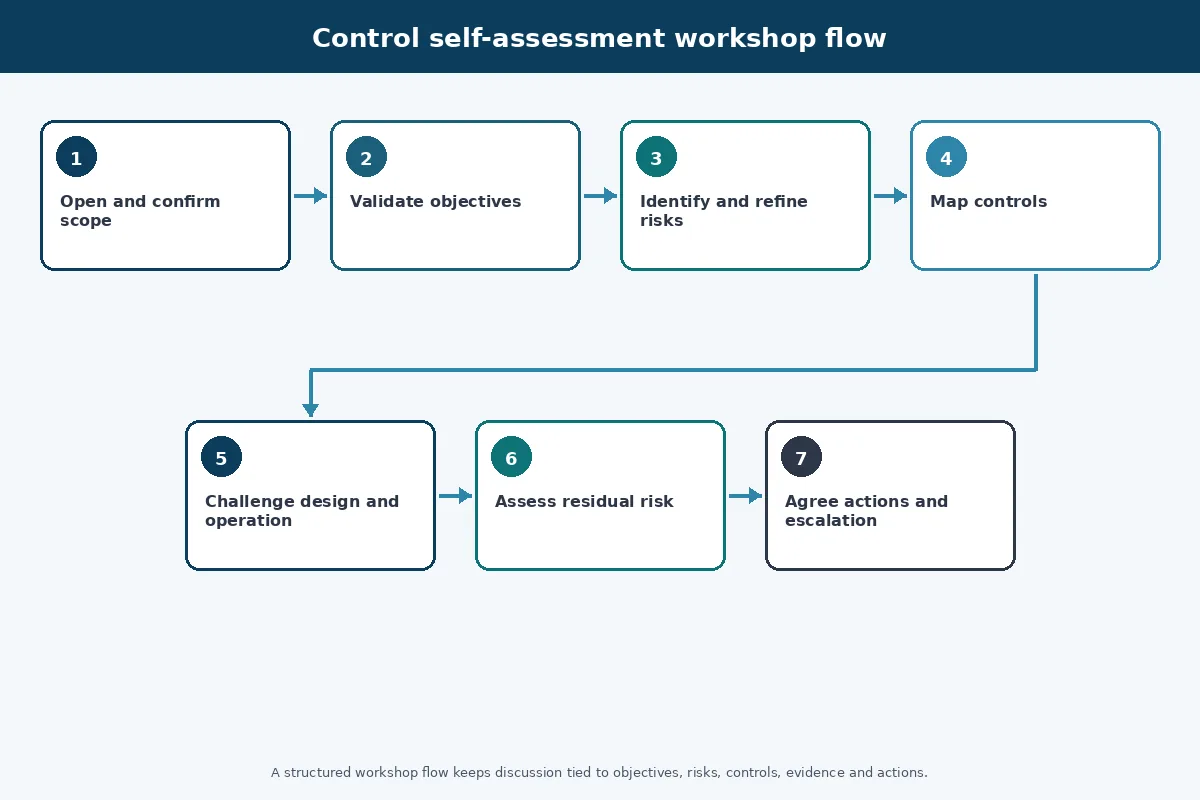
A practical control self-assessment workshop flow
- Open and confirm scope. Restate the decision, boundaries, roles, ground rules and outputs.
- Validate objectives. Agree what the process must achieve for operations, reporting and compliance.
- Identify and refine risks. Use incidents, changes, data and participant experience to develop clear failure scenarios.
- Map controls. Link each material risk to preventive, detective and corrective actions and identify control owners.
- Challenge design and operation. Examine dependencies, exceptions, evidence and known failures.
- Assess residual risk. Apply the agreed criteria and document uncertainty or dissent.
- Agree actions and escalation. Assign owners and dates, identify acceptance authority and confirm follow-up.
Time-box the early stages so the group does not spend the entire session debating wording. Park matters that require research and assign an owner to return with evidence. Display the live risk-control record so participants can correct misunderstandings immediately.
Suggested two-hour workshop agenda
| Time | Activity | Facilitator output |
|---|---|---|
| 0–10 minutes | Purpose, scope and ground rules | Confirmed boundaries and roles |
| 10–25 minutes | Objectives and recent changes | Agreed objectives and change factors |
| 25–55 minutes | Risk identification and prioritisation | Clear risk statements and initial ratings |
| 55–90 minutes | Control mapping and evidence challenge | Owners, control descriptions and evidence gaps |
| 90–110 minutes | Residual-risk decisions | Ratings, rationale and dissent |
| 110–120 minutes | Actions, escalation and close | Named actions and follow-up plan |
Score control design, operation and residual risk separately
Do not collapse the whole discussion into one red-amber-green score. Use at least four fields:
| Field | Question | Example rating |
|---|---|---|
| Control design | If performed as specified, would the control address the stated risk? | Adequate / partial / inadequate |
| Operating evidence | Does reliable evidence show consistent performance for the period and population? | Strong / limited / absent |
| Residual risk | What exposure remains after considering actual control performance? | Low / moderate / high / severe |
| Action urgency | How quickly must management reduce or formally accept the exposure? | Immediate / 30 / 60 / 90 days |
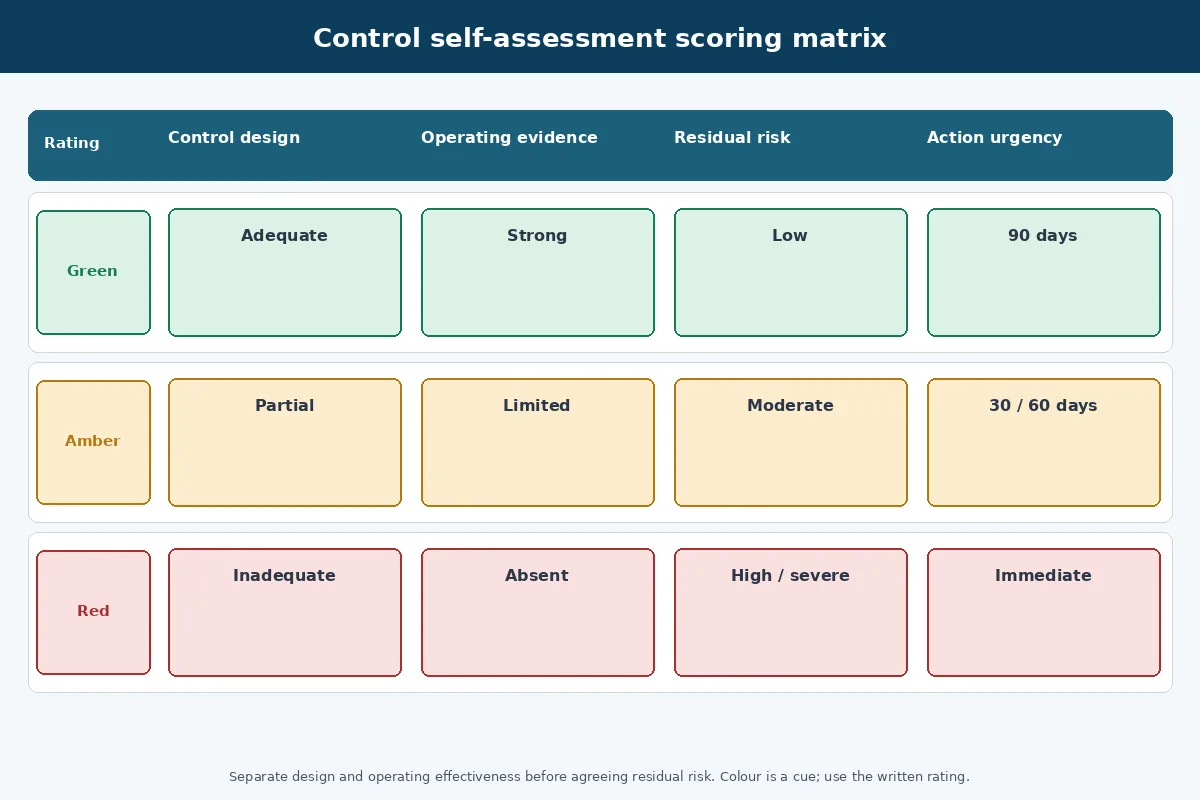
Define who has authority to accept each level of residual risk. Acceptance cannot override a legal requirement, licence condition or mandatory policy. When a control is untested, rate the evidence gap explicitly and consider targeted validation before relying on the CSA for audit-planning decisions.
How to handle difficult workshop situations
Dominant participants
Use structured rounds, silent individual scoring before discussion or direct questions to quieter participants. Ask the dominant participant for evidence, then invite someone who performs the control to describe actual practice.
Defensive reactions
Return to the agreed objective and failure scenario. Separate the person from the process and acknowledge controls that work before examining gaps. If the issue involves potential misconduct, stop group discussion and use the approved confidential escalation route.
False consensus
Ask participants to score privately, then display the range. Explore why views differ: access to evidence, different locations, exceptions or inconsistent execution. Record significant dissent and the evidence needed to resolve it.
Too many risks
Group duplicate scenarios and use transparent prioritisation criteria such as regulatory impact, customer harm, financial exposure, velocity and control weakness. Preserve lower-priority items in the record rather than deleting them merely to finish the session.
Remote or hybrid workshops
Distribute the evidence pack early, test the platform, use a shared visible record and schedule shorter sessions. Confirm identity and confidentiality where sensitive information is discussed. Do not let chat comments disappear without being captured in the assessment record.
Turn workshop discussion into accountable action
Issue a draft record promptly while discussion is fresh. Participants should confirm factual accuracy, but the facilitator should not allow agreed weaknesses to disappear through vague rewriting. For each material action, record the risk addressed, deliverable, owner, due date, dependencies, interim control and verification method.
The IIA guidance on communicating engagement results supports clear communication and monitoring of agreed recommendations or action plans. A CSA follow-up process should likewise distinguish action reported as complete from action independently verified.
Useful performance measures include:
- percentage of scoped processes assessed on time;
- percentage of material controls with current evidence;
- number and age of overdue high-priority actions;
- rate at which later testing confirms CSA ratings;
- repeat incidents or findings linked to previously assessed controls;
- participant feedback on clarity, fairness and decision usefulness.
The IIA’s sample internal control self-assessment policy and instructions can help teams think through formal responsibilities and documentation. Adapt any template to the organisation’s governance, risk taxonomy, legal duties and assurance model rather than adopting it unchanged.
Control self-assessment completion checklist
- Scope, objectives, participants and decision authority were defined.
- Risks were written as specific failure scenarios.
- Controls were linked to risks and described as observable actions.
- Design and operating effectiveness were assessed separately.
- Ratings include rationale, evidence and material dissent.
- Gaps have actions, owners, due dates and verification methods.
- Residual-risk acceptance follows the approved authority framework.
- Results are available to risk, compliance and internal-audit planning teams.
- Follow-up dates and escalation triggers are scheduled.
Developing facilitation and audit-planning skills
Professionals who need to design CSA methods, facilitate workshops, evaluate control evidence and translate results into a risk-based audit plan can review EPW’s Control Self Assessment and Audit Planning course. Its practical scope includes risk and control mapping, facilitation, scoring, documentation and audit-plan development.
Explore the wider Auditing, Governance, and Risk Compliance training portfolio for related courses. For broader context, EPW also explains governance, risk and compliance and the relationship between compliance and risk management.
Conclusion
Effective CSA facilitation combines structure with professional curiosity. Begin with objectives, involve the right operational voices, make controls and evidence observable, expose uncertainty and finish with actions that can be verified. Used this way, self-assessment strengthens management ownership and gives assurance teams a more reliable basis for prioritisation without pretending that self-evaluation replaces independent testing.
Ready to build a more rigorous CSA and audit-planning process? Review the Control Self Assessment and Audit Planning course outline and available training locations.
Sources and References
- The Institute of Internal Auditors. Global Internal Audit Standards. Issued 9 January 2024; effective 9 January 2025.
- The Institute of Internal Auditors. Internal Control Self-Assessment Policy and Instructions. Sample tool, accessed 1 September 2026.
- The Institute of Internal Auditors. Communicating Final Engagement Results. Accessed 1 September 2026.
- Committee of Sponsoring Organizations of the Treadway Commission. Internal Control—Integrated Framework and Monitoring Guidance. Accessed 1 September 2026.
- HM Treasury. The Orange Book: Management of Risk—Principles and Concepts. Updated 29 July 2026.