

AI-generated illustration created to represent the article’s subject. It does not depict an actual EPW course, trainer, participant, client, event or venue.
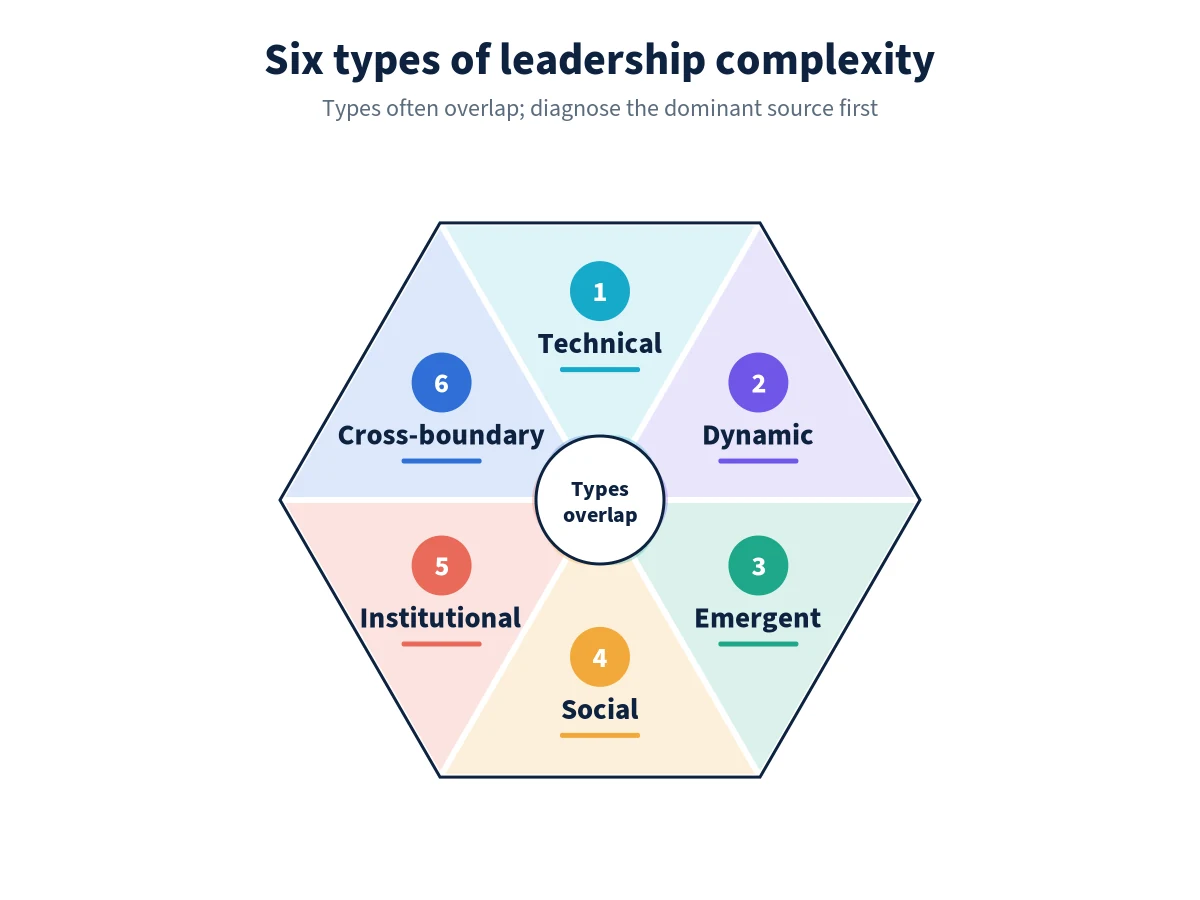
Leaders face at least six materially different types of complexity: technical detail, dynamic systems, emergence, social and political complexity, institutional complexity, and cross-boundary complexity. Each type creates a different decision problem. The practical mistake is to call every difficult situation “complex” and then apply the same leadership response. Senior executives need a taxonomy that reveals what makes the situation difficult before they choose expertise, experimentation, negotiation, governance or network coordination.
These types are not mutually exclusive. A transformation may contain a technically complicated system, delayed feedback, uncertain customer behaviour, conflicting stakeholder interests and several regulators at once. The value of classification is therefore diagnostic: it helps a leader identify the dominant source of difficulty, select a proportionate response and notice when the situation changes.
Key takeaways
- Difficulty caused by many knowable parts is different from complexity caused by unpredictable interaction.
- A leadership response should match the dominant source of complexity, not the seniority of the decision.
- Most strategic challenges combine several types, so leaders should build a complexity profile rather than force one label.
- As evidence changes, the dominant type—and the appropriate leadership approach—may also change.
Contents
- How the six types are classified
- 1. Technical and detail complexity
- 2. Dynamic systems complexity
- 3. Emergent complexity
- 4. Social and political complexity
- 5. Institutional complexity
- 6. Cross-boundary complexity
- Comparison table
- EPW Complexity Profile
How the six types are classified
The taxonomy classifies complexity by its dominant source. Is the problem difficult because there are many parts to analyse? Because cause and effect unfold through feedback over time? Because new patterns emerge from interaction? Because people disagree about values and interests? Because several rule systems apply? Or because no single organisation controls the outcome?
This distinction builds on established complexity and systems thinking without pretending that one framework settles every case. The Cynefin glossary, for example, distinguishes complicated situations—where cause-and-effect relationships can be discovered through expertise—from complex situations, where relationships are non-linear and may only become intelligible retrospectively. The OECD’s work on systems approaches similarly argues that interconnected challenges can defeat traditional analytical and problem-solving tools.
EPW’s six-type taxonomy broadens that distinction for executive diagnosis. It separates sources that often coexist, because each has a different leadership implication.
1. Technical and detail complexity
Technical complexity arises when a situation contains many components, specialist disciplines, interfaces or calculations, but the underlying relationships are broadly knowable. Examples include designing a large engineering asset, consolidating financial systems or applying a detailed regulatory standard. The work may be exceptionally difficult without being emergent.
The leadership task is to organise expertise. Define the problem precisely, decompose it into manageable elements, establish interface ownership and integrate specialist findings. Decision quality depends on evidence, competence and verification. A leader should resist both micromanagement and superficial simplification: their role is to create the conditions in which experts can challenge one another and produce an integrated answer.
Useful response: expert analysis, structured planning, assurance reviews and clear configuration control.
Warning sign: the team has enough knowledge to predict outcomes, but coordination failures prevent that knowledge from being combined.
2. Dynamic systems complexity
Dynamic complexity occurs when actions produce effects through feedback loops, delays and accumulation. A decision that appears successful this quarter may create a constraint next year; an intervention can change the behaviour of the system it is intended to improve. Pricing, workforce capacity, public trust, maintenance backlogs and supply resilience often display this pattern.
The OECD describes systems analysis as a way to examine interaction, multiplying risks, feedback and possible tipping points. For leaders, this means looking beyond a linear chain of tasks. Map stocks, flows, incentives, delays and reinforcing or balancing loops. Track leading signals as well as final outcomes, and test whether a local improvement shifts cost or risk elsewhere.
Useful response: systems mapping, scenario analysis, leading indicators and regular review of unintended effects.
Warning sign: the same intervention repeatedly solves a symptom while the underlying pattern returns or worsens.
3. Emergent complexity
Emergent complexity exists when the relevant pattern cannot be reliably predicted in advance because it arises through interaction among people, technologies, markets or events. Novel customer behaviour, a fast-moving crisis, an unfamiliar operating model or early adoption of a disruptive technology may fall into this category.
In the Cynefin account, complex situations require learning through action rather than assuming that analysis can reveal one correct solution beforehand. The leadership discipline is to create several safe-to-learn experiments, monitor what happens and amplify promising patterns while stopping harmful ones. This is not uncontrolled trial and error. Experiments need boundaries, ethical safeguards, evidence thresholds and clear review points.
The UK government’s updated Magenta Book test-and-learn guidance places experimentation within a wider evaluation discipline. That is an important safeguard: leaders should learn rapidly without abandoning accountability.
Useful response: bounded experiments, diverse hypotheses, rapid feedback and reversible commitments.
Warning sign: leaders demand a fully specified long-range plan when the organisation has not yet learned what works.
4. Social and political complexity
Social complexity arises when stakeholders hold different interests, identities, values, interpretations or levels of power. The facts may be available, yet there is no neutral technical solution that all parties will accept. Restructuring, resource allocation, public policy, organisational culture and partnership governance often involve this type.
The leadership task is not to eliminate disagreement; it is to make it workable. Identify who is affected, what each party values, where power sits and which interests are legitimate but incompatible. Create forums in which evidence and trade-offs can be examined, protect minority voices and state clearly who ultimately decides. Negotiation, coalition building and procedural fairness matter as much as technical analysis.
Useful response: stakeholder mapping, structured dialogue, transparent trade-offs and legitimate decision rules.
Warning sign: a leader describes resistance as an information deficit when stakeholders are actually contesting interests or values.
5. Institutional complexity
Institutional complexity occurs when several laws, standards, policies, professional norms or governance regimes shape the same decision. A multinational organisation may face different labour rules and reporting duties; a public-private programme may answer to statutory, commercial and community expectations; a regulated service may need to satisfy safety, privacy and procurement requirements simultaneously.
Leaders should create a requirements architecture rather than rely on an unstructured list. Separate non-negotiable duties from internal preferences, identify conflicts, name interpretation owners and define escalation routes. The risk process should stay connected to objectives. ISO 31000 provides general guidance for identifying, analysing, evaluating, treating, monitoring and communicating risk; institutional complexity requires leaders to apply that discipline across overlapping sources of authority.
Useful response: obligations mapping, governance integration, legal-risk review and explicit exception handling.
Warning sign: different functions each claim compliance while their combined requirements create contradiction, delay or unmanaged exposure.
6. Cross-boundary and network complexity
Cross-boundary complexity arises when delivery depends on multiple teams, organisations, jurisdictions or supply-chain partners and no single actor controls the entire system. Shared outcomes such as infrastructure resilience, integrated customer service, public health or global product delivery are typical examples.
The leadership task is to make interdependence governable. Define the shared outcome, map critical dependencies, agree decision rights and establish how information, resources and risk move across boundaries. Authority alone is insufficient; leaders need influence, reciprocity and credible commitments. EPW’s Global Leadership for Competitive Advantage course develops related cross-border capabilities.
Useful response: network mapping, joint governance, dependency indicators and agreed escalation protocols.
Warning sign: every participating organisation meets its own target while the shared outcome deteriorates.
Comparison of the six complexity types
| Type | Dominant source | Best initial leadership response | Response to avoid |
|---|---|---|---|
| Technical | Many knowable parts and specialist interfaces | Organise expertise and assurance | Replacing analysis with brainstorming |
| Dynamic | Feedback, delay and cumulative effects | Map the system and monitor leading signals | Optimising one isolated measure |
| Emergent | Unpredictable patterns from interaction | Run bounded experiments and learn | Demanding premature certainty |
| Social | Conflicting values, interests and power | Build legitimacy and negotiate trade-offs | Treating disagreement as ignorance |
| Institutional | Overlapping rules and governance regimes | Integrate obligations and decision rights | Managing each requirement in isolation |
| Cross-boundary | Interdependence without unified control | Govern the network and its dependencies | Relying only on formal authority |
How the types combine: an illustrative example
Consider a regional healthcare group introducing a shared digital scheduling service. Technical complexity appears in system integration and data architecture. Dynamic complexity appears when staffing, appointment demand and waiting times influence one another. Emergent complexity appears because patients and clinicians may use the service in unanticipated ways. Social complexity appears where groups disagree about access priorities. Institutional complexity comes from privacy, clinical and procurement obligations. Cross-boundary complexity comes from hospitals, technology suppliers and public agencies sharing delivery without one chain of command.
A single “digital transformation plan” cannot address all six sources. The executive team needs technical assurance, system measures, controlled pilots, stakeholder dialogue, integrated compliance and network governance—each applied to the part of the challenge it fits.
The EPW Complexity Profile
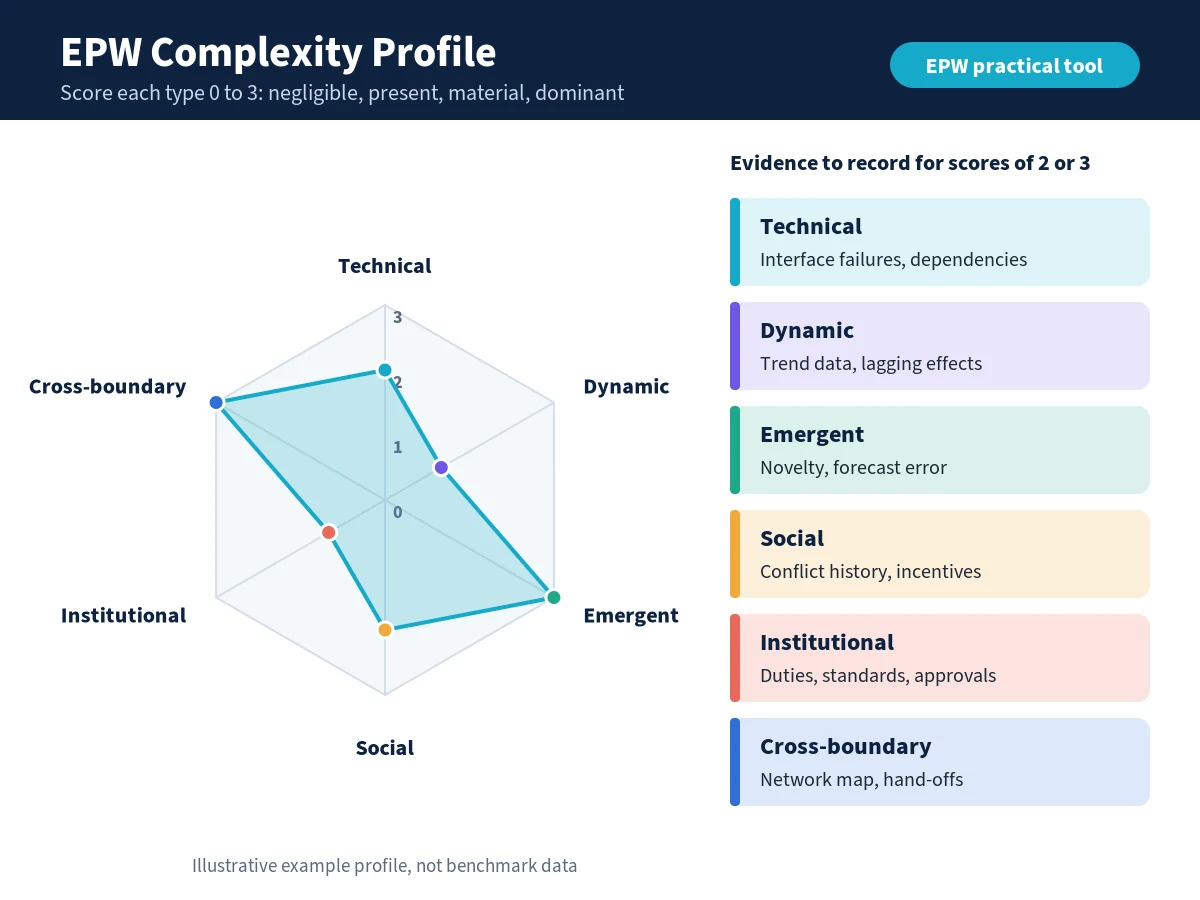
The EPW Complexity Profile helps leaders avoid a one-label diagnosis. For each type, score the situation from 0 to 3: 0 means negligible, 1 present, 2 material and 3 dominant. Record one item of evidence for every score of 2 or 3.
| Diagnostic question | Evidence to examine | Primary response |
|---|---|---|
| How much specialist integration is required? | Interface failures, assurance findings, unresolved dependencies | Expert architecture |
| How strongly do feedback and delay shape outcomes? | Trend data, lagging effects, recurring patterns | Systems analysis |
| How predictable is cause and effect before action? | Novelty, hypothesis quality, forecast error | Experimentation |
| How divergent are stakeholder interests and values? | Conflict history, incentives, trust and power | Dialogue and negotiation |
| How many rule systems apply or conflict? | Legal duties, standards, policies and approvals | Governance integration |
| How dependent is success on actors outside direct control? | Network map, shared resources, hand-offs | Joint governance |
The profile is not a scientific scale. Its value is the leadership conversation it forces. Compare scores across functions: if operations sees technical complexity while community stakeholders see social complexity, that difference is evidence, not noise. Assign an owner and review date to each dominant type. Re-score after a significant intervention or change in context.
Choosing a proportionate response
Start with the two highest-scoring types. Pair each with its primary response and then test for conflict. For example, institutional complexity may favour tighter controls while emergence requires room to experiment. The answer is not to choose one and ignore the other; it is to create bounded experimentation inside non-negotiable regulatory constraints.
Next, decide which commitments must be reversible. Complex and emergent conditions justify shorter decision horizons, but they do not excuse weak purpose. State the outcome and boundaries clearly while allowing methods to evolve. For technical and institutional complexity, invest more in upfront architecture and assurance. For social and cross-boundary complexity, invest in legitimacy, relationships and shared decision mechanisms.
Senior leaders can strengthen these choices through EPW’s Executive Decision Making and Critical Thinking and Leadership Strategies for Complex Environments courses. The broader Management and Leadership Training Courses portfolio includes further options for strategic and adaptive leadership.
Practical takeaways for leaders
- Name the dominant source of complexity before choosing a method.
- Use expertise for knowable detail and experiments for genuine emergence.
- Map delayed effects and interdependencies, not only immediate tasks.
- Treat stakeholder disagreement as a governance issue when interests or values differ.
- Integrate legal and policy obligations into one decision architecture.
- Reassess the profile as learning and context change.
Ready to apply leadership in complex environments in your organisation? Explore EPW’s Leadership Strategies for Complex Environments, review available dates and locations, or request tailored in-house training.
Sources and references
- Cynefin Wiki, Glossary: complicated, complex and ordered systems, accessed 5 September 2026.
- OECD, Systems Approaches to Public Sector Challenges, 2017, accessed 5 September 2026.
- OECD, Systems-Based Approaches for Development Co-operation, accessed 5 September 2026.
- HM Treasury and Evaluation Task Force, Test and Learn, updated 15 May 2026, accessed 5 September 2026.
- International Organization for Standardization, ISO 31000:2018 Risk Management — Guidelines, accessed 5 September 2026.