

AI-generated illustration created to represent the article’s subject. It does not depict an actual EPW course, trainer, participant, client, event or venue.
Quality assurance and quality control in projects are complementary but different. Quality assurance asks whether the project’s processes are suitable and being applied effectively; quality control checks whether a specific deliverable meets defined acceptance criteria. Assurance is primarily confidence- and process-oriented, while control is primarily verification- and output-oriented. Most projects need both, with effort proportionate to risk.
The distinction matters to project managers, sponsors and quality professionals because a passed inspection cannot prove that the whole delivery system is reliable, while a well-designed process cannot prove that every output is acceptable. The American Society for Quality similarly distinguishes assurance activities that provide confidence in requirements being fulfilled from control techniques used to fulfil quality requirements. ASQ: Quality Assurance vs Quality Control.
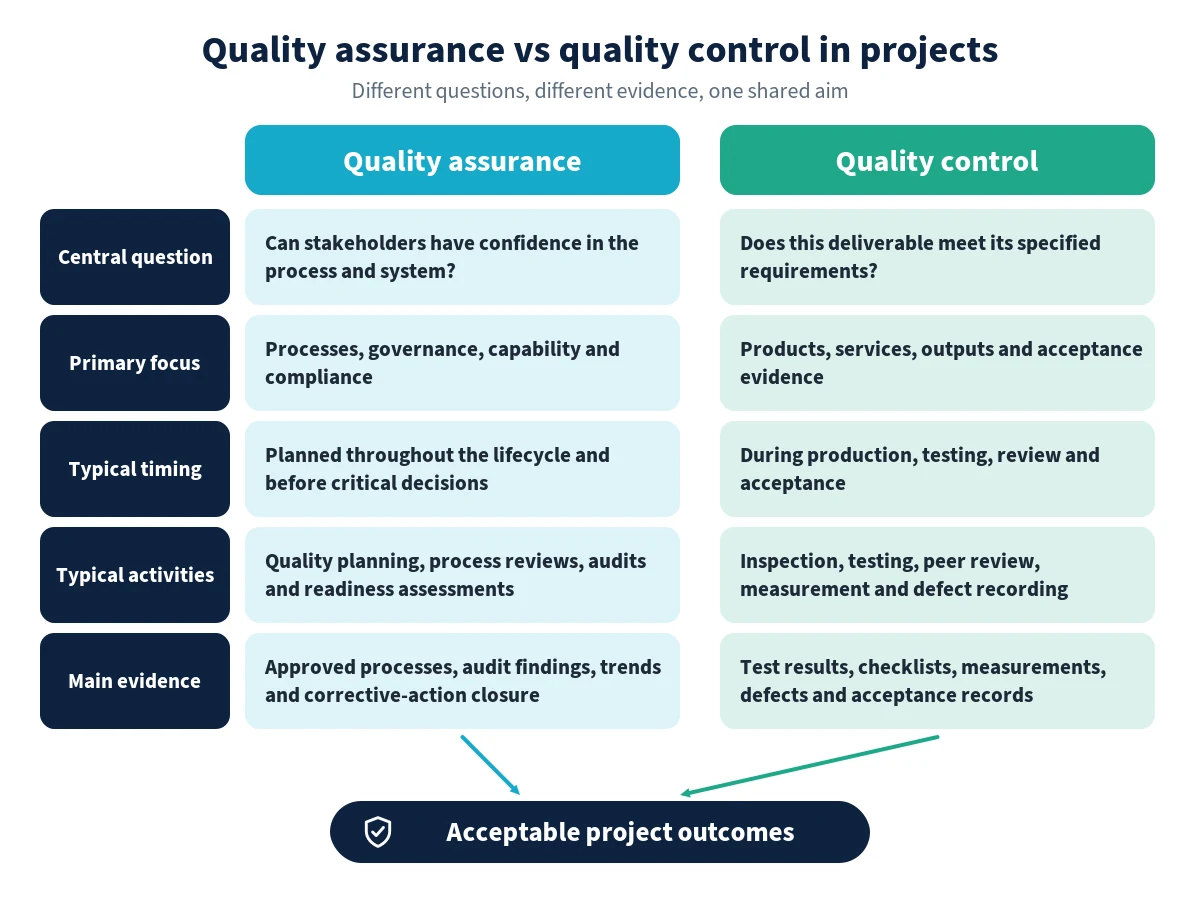
Quality assurance vs quality control at a glance
| Criterion | Quality assurance | Quality control |
|---|---|---|
| Central question | Can stakeholders have confidence in the process and system? | Does this deliverable meet its specified requirements? |
| Primary focus | Processes, governance, capability and compliance | Products, services, outputs and acceptance evidence |
| Typical timing | Planned throughout the lifecycle and before critical decisions | During production, testing, review and acceptance |
| Typical activities | Quality planning, process reviews, audits and readiness assessments | Inspection, testing, peer review, measurement and defect recording |
| Main evidence | Approved processes, audit findings, trends and corrective-action closure | Test results, checklists, measurements, defects and acceptance records |
| Primary ownership | Often a quality or assurance role with sufficient independence | Delivery and technical teams, with customer or user acceptance where appropriate |
| Failure it helps prevent | Systemic or repeated delivery weaknesses | Non-conforming outputs reaching the customer or next stage |
Where assurance and control overlap
Both disciplines begin with clear requirements and an agreed meaning of acceptable quality. Both generate evidence, identify weaknesses, assign actions and support informed decisions. They also share a common aim: increasing the likelihood that project outputs are fit for their intended purpose.
ISO explains that a quality management system brings together leadership, customer focus, a process approach, risk-based thinking, documented information, monitoring and continual improvement. In project terms, assurance and control are therefore not isolated inspection tasks; they are connected parts of a wider management system. ISO 9001 explained.
The material differences in project work
Purpose: confidence versus conformity
Quality assurance provides justified confidence that the delivery arrangements are capable of producing acceptable results. A process audit might examine whether design reviews occur at the right point, use competent reviewers and close material findings.
Quality control determines conformity at the output level. A control activity might test whether a completed interface meets performance thresholds or check whether a handover pack contains every accepted item. Control produces evidence about the item examined, not an automatic conclusion about the strength of every upstream process.
Prevention versus detection
Assurance is commonly associated with prevention because it evaluates how work will be performed and whether recurring causes are controlled. Quality control is commonly associated with detection because it identifies non-conforming outputs before acceptance or release. This is a useful distinction, but not an absolute boundary: control findings can improve processes, and assurance reviews can discover existing failures.
Object of review
An assurance review samples the management system, process or control environment. Quality control examines a product, service or deliverable against defined criteria. The evidence must match the object. A signed procedure is weak evidence that a physical installation works; a passed component test is weak evidence that change control is consistently effective.
Independence and ownership
Delivery teams usually perform much quality control because they create and test outputs. Assurance benefits from an appropriate degree of independence so that people can challenge process effectiveness without reviewing only their own work. Independence should be proportionate: a high-risk gate may need external or organisational assurance, while a low-risk internal deliverable may need only a peer who was not its author.
Timing and feedback
Assurance should be planned early enough to influence delivery, not conducted only after a failure. Quality control should occur at points where a defect can still be corrected economically and before the output is used downstream. Both require closed feedback loops: findings without owners, deadlines and verification do not improve quality.
Examples across a project lifecycle
| Lifecycle point | Quality assurance example | Quality control example |
|---|---|---|
| Initiation | Review whether quality roles, standards and acceptance authority are defined | Check that the approved business-case document contains required information |
| Planning | Assess whether the quality plan addresses risk and critical deliverables | Review requirements for completeness, traceability and testability |
| Delivery | Audit whether design, change and supplier controls are operating as intended | Inspect or test components against specifications and tolerances |
| Transition | Assess operational readiness and whether acceptance governance has been followed | Execute acceptance tests and verify handover records |
| Closure | Review whether corrective actions and lessons have been integrated | Confirm outstanding defects are resolved, accepted or transferred to an owner |
ASQ’s guidance on quality plans recommends identifying standards, objectives, responsibilities, required practices, testing and inspection arrangements, change procedures and methods for measuring achievement. That makes the quality plan a practical bridge between assurance and control rather than a document owned by only one side. ASQ: Quality Plans.
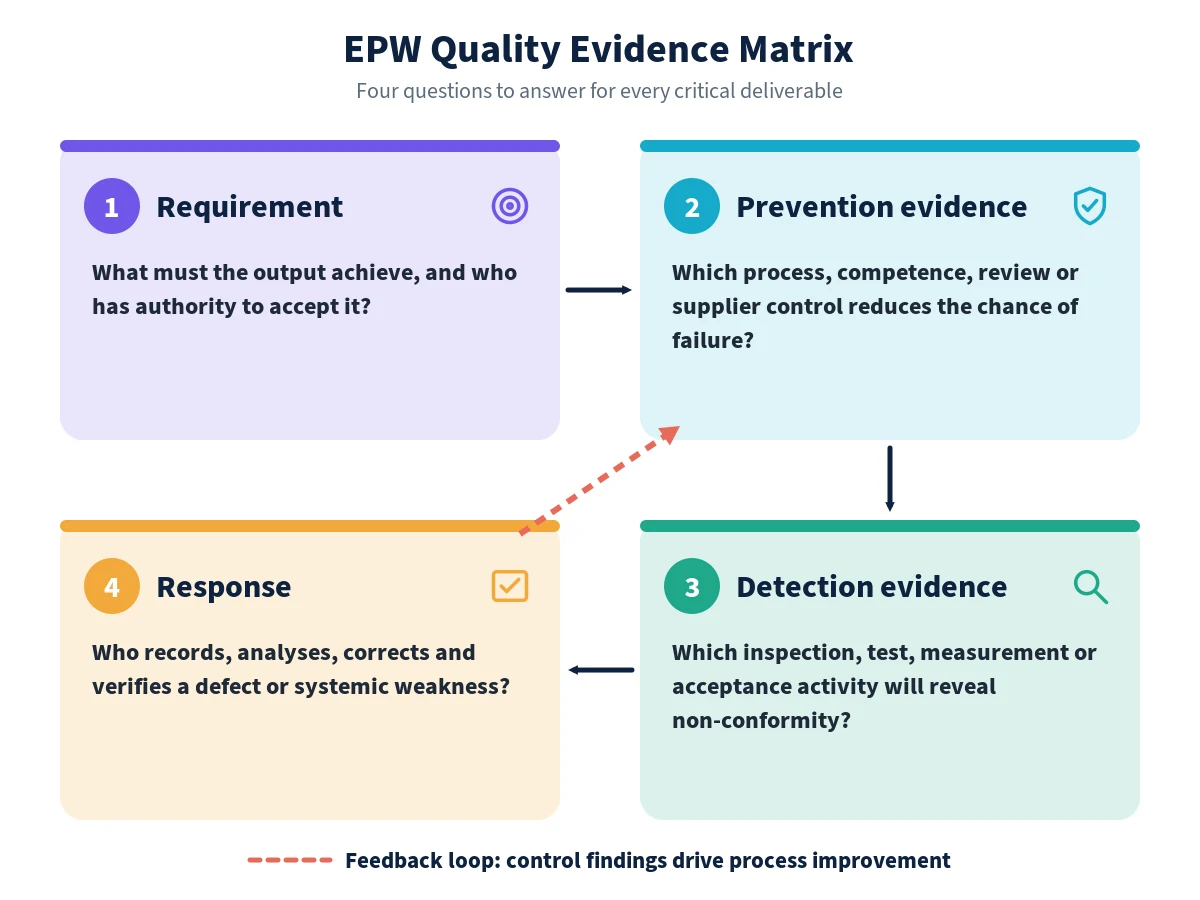
The EPW Quality Evidence Matrix
Use this four-part matrix for every critical deliverable:
- Requirement: What must the output achieve, and who has authority to accept it?
- Prevention evidence: Which process, competence, review or supplier control reduces the chance of failure?
- Detection evidence: Which inspection, test, measurement or acceptance activity will reveal non-conformity?
- Response: Who records, analyses, corrects and verifies a defect or systemic weakness?
The matrix exposes gaps that single checklists can hide. If a critical requirement has no prevention evidence, the project depends on catching errors later. If it has no detection evidence, the team may have confidence in a process without proving the result. If it has no response owner, findings will accumulate without verified correction.
Professionals who need to apply this method across live work can explore EPW’s Project Quality Management and Continuous Improvement course as a focused development option.
When to emphasise assurance or control
Emphasise assurance when several teams use the same process, the same weakness is recurring, a supplier’s management system matters, governance requires independent confidence or a major decision depends on delivery readiness.
Emphasise control when a deliverable has measurable acceptance criteria, safety or performance depends on the output, defects can pass into later stages, or customer acceptance requires objective test evidence.
Use both for high-impact deliverables, novel work, complex interfaces, regulated environments and transitions into operations. The intensity should reflect consequence, uncertainty and detectability. A risk-based plan avoids two extremes: excessive checking of low-impact items and insufficient evidence for critical ones.
Related capability may also be developed through EPW’s Project Risk Management and Mitigation Strategies course, particularly where quality activities must be prioritised by delivery risk.
Common mistakes to avoid
- Treating QA and QC as interchangeable labels: state whether the activity examines the delivery system or a specific output.
- Testing without acceptance criteria: define measurable requirements and the acceptance authority before execution.
- Auditing documents but ignoring practice: sample records, observe work and test whether controls operate effectively.
- Making quality the quality manager’s job alone: allocate responsibilities across sponsors, project managers, technical teams, suppliers and users.
- Counting findings without analysing patterns: distinguish isolated defects from recurring or systemic causes.
- Closing an action without verifying effectiveness: confirm the correction worked and did not create a new risk.
A practical selection checklist
Before approving the project’s quality approach, confirm that:
- requirements and acceptance criteria are clear and traceable;
- quality activities are proportionate to consequence and uncertainty;
- assurance reviews are timed to influence decisions;
- control activities occur before defects pass downstream;
- reviewers have the necessary competence and independence;
- evidence is retained and connected to the relevant requirement;
- findings have owners, due dates and escalation routes; and
- corrective action is verified and feeds continual improvement.
NASA’s project-planning requirements provide a useful high-assurance example: project plans must describe how quality assurance surveillance will be performed and how responsibilities are assigned. The lesson is transferable even when NASA’s formal controls are not—the level of assurance should be explicit in the plan, not assumed. NASA Procedural Requirements, Appendix H.
Combine confidence with objective evidence
Quality assurance and quality control are most effective as a connected system. Assurance improves confidence that suitable processes, roles and controls are operating; quality control supplies objective evidence that individual outputs conform. Link both to clear requirements, risk and a verified response to findings.
For supporting foundations, see EPW’s Project Management Fundamentals and Best Practices course, strengthen planning through Advanced Project Planning and Control Techniques, or browse all Project Management Training Courses.
Ready to integrate assurance, control and continual improvement in project delivery? Explore EPW’s Project Quality Management and Continuous Improvement course, review the available options or enquire about tailored in-house training.
Sources and References
- American Society for Quality. Quality Assurance vs Quality Control.
- International Organization for Standardization. ISO 9001 Explained.
- American Society for Quality. Quality Plans.
- NASA. NASA Procedural Requirements 7120.5F, Appendix H.