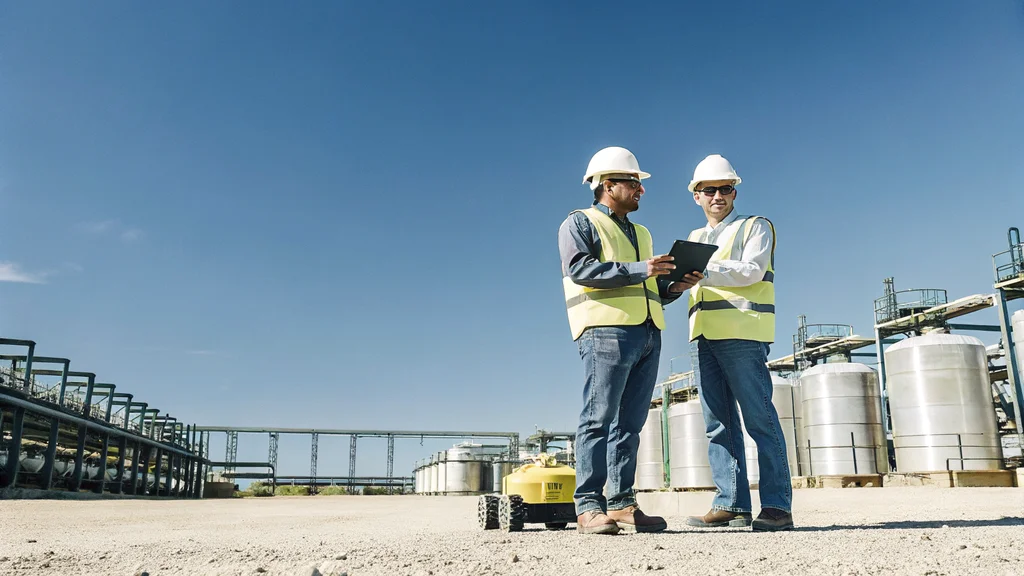
AI-generated illustration created to represent the article’s subject. It does not depict an actual EPW course, trainer, participant, client, event or venue.
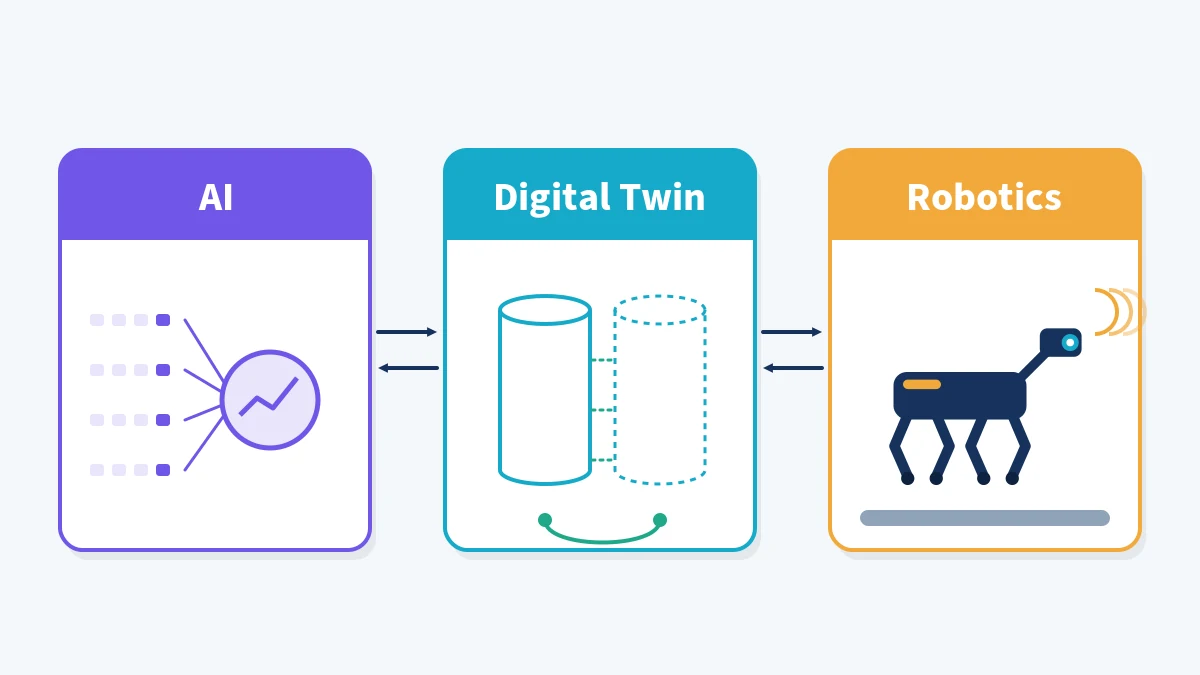
Artificial intelligence, digital twins and robotics perform different jobs in oil and gas operations. AI finds patterns and supports predictions or decisions; a digital twin maintains a contextual digital representation of an asset or process; robotics senses and acts in the physical environment. The strongest programmes combine them only where the operational problem, data quality, safety case and business value justify the added complexity.
These terms are often grouped under “digital transformation”, but treating them as interchangeable creates poor investment decisions. A predictive model is not automatically a digital twin, a three-dimensional model is not necessarily a twin, and an autonomous machine is not simply AI with wheels. This comparison gives managers, engineers and technology teams a practical way to choose the right capability.
AI, digital twins and robotics at a glance
| Dimension | Artificial intelligence | Digital twin | Robotics |
|---|---|---|---|
| Primary purpose | Recognise patterns, predict outcomes, classify conditions or recommend actions | Represent the current and expected behaviour of a defined physical asset or process | Inspect, manipulate, transport or intervene in the physical world |
| Core inputs | Historical and live data, labels, documents, images or signals | Asset configuration, engineering models, operating data and state history | Sensor data, maps, commands, task plans and environmental feedback |
| Typical output | Prediction, anomaly score, classification, optimisation or generated content | Asset state, simulation, scenario result, diagnosis or forecast | Movement, measurement, inspection evidence or physical action |
| Main dependency | Representative data and controlled model performance | Reliable asset context, synchronisation and model validity | Safe hardware, robust control and suitability for the environment |
| Characteristic risk | Bias, drift, weak explainability or false confidence | An outdated or incorrectly scoped representation | Collision, loss of control, environmental limits or unsafe intervention |
| Best question | What is likely to happen or what pattern is present? | What is happening to this asset, and how might it respond? | Can the task be performed remotely, repeatedly or away from exposure? |
What artificial intelligence does in oil and gas
AI is a family of computational methods rather than a single product. In operational settings it may classify inspection images, detect unusual sensor patterns, forecast demand, estimate equipment condition, retrieve knowledge from controlled documents or help optimise a constrained process. Its value lies in turning data into a useful signal or recommendation faster and more consistently than an unaided manual workflow.
AI does not remove the need for engineering judgement. Model performance depends on the population represented in the training and validation data, the definition of a correct outcome and the conditions under which the model is used. The US National Institute of Standards and Technology organises AI risk work around governing, mapping, measuring and managing risk in its AI Risk Management Framework. That structure is especially relevant where a model can influence production, maintenance, safety or environmental decisions.
Best-fit AI use cases
- Detecting anomalies in multivariable equipment or process data.
- Prioritising maintenance work using failure history and condition indicators.
- Classifying corrosion, leakage or surface defects in inspection imagery.
- Forecasting production, energy demand, inventory or logistics constraints.
- Searching technical procedures and lessons learned with controlled retrieval.
An AI output should be tied to a decision, an accountable owner and a response threshold. A model that produces a score nobody trusts or knows how to act upon is not an operational solution.
What makes a digital twin different
A digital twin connects a defined physical entity with a digital representation that is updated using relevant information. Depending on the purpose, it may combine equipment hierarchy, design data, operating history, live measurements, degradation models and simulations. The defining feature is not visual realism; it is a maintained relationship between the physical asset and the digital model for a stated decision.
A three-dimensional plant model becomes part of a twin only when it is governed, connected to the relevant asset state and used for decisions such as integrity assessment, operating-envelope review or maintenance planning. NIST’s work on digital twins emphasises interoperability, trustworthy data exchange and validation—issues that also matter when oil and gas organisations connect engineering, operations and maintenance information.
Best-fit digital twin use cases
- Monitoring the condition and operating envelope of a compressor, pump or production system.
- Testing operating scenarios before changing a live process.
- Combining inspection evidence with degradation or remaining-life models.
- Supporting remote collaboration around a shared, current asset context.
- Evaluating maintenance timing, capacity constraints or energy performance.
The twin must have a boundary. A clear statement of the represented asset, update frequency, assumptions, data lineage and permitted decisions is more valuable than an ambitious “whole enterprise twin” with uncertain accuracy.
What robotics contributes
Robotics brings sensing and action into the physical environment. In oil and gas, systems may inspect confined or hazardous areas, collect repeatable measurements, operate remotely offshore, handle materials or support subsea work. Robots range from remotely operated vehicles and crawlers to aerial systems and fixed automated equipment. Autonomy varies: some follow direct human commands, some execute planned routes, and others adjust behaviour within defined limits.
The benefit is often exposure reduction, repeatability or access—not labour replacement. A robot must be evaluated against the task environment: explosive atmospheres, pressure, temperature, communications, terrain, weather, ingress protection, payload, endurance and recovery arrangements. The US Occupational Safety and Health Administration notes that robotic systems introduce hazards associated with unexpected movement, programming, maintenance and human interaction in its robotics guidance.
Best-fit robotics use cases
- Repeat inspection routes in areas that are difficult, remote or hazardous to access.
- Tank, vessel, pipeline, flare, subsea or elevated visual and sensor inspection.
- Remote manipulation where separation from the hazard is valuable.
- Routine data collection that benefits from consistent position and timing.
- Tasks designed for automation with controlled interfaces and failure states.
Key differences that determine the right choice
1. The unit of value
AI creates value through better information or decisions. A digital twin creates value through reliable asset context and scenario testing. Robotics creates value through physical reach, repeatability or separation from exposure. Start with the operational outcome, not the technology label.
2. The validation question
For AI, teams ask whether the model performs acceptably on representative conditions and how drift will be detected. For a twin, they ask whether the model accurately represents the asset for the intended decision and remains synchronised. For robotics, they ask whether the system can complete the task safely and reliably across credible environmental and failure conditions.
3. The integration burden
AI may require historian, laboratory, maintenance or document data. A twin adds asset identity, engineering configuration and model governance. Robotics adds physical interfaces, communications, charging or deployment arrangements, permits and emergency recovery. Integration cost should be included in the whole-life case rather than hidden inside a pilot budget.
4. The human role
Human oversight is not a generic approval box. Define who reviews an AI recommendation, who accepts a twin scenario, who supervises a robot, who can override the system and what evidence is retained. The more consequential the decision or action, the stronger the competence, verification and escalation design should be.
How the three technologies work together
An inspection robot can collect images, acoustic readings or gas measurements. AI can classify observations and prioritise anomalies. A digital twin can place those findings against the correct equipment, operating history and degradation model. The maintenance team can then review the evidence, confirm the condition and select an intervention.
This architecture is powerful because each component does the job for which it is suited. It is also more complex. A wrong asset tag, delayed sensor feed, biased model or failed robot localisation can propagate error. Interfaces therefore need ownership, timestamp control, quality checks and a safe response when confidence falls below an agreed threshold.
The International Energy Agency’s Digitalisation and Energy analysis describes how connectivity, data and analytics can improve energy-system operations while also introducing cyber-security and privacy challenges. Oil and gas programmes should treat secure architecture, access control and operational technology change management as design requirements, not final-stage additions. The US Cybersecurity and Infrastructure Security Agency provides industrial control systems resources for managing cyber risk in operational environments.
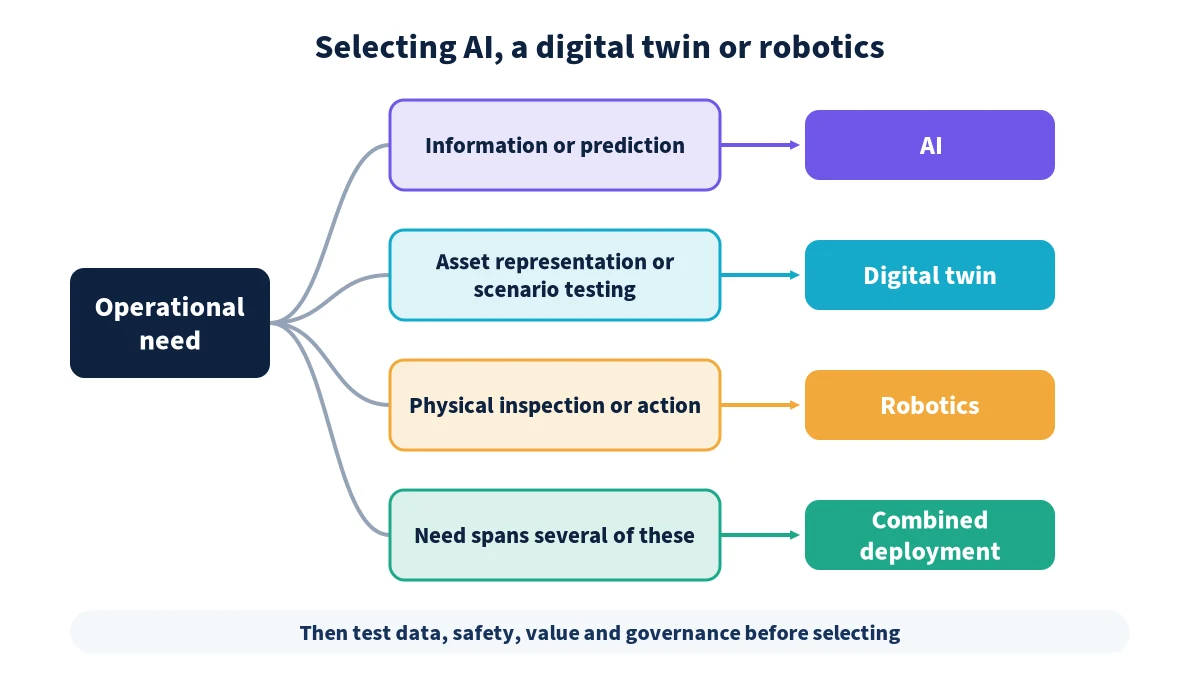
A six-question selection framework
- What decision or task must improve? State the user, current workflow, baseline and consequence of error.
- Is the need informational, representational or physical? This distinguishes AI, a twin and robotics at the first decision gate.
- What evidence is available? Assess data coverage, asset identity, model assumptions, environmental constraints and missing failure examples.
- What is the safe operating boundary? Define where the system may advise, simulate or act, and where a human must intervene.
- What whole-life value is measurable? Include integration, assurance, licences, maintenance, training, cyber controls and retirement—not only pilot cost.
- Can the capability be scaled and governed? Confirm owners, interfaces, performance monitoring, change control and a recovery plan.
Implementation controls for responsible adoption
- Problem definition: record the decision, user, baseline, expected benefit and unacceptable outcome.
- Data governance: establish ownership, quality rules, lineage, retention and access rights.
- Technical assurance: verify models, interfaces, sensors and fallback behaviour against the intended use.
- Operational readiness: update procedures, competency requirements, alarm philosophy and work-management integration.
- Cyber security: segment networks appropriately, control remote access, manage identities and monitor changes.
- Performance monitoring: track technical accuracy, operational adoption, safety indicators and realised value.
- Change and retirement: reassess after process, equipment, data or regulatory changes and retire unsupported systems safely.
Build the supporting capability
Technology selection works best when it connects engineering, operations, safety, data and commercial judgement. EPW’s Digital Transformation and Smart Technologies in Oil and Gas course explores wider digital strategy, while the SCADA and Automation Systems for Energy Infrastructure course develops operational automation context. For asset-focused decisions, see Asset Integrity and Corrosion Management for Oil and Gas Facilities. The full Oil, Gas and Energy training course portfolio provides related technical and commercial programmes.
Strengthen emerging-technology decisions in oil and gas
EPW Training’s Emerging Technologies and Innovation in the Oil and Gas Sector course examines digital transformation, analytics, cloud, connected operations, automation, robotics, sustainability technologies and practical adoption strategy. Review the course outline to evaluate its fit for professionals responsible for technology selection, integration or operational improvement.
Sources and references
- International Energy Agency — Digitalisation and Energy.
- National Institute of Standards and Technology — AI Risk Management Framework.
- National Institute of Standards and Technology — Digital Twins programme.
- US Occupational Safety and Health Administration — Robotics.
- US Cybersecurity and Infrastructure Security Agency — Industrial Control Systems.