

Generative AI is revolutionizing the tech world, allowing machines to create new content. From producing realistic images to creating music, there is a wide array of applications for this amazing tech that’s piquing interest across industries. For someone just starting out, getting to the place where you can build and ship generative AI models might initially seem intimidating, but it is in fact very possible with some help and the right tools.
This article covers the basics of generative AI, how to create your first model and all the tools you’ll need to get started — as well as how you can deploy these models in a real-world context. Regardless of whether you are drawn to the creative or technical side of AI, mastering generative AI could be a gateway to new and exciting possibilities.
What is Generative AI?
Generative AI is a class of artificial intelligence that uses machine learning to generate new content rather than simply analyzing existing data. Unlike traditional AI models that classify data or predict outcomes based on information they are provided with, generative AI algorithms learn from input data and create new independent outputs. This can range from doing computer graphics, writing text down, simulating complex biological systems and so on.
How Does Generative AI Work?
How does generative AI work? Generative AI models are trained on large datasets and, in the process of training, model can learn basic structures, patterns or features from input hierarchical data. After learning, the model produces outputs that exhibit these patterns in a natural or human-like fashion. For instance, developed generative AI model when trained on a database of paintings is capable of generating entirely new pieces of art which looks like the styles and techniques used by the artists in that particular set.
Why Generative AI is a Game-Changer
The power of generative AI lies in its ability to automate creative processes, enhance productivity. And introduce new possibilities for innovation. Some of the key benefits include:
- Enhanced Creativity: Generative AI can produce new content in various forms, whether it’s a piece of music, a product design, or a realistic image, empowering creators to push the boundaries of their work.
- Efficiency: By automating tedious or complex tasks. Generative AI can save time and resources, allowing professionals to focus on more strategic activities.
- Personalization: Generative AI models can create tailored content. As well as personalized marketing materials or customized products, providing businesses with a competitive edge.
Key Components of Generative AI Models
Building a generative AI model involves several essential components that come together to create the final output. These include:
Training Data
The foundation of any generative AI model is the data it’s trained on. The more high-quality and diverse the dataset, the better the model will be at generating realistic and useful outputs.
Algorithms
The algorithms that drive generative AI are what allow the model to learn from data. These can include deep learning techniques, such as Generative Adversarial Networks (GANs) or Variational Autoencoders (VAEs), which are commonly used for tasks like image and text generation.
Model Architecture
This refers to how the model is structured. It defines how layers of artificial neurons interact and process data to produce outputs. For generative tasks, these architectures are specifically designed to handle the complexity of learning data distributions and generating new content based on them.
How to Build a Generative AI Model
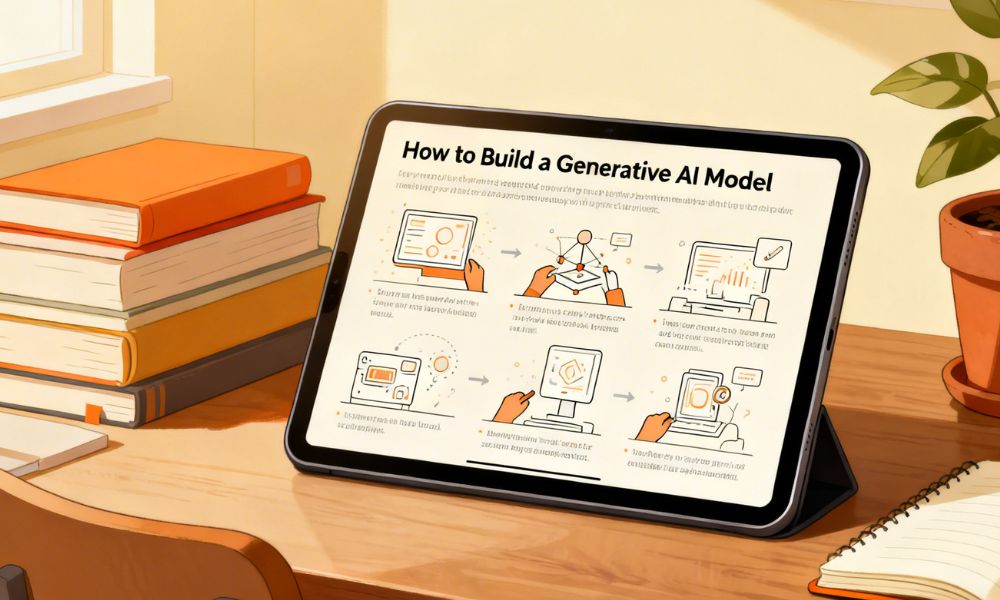
Building a generative AI model from scratch can be a complex but rewarding process. Here’s an overview of the key steps involved:
Prepare Your Data
Before you can train a generative model, you need to collect and prepare the data. This involves cleaning, preprocessing, and possibly augmenting the data to ensure that it’s of high quality and representative of the content you want the AI to generate.
Choose Your Model
Choosing the right model architecture is crucial. Depending on the type of content you want to generate, you might select from a variety of models, including GANs for images, VAEs for diverse content. Or transformer-based models for text generation.
Train the Model
Training is where the magic happens. During this phase, the model learns the patterns in the data and adjusts its internal parameters to improve its output. This requires significant computational resources, especially if you’re working with large datasets.
Fine-Tune and Optimize
After training, the model may need fine-tuning. This involves adjusting hyperparameters, tweaking the architecture, or improving the dataset to enhance the quality of the generated content.
Deploying a Generative AI Model
Once your model is trained and fine-tuned, it’s time to deploy it into a real-world application. Deployment means making the model accessible for use and ensuring it runs efficiently.
Choose a Deployment Platform
There are several platforms for deploying generative AI models, including cloud-based services like Google Cloud AI, AWS, or Microsoft Azure. These platforms offer the infrastructure needed to scale your model and integrate it with applications.
Model Optimization for Deployment
Before deployment, optimizing the model for performance is essential. This includes reducing the model’s size, compressing data. And ensuring that it can handle real-time input without lagging or consuming excessive resources.
Monitoring and Maintenance
Once deployed, your model will require continuous monitoring to ensure that it functions as expected. Regular updates, retraining, and performance evaluations are necessary to keep the model performing well in changing environments.
Applications of Generative AI
Generative AI is making waves across multiple industries, creating new opportunities for innovation. Here are just a few examples of how it’s being applied:
- In Healthcare: Generative AI can simulate new drug compounds or predict molecular structures, helping accelerate the drug discovery process.
- In Entertainment: AI models can generate realistic visual effects, create original music, and even write scripts, revolutionizing the creative process in film and television production.
- In Business: From generating personalized advertisements to automating customer service interactions, businesses are leveraging generative AI to improve efficiency and enhance customer experiences.
The Future of Generative AI
As technology continues to evolve, the potential of generative AI is growing exponentially. Future advancements in machine learning algorithms, increased computational power, and better access to data will make generative models even more powerful and accessible. The future promises even more creative possibilities, with AI potentially becoming an integral part of everyday life.
Conclusion
Generative AI is transforming industries by allowing machines to generate new, creative content that can enhance human capabilities. By learning how to build and deploy generative AI models, individuals and businesses alike can leverage this powerful technology to drive innovation and create exciting new possibilities. Whether you’re interested in the technical aspects or the creative potential of generative AI, mastering this field opens up numerous opportunities for the future.
Taking the first steps with a generative AI course will set you on the path to becoming proficient in this revolutionary technology, enabling you to make meaningful contributions to the AI-driven world of tomorrow.