

Artificial Intelligence (AI) is no longer the stuff of lore – it’s here and now, changing how we work and live. For those who want to be ahead of the game, mastering AI is a must. Here in this guide, we’ll tell you how to go about doing AI courses, what kinds of skills to pick up and how can you make the most of your learning journey. Whether you’re a beginner or want to advance your understanding, we’ve got all you need to know to start an AI course covered in this article.
Why Learn AI?
AI is a game-changer in the contemporary world. From self-driving cars and personalized recommendations on Netflix to anything that Google brings up upon your search. Learning AI isn’t just about understanding the technology, it’s also about future-proofing your career. You’re getting collectible AI cards and investing that will become one of the most in-demand skill sets across all industries as automation becomes more core to business – think health care, finance or entertainment. With an AI course, you unlock limitless job opportunities in one of the most exhilarating industries today.
Key Skills You’ll Learn in an AI Course
An AI course is designed to equip you with both the theoretical knowledge and practical skills necessary for mastering artificial intelligence. Here are some of the core concepts you’ll encounter:
Fundamentals of AI
You’ll start with the basics, learning about machine learning, deep learning, neural networks, and natural language processing (NLP). These are the building blocks of AI, and understanding them is crucial for tackling more complex topics later on.
Programming with Python
Python is the primary language used for AI development. An AI course will teach you how to use Python for data manipulation, model building, and AI system development. You’ll work with popular libraries like TensorFlow, Keras, and Scikit-learn.
Mathematics for AI
AI heavily relies on mathematical concepts, particularly linear algebra, calculus, and probability theory. Don’t worry—most AI courses will offer beginner-friendly resources to help you grasp these concepts.
Data Handling and Analysis
Working with data is at the heart of AI. You’ll learn how to collect, clean, and preprocess data, which is essential for building reliable machine learning models.
Online vs. Offline AI Courses: Which One Should You Choose?
When it comes to how to do an AI course, one of the first decisions you’ll need to make is whether to take an online or offline course. Both options have their own pros and cons.
Online AI Courses
Online platforms like Coursera, edX, and Udacity offer a wide range of AI courses. These courses allow you to learn at your own pace and on your own schedule. Many courses are taught by top-tier universities and offer certificates upon completion, which can help enhance your resume.
Offline AI Courses
Offline courses, often provided by universities or specialized institutions, offer structured learning with in-person lectures and hands-on support. These courses may be more expensive but often provide more in-depth learning and greater networking opportunities.
Free vs. Paid AI Courses: What’s the Difference?
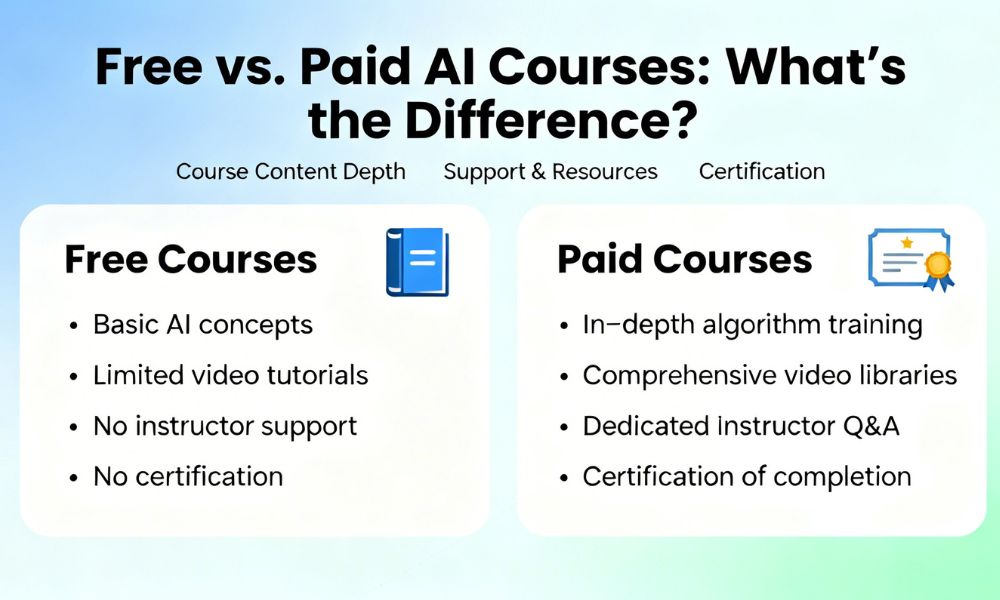
For beginners, choosing between free and paid AI courses can be challenging. Here’s a breakdown of what to expect:
Free AI Courses
Many free courses are available online, offering a great way to start learning AI without any financial commitment. However, free courses tend to cover only the basics and may not provide the depth required to secure a job in AI. Platforms like Google AI and Khan Academy offer excellent free resources.
Paid AI Courses
Paid courses usually offer more comprehensive content, including interactive exercises, assignments, and certificates. They often provide direct access to expert instructors and a more structured curriculum, making them ideal for those serious about building a career in AI.
Building the Right Skills for AI
To succeed in an AI course, there are several key skills you should focus on:
Programming
Learning Python is a must. Many AI tasks are performed using Python because of its simplicity and powerful libraries. Gaining proficiency in Python will help you apply machine learning algorithms and build AI systems efficiently.
Mathematics
AI requires a solid understanding of mathematics. Concepts like statistics, linear algebra, and calculus are fundamental to understanding how algorithms work and how to optimize them.
Data Science
Data is the core of AI. You’ll need to learn how to process, clean, and manipulate data for use in machine learning models. Data science techniques like data visualization and statistical analysis are essential to building robust AI systems.
How to Maximize Your Learning Experience with AI Courses
Taking an AI course is an exciting journey, but to truly get the most out of it, you should consider the following tips:
Start with Small Projects
Hands-on experience is critical. Start by applying the concepts you learn in small projects, such as creating a basic recommendation system or a simple chatbot. This will help you understand how the theory translates into real-world applications.
Join AI Communities
AI communities, both online and offline, can provide valuable support and networking opportunities. Websites like Stack Overflow and Reddit’s AI community are great places to discuss ideas, solve problems, and connect with like-minded learners.
Practice Regularly
AI is a field that requires constant practice and experimentation. The more you work with different algorithms, datasets, and models, the better you’ll become at solving complex problems.
Career Opportunities in AI: What’s Next After Your Course?
Once you’ve completed your AI course, exciting career opportunities await in various industries. AI professionals are in high demand, and several roles offer rewarding prospects. These include:
- Machine Learning Engineer: Develops and deploys machine learning models across AI applications.
- Data Scientist: Analyzes large datasets to provide actionable insights, guiding business decisions.
- AI Researcher: Innovates by developing new algorithms and techniques to advance machine learning models.
- AI Product Manager: Manages AI-driven products, ensuring their technical feasibility and market alignment.
These roles offer unique challenges and opportunities for growth. As AI continues to shape industries, professionals in these fields will play key roles in driving innovation and technological progress. The future of AI is bright, and now is the time to seize it.
Conclusion
Learning how to do an AI course is an exciting and rewarding journey. By mastering the fundamentals of AI, programming, and data science, you’ll be prepared to tackle real-world challenges and explore numerous career opportunities in one of the most innovative fields today. Whether you choose an online or offline course, free or paid, the key is to stay motivated, practice regularly, and continuously seek to deepen your understanding. The world of AI is waiting for you to explore—take the first step today and unlock a world of possibilities.