
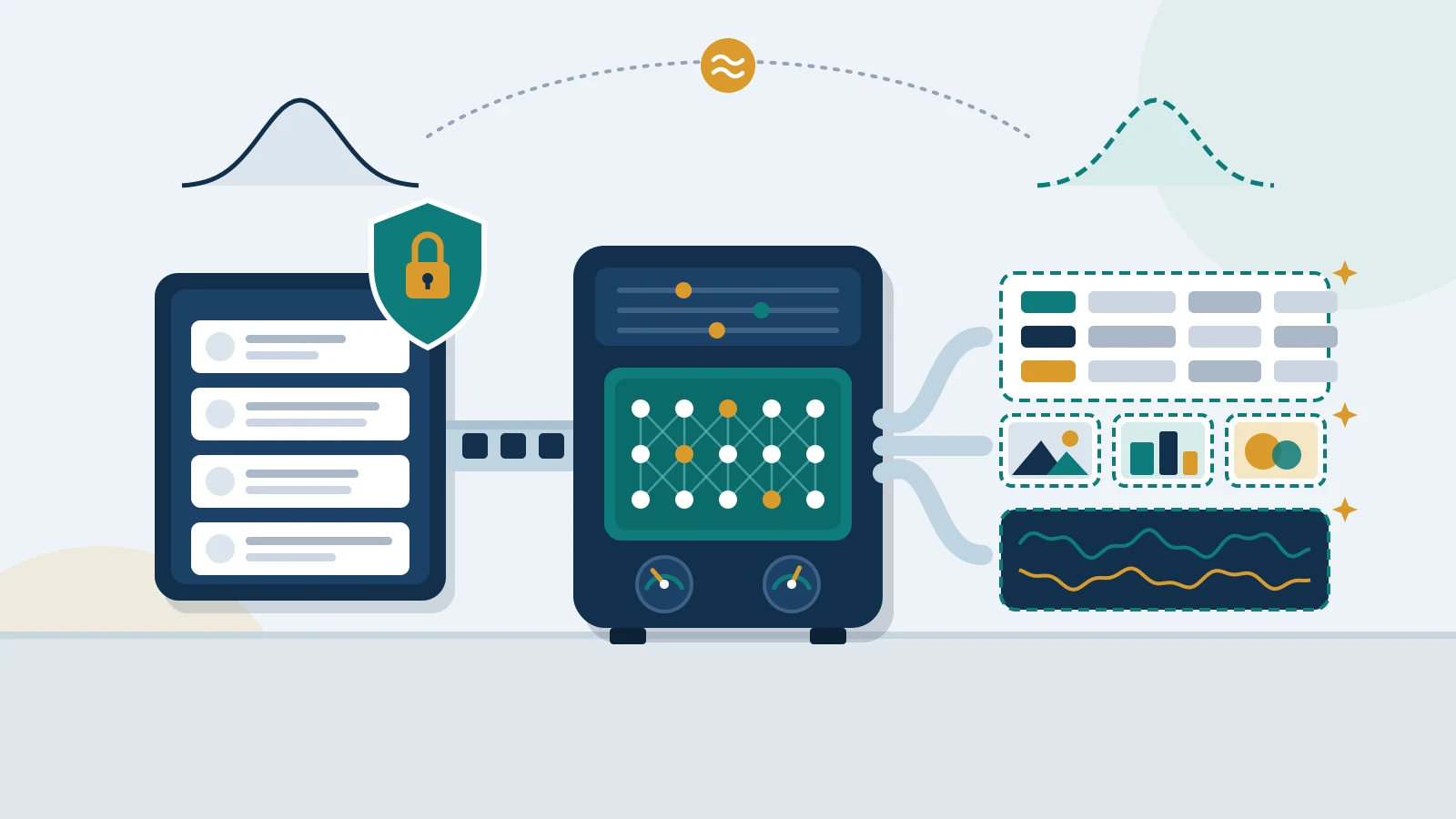
AI-generated illustration created to represent the article’s subject. It does not depict an actual EPW course, trainer, participant, client, event or venue.
Computer vision is the broader field that enables machines to interpret images and video, while image recognition is a narrower task that identifies or classifies what appears in an image. A computer-vision system may detect, locate, segment, track, measure or read visual information. Image recognition normally answers a more focused question such as “Which product, defect or object category is present?”
The distinction matters because it changes the data labels, model output, evaluation measures, infrastructure and operational controls a project needs. Teams that call every visual task “image recognition” may select a classification model when the real requirement is to find where an object is, measure its shape or follow it through video.
Key takeaways
- Image recognition is usually one capability within a wider computer-vision solution.
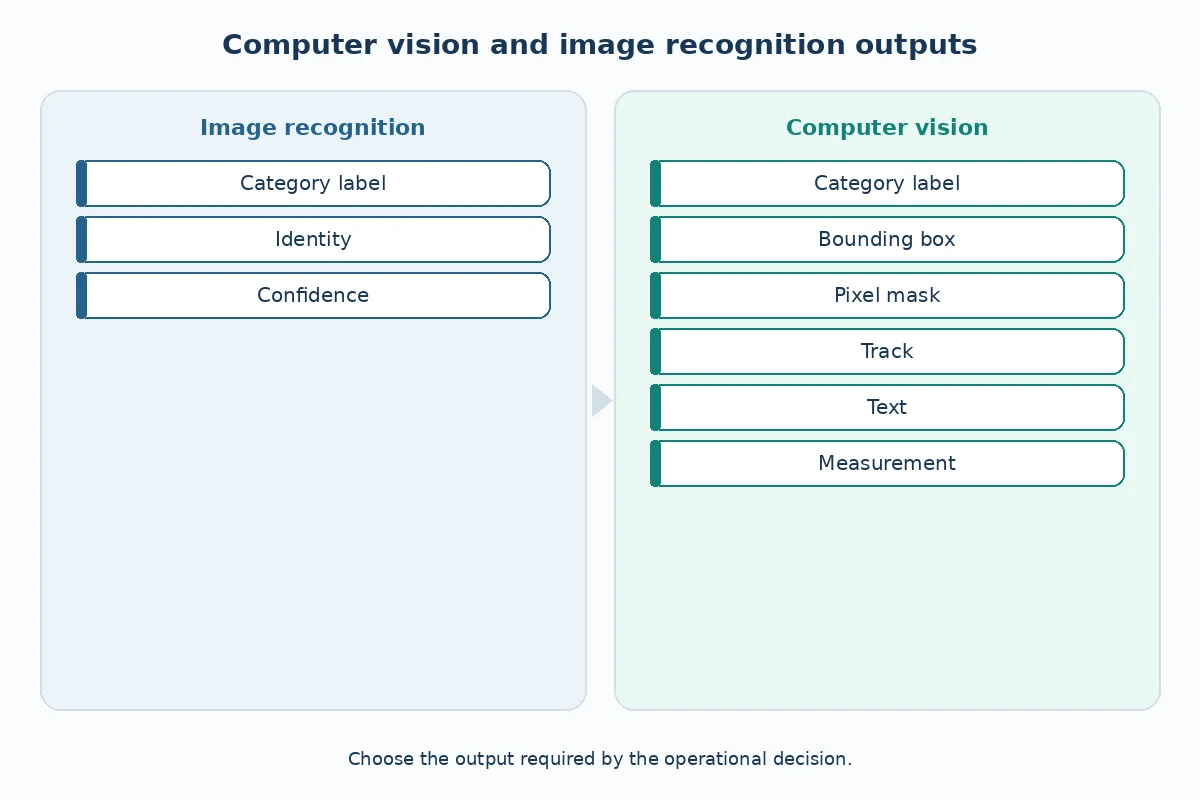
- Recognition returns an identity or category; broader vision tasks can also return locations, pixel masks, text, motion or measurements.
- The correct task is defined by the operational decision, not by the availability of a particular model.
- Classification accuracy alone cannot evaluate detection, segmentation or tracking performance.
- Camera conditions, representative data and human-review rules affect both approaches in production.
Computer vision vs image recognition at a glance
| Comparison criterion | Computer vision | Image recognition |
|---|---|---|
| Scope | Broad discipline covering many ways to interpret images and video | Focused capability for identifying or classifying visual content |
| Typical question | What is happening, where is it, what shape is it and how is it changing? | What object, class, person, product or condition is present? |
| Common outputs | Labels, bounding boxes, pixel masks, tracks, key points, text or measurements | One or more class labels, identities or confidence scores |
| Typical input | Still images, video streams, multi-camera feeds or specialised imagery | Usually a still image or selected video frame |
| Label requirements | May require boxes, polygons, masks, tracks, key points or text transcription | Usually image-level class or identity labels |
| Evaluation | Task-specific measures such as precision, recall, intersection over union, mean average precision, tracking quality and latency | Measures such as class accuracy, precision, recall, confusion matrices and calibration |
| Example | Locate every damaged package on a conveyor and measure the damaged area | Classify a package image as damaged or acceptable |
What computer vision covers
Computer vision is an umbrella discipline concerned with extracting useful information from visual inputs. Official TensorFlow computer-vision guidance groups common workflows such as data augmentation, classification, object detection and segmentation under the same wider field.
A computer-vision solution may combine several tasks. A warehouse application could detect pallets, read labels through optical character recognition (OCR), track movements across cameras and flag unsafe proximity between equipment and people. The output is not simply a name for the image; it is structured evidence about a scene.
Examples of broader computer-vision tasks include:
- Object detection: identifies objects and returns their positions, often as bounding boxes.
- Segmentation: assigns a class to individual pixels so the system can represent an object’s shape or area.
- Tracking: associates the same object across frames in a video.
- OCR: detects and extracts printed or handwritten text from images and documents.
- Pose or key-point estimation: locates defined landmarks on a person, component or object.
- Visual measurement: estimates dimensions, counts, distances or changes when the imaging geometry supports it.
Google Cloud’s official Vision feature list illustrates this range: label detection produces general labels, while object localisation adds positions and OCR extracts text. The technical family is shared, but the outputs serve different decisions.
What image recognition means
Image recognition identifies the content or identity represented in an image. In many practical projects, the underlying task is image classification: the model receives an image and assigns one or more labels. A manufacturer might classify a component as the correct part number; a service team might recognise a meter type before directing the image to the correct workflow.
The official TensorFlow image-classification tutorial demonstrates the standard machine-learning sequence: examine the data, build an input pipeline, train, test and improve the model. Recognition still demands representative data, valid class definitions and production testing; it is not merely a software feature that works independently of context.
The term is sometimes used loosely to include detection or facial recognition. To remove ambiguity, project teams should name the required output explicitly. “Recognise defects” might mean classifying an entire image, detecting each defect, segmenting damaged pixels or identifying a known defect type. Those are different specifications.
Material differences that affect project design
1. Scope and output structure
Image recognition typically produces a label and confidence score. A broader vision system may produce several objects, locations, masks, relationships or time-based tracks. Google Cloud’s object-localisation documentation, for example, describes outputs that include object information and rectangular bounds rather than only a label for the complete image.
2. Annotation effort
Image-level labels can be sufficient for classification. Detection requires a box around each relevant object; segmentation requires pixel-level masks; tracking requires consistent identity across frames. Greater annotation detail can support a more useful output, but it also increases specification, quality-control and review demands.
3. Evaluation measures
A recognition model can be evaluated with a class confusion matrix, precision, recall and other classification measures. A detection system must also judge whether locations are correct. A segmentation system must evaluate overlap between predicted and reference areas. The TensorFlow segmentation guide makes the distinction explicit: classification assigns a class to an image, while segmentation assigns a class to pixels.
4. Operational conditions
Both approaches are affected by lighting, angle, resolution, focus, occlusion and changes in equipment or environment. Video systems add frame rate, motion blur, tracking continuity and processing latency. A model that succeeds on curated test images may still fail when a camera moves, packaging changes or rare conditions are absent from the test set.
5. System integration
A recognition result may route an image to a known process. A full computer-vision system can require camera control, edge hardware, video storage, event processing, privacy controls and interfaces for reviewing boxes, masks or tracks. Project scope therefore includes the imaging and operating system, not only the model.
A worked example: visual quality inspection
Consider a production team inspecting sealed containers. If the only decision is whether a close-up image belongs to “acceptable seal” or “defective seal”, image recognition may be sufficient. The team needs reliable class definitions, representative examples and an escalation rule for uncertain predictions.
If the process must locate every defect, distinguish several defect types, measure affected area and track the container to a rejection point, the requirement is broader computer vision. Detection or segmentation outputs must be linked with timing, identity and equipment controls.
| Operational need | Suitable task | Required output |
|---|---|---|
| Accept or reject one centred seal image | Image classification | Acceptable, defective and confidence |
| Find defects anywhere on a container | Object detection | Defect label and bounding box |
| Measure the exact damaged area | Segmentation | Pixel mask and calculated area |
| Follow a defective container to a diversion point | Detection and tracking | Location and persistent track identity |
The EPW SCOPE test for selecting the right task
SCOPE is an original EPW decision aid. It prevents the project from beginning with a fashionable model and instead connects the visual output to the operating decision.
| Test | Decision question | Evidence to record |
|---|---|---|
| S — Scope | Is one image-level identity enough, or must the system interpret a scene? | Decision statement and required visual entities |
| C — Coordinates | Does the user need position, shape, count, movement or spatial relationships? | Required boxes, masks, tracks, key points or measurements |
| O — Operational action | Who acts on the output, and what happens after a positive, negative or uncertain result? | Workflow, escalation and fallback rules |
| P — Performance | Which errors matter, and which technical and operational measures expose them? | Class and spatial metrics, thresholds, latency and review capacity |
| E — Environment | Which cameras, lighting, angles, devices and changes must the system handle? | Deployment conditions and representative evaluation plan |
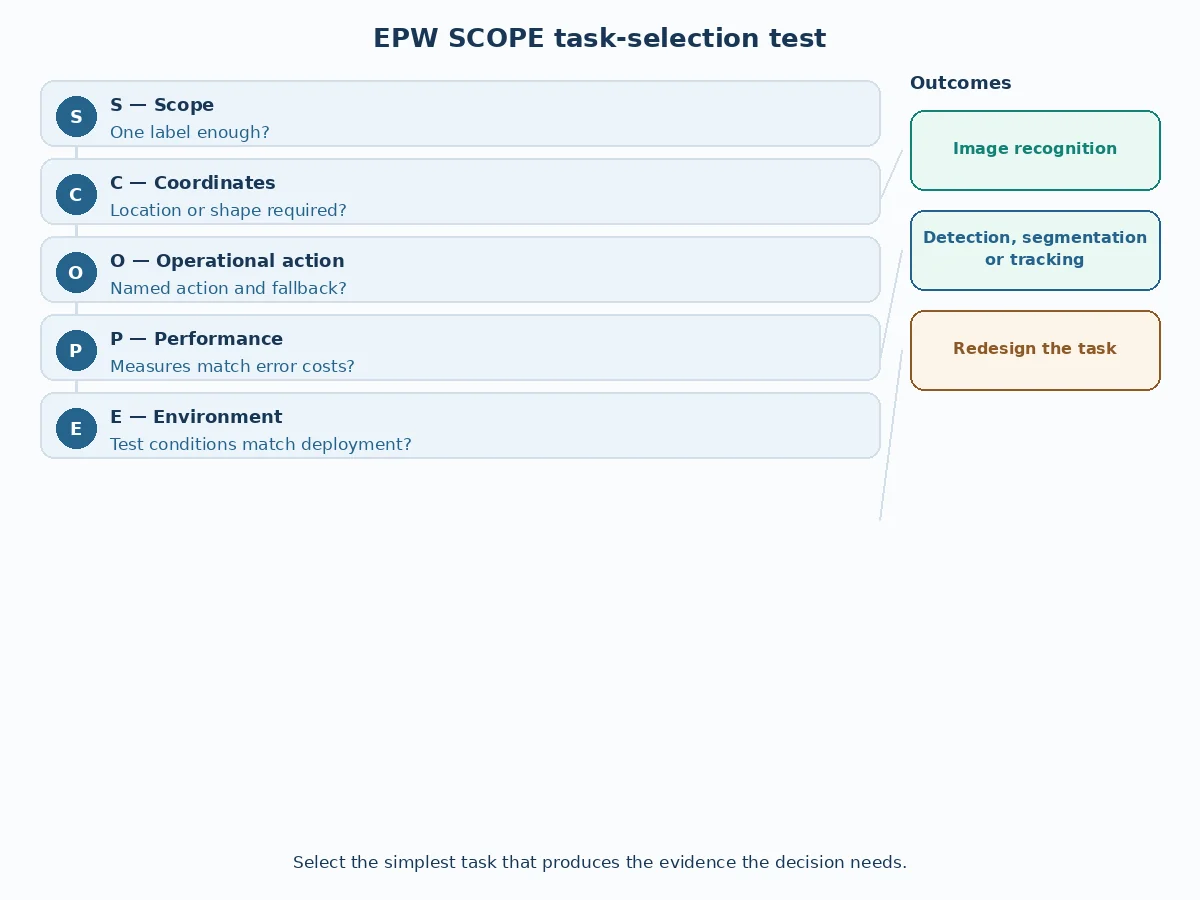
If an image-level label satisfies all five tests, recognition is usually the simpler specification. If the decision needs coordinates, shape, motion or relationships, select the corresponding broader vision task. If the operational action or evaluation environment is unclear, the correct response is to redesign the requirement before building a model.
Similarities and shared controls
Computer vision and image recognition use many of the same foundations: representative images, consistent annotations, feature learning, transfer learning, data augmentation and controlled evaluation. The TensorFlow transfer-learning guide shows how a pretrained network can be adapted to a new classification task; related pretrained backbones also support detection and segmentation workflows.
Both approaches need lifecycle controls. The NIST AI Risk Management Framework recommends managing trustworthiness considerations across design, development, use and evaluation. For a visual system, that means documenting intended use, testing representative conditions, monitoring input and performance changes, controlling access and retaining a safe human or process fallback.
Build the skills to specify visual AI correctly
Choosing between computer vision and image recognition is a requirements decision before it is an algorithm decision. Teams need to formulate classification, detection and segmentation problems; design labels; evaluate class and spatial errors; and plan reliable edge or cloud deployment.
EPW’s five-day Computer Vision and Image Recognition Applications course develops these capabilities through image processing, convolutional networks, detection, segmentation, tracking, transfer learning, task-specific evaluation and production-system design. Readers can also explore the existing articles on image-recognition applications and deep learning for image recognition.
Review EPW’s Artificial Intelligence and Machine Learning Courses or the AI and machine learning article hub. To apply the SCOPE test to a real inspection, recognition or monitoring requirement, explore the Computer Vision and Image Recognition Applications course, available dates and locations, or request tailored course details.
Sources and references
- TensorFlow. Computer vision with TensorFlow. Official documentation.
- Google Cloud. Cloud Vision API features list. Official documentation.
- Google Cloud. Detect multiple objects with object localisation. Official documentation.
- TensorFlow. Image classification. Official tutorial.
- TensorFlow. Image segmentation. Official tutorial, updated 16 August 2024.
- TensorFlow. Transfer learning and fine-tuning. Official tutorial, updated 16 August 2024.
- National Institute of Standards and Technology. Artificial Intelligence Risk Management Framework. AI RMF 1.0, 2023.
- EPW Training. Computer Vision and Image Recognition Applications Course. Course outline accessed 31 August 2026.


One thought on “Computer Vision vs Image Recognition: Key Differences”
Comments are closed.