

AI-generated illustration created to represent the article’s subject. It does not depict an actual EPW course, trainer, participant, client, event or venue.
Energy project compliance is most effective when legal and regulatory obligations are translated into specific controls, owners, evidence and review dates. The best programmes do not rely on a static legal register or a final pre-start audit. They integrate compliance into project development, design, procurement, construction, commissioning, operations and closure.
This article sets out eight practical best practices for managing legal risk. It is a governance guide, not legal advice: obligations differ by jurisdiction, project type, licence, contract and lifecycle stage, so qualified local counsel and relevant technical specialists should confirm the requirements for each project.
Why energy-project compliance is difficult
An energy project may face corporate, land, planning, environmental, safety, electricity or petroleum, construction, labour, tax, trade, data, maritime and decommissioning requirements. Different authorities can impose overlapping approvals, reporting duties and conditions. A project may also commit to lender standards, contractual requirements and voluntary frameworks that go beyond minimum law.
Complexity increases when requirements change during a multi-year development or when equipment, contractors and finance cross borders. The International Energy Agency’s policy database illustrates the breadth and pace of energy-related policy measures across countries and technologies [1]. A reliable compliance system therefore needs active change monitoring, not a one-off legal review.
Energy project compliance at a glance
| Project stage | Typical compliance focus | Evidence to retain |
|---|---|---|
| Opportunity and site selection | Rights, licences, land, policy eligibility and early constraints | Legal due diligence, title records, screening and authority advice |
| Development and design | Environmental assessment, permits, technical codes and stakeholder duties | Applications, studies, design basis, consultation and approvals |
| Procurement | Contract flow-down, trade controls, supplier qualifications and product conformity | Clauses, due diligence, certificates and approval records |
| Construction | Site safety, working conditions, inspections, environmental limits and reporting | Method statements, permits to work, monitoring data and corrective actions |
| Commissioning and operations | Operating licence conditions, asset integrity, emissions, market and reporting rules | Test packs, operating procedures, competence and regulatory submissions |
| Closure | Decommissioning, waste, remediation, financial security and records | Closure plan, transfer notes, surveys, releases and retained archives |
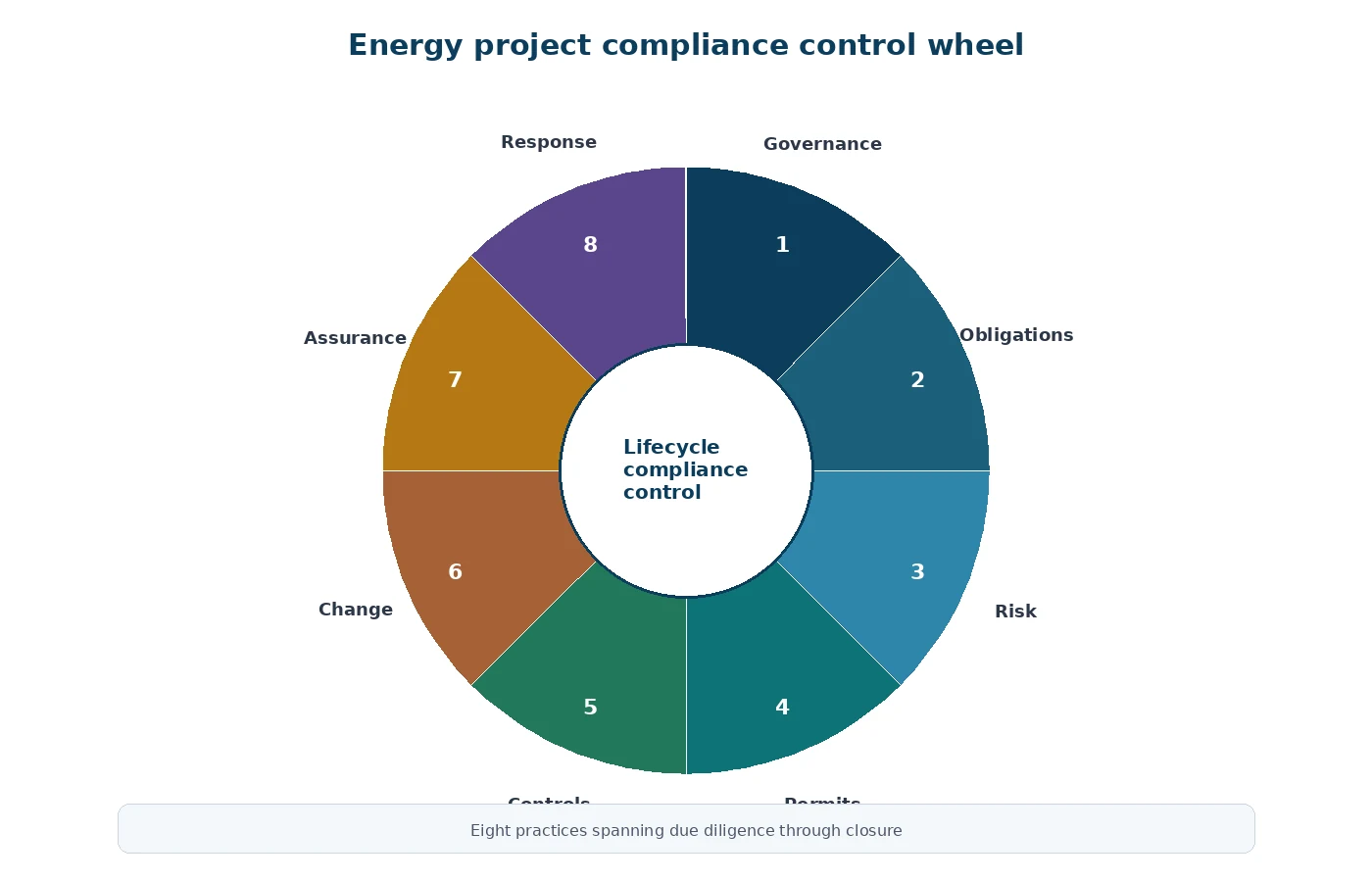
Eight best practices for managing legal risk
1. Establish accountable compliance governance
Name an executive sponsor, project compliance lead, legal advisers and control owners. Define which decisions require legal review, regulatory notification or board approval. Separate advice, ownership and assurance: lawyers may interpret an obligation, but the project function performing the work must own the control.
ISO 37301 presents a compliance-management-system approach built around governance, responsibilities, risk assessment, controls, evaluation and improvement [2]. Projects can apply these principles proportionately even when they do not seek certification.
2. Build an obligation register that drives action
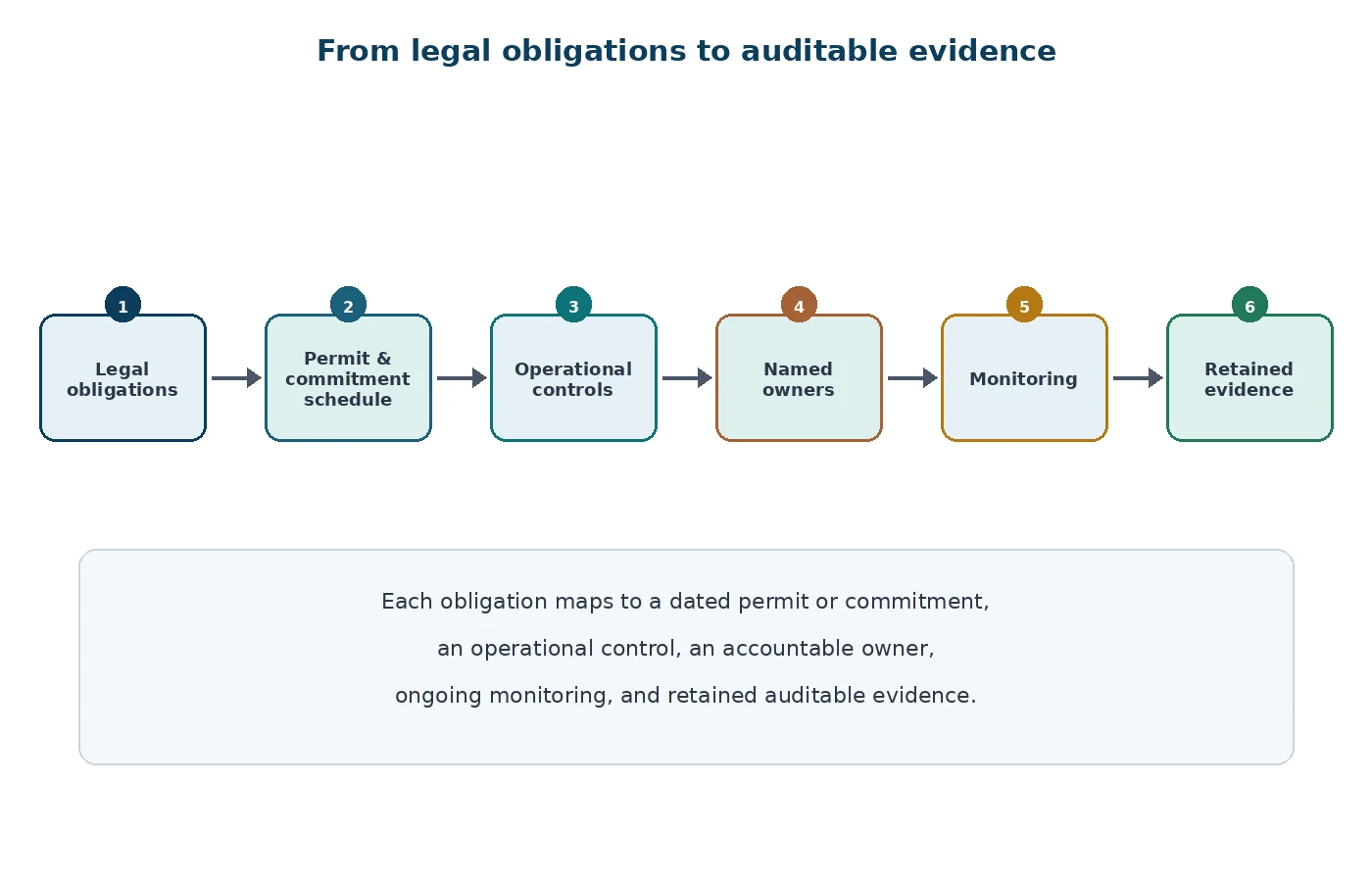
A useful register is more than a list of laws. For every material obligation, record the source, jurisdiction, applicability, plain-language requirement, owner, control, frequency, evidence, reporting path and consequence of failure. Link each permit condition to the design or operating document that implements it.
Distinguish binding requirements from guidance and internal commitments. Also record dependencies: one permit may require completion of a study, consultation or land agreement before another application can proceed.
3. Use risk-based prioritisation without ignoring mandatory duties
Assess the likelihood and consequence of non-compliance, including safety, environmental, schedule, financial, licence and reputation effects. Prioritisation determines the depth of control and assurance; it does not make a mandatory obligation optional. ISO 31000 recommends integrating risk management into governance, strategy, planning, reporting and culture [3].
High-risk topics deserve early specialist review and independent assurance. Low-frequency but severe exposures—such as loss of a core licence or serious environmental harm—should not be buried by high-volume administrative tasks.
4. Create an integrated permit and commitment schedule
Map applications, consultations, regulator review periods, dependencies, conditions precedent and renewal dates into the master schedule. Use realistic ranges rather than assuming the shortest statutory period. Identify the latest responsible date for submitting complete information, not merely the formal deadline.
Maintain a commitments register for promises made in applications, environmental and social plans, lender documents, stakeholder agreements and contracts. Untracked commitments can become compliance failures even when the principal permit remains valid.
5. Translate requirements into design, contracts and procedures
Requirements must reach the people who can implement them. Incorporate technical limits into the design basis, employer’s requirements, specifications, interface registers, inspection plans and operating procedures. Flow relevant duties into supplier and contractor contracts, but do not assume contractual transfer removes the project owner’s regulatory accountability.
The International Finance Corporation’s Environmental, Health and Safety Guidelines provide examples of good international industry practice that lenders and projects may use alongside host-country law [4]. Teams should document which standard applies when requirements differ and how the selected criterion was approved.
6. Control change across law and project scope
Monitor new legislation, regulator guidance, permit variations and relevant enforcement decisions. At the same time, route design, ownership, contractor, technology, capacity and schedule changes through a compliance-impact check. A permit based on one footprint or operating mode may not cover a later modification.
Define trusted sources, monitoring frequency and accountable reviewers for every jurisdiction. Log the assessment even when no action is required. This creates evidence that the project considered the change deliberately.
7. Verify performance and preserve evidence
Use inspections, monitoring, control testing, contractor reviews and internal audits to determine whether controls work in practice. Sample source evidence rather than relying only on dashboard status. Corrective actions should have owners, risk-based deadlines, closure evidence and verification.
Design a records schedule that covers format, retention, access, version control and transfer to the operator. Evidence may need to outlive the project team. Test whether records can be retrieved quickly by permit condition, asset, contractor or reporting period.
8. Prepare for incidents, disclosures and regulator engagement
Define notification thresholds, decision authority and contact paths before an incident. Protect privilege where applicable, preserve evidence and coordinate legal, technical, HSE and communications work. Never delay an obligatory notification while seeking perfect information; confirm the applicable timing and submit verified updates as permitted.
Engage regulators accurately and consistently. Keep a record of meetings, advice, submissions and agreed actions. Early, evidence-based dialogue can expose misunderstandings before they become schedule-critical.
How to measure compliance performance
Use a balanced set of measures. A low number of reported breaches can indicate strong control—or weak detection. Combine lagging outcomes with leading evidence:
- material breaches, notices, penalties and repeat findings;
- permits or renewals at risk against the critical path;
- percentage of material obligations with tested controls;
- overdue high-risk actions and average closure age;
- regulatory submissions delivered complete and on time;
- contractors completing required due diligence and training;
- legal or regulatory changes assessed within the target period;
- record-retrieval tests completed successfully.
Report exceptions, trends and decisions, not just totals. Senior governance should see which obligations threaten safety, permission to operate, financing or the project schedule.
Common compliance failures to avoid
- Late permitting: applications start after design or procurement has constrained the available options.
- Register without controls: obligations exist in a spreadsheet but not in specifications or procedures.
- Unclear ownership: legal, HSE, engineering and contractors each assume another party is responsible.
- Contract-only transfer: the owner delegates work but overlooks retained legal accountability.
- Fragmented evidence: records cannot demonstrate that a condition was satisfied.
- Scope-change blindness: a revised design or operating mode invalidates an earlier approval assumption.
- Audit theatre: teams close findings administratively without verifying control effectiveness.
Professionals handling commercial interfaces may benefit from EPW’s Strategic Negotiation of Oil and Gas Contracts course. For market and policy context, see the Energy Pricing, Markets and Regulatory Frameworks course.
A practical compliance review agenda
A monthly project review should answer five questions: What has changed? Which approval or obligation could affect the critical path? Which controls failed or remain untested? Which commitments are approaching delivery? Which decisions or regulator engagements require senior action? Record decisions and verify that actions reach the master schedule and control owners.
EPW’s Legal Framework and Regulatory Compliance in Energy Projects course examines legal frameworks, project compliance, risk, stakeholder responsibilities and practical governance in an energy context.
Frequently asked questions
Who owns compliance on an energy project?
The project organisation remains accountable for compliance. Individual obligations and controls should have named owners, supported by legal, regulatory, technical and assurance specialists.
Is a legal register enough?
No. It must connect each applicable obligation to a control, responsible owner, evidence, review frequency and escalation route.
Can a contractor take all regulatory responsibility?
Usually not. Contracts can allocate work, liabilities and evidence duties, but statutory accountability depends on the law, licence and role. Obtain jurisdiction-specific legal advice.
When should compliance planning begin?
During opportunity screening and site selection. Early constraints can determine whether a concept is feasible and how long development will take.
Build stronger compliance capability
Effective legal-risk management is traceable, lifecycle-based and owned by the people delivering the project. Explore EPW’s Legal Framework and Regulatory Compliance in Energy Projects course, or browse the wider Oil, Gas and Energy training portfolio.
Sources and references
- International Energy Agency, Policies Database.
- International Organization for Standardization, ISO 37301 compliance management systems.
- International Organization for Standardization, ISO 31000 risk management guidance.
- International Finance Corporation, General Environmental, Health and Safety Guidelines.
- OECD, Recommendation of the Council on Regulatory Policy and Governance.