

Supervisor skills training helps new and aspiring team leaders make the transition from completing their own work to achieving results through other people. The most useful programmes combine role clarity, communication, delegation, performance conversations, coaching, problem-solving and conflict management with realistic practice. They suit employees preparing for promotion, recently appointed supervisors and experienced team leaders who need a consistent management foundation.
A strong technical performer does not automatically become an effective supervisor. The job changes: priorities must be translated into clear expectations, workloads coordinated, progress reviewed and difficult issues handled fairly. Training should therefore be chosen for the workplace decisions participants must make, not for an impressive list of leadership theories.
Key takeaways
- Supervisor training is most valuable before promotion or within the first months of responsibility.
- A credible course develops observable behaviours, not only leadership vocabulary.
- Practice, feedback and workplace application matter more than the number of topics advertised.
- The right programme should match the participant’s authority, team context and experience.
Who needs supervisor skills training?
Supervisor skills training is designed for people who coordinate day-to-day work and are accountable for the performance, conduct or development of others. Job titles vary: supervisor, team leader, shift leader, section head, first-line manager or project lead. What matters is the responsibility, not the label.
The CIPD’s line-manager factsheet, updated on 17 January 2025, describes line managers as responsible for day-to-day operations and people management, including implementing organisational policies and developing teams. This explains why the transition is demanding: the role sits between organisational requirements and employees’ daily experience.
Aspiring supervisors
Employees preparing for promotion benefit from learning the responsibilities before they receive formal authority. Training lets them test whether they are ready to set expectations, give feedback, make balanced decisions and address conflict. It also reduces reliance on trial and error during the first weeks in post.
Newly appointed supervisors
New supervisors often face a double transition: their output is now partly measured through the team, and former peers may expect the relationship to remain unchanged. They need practical boundaries, a method for assigning work, and confidence in escalating matters that exceed their authority. Acas identifies new managers, people promoted above former peers, team leaders and aspiring managers as suitable audiences for foundation management training.
Experienced team leaders who learned informally
Experience is valuable, but it can leave uneven capability. A supervisor may be excellent at scheduling yet avoid feedback, or strong in emergencies but inconsistent in delegation. Structured development helps reveal such gaps and creates shared language across a management group.
Skills a useful programme should develop
Course content should reflect the moments that determine a supervisor’s credibility. The following areas are a practical baseline.
| Capability | Workplace behaviour | Evidence of learning |
|---|---|---|
| Role clarity | Distinguishes personal tasks, supervisory decisions and issues requiring escalation | Creates a responsibility map for a real team |
| Communication | Explains priorities, checks understanding and listens for concerns | Runs a structured briefing and receives feedback |
| Delegation | Matches work to capability, defines authority and agrees review points | Produces a delegation plan with clear controls |
| Performance management | Sets expectations, monitors evidence and holds regular conversations | Practises an evidence-based feedback discussion |
| Coaching | Uses questions and reflection to build capability rather than solving every problem | Conducts a short coaching conversation |
| Problem-solving | Separates symptoms from causes and involves the right people | Applies a simple diagnostic method to a case |
| Conflict management | Intervenes early, listens impartially and uses appropriate procedures | Plans and role-plays a difficult conversation |
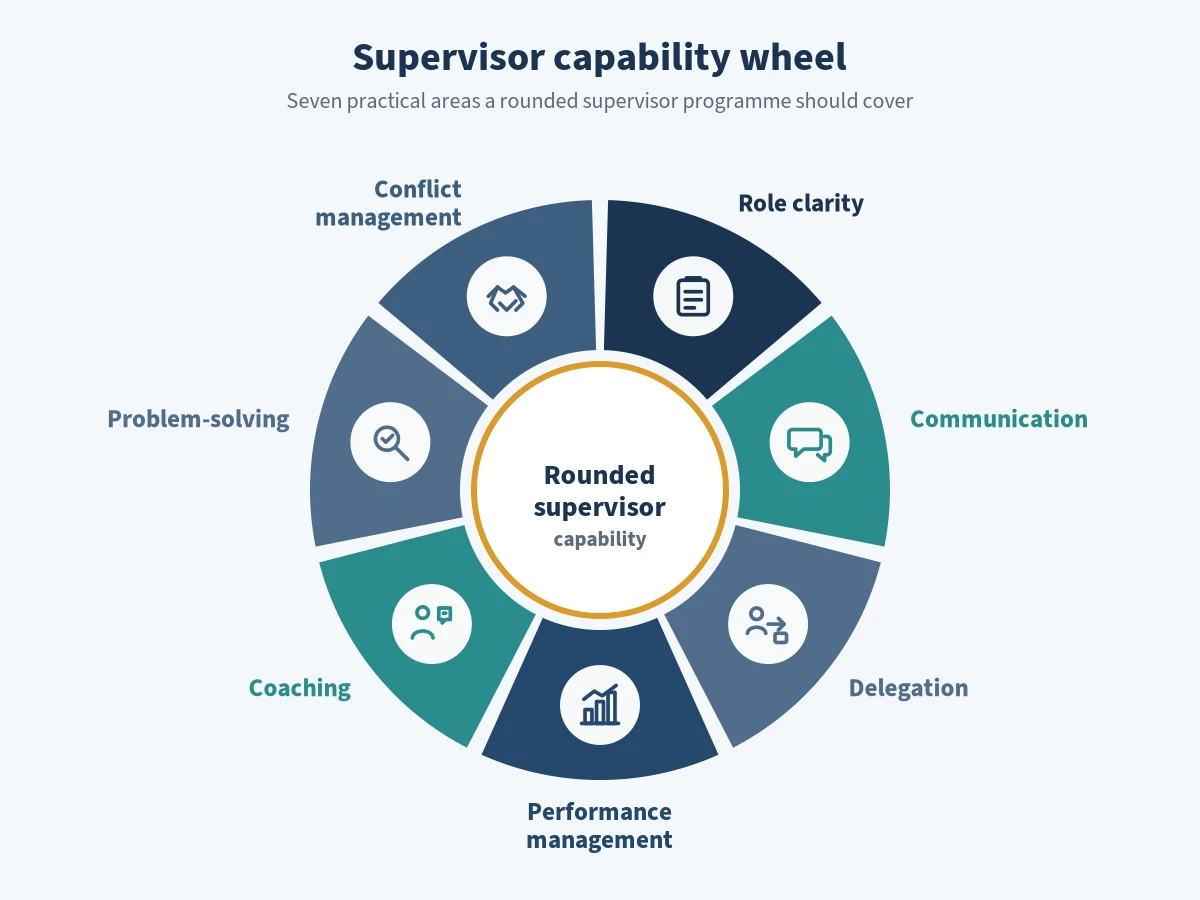
Performance capability deserves particular attention. The CIPD’s performance-management guidance, updated on 29 January 2026, treats performance management as a group of connected practices, including objectives, feedback, learning and accountability. A training course should therefore go beyond completing an appraisal form. Participants need to practise regular, supportive conversations and learn when a formal process is appropriate.
Related development may also be useful. EPW’s coaching and development course explores a deeper coaching remit, while the employee relations course is relevant for professionals whose responsibilities include more complex workplace procedures. These are complementary subjects, not substitutes for a sound supervisory foundation.
How to choose supervisor training
Compare programmes against the participant’s real work. A useful decision process has five steps.
1. Define the target role
Clarify team size, shift or office setting, decision authority, reporting lines and recurring people challenges. A course for an aspiring team leader should introduce the role; a programme for established supervisors can spend more time on judgement, coaching and complex conversations.
2. Specify the behavioural gaps
Avoid vague objectives such as “become a better leader”. Translate needs into actions: conduct a fair allocation discussion, delegate with checkpoints, challenge missed standards, brief a mixed-experience team, or diagnose a recurring operational problem.
3. Examine the learning method
Ask how participants will practise. Case analysis, role-play, guided reflection and feedback help convert concepts into behaviour. Slide-heavy instruction can explain terminology but may not prepare someone for an emotionally charged conversation.
4. Check the scope and progression
The sequence should move from role and self-awareness to leading others, managing performance and resolving problems. Too many unrelated topics can reduce practice time. Conversely, a narrow communication seminar may not address delegation, accountability or decision-making.
5. Plan transfer before enrolment
Agree with the participant’s manager which behaviours will be applied after training and how progress will be reviewed. A course cannot compensate for unclear authority, contradictory procedures or a manager who discourages new approaches.
For organisations working on motivation and retention as a broader system, EPW’s employee engagement and retention course can extend the conversation beyond the individual supervisor.
What outcomes should participants expect?
A credible course should state outcomes as decisions or behaviours. Participants should normally leave able to:
- explain the supervisor’s role, limits and accountabilities;
- adapt communication to the person, task and level of risk;
- set clear expectations and confirm understanding;
- delegate work without abandoning accountability;
- observe performance and give specific, balanced feedback;
- use coaching questions to support development;
- analyse routine problems and choose proportionate action; and
- address disagreement early and escalate formal issues correctly.
These outcomes are developmental, not a guarantee of promotion or organisational performance. Results also depend on workplace opportunity, manager support, policy clarity and continued practice. Acas’s current performance review guidance describes reviews as opportunities to discuss strengths, improvement, support, training and career objectives. That is a useful model for reviewing the participant after the course.
Turning supervisor training into workplace performance
Use a simple 30-day transfer plan rather than waiting for an annual appraisal.
| Period | Application task | Review evidence |
|---|---|---|
| Days 1–5 | Share three chosen behaviours with the manager and team | Clear expectations and agreed boundaries |
| Days 6–15 | Apply one delegation, briefing and feedback method | Notes on what happened and what changed |
| Days 16–25 | Use a structured approach on one real problem or disagreement | Decision rationale and stakeholder feedback |
| Days 26–30 | Review progress with the manager | One behaviour sustained and one next priority |
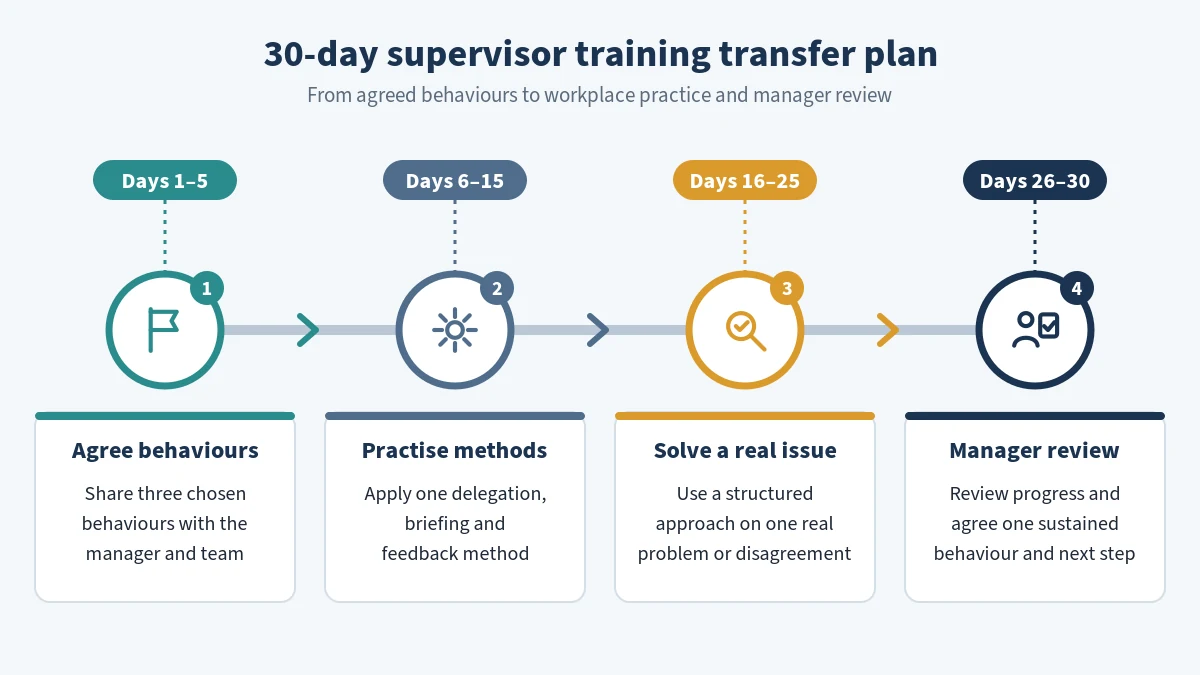
Evidence should remain proportionate. The aim is not to create surveillance or unnecessary paperwork. Short observation notes, examples of clearer delegation, feedback from the manager and resolution of a genuine work issue are usually more useful than a satisfaction score alone.
EPW supervisor skills training
EPW’s Effective Supervisor Skills for Leading with Confidence course is designed for aspiring and current supervisors. Its published outline covers the supervisory role, leadership styles, team performance, communication, problem-solving and conflict resolution. That scope is suitable for professionals who need a broad first-line management foundation rather than a specialist qualification.
Soft CTA: Review the course outline against your role profile and select two or three workplace behaviours that should improve after attendance. You can also browse EPW’s wider Human Resources training courses when the development need is more specialised.
Frequently asked questions
Is supervisor training only for newly promoted managers?
No. It can prepare aspiring supervisors, support people who have just been promoted, or provide structure for experienced team leaders who learned informally.
Does a supervisor course provide a professional certification?
A training certificate may confirm attendance or successful completion under the provider’s stated rules, but it should not be described as a regulated licence or professional certification unless a recognised awarding body and assessment route are explicitly identified.
What is the difference between supervisor and leadership training?
Leadership training can address influence and direction at many levels. Supervisor training focuses on first-line responsibilities such as work allocation, communication, performance, coaching and conflict within a defined team.
Conclusion
Supervisor skills training is worthwhile when it prepares participants for real first-line decisions and includes practice, feedback and a plan for workplace use. Choose a programme by matching its outcomes to the participant’s authority, experience and team challenges. The strongest result is not a longer topic list; it is more consistent behaviour after the learner returns to work.
Final CTA: Ready to build practical first-line leadership capability? Explore EPW’s Effective Supervisor Skills for Leading with Confidence course to review the published outline and available delivery options.
Sources and References
- Chartered Institute of Personnel and Development. Line Managers’ Role in Supporting the People Profession. 17 January 2025. CIPD factsheet.
- Chartered Institute of Personnel and Development. Performance Management: An Introduction. 29 January 2026. CIPD factsheet.
- Acas. Management Training for New Managers. Accessed 6 September 2026. Acas course information.
- Acas. Reviews and Appraisals: Performance Management. Updated 23 June 2026. Acas guidance.