

AI-generated illustration created to represent the article’s subject. It does not depict an actual EPW course, trainer, participant, client, event or venue.
Performance management is the continuous process of aligning expectations, supporting people, reviewing evidence and improving performance in line with organisational goals. Its purpose is not merely to score employees. A sound system clarifies what good work looks like, enables useful conversations, identifies development needs and creates fair accountability. The cycle therefore runs throughout the year, even when an organisation retains a formal annual review.
This article explains the meaning, purpose and cycle of performance management for HR professionals, managers and leaders. It also distinguishes the system from appraisal and performance measurement, so each tool can be used for the job it is meant to do.
What does performance management mean?
Performance management is an integrated set of practices used to maintain and improve employee contribution. The CIPD performance management factsheet describes it as a holistic group of practices that aligns individual performance with organisational goals. Typical elements include objective setting, regular feedback, development, review and appropriate consequences.
The important word is system. A form, rating scale or annual meeting is only one component. Performance is affected by role clarity, resources, capability, relationships, work design and changing priorities. A useful system brings those factors into a recurring management conversation instead of treating every shortfall as an individual motivation problem.
Performance management, appraisal and measurement
These terms are related but not interchangeable. Confusing them often produces a process that collects scores without improving work.
| Term | Primary purpose | Typical output | Usual timing |
|---|---|---|---|
| Performance management | Align, enable and improve contribution | Clear goals, feedback, support and decisions | Continuous cycle |
| Performance appraisal | Formally review a defined period | Documented assessment and agreed actions | Periodic, often annual or biannual |
| Performance measurement | Track selected results or behaviours | Indicators, evidence and trends | As data becomes useful |
An appraisal can be a valuable checkpoint, but it cannot replace day-to-day management. Measurement provides evidence, but a metric does not explain every cause or prescribe the right response. The wider performance-management system connects the evidence to judgement, dialogue, learning and action. Organisations developing their measurement discipline may also benefit from EPW’s Human Capital Analytics and HR Metrics course.
What is the purpose of performance management?
The central purpose is to turn organisational direction into understandable, supported and reviewable work. This has several connected dimensions.
Strategic alignment
People need to see how their priorities contribute to team and organisational outcomes. Alignment does not mean cascading identical numerical targets down a hierarchy. It means translating strategy into relevant responsibilities while recognising dependencies, professional judgement and work that is difficult to quantify.
Role clarity and focus
Clear expectations reduce avoidable ambiguity. Employees should understand the intended outcome, the standards that matter, the boundaries of their authority and how competing priorities will be resolved. Objectives should be revised when circumstances change rather than preserved simply because they were recorded at the start of the year.
Support and development
Performance conversations should identify what would help: coaching, practice, information, tools, collaboration, authority or formal learning. The system is stronger when development is linked to real work instead of being postponed until a course becomes available. EPW’s Coaching and Development for HR Professionals course explores the supporting conversations behind this work.
Recognition and accountability
A fair process acknowledges valuable contribution and addresses persistent gaps. Accountability requires specific expectations, credible evidence and an opportunity to respond. It should not be reduced to a forced rating distribution or an unexplained manager judgement.
Better organisational decisions
Aggregated patterns can reveal capability gaps, workload problems, weak processes or roles that no longer fit the operating model. HR can then distinguish an individual issue from a systemic one and make better choices about workforce planning, learning and job design.
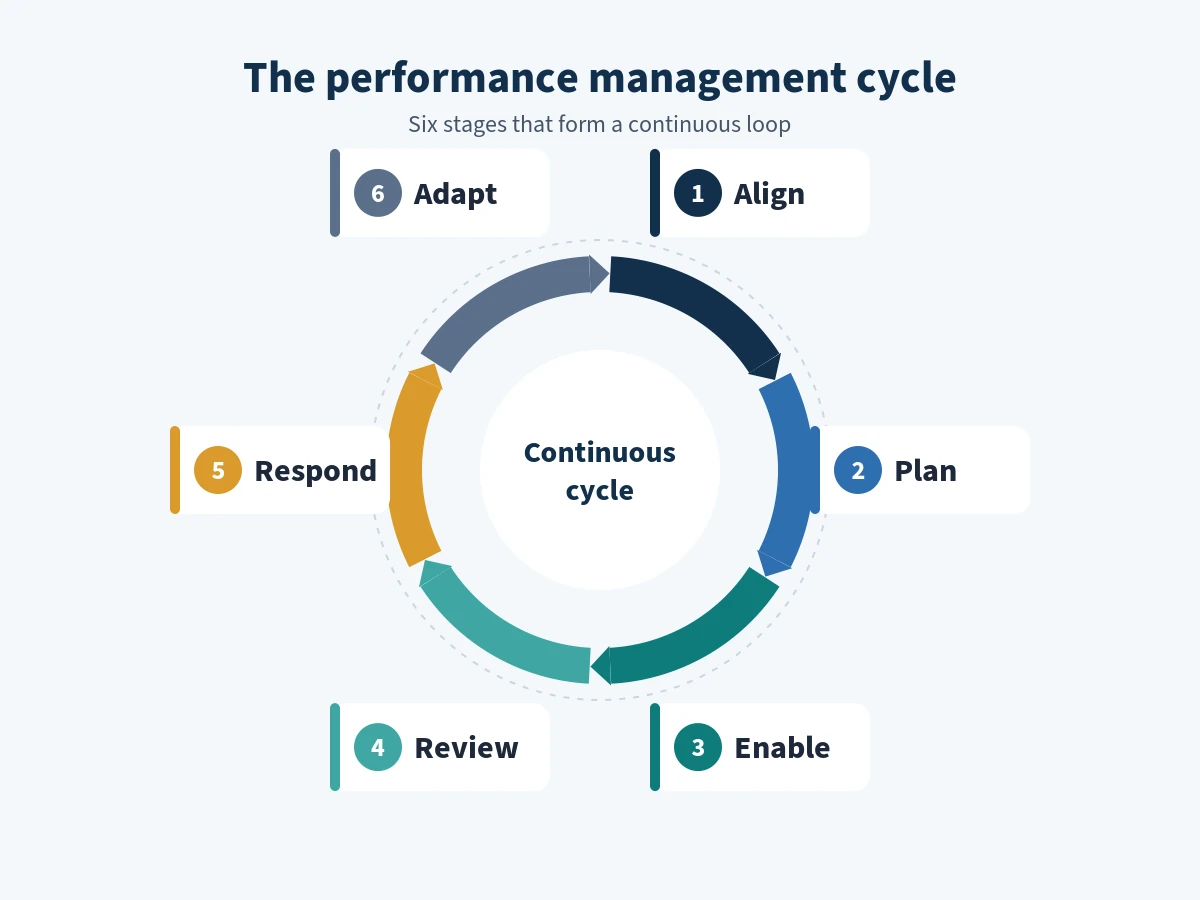
The performance management cycle in six stages
1. Align
Start with organisational and team priorities. Decide which outcomes, behaviours and capabilities genuinely matter. Check for tensions between goals: for example, faster service must not quietly undermine quality, safety or inclusion.
2. Plan
Agree a manageable set of objectives, measures and working expectations. Establish what evidence will be considered, who depends on whom and when progress will be discussed. Measures should be necessary, relevant and connected to strategy, as the CIPD guidance recommends.
3. Enable
Provide the conditions for success. This may include resources, information, training, clearer decision rights, removal of barriers or coaching. Managers should ask what the employee needs as well as what the employee must deliver.
4. Review
Use regular, proportionate check-ins to compare progress with expectations. Review results and relevant behaviours, not personality or visibility. Evidence may include service outcomes, quality checks, milestones, stakeholder feedback and examples of collaboration, depending on the role.
5. Respond
Recognise progress, give timely feedback and agree next actions. Where performance is below expectation, explore causes before selecting a response. A capability gap, unclear goal, broken process and unreasonable workload require different interventions.
6. Adapt
Update goals, support or work design when priorities and evidence change. The CIPD evidence-based practice factsheet encourages decisions that draw on research, organisational data, professional expertise and stakeholder perspectives. Adaptation closes the loop and prevents a performance plan from becoming obsolete.
Core components of an effective system
- Purpose and principles: a clear explanation of what the system is meant to achieve and how fairness will be protected.
- Role and goal architecture: a visible connection between strategy, team commitments and individual contribution.
- Relevant evidence: balanced information about outcomes and behaviours, with limitations made explicit.
- Frequent conversations: short, useful check-ins supported by deeper periodic reviews.
- Development routes: practical options for coaching, learning, stretch work and peer support.
- Decision governance: documented criteria, review routes and appropriate calibration for high-impact decisions.
- System evaluation: monitoring whether the process improves clarity, performance and perceived fairness.
HR teams seeking to connect these elements more firmly to organisational priorities can explore EPW’s Strategic Human Resource Management course.
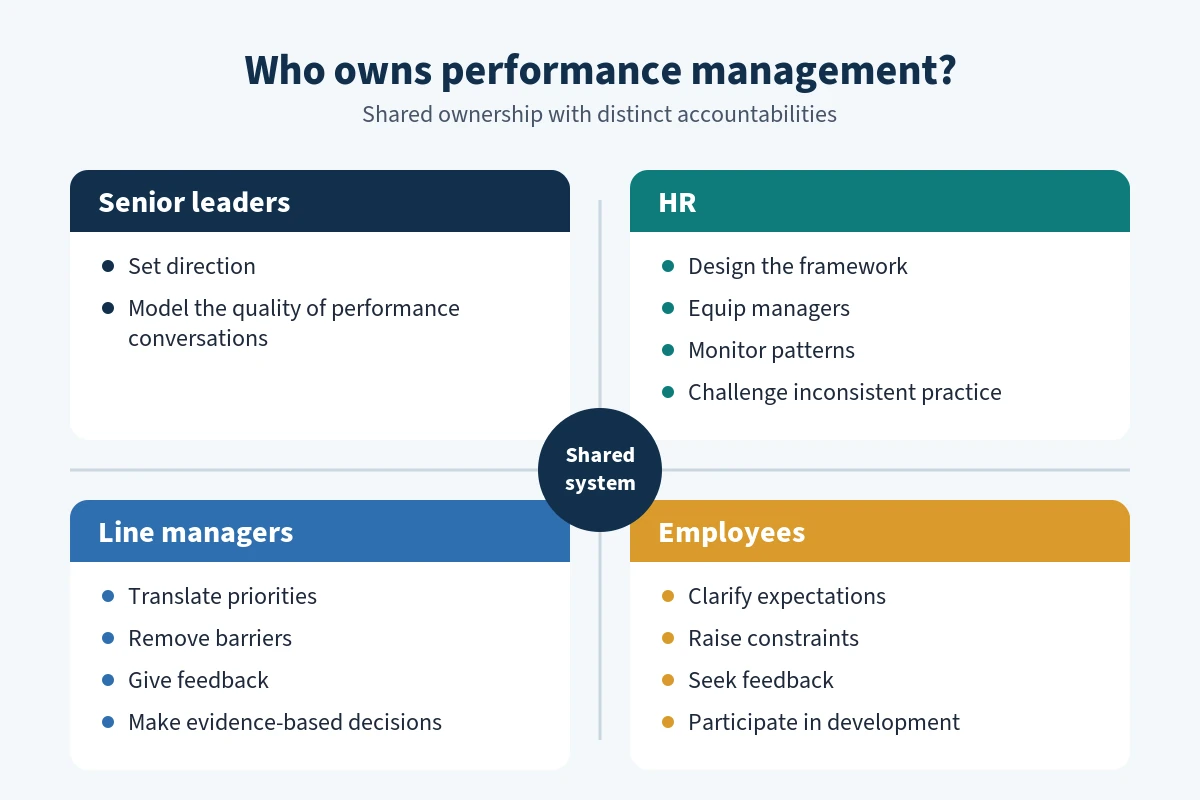
Who owns performance management?
Ownership is shared, although responsibilities differ. Senior leaders set direction and model the quality of performance conversations. HR designs the framework, equips managers, monitors patterns and challenges inconsistent practice. Managers translate priorities, remove barriers, give feedback and make evidence-based decisions. Employees clarify expectations, raise constraints, seek feedback and participate in development.
Shared ownership does not mean blurred accountability. The organisation should state who approves objectives, who can amend a rating, how disagreements are reviewed and where confidential records are held. Managers also need enough time and authority to do the work well.
A practical example
Imagine a customer-support team asked to improve response times. A weak approach would assign a speed target and review it months later. A stronger cycle would first protect quality and customer outcomes, then define a balanced set of expectations. The manager might review response time alongside resolution quality, workload mix and customer feedback.
During check-ins, the team discovers that delays cluster around a complex product line and an outdated approval step. The response is not simply to press employees to work faster. The organisation updates guidance, gives targeted coaching and removes the approval bottleneck. Goals and evidence are then revised. This example is hypothetical, but it shows why performance management must connect individual contribution with the system in which work occurs.
Common design mistakes
- Treating the annual appraisal as the whole system.
- Using too many measures or rewarding one metric at the expense of quality.
- Setting goals without checking resources, dependencies and decision rights.
- Giving delayed feedback that employees cannot act on.
- Allowing unstructured judgements to outweigh relevant evidence.
- Linking every conversation immediately to pay, which can suppress honest dialogue.
- Failing to evaluate whether the process works for different roles and groups.
How to judge whether the system is working
Do not rely only on completion rates for appraisal forms. Examine whether employees understand priorities, managers hold useful conversations, objectives remain current, development actions occur and decisions are consistent. Review patterns by role, function and relevant workforce groups where lawful and appropriate. Qualitative evidence matters too: a well-timed conversation may prevent a problem that never appears in a dashboard.
The strongest test is practical: does the system help people perform valuable work, learn and respond to change? If it mainly produces administration, redesign is needed.
Build a performance management system that supports work
Performance management means creating a continuous connection between purpose, expectations, support, evidence and action. Appraisals and metrics can support that connection, but neither is sufficient alone. A credible system is clear enough to guide decisions and flexible enough to reflect real work.
For a structured exploration of appraisal methods, feedback, coaching, strategic alignment and implementation challenges, view EPW’s Performance Management Systems and Appraisal Methods course. You can also browse the wider Human Resources Training Courses portfolio.
Sources and references
- CIPD, Performance management factsheet, updated 29 January 2026.
- CIPD, Evidence-based practice for effective decision-making, updated 1 July 2026.
- EPW, Performance Management Systems and Appraisal Methods course, accessed 11 September 2026.