
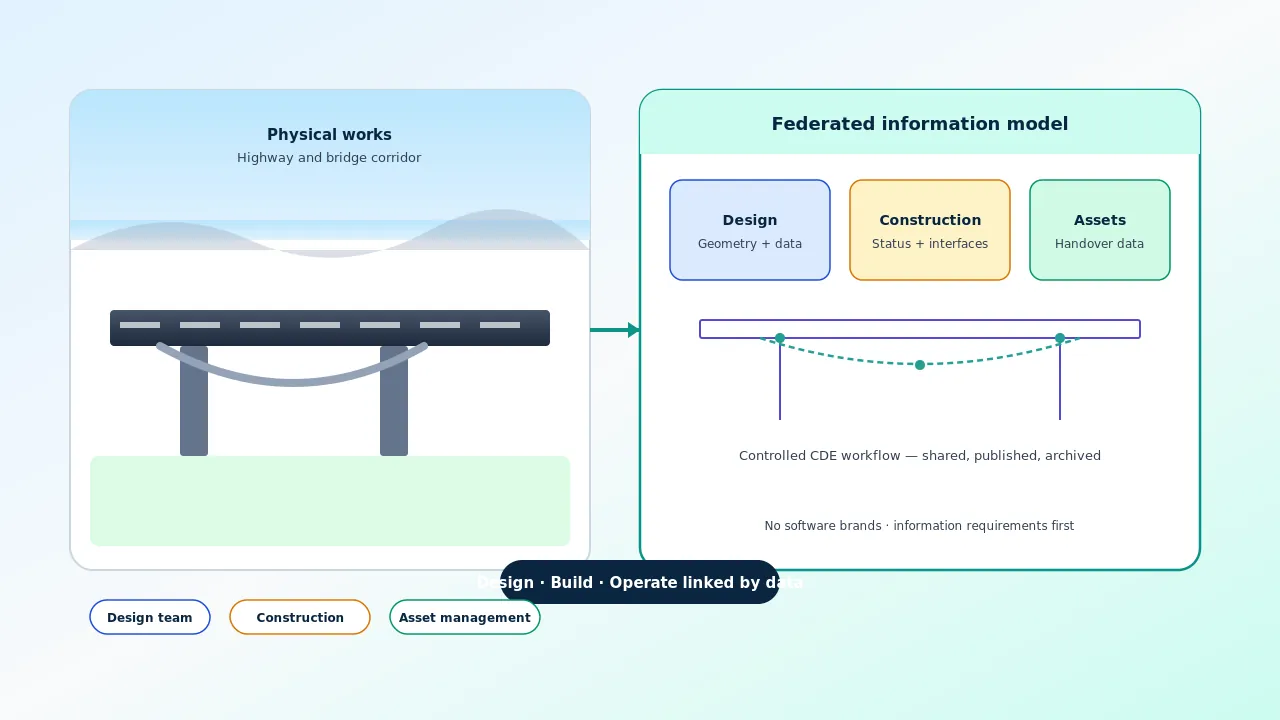
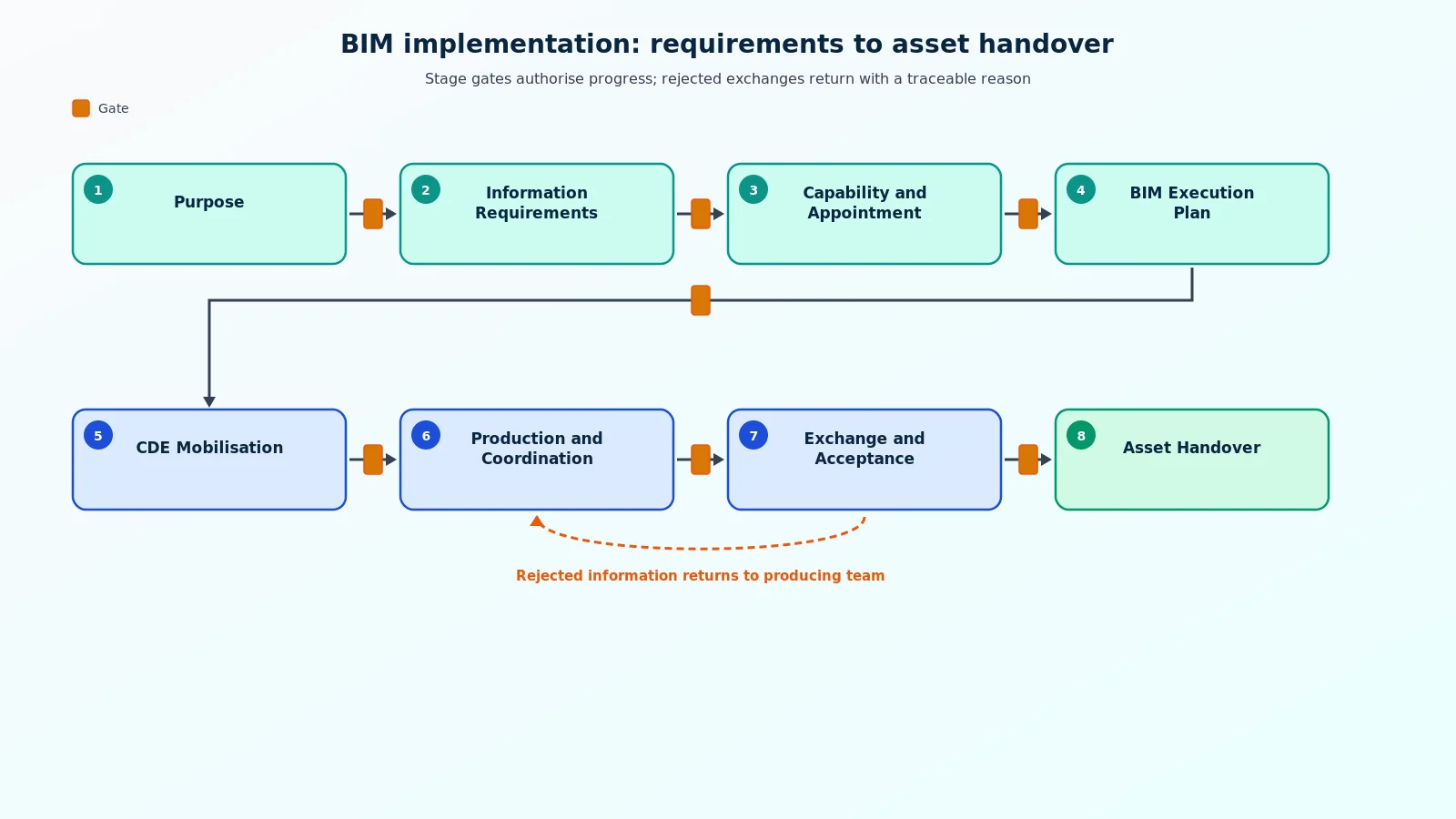
The BIM implementation process begins with the asset owner’s information needs and ends when verified, usable information is accepted for operations. For civil projects, the core sequence is to define requirements, appoint capable teams, agree the BIM execution plan, establish the common data environment, produce and coordinate information, authorise exchanges and validate the final asset handover.
Software and three-dimensional models support this process, but they do not define it. Building information modelling succeeds when information has a purpose, an accountable author, an agreed format, a required delivery date and a controlled route from work in progress to shared, published and archived states.
Key takeaways
- Start with decisions and information requirements, not modelling detail or software selection.
- Define roles, capability, delivery plans, naming, status and acceptance criteria before production.
- Use a common data environment as a governed workflow, not merely shared storage.
- Validate every information exchange against purpose, geometry, data, coordination and security requirements.
- Plan asset handover early and involve operations teams throughout delivery.
Contents
- BIM implementation process overview
- Requirements and mobilisation
- Production, coordination and exchange
- Asset handover and operational readiness
- Worked civil-project example
- Implementation checklist
BIM implementation process overview
BIM implementation is the establishment and operation of a consistent information-management system across appointments, teams and project stages. ISO 19650-1:2018 describes concepts and principles for managing, exchanging, recording, versioning and organising information using BIM. ISO 19650-2:2018 addresses the delivery phase of built assets.
The organisation should tailor the process to the project, appointment structure, applicable standards and contractual arrangements. Terms such as appointing party, lead appointed party and task team have specific meanings within ISO 19650-based practice; organisations using other frameworks should map equivalent responsibilities explicitly.
| Stage | Main input | Primary action | Accountable lead | Required output | Decision gate |
|---|---|---|---|---|---|
| 1. Purpose and requirements | Asset and project objectives | Define decisions, exchanges and acceptance criteria | Appointing party | Information requirements | Requirements approved and testable |
| 2. Procurement and capability | Invitation and requirements | Assess approach, capacity and competence | Appointing party | Evaluated tender response | Delivery team demonstrably capable |
| 3. Mobilisation | Confirmed appointments | Agree execution plan, responsibilities and resources | Lead appointed party | Mobilised team and delivery plan | Methods and systems tested |
| 4. Collaborative production | Task information plans | Author, check, coordinate and share | Task-team leads | Controlled information containers | Suitability and status confirmed |
| 5. Exchange and acceptance | Reviewed information model | Authorise, submit, review and accept | Lead appointed and appointing parties | Accepted project information | Exchange criteria passed |
| 6. Handover and close-out | Accepted delivery information | Validate, transfer and operationalise | Appointing party/asset owner | Usable asset information model | Operations readiness accepted |
Requirements and mobilisation
Step 1: Define the information purpose
Begin with the decisions the information must support: option selection, land and consent coordination, quantities, construction sequencing, safety planning, progress verification, commissioning, maintenance or renewal. Each purpose should have an owner and measurable success condition.
A useful requirement states what information is needed, why, by whom, at what milestone, to what level of information need, in which format and against which acceptance test. Avoid asking for “a detailed BIM model” without defining the decisions it must support.
Step 2: Develop information requirements
Translate organisational and asset needs into project and exchange information requirements. Include geometry, alphanumeric data, documents, classification, coordinate systems, survey control, naming, security, formats, status, dates and acceptance criteria. The UK BIM Framework’s guidance on developing information requirements explains how requirements support ISO 19650 implementation.
For civil works, address linear referencing, geographic coordinates, terrain, alignment, structures, utilities and links with geographic information systems. Specify the authoritative source when the same attribute could exist in several models or databases.
Step 3: Procure and assess capability
Issue requirements with the invitation so prospective teams can propose a delivery method. Evaluate relevant experience, staff competence, technology, quality assurance, information security, resource capacity and the ability of supply-chain members to collaborate. A polished model sample is not evidence that the team can sustain the process through a complex programme.
The prospective lead team’s pre-appointment BIM execution plan should respond directly to the requirements. The UK BIM Framework’s delivery-phase guidance explains that the plan should reflect how the whole delivery team will generate, review, approve, authorise and exchange information.
Step 4: Confirm the BIM execution plan
After appointment, confirm the BIM execution plan, responsibility matrix, master information delivery plan and task information delivery plans. Define production methods, federation strategy, coordinates, naming, status, review cycles, software and exchange versions, security controls, training and support.
The plan is a controlled delivery document, not a static tender attachment. It should be concise enough for teams to use, updated through formal change control and linked to project governance. Responsibilities must identify who authors, checks, approves, authorises, accepts and maintains each information set.
Step 5: Establish and test the common data environment
The common data environment (CDE) is the agreed workflow for collecting, managing and distributing information containers. It needs permissions, naming and metadata rules, revision control, status codes, review workflows, audit history, retention and recovery. The UK BIM Framework’s resources include guidance for common-data-environment workflow and whole-life information management.
Run a mobilisation test before production. A small exchange should prove that coordinates align, naming rules work, metadata is retained, review and authorisation routes operate, open formats can be consumed and rejected information returns to the right team with a traceable reason.
Production, coordination and information exchange
Step 6: Produce information within task teams
Task teams author information according to their task plans and agreed methods. Internal checking should cover the required content, coordinate basis, interfaces, classification, naming, metadata and suitability before information is shared. Model-checking rules should be tied to requirements, not applied as an unexplained generic score.
Use the level of information needed for the decision. Excessive geometry increases file size and coordination effort, while insufficient data creates ambiguity. Temporary works, construction logistics and sequencing should be modelled only where they support defined uses.
Step 7: Coordinate multidisciplinary information
Federate relevant discipline models and run geometric, spatial and data checks. Not every intersection is a meaningful clash, and not every coordination risk is geometric. Review clearance, access, drainage, earthworks balance, temporary states, interfaces, tolerances, construction sequence and asset data.
Record issues with an owner, location, priority, due date and resolution evidence. Common BIM Collaboration Format workflows can help exchange issues without locking teams to one authoring platform. Coordination meetings should decide and close issues, not merely display them.
Step 8: Authorise exchanges and accept information
At each milestone, assemble the required information model, complete checks and authorise it for exchange. The appointing party then reviews against stated acceptance criteria. Rejection should identify the failed requirement and required correction; acceptance should not be based on visual appearance alone.
| Acceptance area | Example test | Evidence |
|---|---|---|
| Purpose and completeness | All required assets, documents and attributes delivered | Requirement-to-deliverable matrix |
| Geometry and location | Coordinates, alignment, levels and tolerances validated | Automated checks and survey comparison |
| Coordination | Priority interfaces resolved or formally accepted | Closed issue register |
| Data quality | Mandatory fields use approved values and units | Schema validation report |
| Format and interoperability | Native and required open exchanges open correctly | Exchange test log |
| Security | Classification, permissions and sensitive data comply | Security review and audit trail |
Open standards support reliable exchange. buildingSMART describes Industry Foundation Classes (IFC) as a vendor-neutral digital description of buildings and civil infrastructure. Its official IFC page identifies IFC 4.3.2.0 as the latest official release and notes its publication as ISO 16739-1:2024. Teams must still test whether the selected use case and software implementation support the required civil entities and data.
Professionals who want to strengthen this end-to-end capability can explore EPW’s Building Information Modeling for Civil Projects Course. It covers information requirements, execution planning, common data environments, coordination, 4D and 5D uses, quality and digital handover.
Asset handover and operational readiness
Step 9: Define handover from the beginning
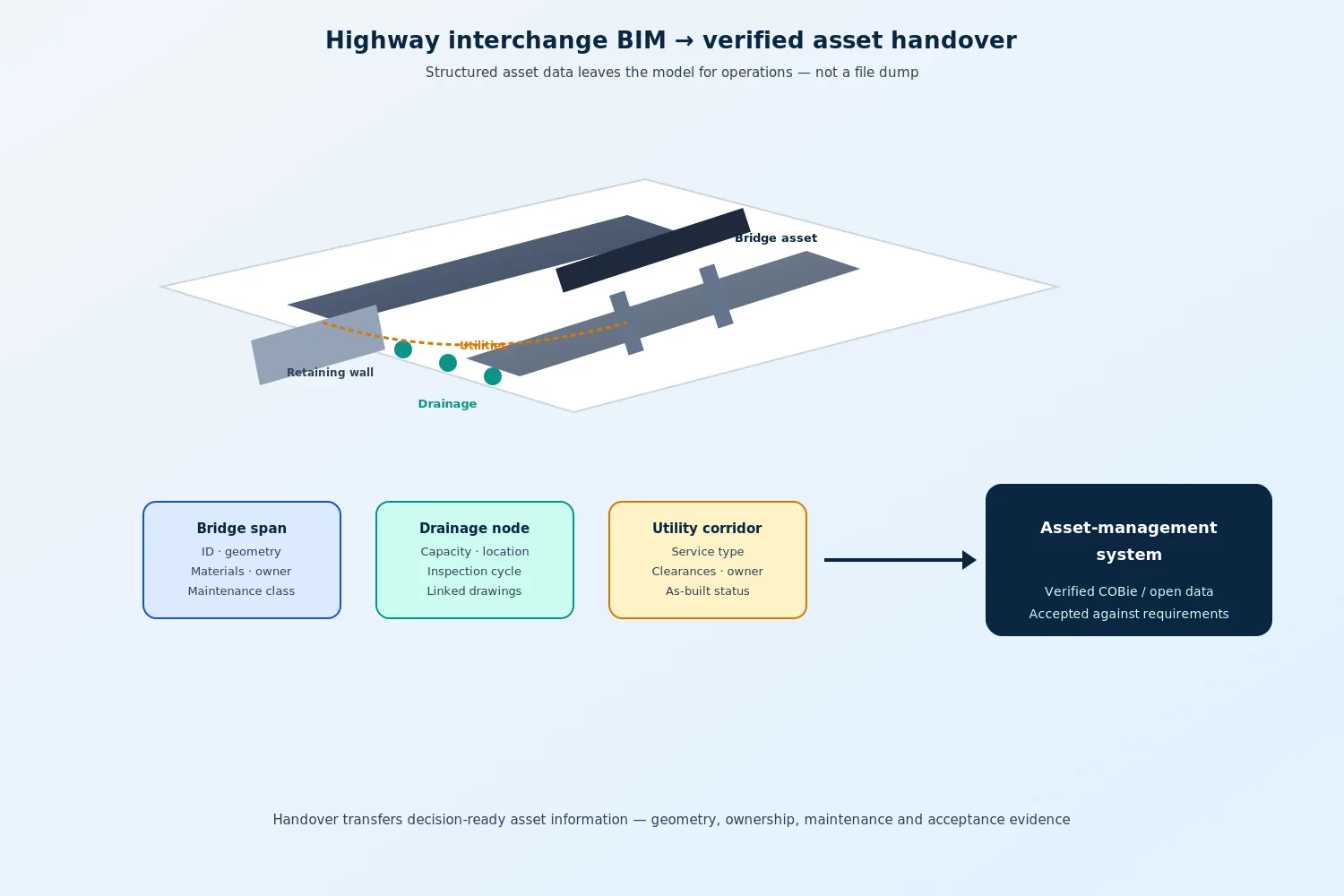
Asset-information requirements should be available before design teams decide model structure and data ownership. Involve maintainers, operators, safety teams and asset-system administrators early. Confirm asset identifiers, classification, required attributes, document links, spatial hierarchy, warranty and commissioning information, spares, inspection data and interfaces with enterprise systems.
ISO 19650-3:2020 addresses information management during the operational phase. The handover should establish a controlled asset information model that supports specified operational activities, not simply copy every design and construction file into an archive.
Step 10: Validate and transfer the asset information model
Reconcile installed assets with approved information through commissioning records, surveys, field verification and structured data checks. Remove superseded or duplicated information, retain required history and confirm that document links work. Test a sample of real operational tasks, such as finding an isolation point, planning an inspection or retrieving a manufacturer requirement.
Information security must continue after project close-out. ISO 19650-5:2020 sets principles and requirements for security-minded information management. Access, retention and sharing should reflect the sensitivity and operational risk of the asset.
Worked example: highway interchange upgrade
A road authority plans an interchange upgrade involving earthworks, drainage, retaining walls, structures, utilities and traffic staging. It defines information uses for option appraisal, utility coordination, quantities, 4D traffic switches, machine-control surfaces, progress assurance and maintenance handover.
Project requirements specify survey control, alignment referencing, classification, exchange dates, required attributes and acceptance tests. The appointed team confirms a federated-model strategy and responsibility matrix. A mobilisation exchange proves coordinate transformation, naming, IFC delivery, issue tracking and the CDE approval route before design production accelerates.
During delivery, discipline teams check their containers before sharing. Federation identifies conflicts between drainage, foundations and utilities; 4D reviews test temporary traffic stages and access. At each design gate, authorised information is exchanged with a validation report. Construction updates use approved change control, field verification and survey evidence.
Before handover, the authority tests asset identifiers, drainage and structure data, inspection documents and links into its maintenance system. A sample maintenance task confirms that operations staff can locate the correct asset, access current documentation and understand outstanding risks. Only then is the asset information model accepted.
BIM delivery should be integrated with construction project management and scheduling and sustainable infrastructure planning. Teams can also review the full Civil Engineering Training Courses portfolio for related development routes.
Common implementation failures
- Starting with software: creates models without a decision or information purpose.
- Generic requirements: make completeness and acceptance impossible to test.
- Unowned data: produces duplicated or conflicting attributes.
- CDE as storage only: removes status, authorisation and audit discipline.
- Coordination without closure: generates growing issue lists rather than decisions.
- Late operations involvement: delivers information that cannot be imported or used.
- Assumed interoperability: discovers exchange losses only at a contractual milestone.
- Over-modelled detail: increases effort without improving the required decision.
BIM implementation checklist
- Are information uses tied to project and asset decisions?
- Do requirements specify content, format, timing, owner and acceptance?
- Have capability and capacity been assessed across the supply chain?
- Are execution plans, responsibilities and delivery schedules confirmed?
- Has the common data environment workflow been tested?
- Are coordinate, naming, metadata and status rules controlled?
- Do task teams check information before sharing?
- Are coordination issues owned, prioritised and closed?
- Are open-format exchanges validated in the receiving software?
- Have operations teams tested the handover against real tasks?
- Are sensitive asset data protected through appropriate controls?
Conclusion
A reliable BIM implementation process connects requirements, appointments, production, exchange and asset operation through controlled information. Its quality depends less on visual model sophistication than on clear purpose, competent teams, traceable decisions and objective acceptance. Planning handover at the start prevents the project from delivering impressive files that the asset owner cannot use.
Ready to implement coordinated BIM information management on civil projects? Explore EPW’s Building Information Modeling for Civil Projects Course, review available dates and locations, or request tailored in-house training.
Sources and References
- International Organization for Standardization. ISO 19650-1:2018 — Concepts and principles. Published December 2018.
- International Organization for Standardization. ISO 19650-2:2018 — Delivery phase of assets. Published December 2018.
- International Organization for Standardization. Building information modelling standards overview. Accessed 5 September 2026.
- UK BIM Framework. Guidance Part D: Developing information requirements. Edition 2, February 2021.
- UK BIM Framework. Guidance Part 2: Parties, teams and processes for the delivery phase. Edition 6, February 2021.
- buildingSMART International. Industry Foundation Classes. Accessed 5 September 2026.
- International Organization for Standardization. ISO 19650-5:2020 — Security-minded approach to information management. Published 2020.
Technical review note: An appropriately qualified BIM or information-management lead should verify contractual terminology, applicable standards, exchange formats, security requirements and asset-system interfaces before publication or project use.