
The main types of project reports are status, progress, milestone or gate, exception, risk and issue, cost, resource, quality, benefits, and closure reports. They are not interchangeable. Each should answer a particular management question for a defined recipient, at the point when that information can support a decision or action.
Project teams often create too many reports while still leaving sponsors unsure about delivery confidence. The solution is not a larger template. It is a reporting framework that matches content, timing and detail to the reader’s responsibility. This article classifies ten practical report types and explains when each is useful.
Key takeaways
- A report should be chosen by the decision it supports, not by habit or software availability.
- Status reports give an integrated snapshot; specialist reports provide depth on one control area.
- Periodic reporting and exception reporting should work together: one establishes rhythm, while the other escalates material deviation.
- Live dashboards can provide on-demand detail, but accountable managers must still explain implications, uncertainty and required action.
What is a project report?
A project report is a controlled communication that presents verified information about past progress, current status or future outlook so a recipient can understand, decide or act. Reporting therefore converts project-control data into management insight; it is not simply an export from a scheduling or finance system.
The UK Government’s Project Delivery Teal Book describes reporting as the flow of information among portfolio, programme, project and work-package teams, focused on status, variance analysis and forecasts. It also advises that reports should be timely, realistic, checked for accuracy and explicit about requests for decisions or direction.
Names vary between organisations. A “highlight report” in one governance system may be called a “monthly status report” in another. The useful distinction is the report’s purpose, audience, trigger and expected action—not its label.
Project report types at a glance
| Report type | Primary question | Typical recipient | When to use it |
|---|---|---|---|
| Status report | Are we still likely to deliver? | Sponsor or project board | At an agreed weekly or monthly control point |
| Progress report | What was completed and what comes next? | Project or work-package manager | During active delivery, often weekly |
| Milestone or gate report | Is the work ready to pass a decision point? | Gate authority or steering group | Before a milestone, phase or investment gate |
| Exception report | Which tolerance is forecast to be exceeded? | Sponsor or higher management level | When an agreed threshold is breached or forecast to be breached |
| Risk and issue report | What uncertainty or problem needs attention? | Risk owners and governance bodies | At reviews and when exposure materially changes |
| Cost report | How do actual and forecast costs compare with plan? | Sponsor, finance and commercial leads | At the financial control cadence |
| Resource report | Do we have the capacity and capability to deliver? | Project and functional managers | Before commitments and throughout delivery |
| Quality report | Do outputs meet agreed acceptance criteria? | Quality lead, product owner or board | After inspections, tests or quality reviews |
| Benefits report | Is intended value being realised? | Benefit owners and sponsor | During transition, operation and post-project review |
| Closure and lessons report | What has been completed, transferred and learned? | Sponsor and operational owner | At project or phase closure |
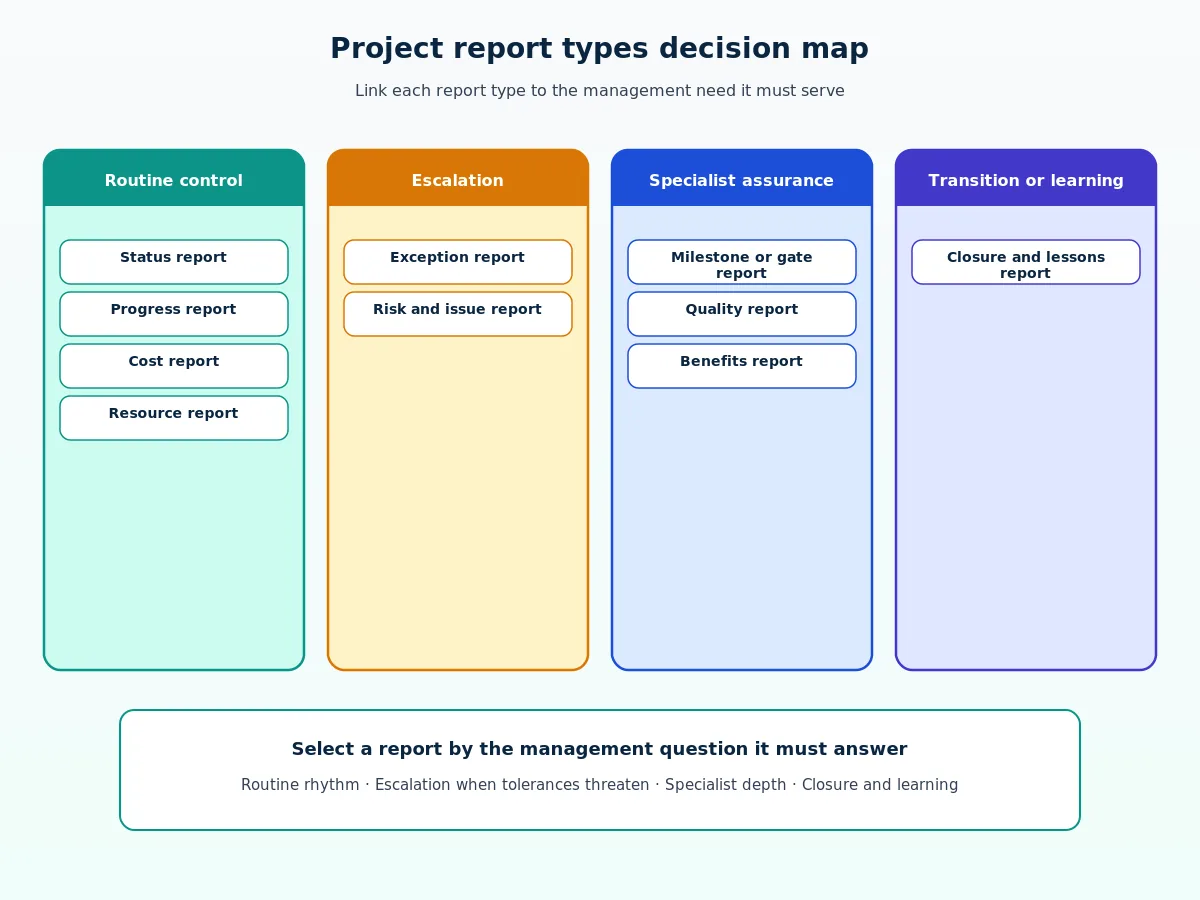
The ten main types of project reports
1. Project status report
A status report integrates the project’s overall position at a stated date. It normally summarises delivery confidence, schedule, cost, scope, resources, risks, issues, changes, quality and benefits, with clear requests for action. The Teal Book’s current reporting guidance identifies these areas as typical content for programme and project-level reporting.
Use it for routine governance when a sponsor or board needs one coherent view. Keep it concise and link to detailed registers rather than copying them. A red, amber or green indicator is only useful when the definition, evidence and trend are visible.
2. Progress or work-package report
A progress report concentrates on completed work, work in progress, the near-term plan, dependencies and blockers. It is more operational than an executive status report and is usually prepared by a team or work-package lead for the project manager.
Use it to coordinate delivery. Separate verified completion from percentage estimates, and connect completed work to accepted deliverables. Teams developing stronger baselines and control cycles may also benefit from EPW’s Advanced Project Planning and Control Techniques course.
3. Milestone, phase or gate report
This report assembles the evidence needed for a defined decision point. It may confirm completion of required outputs, unresolved conditions, readiness for the next phase, updated forecasts and a recommendation to proceed, pause, recycle or stop.
Use it when authorisation depends on more than calendar progress. Its contents should align with the organisation’s gate criteria and delegated authority; it should not invent approval rules after the work reaches the gate.
4. Exception report
An exception report escalates an actual or forecast breach of an agreed tolerance. It should identify the constraint affected, the cause, consequences, recovery options, recommendation and decision deadline. Government project-delivery guidance states that exception triggers should be defined in advance and that the report should describe the exception, recovery action and threat to benefits, schedule, cost and risk.
Use it when waiting for the next routine report would delay necessary intervention. Do not label every variance an exception; escalation should follow approved thresholds.
5. Risk and issue report
A risk and issue report focuses on uncertainty and present problems that require ownership or governance attention. It should show exposure, trend, proximity, response, owner, due date and any escalation. Risks remain uncertain events; issues have already occurred, so their treatment and reporting should not be merged into vague commentary.
Use a specialist report when exposure is complex or a governance body needs depth. For practical capability development, EPW’s Project Risk Management and Mitigation Strategies course connects assessment with response and control.
6. Cost and financial report
A cost report compares approved budget, actual expenditure, commitments and forecast outturn. It should explain material variance and show the assumptions behind the forecast. Where earned value management is appropriate, schedule and cost indicators can add diagnostic value, but figures still require interpretation.
Use it at the organisation’s financial-control cadence and before funding decisions. EPW’s Earned Value Management and Performance Tracking course covers integrated performance analysis rather than isolated cost reporting.
7. Resource and capacity report
This report shows whether people, equipment or specialist capability are available when required. Useful fields include demand, confirmed supply, vacancies, utilisation assumptions, critical shortages and the effect of delayed mobilisation.
Use it when functional managers allocate shared resources or when capacity constrains the schedule. Avoid presenting nominal headcount as usable capacity; timing, skills and competing commitments matter.
8. Quality and testing report
A quality report summarises inspections, tests, defects, acceptance evidence, rework and trends against agreed criteria. It should distinguish a completed activity from an accepted output and make unresolved non-conformities visible.
Use it before acceptance decisions and where defects create material delivery risk. The reporting period, sample or test scope, threshold and data source should be stated so the recipient can interpret the result.
9. Benefits realisation report
A benefits report compares forecast and realised value, including adverse effects or disbenefits where relevant. It records measures, baselines, targets, benefit owners, timing, evidence and corrective action. Benefits can continue after project closure, so responsibility must transfer to an operational owner.
Use it during transition and post-implementation review—not only while producing outputs. The distinction prevents a project from being declared successful solely because it delivered on time.
10. Closure and lessons report
A closure report confirms what has been delivered and accepted, what remains open, who owns continuing risks and benefits, how contracts and records are closed, and which lessons should inform future work. Government Functional Standard GovS 002, version 2.1 requires controlled closure, documentation of unfulfilled requirements, handover of ongoing responsibilities and a closure review.
Use it at the end of a project or phase. A closure report should not conceal unfinished work: residual actions need named owners and acceptance dates. EPW’s Monitoring Evaluation and Project Closure Excellence course explores monitoring evidence and disciplined handover.
How to choose the right project report
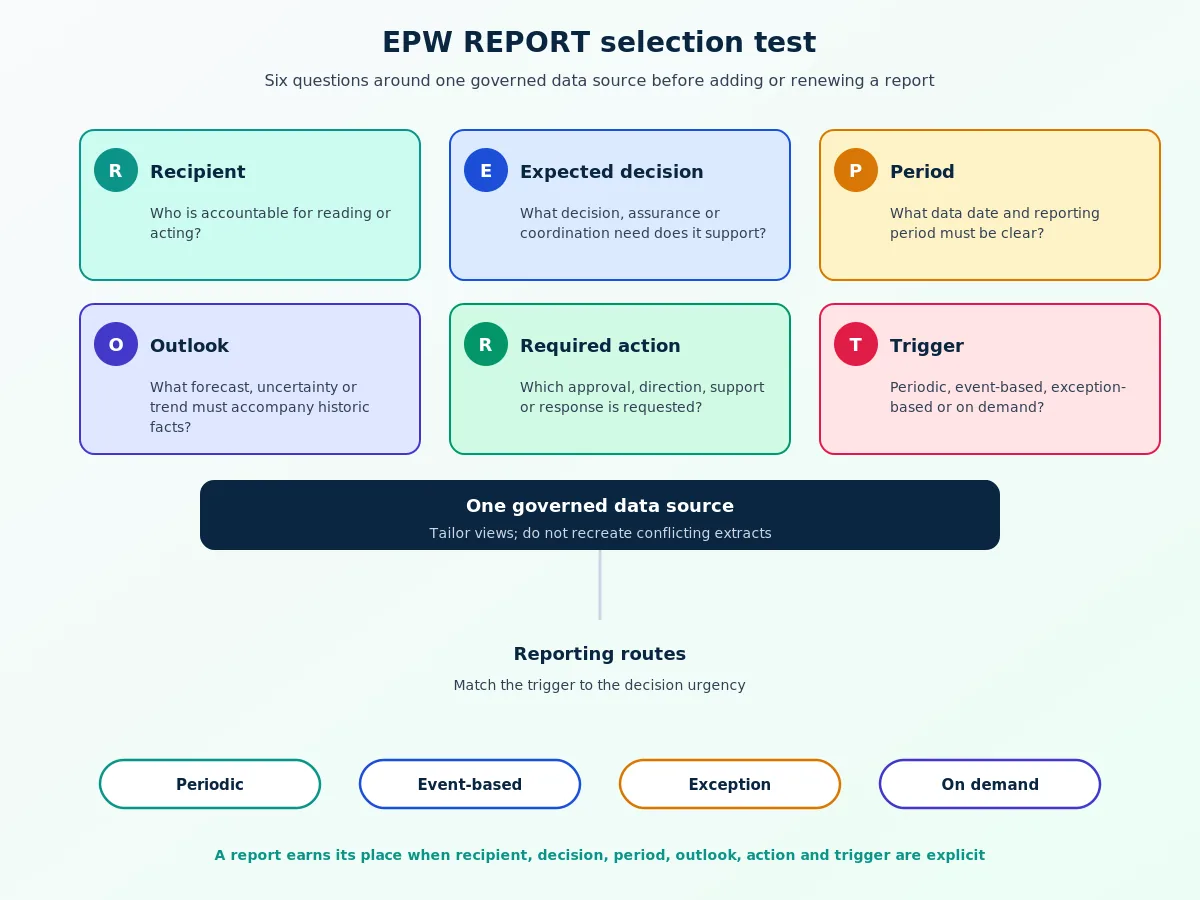
Apply the EPW REPORT test before adding or renewing any report:
- Recipient: Who is accountable for reading or acting?
- Expected decision: What decision, assurance or coordination need does it support?
- Period: What data date and reporting period must be clear?
- Outlook: What forecast, uncertainty or trend must accompany historic facts?
- Required action: Which approval, direction, support or response is requested?
- Trigger: Should it be periodic, event-based, exception-based or available on demand?
If no accountable recipient or expected decision can be named, challenge the report’s value. If several audiences need the same underlying data at different levels of detail, maintain one governed source and tailor the view. The Teal Book recognises both active reports sent to recipients and on-demand information drawn from a repository; in practice, a mixture is often appropriate.
What every effective project report should contain
Templates should be proportionate, but six elements are widely useful: the report’s purpose; data date and period; concise status and outlook; material variance and cause; actions or decisions required; and named ownership. Facts, professional judgement and uncertainty should be distinguishable.
Consistency helps readers compare periods, while tailoring keeps the information relevant. The Teal Book recommends defining content, author, recipients, frequency, confidentiality and format early, then adjusting the framework as needs and risk change. An Association for Project Management article on reporting and engagement also stresses that reports should support dialogue and outcomes rather than become a box-ticking exercise.
Common reporting mistakes
- Reporting activity instead of control: “Meetings held” says less than the resulting decision, change or acceptance.
- Hiding the forecast: Green historic performance can coexist with a deteriorating completion forecast.
- Repeating registers: Summarise implications and link to governed detail.
- Using undefined colours: Set thresholds and disclose overrides.
- Sending one format to everyone: Boards, managers and delivery teams need different depth.
- Leaving decisions buried: Put the request, owner and deadline where the recipient will see them.
Develop practical project reporting capability
Organisations need both sound controls and the ability to comunicate their implications. Explore EPW’s Project Management Training Courses to compare learning routes across planning, governance, risk, reporting and leadership.
Ready to improve the clarity and usefulness of project information? Explore EPW’s Project Communication and Reporting Techniques course, review available dates and locations, or request tailored in-house training.
Conclusion
The right report is the smallest reliable communication that enables the right recipient to understand status, judge outlook and take action. A disciplined framework combines routine status with specialist evidence and exception escalation. Use the ten-type classification and REPORT test to remove duplication, expose uncertainty and make reporting part of project control.
Sources and References
- Government Project Delivery. The Teal Book, Chapter 18: Reporting. Updated 1 July 2026. https://projectdelivery.gov.uk/teal-book/home/part-e-planning-and-control/chapter-18-reporting/
- Government Project Delivery. Government Functional Standard GovS 002: Project Delivery, version 2.1. Published 1 September 2025. https://projectdelivery.gov.uk/library-products/government-functional-standard-govs-002-project-delivery/
- Association for Project Management. Fran Bodley-Scott. Project reporting and stakeholder engagement. 8 June 2017. https://www.apm.org.uk/blog/five-ways-to-make-project-reporting-an-effective-stakeholder-engagement-tool/