

AI-generated illustration created to represent the article’s subject. It does not depict an actual EPW course, trainer, participant, client, event or venue.
Project monitoring and evaluation work best when they begin with the decision, not the dashboard. Define the intended outcomes and theory of change, establish baselines, select a small balanced set of indicators, assign data ownership, review evidence at a useful rhythm and record what action follows. Monitoring tracks what is happening; evaluation explains what changed, for whom, why and with what value.
The best practices below help project teams avoid two extremes: reporting large volumes of data that do not change decisions, and waiting until closure to discover that the evidence needed for evaluation was never collected.
Monitoring and evaluation are related, not identical
Monitoring is the routine collection and review of information about delivery, outputs, outcomes, risks and benefits. It supports timely control. Evaluation is a systematic assessment of an intervention’s design, implementation and results. It uses evidence to make a reasoned judgement, often including contribution, value and learning.
| Question | Monitoring | Evaluation |
|---|---|---|
| What is it for? | Track progress, variance, risk and emerging results | Judge relevance, performance, effects and learning |
| When? | Continuously or at regular intervals | At planned decision points, during or after delivery |
| Typical evidence | Milestones, cost, schedule, quality, risk, output and outcome indicators | Monitoring data plus research, comparison, qualitative evidence and analysis |
| Main output | Dashboard, exception report and action record | Findings, conclusions, limitations and recommendations |
| Management use | Correct course now | Understand performance and improve future choices |
The distinction prevents a common error: treating a green dashboard as proof that a project created value. Deliverables can be on time while expected outcomes fail to materialise. Conversely, weak early delivery measures may hide benefits that emerge later. Both views are necessary.
1. Start with the decisions the evidence must support
List the recurring and one-off decisions that sponsors, project managers, benefit owners and operational leaders must make. Examples include whether to release the next funding tranche, alter scope, escalate a risk, change an adoption intervention or close a benefit measure.
For each decision, specify:
- the decision owner and review date;
- the evidence needed and the acceptable confidence level;
- the threshold or condition that triggers action;
- who can challenge the evidence;
- how the decision and rationale will be recorded.
This reverses the usual reporting problem. Instead of collecting data because it is available, the team collects evidence because it informs a defined choice.
2. Make the theory of change explicit
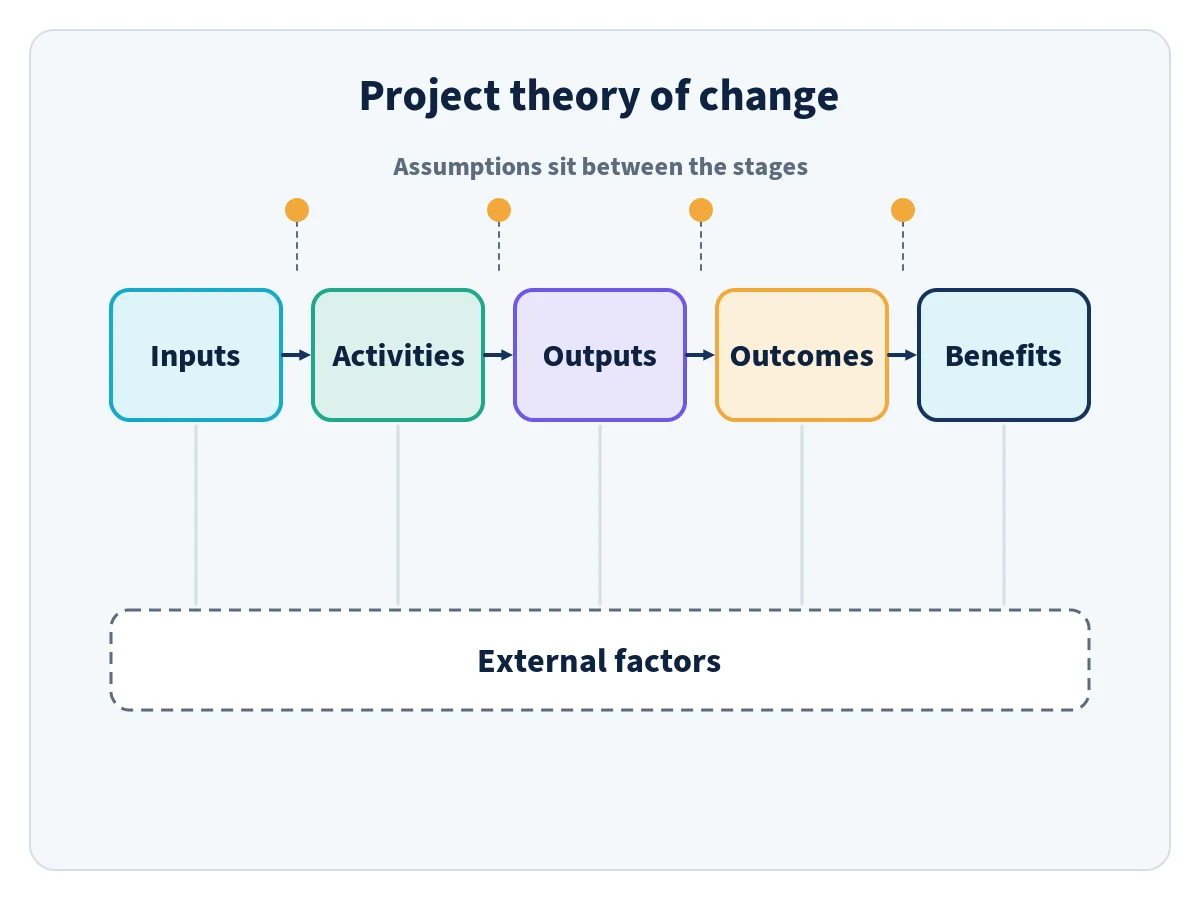
A theory of change explains how project activities are expected to produce outputs, outcomes and longer-term effects, including the assumptions and external factors between them. The UK Government Analysis Function’s Theory of Change toolkit emphasises baseline evidence and shows how a monitoring and evaluation framework can be connected to the causal logic.
Write each causal link as a testable proposition: “If we deliver X, then Y should change because Z.” Then ask what evidence would increase or reduce confidence in that link. Where several explanations are plausible, plan to collect evidence that can distinguish between them.
Keep the model usable. A one-page chain with critical assumptions is more valuable to management than a complex diagram no one reviews.
3. Establish baselines before interpreting progress
A baseline describes the starting position against which change will be assessed. It should specify the measure, population or scope, collection method, reference period, source, limitations and owner. Without it, statements such as “performance improved” may be impossible to verify.
If a perfect baseline is unavailable, do not invent one. Use the strongest defensible alternative: existing administrative data, a documented retrospective reconstruction, a comparison group, an early implementation measure or a qualitative benchmark. Record the limitation and how it affects conclusions.
4. Build a small, balanced indicator set
Good indicators cover the result chain without turning the project into a data-collection exercise. Include a deliberate mix:
- Inputs: resources used, where material to decisions.
- Activities and outputs: what the project delivers.
- Outcomes: changes in behaviour, capability, service or performance.
- Benefits: measurable improvements that justify the investment.
- Quality and safeguards: whether results meet requirements without unacceptable harm.
- Leading indicators: early signs of future performance.
- Lagging indicators: confirmed results after they occur.
For every indicator, maintain a decision-ready record containing its definition, formula, unit, disaggregation, baseline, target, frequency, data source, owner, quality checks and action threshold. This “indicator passport” prevents different teams from reporting the same label with different meanings.
Targets should be ambitious but evidence-based. A target without a baseline or capacity assumption can encourage gaming. A metric without an action threshold is often just decoration.
5. Assign ownership across the evidence chain
Data ownership is more than responsibility for entering figures. The owner must understand the definition, maintain the source, investigate anomalies and explain limitations. Separate useful roles where proportionate:
- the measure owner maintains the indicator;
- the benefit owner is accountable for realisation;
- the project manager integrates delivery evidence;
- the sponsor makes or escalates decisions;
- an assurance or evaluation lead challenges methods and conclusions.
The UK Government Teal Book guidance on benefits management assigns clear accountability for benefits and stresses tracking and review throughout the lifecycle, including ownership after project closure. That continuity is vital: many benefits mature after the temporary delivery team has disbanded.
6. Design data quality into collection
Do not wait for a reporting dispute to examine quality. Define checks for completeness, validity, timeliness, consistency, uniqueness and accuracy. Retain an audit trail from source to report, control manual adjustments and document changes to definitions.
Proportionality matters. A high-value, safety-critical decision may require independent validation and stronger controls. A low-risk operational measure may justify sampling or automated checks. In both cases, users should know enough about the evidence to judge its fitness for the decision.
7. Review exceptions, causes and actions—not colours
A red-amber-green status is a prompt, not an explanation. Effective reviews examine:
- what changed since the previous review;
- whether the variance is real or a data-quality issue;
- the likely causes and affected outcomes;
- the options available, with trade-offs;
- the owner, due date and expected effect of the chosen action;
- what evidence will show whether the action worked.
Use exception-based reporting so attention follows material risk and uncertainty. Keep a short narrative beside each important indicator: position, cause, forecast and action. This provides more management value than adding more charts.
8. Plan evaluation early and proportionately
Evaluation questions should be agreed while the project can still collect the required evidence. The 2026 HM Treasury Green Book distinguishes appraisal before approval from evaluation after implementation, and advises teams to consider evaluation from the outset.
Choose evaluation methods to match the question. Process evaluation examines how implementation worked. Impact evaluation examines the change attributable or plausibly contributed to the intervention. Economic evaluation compares costs and consequences. A mixed-method design can combine quantitative trends with interviews, observation and documentary evidence.
The OECD guidance on evaluation criteria presents relevance, coherence, effectiveness, efficiency, impact and sustainability as complementary lenses, while stressing that they should be selected and applied according to the evaluation’s purpose and context. They are a question framework, not a compulsory scoring template.
9. Preserve independence without isolating evaluators
Evaluators need enough independence to challenge assumptions and report limitations honestly, but isolation can produce work that arrives too late or answers the wrong question. Agree roles, access, methods and publication arrangements early. Let evaluators engage with delivery teams while protecting analytical judgement and the integrity of findings.
Triangulate evidence where practical. A claimed improvement is stronger when operational data, stakeholder experience and implementation records point in the same direction. When they conflict, investigate rather than average the disagreement away.
10. Close the learning loop
Recommendations need an owner, response, priority and target date. Record whether management accepts, partially accepts or rejects each recommendation and why. Feed lessons into standards, templates, future business cases and portfolio decisions.
The Office for National Statistics Evaluation Strategy describes monitoring and evaluation frameworks as a way to support timely decisions and effective reporting. That is the practical test: evidence should improve an actual decision, not merely complete a reporting cycle.
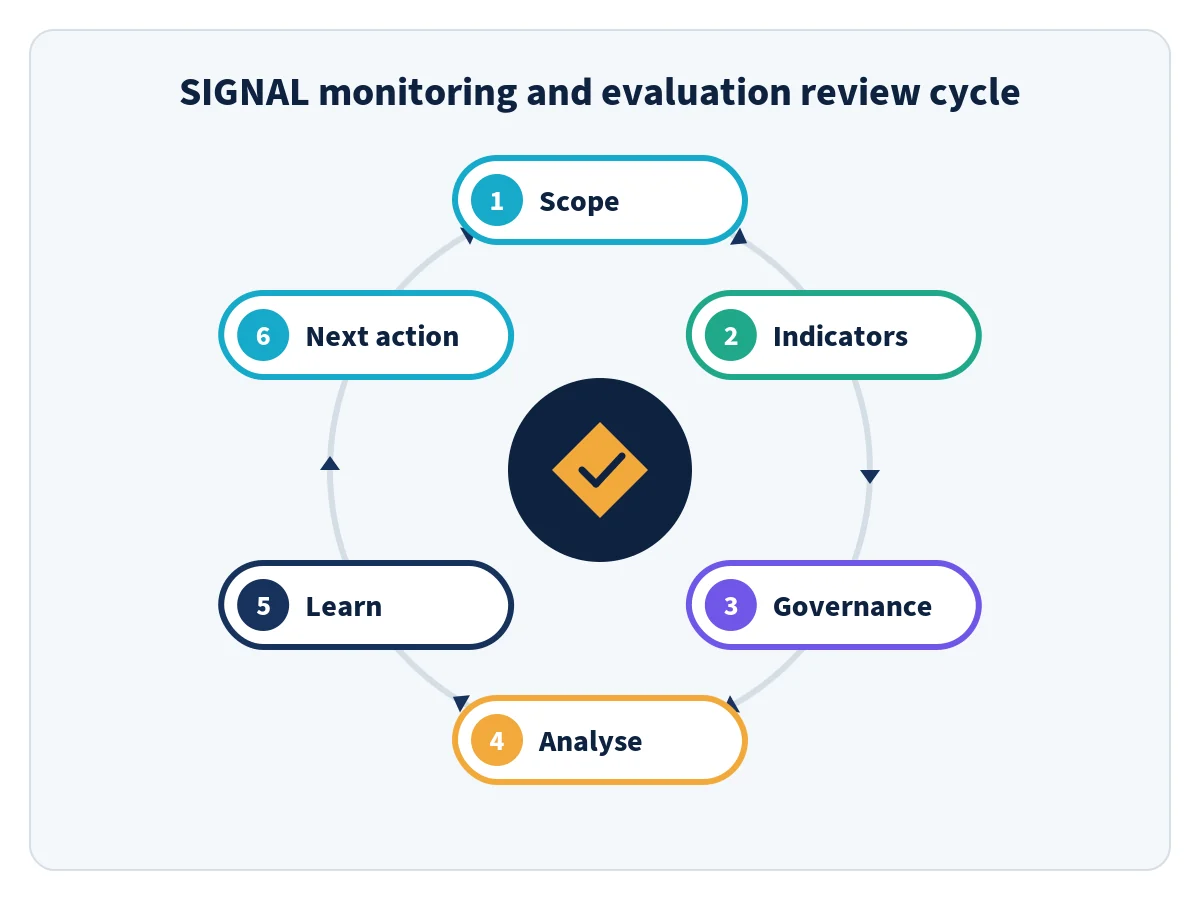
The EPW SIGNAL review method
Use SIGNAL as a concise agenda for each evidence review:
- S — Scope the decision: What choice or control does this review support?
- I — Inspect indicators: What changed, against which baseline and target?
- G — Gauge quality and uncertainty: How reliable, complete and timely is the evidence?
- N — Name causes and consequences: What explains the variance, and which outcomes or benefits are affected?
- A — Agree action: Who will do what, by when, within which authority and tolerance?
- L — Learn and log: What should change in the plan, model, controls or future projects?
The method prevents review meetings from stopping at status description. It also makes uncertainty discussable: a decision can proceed with incomplete evidence when the risk is understood, tolerances are explicit and further learning is planned.
Project monitoring and evaluation checklist
- Decision questions, users and review points are documented.
- The theory of change links outputs to outcomes and benefits.
- Baselines and counterfactual or comparison logic are proportionate.
- Indicators cover delivery, quality, outcomes, benefits and safeguards.
- Definitions, owners, sources, frequency and thresholds are controlled.
- Data quality and limitations are visible to decision makers.
- Reports explain causes, forecasts and actions, not only status.
- Evaluation questions and methods are agreed early.
- Benefits ownership continues beyond project closure where required.
- Findings lead to tracked decisions, actions and organisational learning.
Turn evidence into better project decisions
Monitoring and evaluation should be designed as one evidence system: monitoring supplies timely signals, evaluation tests explanations and value, and governance converts both into action. Teams developing this capability can extend it through EPW’s courses in advanced project planning and control, PMO setup and project governance, project risk management and project leadership and stakeholder engagement. The full Project Management Training Courses category provides related learning paths.
To practise indicator design, evidence review, evaluation and controlled handover as an integrated discipline, explore EPW’s Monitoring Evaluation and Project Closure Excellence course.