
How long does a civil engineering course take?
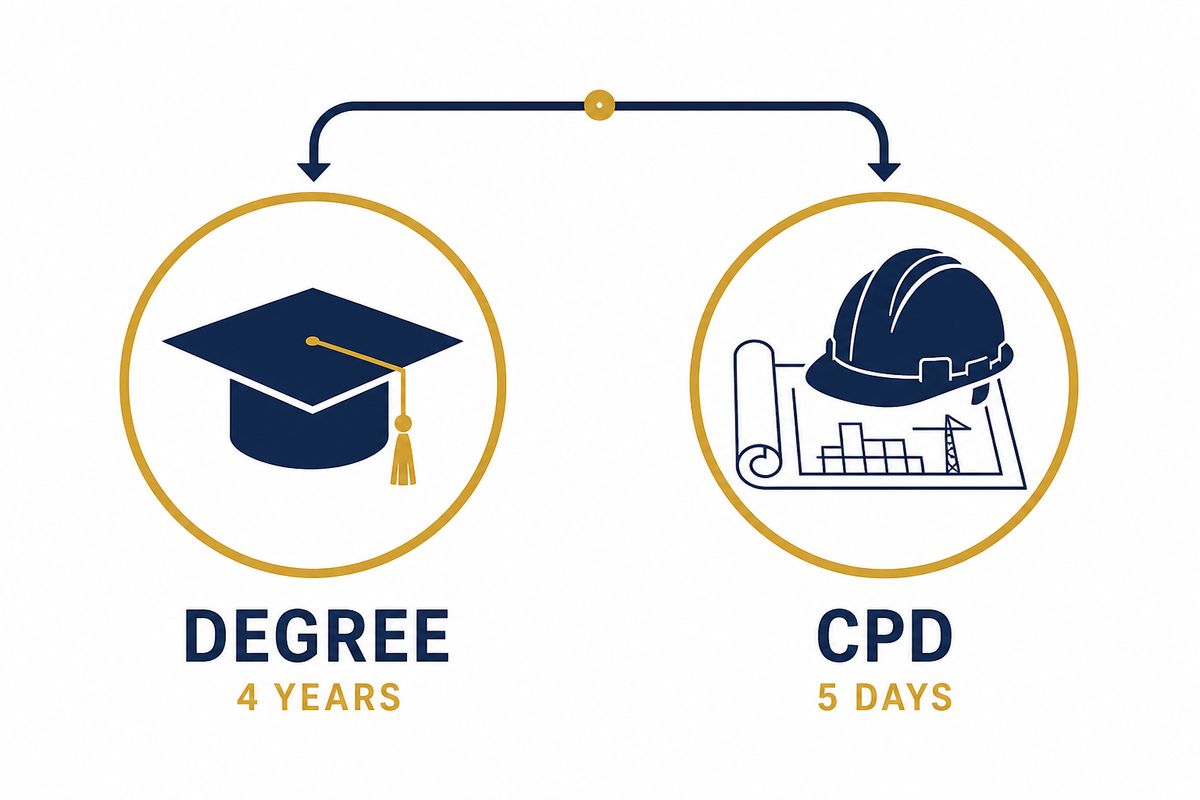
How long does civil engineering course take depends on the course type. A full-time bachelor’s degree is typically about four years. A five-day CPD course is short professional training for practising engineers, not a route into the profession. Search mixes the two; answer the one that matches the job you need.
If you are choosing a university, the useful number is years. If you already employ civil engineers and need BIM, digital twins or new materials used on a live job, the useful number is days. This page is for that second reader as much as the first. It does not walk bachelor’s, master’s and doctorate as if they were the only “courses” that exist.
What is the difference between a degree and a five-day CPD course?
A degree is how you enter the profession. A five-day course is how a practising engineer updates a skill.
| Degree (typical bachelor’s) | Five-day CPD course | |
|---|---|---|
| Who it is for | Students entering civil engineering | Practising engineers and managers already on projects |
| How long | About four years full-time (often three in England for a BEng; four for many BSc/MEng routes) | Five consecutive working days |
| What it gives | Foundation in maths, mechanics, materials, design, and a path toward professional status | A focused method you can apply on a current job |
| What it does not give | Immediate site competence in one new technology | A licence to practise, or a substitute for the degree |
| When it is the wrong buy | You already hold the degree and need a specific tool used this quarter | You are trying to become a civil engineer from scratch |
That table is the whole SERP mismatch. Google shows “how long does a civil engineering course take” next to both university pages and short professional programmes. If you pick the wrong column, you waste either four years of expectation or five days of budget.
A degree is still the right answer for what course you should take to become a civil engineer. Civil engineering is a professional course in the sense that practice is regulated and a first degree is the usual gate. None of that is what a five-day classroom is for.
Do not stretch this page into master’s and PhD timelines. Those are different searches. If someone already has the bachelor’s and is asking about a one-week course, the doctorate calendar is noise.
When is a five-day civil engineering course the right length?
Use five days when the person already designs, supervises or delivers civil work, and the gap is a named method, not a missing degree.
Good fits:
- A design lead who must decide whether a digital twin is a model, a dashboard, or a contract risk
- A site or project engineer who needs BIM, sensing or robotics framed as delivery, not as a vendor pitch
- A manager who has to write a short adoption plan the board will fund
Bad fits:
- A school leaver asking how long university takes
- Anyone who needs chartered status and thinks a week will replace the degree
- A team that only needed a half-day tool briefing
Five days is long enough to practise judgement: problem, option, risk, governance. It is not long enough to teach structural analysis from zero. That is why instructor led training vs e-learning still matters here. New kit on a live asset needs challenge in the room, not a paused video.
If the real gap is planning and delivery rather than civil technology, send them to project management courses for working professionals instead of a civil innovation week.
How should a manager choose between degree time and CPD time?
Ask four questions in order.
- Does this person already practise as a civil engineer? If no, the timeline is years. Stop. Do not buy a five-day course as a shortcut into the title.
- What must they do in the next 90 days that they cannot do now? If you cannot name the behaviour, you do not have a course length problem. You have an unclear job.
- Is the gap a whole discipline or one method? Whole discipline (structures, geotechnics, water) belongs in a degree or a long specialist programme. One method (digital twin use cases, sensor programmes, materials qualification) belongs in a week.
- Will they apply it on a live project with an owner? If the answer is a slide deck and no pilot, five days is still too long.
Length follows the job. A four-year degree builds the profession. A five-day course updates one part of practice. Mixing them in one booking is how L&D budgets buy the wrong thing and still feel under-trained.
If your civil engineers already hold the degree and the gap is innovation they must apply on live work (BIM, digital twins, sensors, robotics, advanced materials), review EPW’s five-day Innovation and Emerging Technologies in Civil Engineering course. It is for practising engineers and managers, not for people asking how many years university takes.
FAQ
How long does a civil engineering bachelor’s degree take?
Typically about four years full-time. In England a BEng is often three years; many BSc and MEng routes take four. Part-time study takes longer.
Does a five-day course make someone a civil engineer?
No. It does not replace the degree or professional status. It updates a practising engineer on a defined method.
Should I send graduates on a five-day innovation course instead of a master’s?
Only if the gap is a current project method, not a deeper specialism. A master’s is years and a different intent. A five-day course is CPD for the job they already have.