

AI-generated illustration created to represent the article’s subject. It does not depict an actual EPW course, trainer, participant, client, event or venue.
Advanced contract drafting is the disciplined process of converting a commercial agreement into precise, coherent and usable contractual rights, obligations, controls and remedies. It goes beyond completing a template: the drafter tests how clauses interact, allocates risk deliberately, anticipates operational events and expresses the parties’ intended deal in language that can be understood, administered and, if necessary, enforced.
For legal, commercial, procurement and contract-management professionals, the quality of drafting affects much more than signature. It influences how teams deliver, approve changes, measure performance, manage liability and resolve uncertainty throughout the contract lifecycle. This article explains the meaning, purpose and key principles of advanced drafting and provides a practical clause test and worked example.
Professional note: This article is general educational information, not legal advice. Contract formation, interpretation, execution and enforceability depend on the governing law, transaction and facts. Obtain advice from a suitably qualified lawyer for the relevant jurisdiction before relying on a contractual provision.
Key takeaways
- Advanced drafting begins with the commercial outcome and risk position, not with inherited wording.
- A strong clause identifies who must do what, to what standard, by when, with what evidence and consequence.
- Definitions, schedules, remedies, liability provisions and change mechanisms must work as one system.
- Drafting and negotiation are connected but different: negotiation selects the position; drafting expresses it accurately.
- Jurisdiction, mandatory rules and execution formalities must be checked rather than assumed.
What is advanced contract drafting?
Advanced contract drafting is the design and expression of a contract as an integrated operating and risk-allocation system. The drafter translates the approved deal into provisions that establish performance, payment, governance, information, change, risk, remedies, liability, termination and dispute-resolution arrangements.
The word advanced does not simply mean longer, more legalistic or more aggressive. A sophisticated contract may be shorter than an inherited template because it removes duplication, resolves contradictions and uses schedules intelligently. The distinguishing feature is the quality of the analysis behind the words: the drafter understands the transaction, chooses a position consciously and makes the document workable for its real users.
International guidance reinforces why this coherence matters. Under the UNIDROIT Principles of International Commercial Contracts, interpretation may examine the parties’ common intention, the meaning reasonable persons would give the contract and the document as a whole. The Principles also address unclear terms supplied by one party and discrepancies between equally authoritative language versions. These rules are not a substitute for applicable national law, but they illustrate the practical cost of ambiguity, inconsistency and unmanaged translation risk.
What is the purpose of advanced contract drafting?
The purpose is to create a reliable bridge between the deal agreed during negotiations and the decisions required during performance. The contract should help an authorised user determine the expected action without reconstructing the negotiation history or seeking legal interpretation for routine events.
Advanced drafting therefore seeks to:
- record the bargain accurately, including the scope, price, assumptions and dependencies;
- make performance administrable through owners, dates, procedures, notices, records and decision rights;
- allocate risk deliberately between the parties according to control, reward, insurance and commercial leverage;
- prevent avoidable ambiguity by aligning definitions, clauses, schedules and document precedence;
- provide controlled responses to delay, underperformance, change, breach, force majeure and termination; and
- preserve enforceability and compliance by considering governing law, mandatory rules and execution requirements.
Key principles of advanced contract drafting
| Principle | Professional question | Drafting outcome |
|---|---|---|
| Commercial alignment | What business outcome and risk position have the parties approved? | Clauses reflect the real deal rather than inherited assumptions. |
| Precision | Can a reader identify the actor, action, standard, timing and evidence? | Obligations can be performed and tested objectively. |
| Internal consistency | Do definitions, clauses, schedules and precedence rules agree? | The contract operates as one coherent document. |
| Proportionate risk allocation | Who controls the risk, receives the benefit and can insure it? | Indemnities, exclusions, caps and remedies reflect a conscious position. |
| Operational usability | Can delivery, finance and governance teams administer the clause? | Procedures, owners, notices and records are practical. |
| Change resilience | What happens when scope, law, cost, demand or dependencies change? | Variation, relief, escalation and exit mechanisms are controlled. |
| Jurisdictional validity | What governing law, mandatory rules and formalities apply? | The form and substance receive appropriate local legal review. |
Start with commercial intent
The drafter must understand the transaction before selecting language. That includes the deliverables, acceptance criteria, price model, dependencies, timetable, decision rights and failure scenarios. A clause copied from another transaction can appear polished while solving the wrong problem.
Write obligations that can be tested
An obligation should normally reveal the responsible party, required action, subject matter, standard and time. Where performance must be demonstrated, it should also identify the record, certificate, report or approval that provides evidence. Words such as “promptly”, “appropriate” or “regularly” may be useful when flexibility is deliberate, but they should not conceal a decision that the parties could define.
Use definitions as controls, not decoration
Definitions should give a term one necessary and consistent meaning. They should not hide substantive obligations, contradict ordinary usage or create a circular chain. Capitalised terms that appear once may not need definition, while frequently used technical or commercial concepts often do.
Connect provisions across the document
A service-level provision may depend on the specification, measurement rules, reporting process, service credits, exclusions, dispute procedure and termination trigger. Changing one section without testing these links can create gaps or double recovery. Advanced drafting includes cross-reference review and a hierarchy for conflicts between the main agreement and schedules.
Align consequences with the obligation
Remedies should respond to the relevant failure and fit the wider liability structure. The drafter checks cure periods, service credits, damages, indemnities, suspension and termination rights for overlap, exclusivity and proportionality. The purpose is not to maximise sanctions; it is to create a predictable and commercially approved response.
Draft for the people who will operate the contract
Usability supports performance. Clear headings, short provisions, consistent numbering, accessible tables and well-designed schedules allow operational users to find and apply the rule they need.
Check governing law and execution
Do not assume that a familiar template travels safely across borders. The UK Government’s Lambert Toolkit guidance, for example, states that its model agreements are designed for English law and advises obtaining locally qualified legal advice when adapting them to another legal system.
Execution also requires transaction-specific review. The Law Commission explains that electronic signatures are validly used for many transactions in England and Wales, while noting that particular documents may be subject to signing or witnessing procedures. Its electronic execution project demonstrates why “signature” cannot be treated as a purely administrative afterthought.
How advanced contract drafting works
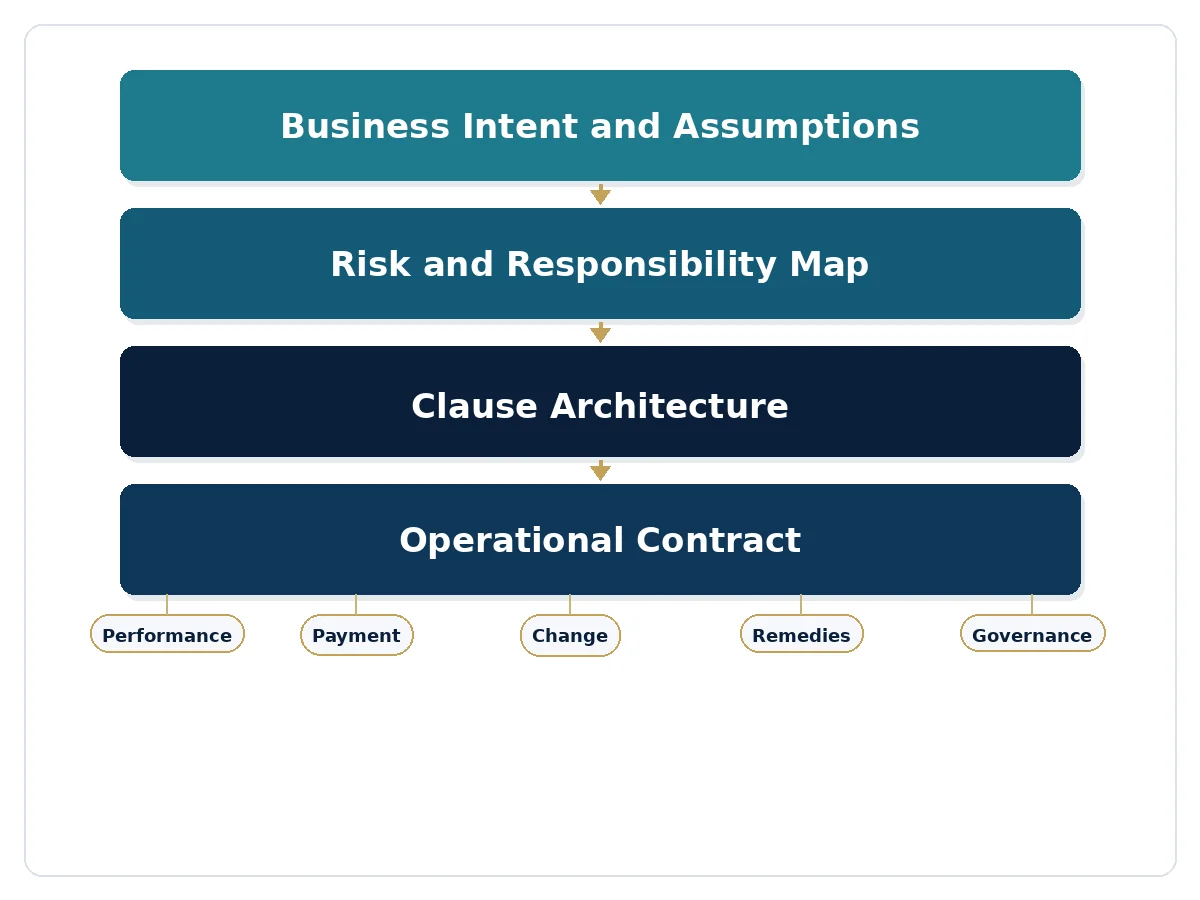
- Analyse the brief. Confirm the parties, authority, transaction, commercial objectives, governing law, timeline and approved deviations.
- Map obligations and risk. Identify deliverables, dependencies, data flows, approvals, payment events and material failure scenarios.
- Design the architecture. Decide what belongs in the main agreement, schedules, policies, statements of work and incorporated documents.
- Draft from the approved position. Use precise obligations, coherent definitions, controlled discretion and appropriate procedures.
- Test clause interactions. Review cross-references, precedence, remedies, liability, change, termination and survival provisions together.
- Negotiate through controlled redlines. Record why material positions change and route legal, financial, technical or security issues to the right decision-maker.
- Complete a legal and operational review. Check enforceability, mandatory law, tax, regulatory requirements, execution and whether users can administer the final wording.
- Prepare the contract for management. Extract obligations, dates, notices, performance measures and governance commitments into the contract-management process.
Performance measures illustrate this connection. The UK Government’s current Mid-Tier Contract guidance links key performance indicators to reporting requirements for relevant public contracts. In any sector, a KPI clause is only useful when the metric, data source, frequency, owner, threshold and consequence are defined consistently across the agreement.
The EPW seven-question clause test
Before approving a material clause, review it through seven questions. This is an EPW drafting aid, not a rule of law.
| Test | Question | What to verify |
|---|---|---|
| Actor | Who must act or decide? | The correct legal entity, role and authority. |
| Action | What must, may or must not happen? | A specific obligation, right or prohibition. |
| Standard | What level of performance applies? | Objective criteria or consciously chosen discretion. |
| Time | When is action due? | Trigger, period, deadline, time zone and working-day rule. |
| Evidence | How will compliance be shown? | Notice, record, approval, report or acceptance evidence. |
| Consequence | What follows from compliance or failure? | Payment, relief, cure, credit, damages, escalation or termination. |
| Dependencies | Which other provisions affect the result? | Definitions, schedules, exclusions, liability, precedence and survival. |
Worked example: from vague wording to an operational clause
Assume a services agreement requires the supplier to notify the customer about a security incident. The example is intentionally simplified and must not be adopted without jurisdiction-specific legal and technical review.
| Version | Illustrative wording | Drafting assessment |
|---|---|---|
| Vague | “The Supplier shall promptly notify the Customer of any security incident and take appropriate action.” | The actor is clear, but “security incident”, “promptly” and “appropriate action” are undefined. The clause gives no recipient, method, content, update duty or evidence requirement. |
| Structured | “The Supplier shall notify the Customer’s Security Contact through the Incident Portal without undue delay and in any event within 12 hours after confirming a Security Incident. The notice shall describe the known nature, systems affected, containment measures and material service impact. The Supplier shall provide material updates every 24 hours until containment and a written root-cause report within 10 Business Days after containment.” | The clause defines the recipient, channel, trigger, deadline, minimum content, update cycle and final evidence. The full agreement would still need definitions, cooperation duties, data-protection alignment, liability treatment and a process for disputed classification. |
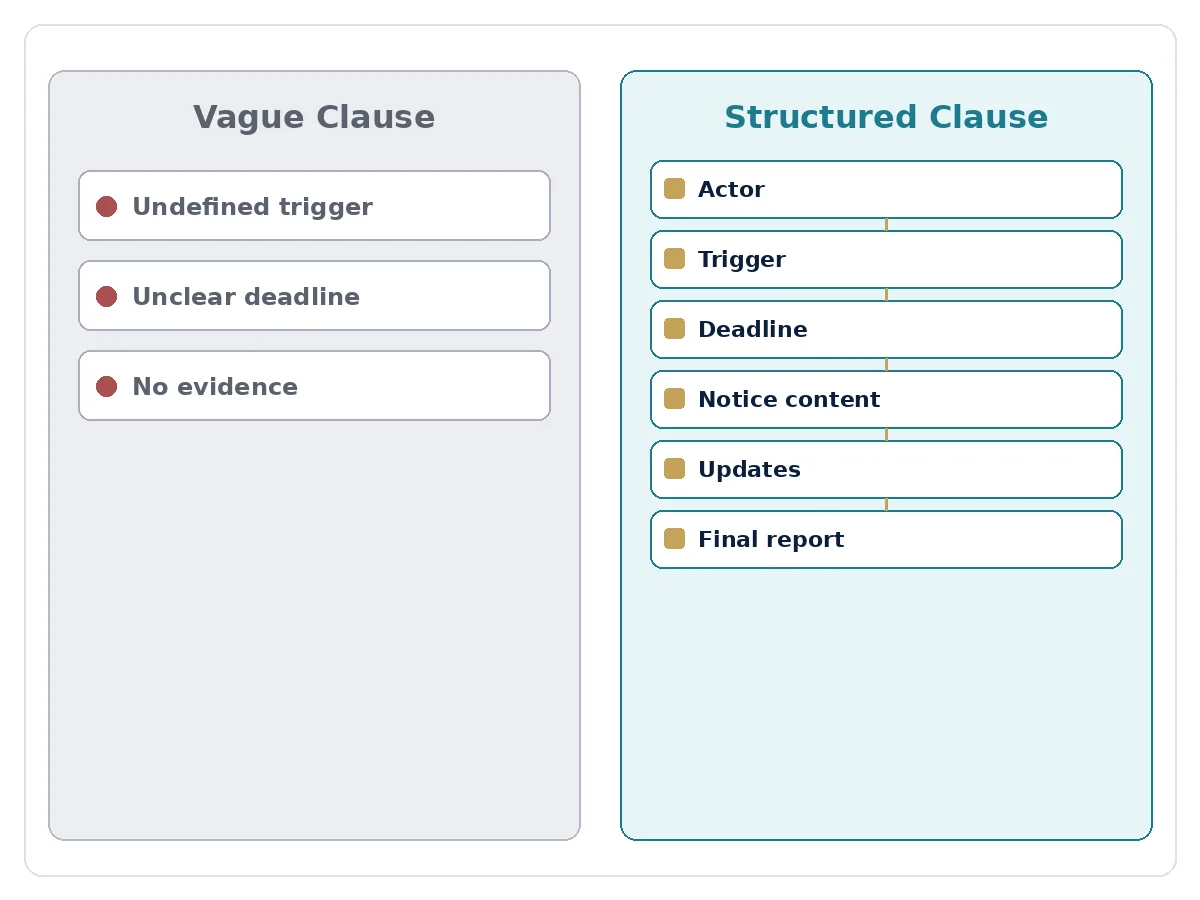
The improvement is not merely additional detail. It converts an uncertain expectation into a process that both parties can follow and audit. Advanced review then tests whether the precision creates unintended obligations, conflicts with law or policy, or duplicates a separate incident-response schedule.
Advanced drafting compared with related activities
| Activity | Primary purpose | How it differs |
|---|---|---|
| Basic or template-based drafting | Populate a familiar document for a relatively standard transaction. | Advanced drafting challenges assumptions, redesigns structure where necessary and tests legal and operational interactions. |
| Contract negotiation | Reach an acceptable commercial and legal position between parties. | Negotiation decides the position; drafting records that position precisely. Each informs the other, but neither replaces the other. |
| Legal review | Assess enforceability, legal exposure, mandatory rules and legal consequences. | Drafting creates or revises the language; legal review may identify changes required by the relevant law and facts. |
| Contract management | Administer obligations, performance, changes, records, risks and relationships after award. | Management operates the contract, but advanced drafting anticipates the information and procedures management will need. |
Professionals who need a foundation before advanced work may find EPW’s Contract Drafting for Non-Lawyers course relevant. Project professionals seeking the underlying legal concepts can also review Contract Law Fundamentals for Project Managers.
Professional contract-drafting checklist
- Confirm the parties’ identities, authority, governing law and execution method.
- Record the approved commercial assumptions, scope, price and dependencies.
- Use definitions consistently and remove unused or circular definitions.
- Draft obligations with a clear actor, action, standard, trigger and deadline.
- Align specifications, service levels, acceptance and payment mechanisms.
- Map risk allocation across warranties, indemnities, insurance, exclusions and liability caps.
- Test change, delay, relief, suspension, termination and exit provisions as connected processes.
- Check notice requirements, document precedence, cross-references and surviving obligations.
- Separate actual legal requirements from commercial preferences and drafting conventions.
- Complete specialist reviews for tax, data, competition, employment, intellectual property, sanctions, technical safety or regulation where relevant.
- Read the final contract from the perspective of the teams that must perform, measure and govern it.
- Preserve the final approvals and negotiation record according to the organisation’s governance process.
Developing advanced contract-drafting capability
Advanced capability develops through repeated analysis, redlining, clause comparison, risk discussion and feedback from experienced legal and commercial reviewers. Training should use realistic transactions and require participants to explain why a clause is necessary, how it interacts with other provisions and what operational evidence it creates.
EPW’s Advanced Contract Drafting and Negotiation Techniques course covers clause architecture, risk allocation, remedies, indemnities, liability limits, redlines and negotiation strategy. The wider Contracts Management and Law Training Courses category includes related development routes for legal, procurement, project and commercial professionals.
Ready to apply stronger clause architecture and risk-allocation techniques in your organisation? Review the Advanced Contract Drafting and Negotiation Techniques course, available dates and locations, or request tailored in-house training.
Conclusion
Advanced contract drafting means designing a contract that accurately expresses the bargain, allocates risk consciously and works during performance. Its quality is visible in the connections: definitions support obligations, obligations support measurement, measurement supports remedies, and change and exit provisions handle foreseeable disruption.
Sources and References
- UNIDROIT. Principles of International Commercial Contracts: Chapter 4, Interpretation. Accessed 30 August 2026.
- UK Cabinet Office. The Mid-Tier Contract: Guidance for Buyers. Updated 27 April 2026.
- UK Government Office for Technology Transfer. University and Business Collaboration Agreements: Model Agreement Guidance. Accessed 30 August 2026.
- Law Commission. Electronic Execution of Documents. Published 4 September 2019.