

The board of directors and executive management share responsibility for organisational success, but they do not perform the same role. The board governs: it sets direction, appoints and oversees senior leadership, approves major decisions and remains accountable for stewardship. Executive management leads implementation: it develops proposals, operates the business, manages resources and delivers performance within the authority delegated by the board.
When these boundaries are unclear, boards can drift into operational micromanagement while executives make decisions that should have received board scrutiny. This comparison explains the key governance differences and shows how to build an effective relationship without weakening accountability.
Board of directors vs executive management: the key difference
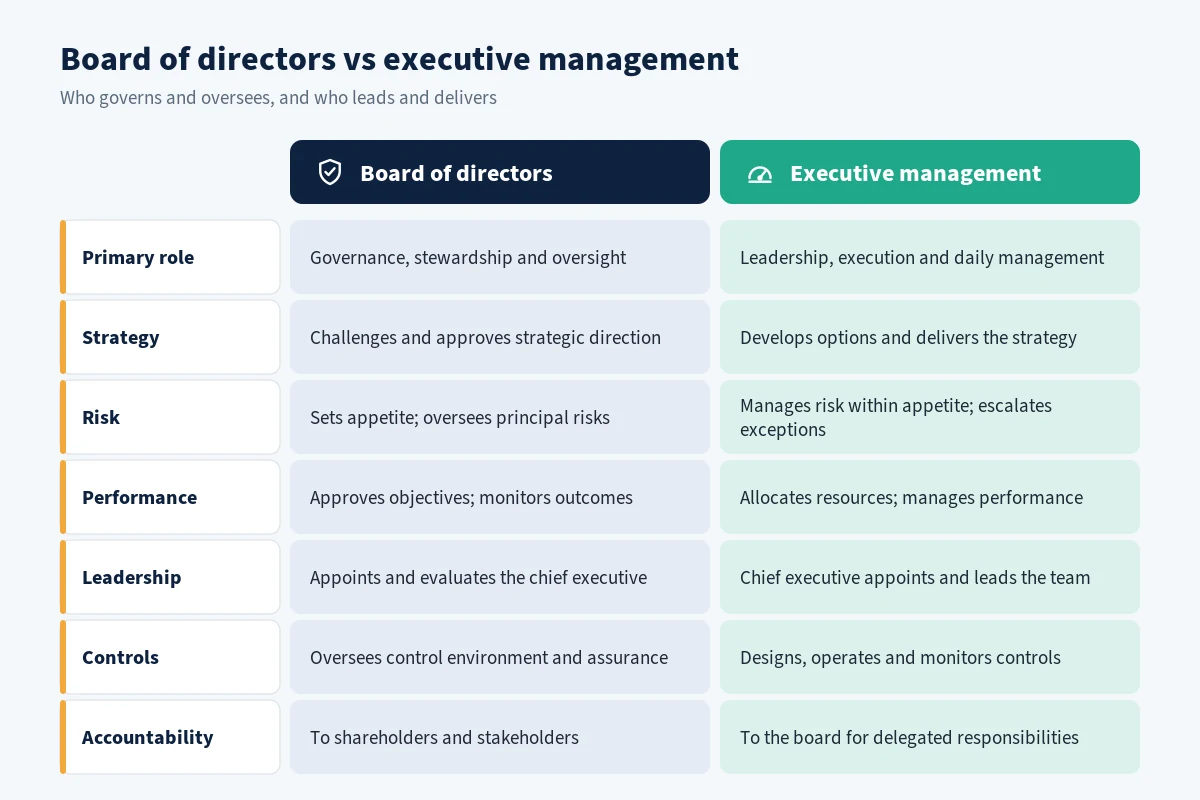
The board directs and oversees the organisation as a collective governing body. Executive management runs the organisation under delegated authority. The board should challenge, approve, monitor and hold management accountable; executives should recommend, implement, report and escalate.
| Governance dimension | Board of directors | Executive management |
|---|---|---|
| Primary role | Governance, stewardship and oversight | Leadership, execution and daily management |
| Strategy | Challenges and approves strategic direction | Develops options and delivers the approved strategy |
| Risk | Sets appetite and oversees principal and emerging risks | Manages risk within appetite and escalates exceptions |
| Performance | Approves objectives and monitors enterprise outcomes | Allocates resources and manages operational performance |
| Leadership | Appoints, supports, evaluates and, when necessary, replaces the chief executive | The chief executive appoints and leads the executive team |
| Controls and assurance | Oversees the control environment and assurance | Designs, operates and monitors controls |
| Accountability | Accountable to shareholders or the relevant ownership and stakeholder framework | Accountable to the board for delegated responsibilities |
The G20/OECD Principles of Corporate Governance 2023 provide internationally recognised guidance on the institutional framework, shareholder rights, disclosure, sustainability and board responsibilities. They emphasise strategic guidance, effective monitoring of management and board accountability to the company and shareholders.
What is the board responsible for?
Exact legal duties depend on jurisdiction and organisational form, but effective boards commonly retain responsibility for:
- organisational purpose, values and long-term direction;
- approval and oversight of strategy, capital allocation and major transactions;
- risk appetite and oversight of principal and emerging risks;
- appointment, remuneration, succession and evaluation of the chief executive;
- board and committee composition, independence and effectiveness;
- integrity of reporting, internal control and assurance arrangements;
- culture, conduct and significant stakeholder consequences;
- decisions formally reserved for the board by law, constitution or policy.
Directors exercise judgement collectively. Individual directors do not normally instruct employees or suppliers unless authority has been expressly delegated. The chair leads the board, supports constructive challenge and manages the relationship with the chief executive, but does not replace the chief executive’s management role.
What is executive management responsible for?
Executive management converts purpose and strategy into plans, operating decisions and measurable results. Typical responsibilities include:
- developing strategic options and recommendations for board consideration;
- delivering approved plans, budgets and transformation programmes;
- leading people, operations, technology, customers and suppliers;
- managing risks and controls within approved appetite and policy;
- maintaining reliable management information and regulatory compliance;
- escalating material exceptions, incidents and decisions outside delegated authority;
- building organisational capability and succession below board level;
- implementing board decisions and reporting progress transparently.
Executives need sufficient authority to act. If every meaningful decision returns to the board, accountability becomes blurred and response slows. Delegation should be clear, but the board cannot delegate away its ultimate responsibility for governance and oversight.
Seven areas where responsibilities differ
1. Purpose and strategy
Management analyses markets, capability and resources, then proposes strategic choices. The board tests assumptions, considers stakeholder and risk consequences and approves direction. Once approved, management owns execution; the board monitors outcomes and challenges whether the strategy remains viable.
2. Risk appetite and risk management
The board defines the nature and extent of risk the organisation is willing to take in pursuit of objectives. Executives translate that appetite into limits, controls, decisions and escalation. Management should not present only risks that have already become problems; boards need forward-looking information about uncertainty, concentration and emerging threats.
3. Performance and resources
The board approves significant objectives, budgets, capital priorities and performance expectations. Management deploys people and resources, resolves trade-offs and takes corrective action. Board oversight should focus on drivers, trends and strategic implications rather than operational detail that belongs to executives.
4. Leadership appointments and succession
The board appoints and evaluates the chief executive and oversees senior-leadership succession. The chief executive recommends or appoints other executives according to the governance framework and manages their performance. Nomination and remuneration committees may conduct detailed work, but accountability remains with the board.
5. Internal control and assurance
Management designs and operates the risk-management and internal-control framework. The board determines whether it receives sufficient evidence to oversee effectiveness. The UK Corporate Governance Code 2024 requires boards within its scope to monitor the risk-management and internal-control framework, review effectiveness at least annually and report on material controls. The organisation’s applicable law and code must determine the precise requirement.
6. Information and reporting
Management prepares complete, timely and balanced information. The board defines what it needs, challenges omissions and requests independent assurance where necessary. A large board pack is not automatically informative; high-quality reporting highlights decisions, variance, uncertainty, risk exposure and action.
7. Stakeholder accountability
Executives maintain daily relationships with employees, customers, regulators, partners and communities. The board oversees whether stakeholder interests and consequences are considered consistently with purpose, duties and long-term success. Directors should receive evidence from more than one management channel where the matter is significant.
Reserved matters vs delegated authority
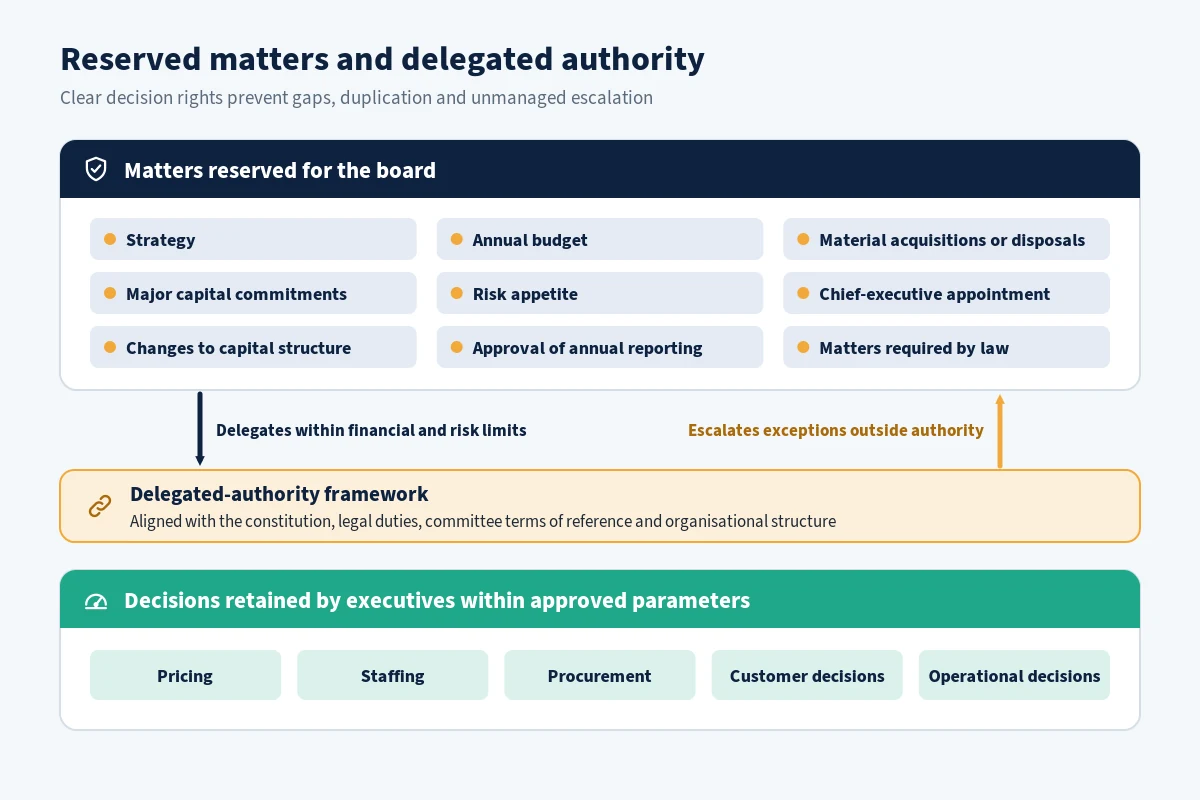
A schedule of matters reserved for the board establishes which decisions require board approval. A delegated-authority framework states what executives and committees may decide, within which financial and risk limits. Both documents should align with the constitution, legal duties, committee terms of reference and organisational structure.
Common board-reserved matters include strategy, annual budget, material acquisitions or disposals, major capital commitments, risk appetite, chief-executive appointment, significant changes to capital structure, approval of annual reporting and matters required by law. Executives usually retain pricing, staffing, procurement, customer and operational decisions within approved parameters.
What good board-management interaction looks like
- Clear mandates: board, committees, chair, chief executive and executives understand their authority.
- No surprises: management escalates material developments early, including uncertainty and bad news.
- Constructive challenge: directors test assumptions without managing the task themselves.
- Decision-ready papers: proposals state options, evidence, risk, stakeholder impact and the decision required.
- Recorded accountability: minutes distinguish challenge, decisions, conditions and actions.
- Independent access: the board can hear from internal audit, external audit, risk and other specialists without inappropriate filtering.
- Disciplined follow-up: executives report delivery against decisions and agreed thresholds.
Common governance boundary failures
Board micromanagement
Directors become involved in routine recruitment, supplier selection or project decisions. Executives hesitate, duplicate reporting grows and accountability weakens. The remedy is a clearer delegation framework and board agendas centred on strategic outcomes and material risk.
Management dominance
Executives control agendas, filter information or present decisions after they are effectively irreversible. Independent directors cannot provide meaningful challenge. Board and committee chairs should control agendas, information expectations and access to assurance.
Rubber-stamp approval
The board receives polished recommendations but insufficient alternatives, sensitivity analysis or dissenting views. Approval exists formally without informed judgement. Decision papers should show rejected options, assumptions and consequences.
Unclear committee ownership
Audit, risk, remuneration and sustainability committees review connected matters without clarity about interfaces. Committees may recommend and scrutinise, but the board remains collectively responsible. Terms of reference and an annual work plan should show hand-offs and escalation.
Information overload
Board packs contain hundreds of pages yet conceal material change. Management and the company secretary should design reporting around strategy, risk appetite, performance drivers, decisions and exceptions.
A practical governance-boundary checklist
- Are board and executive responsibilities documented and understood?
- Do reserved matters and delegated authorities cover financial and non-financial risk?
- Can executives act quickly within clear thresholds?
- Are decisions outside appetite or authority escalated consistently?
- Does the board receive balanced information, including failures and uncertainty?
- Do directors challenge assumptions without prescribing operational methods?
- Are chief-executive objectives, evaluation and succession governed independently?
- Do committees coordinate without fragmenting collective board responsibility?
- Are significant decisions, dissent and follow-up actions recorded?
- Is the governance framework reviewed after major change or crisis?
Strengthen board and executive governance
EPW’s Corporate Governance for Board Members and Executives Course helps directors, senior executives and company-secretariat leaders clarify accountabilities, evaluate board architecture, oversee strategy and risk appetite, challenge management information, coordinate committees and assurance, and design a practical governance-improvement agenda. The five-day programme includes boardroom simulations for constructive challenge and high-stakes decisions.
For related guidance, read how to build an ethical corporate governance culture, or browse more Auditing, Governance, and Risk Compliance Articles.
References
- Organisation for Economic Co-operation and Development (2023), G20/OECD Principles of Corporate Governance 2023.
- Financial Reporting Council (2024), UK Corporate Governance Code 2024.
- The Institute of Internal Auditors (2024), Global Internal Audit Standards.