What is onshore and offshore in oil and gas?
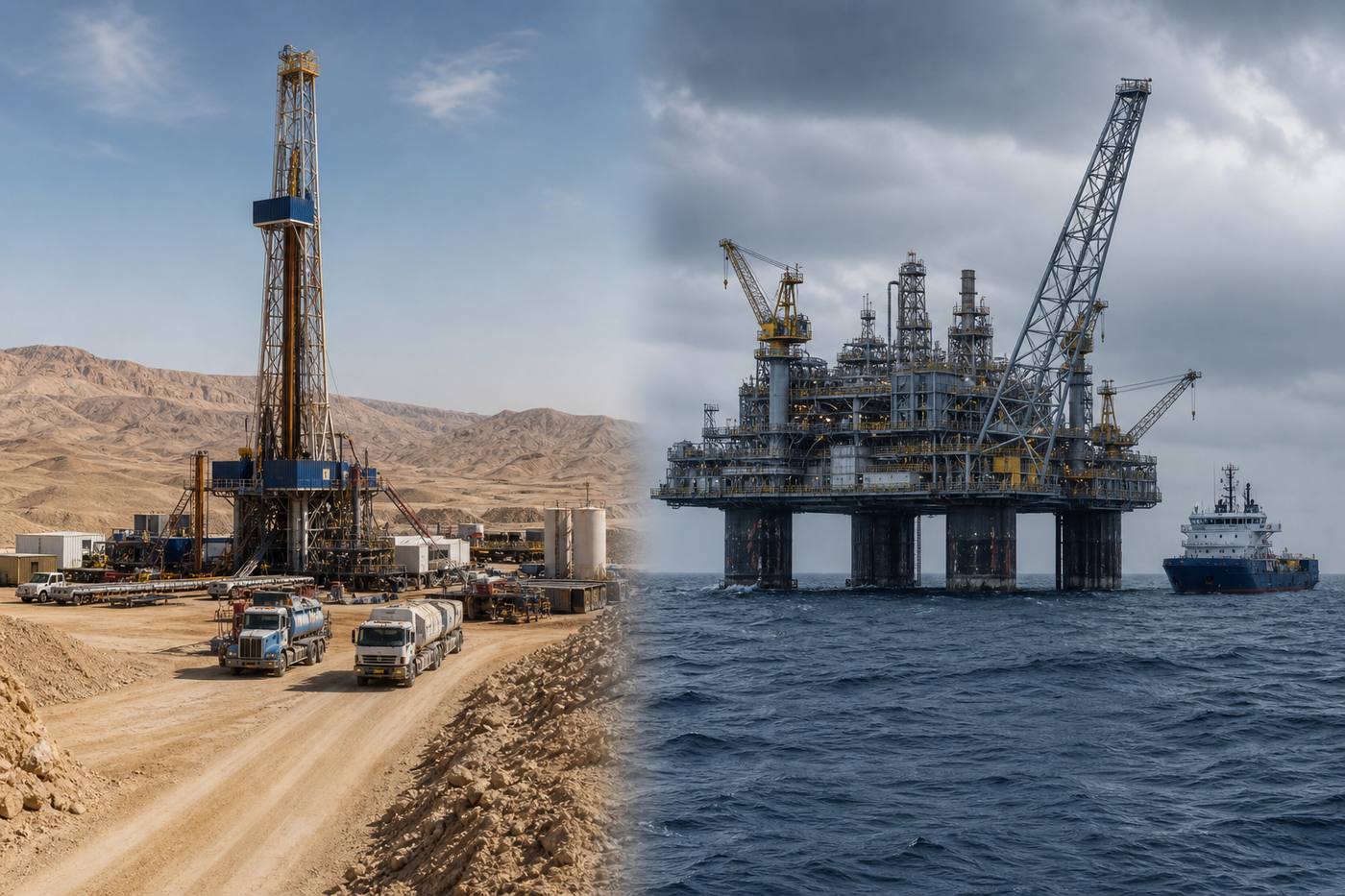
Onshore oil and gas operations take place on land. Offshore operations develop oil and gas resources beneath the seabed, using equipment such as platforms, mobile drilling units and subsea production systems. The distinction describes location, rather than a different type of oil or gas.
Location influences access, equipment, logistics and emergency planning. An onshore site may be reached by road; an offshore installation may depend on vessels or helicopters. Remote land operations can also involve difficult access, so the practical comparison depends on the individual site.
The U.S. Energy Information Administration’s offshore overview explains how offshore resources are developed. The sections below compare the implications for operations teams and managers.
How do location, equipment and logistics differ?
Location is the first criterion. Onshore sites sit on land, usually with some road, power and pipeline access. That does not make them easy. Desert, jungle and remote basin work still has long supply lines. It does mean a failed pump can often be reached by truck, and a casualty can often be moved by road.
Offshore sites sit in water, from near-shore jack-ups to deepwater floating systems. Distance from the beach, water depth and sea state sit in every plan. You do not “drop in” a spare. You schedule it.
Equipment follows location.
- Onshore: land rigs, pumpjacks on mature wells, surface gathering, tank farms, and workover units that travel by road.
- Offshore: jack-ups in shallow water, semi-submersibles and drillships in deeper water, subsea trees and risers, and production on fixed platforms or floating units.
Salt water, wave loading and access constraints influence offshore equipment design and maintenance planning. Review the role of remote monitoring and inspection in the context of the actual asset; EPW’s overview of emerging technologies in oil and gas management explores related training topics.
Logistics is the daily difference. Onshore logistics is trucks, roads, pad access and a workshop that is usually on the same land mass. Offshore logistics is marine supply, helicopter slots, weather windows and a spare-parts philosophy that assumes you cannot send a van. If your delay is a missed boat, you do not have an onshore problem with a different badge.
What does onshore and offshore mean for cost and HSE?
Compare both development spending and operating costs, including when expenditure occurs and how changes to the project schedule affect it.
Offshore developments can require substantial spending on platforms, subsea equipment and marine construction before production starts. Some onshore developments can be built in smaller stages. These are useful tendencies, not universal rules: compare the actual field size, reservoir conditions, infrastructure, development schedule and intervention costs before judging a project’s economics.
The oil and gas accounting perspective connects development spending, operating assumptions and the timing of cash flows. Use the assumptions for each asset when comparing budgets.
Both onshore and offshore operations require controls for serious process and occupational hazards. The site layout, access routes and surrounding environment influence how teams prevent incidents and plan a response.
Onshore planning should address the site’s process hazards, vehicle movements, nearby communities and the emergency support that can actually reach the location. A remote land site may require its own response arrangements rather than relying on nearby services.
Offshore planning must account for marine access, weather, transfer arrangements and evacuation from the installation. Evaluate the site’s actual response resources and constraints instead of assuming every offshore incident will have the same response time.
Identify the requirements that apply to the particular asset and location. Assign responsibility for keeping procedures, permits and supporting evidence current, and check that the arrangements reflect the site’s activities.
Risk ownership still sits with the people who run the asset, which is why how to train employees on risk management is not a classroom extra. First line has to name the control. Second line has to challenge it. Audit cannot substitute for either.
How do crew rotation and the human side compare?
Working arrangements depend on the site, role and employer.
Onshore arrangements range from commuting to remote camps and rotational assignments. Offshore personnel may live on the installation during an assignment and rotate between offshore and onshore periods. Shift length and rotation patterns vary by operator, role and location; check the actual roster rather than assuming one industry-wide pattern.
For either setting, workforce planning should consider fatigue, accommodation, medical support, transport and emergency responsibilities. These conditions affect the preparation people need before starting work.
When comparing instructor-led training and e-learning, check how participants will practise and demonstrate the required skills. A general industry overview serves a different purpose from role-specific safety training or a practical competence assessment.
Onshore versus offshore: six criteria for managers
Use this table as a working comparison, not as a ranking of which is “better.”
| Criterion | Onshore | Offshore |
|---|---|---|
| Location | Operations on land, including remote sites | Operations at sea, with resources beneath the seabed |
| Equipment | Land drilling and production equipment suited to the field | Marine drilling units, platforms or subsea systems suited to water depth and field conditions |
| Cost | Depends on reservoir, access and infrastructure; some developments can be staged | May involve substantial marine infrastructure and intervention costs; assess the actual project |
| Safety and response | Plan for process hazards, land access, traffic and local conditions | Plan for process hazards, marine access, weather and evacuation arrangements |
| Working arrangements | Commuting, camps or rotations, depending on the site | Offshore assignments and rotations, depending on the operator and role |
| Logistics | Road or other land access where available | Marine supply and, where used, helicopter transport |
Use the comparison to identify which assumptions differ across your assets and where the team needs additional knowledge or site-specific preparation.
Which five-day course fits an onshore or offshore team?
Pick the course from the skill you need applied, not from the word “offshore” in a title.
Use this decision:
- The team needs to understand the exploration-to-production chain. Compare the starting level and learning outcomes of introductory and advanced courses. Ask the provider which option fits participants’ existing knowledge of reservoirs, drilling and surface facilities.
- The gap is digital, remote operations or new kit on an existing field. Do not start with fundamentals. Use a technology or digital-operations programme after the team can already describe the asset.
- The gap is HSE ownership, permits and escalation. That is a risk-and-control problem. Fundamentals will not fix a team that cannot stop a job.
- The gap is cost, reserves reporting or joint-venture books. That is accounting and commercial, not drilling.
A five-day programme can provide time to work through topics across disciplines. Confirm the expected starting knowledge, practical exercises and assessment before choosing a course for the team.
For experienced professionals, review EPW’s five-day Advanced Oil and Gas Exploration and Production Fundamentals course. Its published outline covers exploration techniques, drilling, reservoir engineering, production optimisation and economics. Compare the syllabus with the team’s needs and select a location to review current dates.
FAQ
What is onshore and offshore in simple terms?
Onshore is oil and gas work on land. Offshore is the same class of work from a unit in the sea. The meaning is location and the operating system that follows, not a different commodity.
Is offshore always more expensive than onshore?
No single rule applies to every project. Offshore infrastructure and access can be costly, but reservoir size, production rates, field life and existing infrastructure also affect the economics. Compare the development and operating assumptions for the actual fields.
Do onshore and offshore teams need different training?
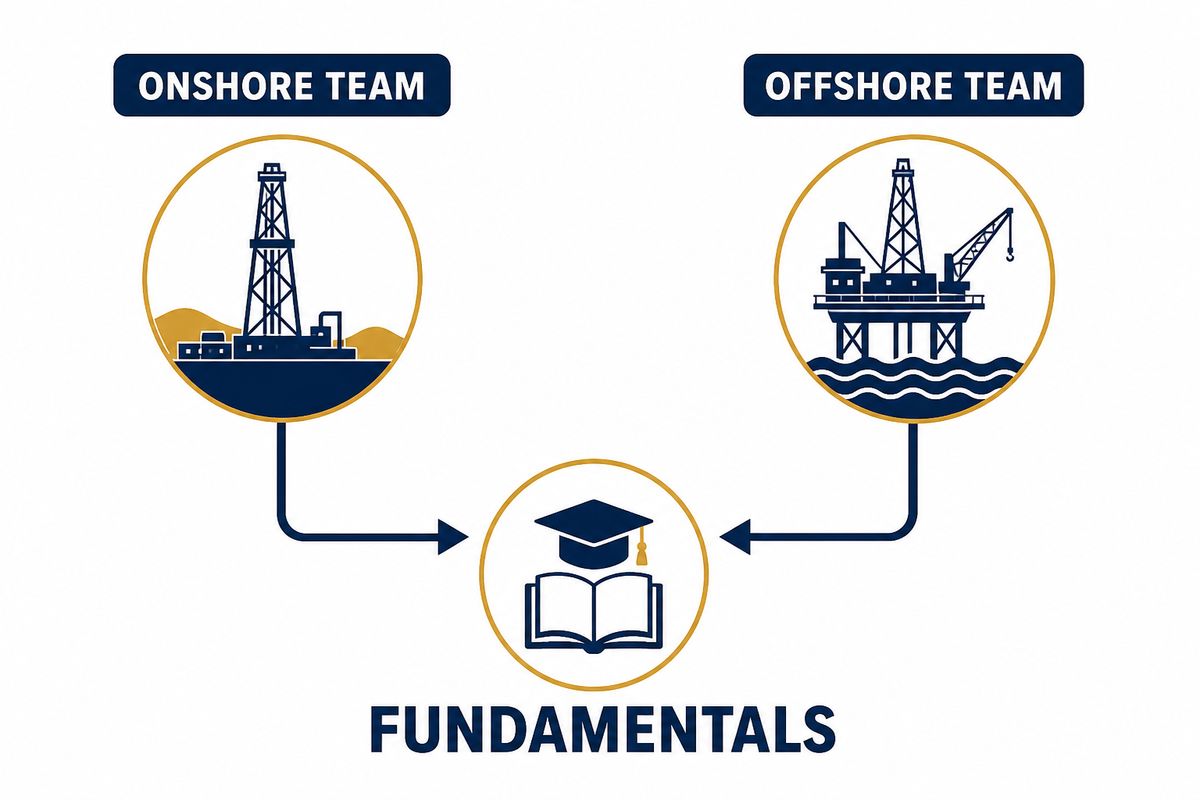
Yes, in HSE, logistics and emergency response. They still need a shared picture of how exploration and production works, which is why a fundamentals course sits underneath specialist modules.