

AI-generated illustration created to represent the article’s subject. It does not depict an actual EPW course, trainer, participant, client, event or venue.
Ethics and integrity in corporate governance mean directing and controlling an organisation so that decisions reflect defensible principles, stated values and accountability to stakeholders. Ethics helps leaders decide what ought to be done; integrity is the consistency between those commitments and actual conduct. Together, they turn governance from formal compliance into trustworthy decision-making.
This explanation is designed for board members, executives, governance professionals, company secretaries, risk and compliance leaders, internal auditors and managers responsible for organisational culture.
Key takeaways
- Ethics supplies principles for judging choices; integrity means applying them consistently, especially under pressure.
- Compliance establishes mandatory boundaries, but an ethical decision may require more than the minimum legal response.
- The board sets ethical direction through its own conduct, executive appointments, incentives, challenge and accountability.
- Codes and training matter only when decision rights, speak-up arrangements, investigations and consequences support them.
- Culture should be assessed with several sources of evidence, including employee experience, conduct events, incentives and remediation.
- Integrity protects trust by reducing the gap between what an organisation says and what it rewards or tolerates.
Contents
- Ethics, integrity, governance and compliance defined
- Why ethics and integrity matter
- The ethical governance system
- The board’s responsibilities
- Evidence and indicators
- Common governance failures
Ethics, integrity, governance and compliance defined
Ethics concerns the principles used to judge right action. In an organisation, it frames questions about fairness, honesty, harm, responsibility, conflicts and the legitimate interests of affected stakeholders. Ethical reasoning becomes especially important when rules are incomplete, values compete or a technically lawful option could still cause unjustifiable harm.
Integrity is alignment between professed principles and behaviour. An organisation demonstrates integrity when its leaders apply standards consistently, disclose relevant conflicts, keep commitments, correct mistakes and accept accountability. Integrity is therefore observable over time; it cannot be established by a mission statement alone.
Corporate governance is the system through which an organisation is directed, overseen and held accountable. It includes the board, management, ownership and stakeholder relationships, decision rights, information flows, controls, incentives and assurance. Ethics determines the quality of judgement within that system, while integrity determines whether the system works as represented.
Compliance means meeting applicable laws, regulations, contractual duties and internal requirements. It is essential, but it answers a narrower question: what must the organisation do? Ethics also asks what should it do, and integrity asks whether it will act accordingly when doing so is inconvenient.
| Concept | Central question | Governance expression | Failure signal |
|---|---|---|---|
| Ethics | What is the responsible choice? | Principles, stakeholder consideration and reasoned judgement | Decisions are legal but misleading, unfair or harmful |
| Integrity | Do actions match commitments? | Consistency, candour and accountability | Leaders tolerate behaviour they publicly reject |
| Compliance | What requirements apply? | Obligations, controls, monitoring and evidence | Breaches, weak records or unmanaged obligations |
| Governance | Who directs, decides and oversees? | Roles, authority, reporting, challenge and assurance | Blurred accountability or ineffective oversight |
EPW’s guide to governance, risk and compliance explains how these disciplines support objectives when their responsibilities and information are connected.
Why ethics and integrity matter in corporate governance
The G20/OECD Principles of Corporate Governance 2023 recognise the board’s role in setting the ethical tone through its own conduct and its appointment and oversight of executives. They also explain that high ethical standards support credibility and trustworthiness in everyday operations and long-term commitments.
Ethical governance improves more than reputation. It helps leaders identify whose interests may be affected, expose hidden assumptions, question incentives and explain decisions. This can reduce misconduct, regulatory exposure, employee silence, unreliable reporting and value-destructive short-termism. It also makes corrective action more credible because accountability is based on evidence rather than hierarchy.
The opposite is an integrity gap: published values say one thing, while targets, promotions, resource decisions or disciplinary outcomes encourage another. Employees learn from what leaders reward and tolerate. Stakeholders judge the organisation by those patterns, not by the wording of its code.
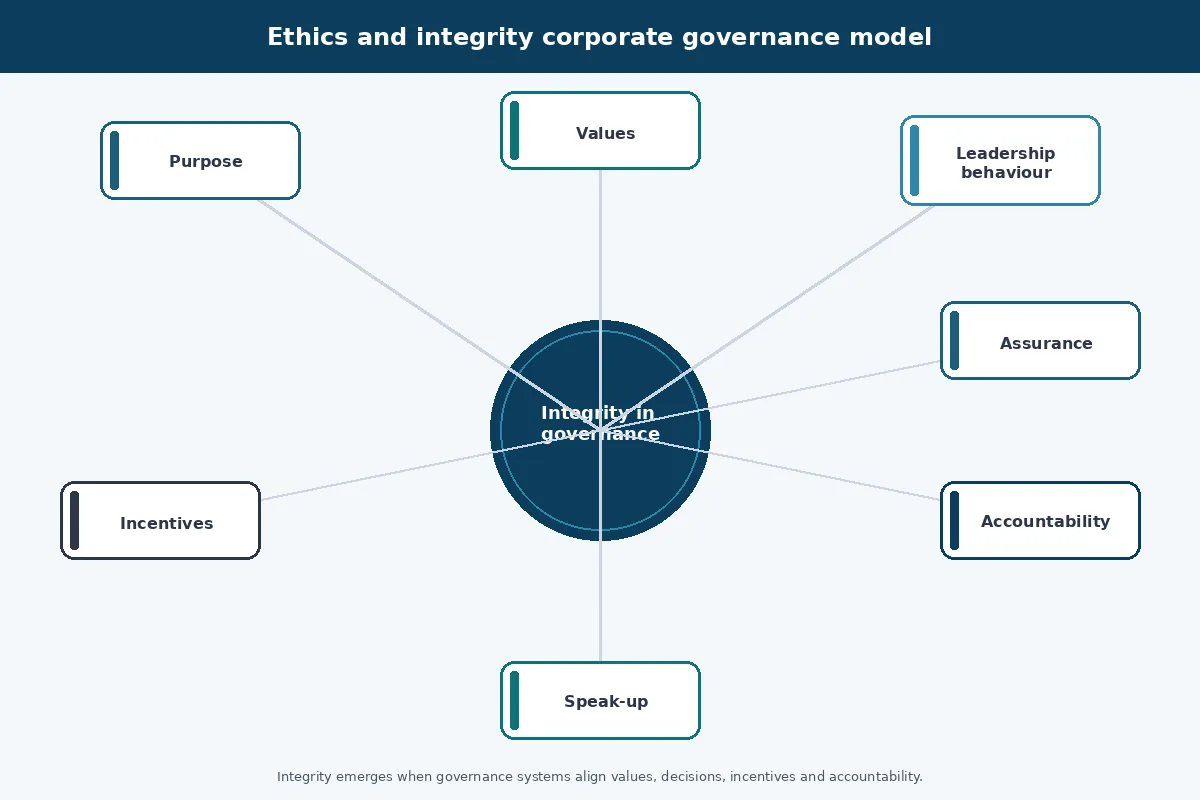
Seven elements of an ethical governance system
1. Purpose and values linked to decisions
Values should guide real choices about customers, employees, suppliers, communities and investors. Decision papers can require authors to state ethical implications, affected stakeholders, trade-offs and alternatives. This makes values operational rather than decorative.
2. Leadership example and accountability
Directors and executives should disclose conflicts, invite challenge, correct errors and accept proportionate consequences. A leader who bypasses controls or retaliates against difficult questions can invalidate months of ethics communication.
3. Clear conduct expectations
A code of ethics or conduct should translate principles into expectations for conflicts, gifts, information, competition, human rights, third parties and use of organisational resources. Scenarios are more useful than slogans because they show how standards apply under pressure.
4. Aligned incentives and people processes
Targets, remuneration, promotion and performance management should consider how results are achieved. Boards should question whether aggressive goals, weak supervision or inconsistent discipline create pressure to conceal problems or mistreat stakeholders.
5. Accessible speak-up arrangements
Employees and relevant third parties need trusted routes to raise concerns, ask advice and report retaliation. Accessibility, confidentiality, triage, investigation independence and feedback all influence credibility. Low reporting may indicate a healthy culture, but it may equally indicate fear or disbelief; context is essential.
6. Fair investigations and remediation
Investigations should be competent, impartial, timely and respectful of legal rights. Findings should lead to proportionate consequences, control improvements and analysis of root causes. Similar cases should receive reasonably consistent treatment regardless of seniority or commercial performance.
7. Monitoring, assurance and learning
Management, compliance, human resources and internal audit provide different perspectives on conduct and culture. Boards need a coherent view of themes, high-risk populations, recurring causes and whether actions have changed behaviour. EPW’s article on compliance and risk management gives additional context on obligations, monitoring and control improvement.
What is the board responsible for?
The board does not manage every conduct case. It establishes direction, approves important standards, oversees management and obtains assurance that the system is working. The UK Corporate Governance Code 2024 places board leadership, company purpose, responsibilities, audit, risk, internal control and remuneration within one governance framework. The FRC’s corporate culture guidance highlights alignment among purpose, values, strategy and culture, together with regular board assessment and monitoring.
In practice, the board should:
- define expected conduct and ensure directors model it;
- approve the approach to conflicts, speaking up, investigations and escalation;
- test whether incentives and appointments support the desired culture;
- receive information that reveals both positive and adverse evidence;
- challenge management on recurring issues, delayed remediation and unequal consequences;
- protect the independence and resources of assurance functions;
- communicate candidly with stakeholders about material concerns and responses; and
- review whether lessons result in durable system change.
Committees may conduct detailed oversight, but ethics cannot be delegated to an audit or compliance committee alone. Remuneration, nomination, risk and sustainability decisions can all influence organisational integrity.
How ethical decisions should be made
A practical decision process begins by defining the issue and verifying facts. Leaders then identify applicable duties, affected stakeholders, potential harms and benefits, conflicts, options and uncertainties. They test each option against law, values, consistency, transparency and long-term consequences before assigning action and documenting the reasoning.
Useful challenge questions include:
- Would this decision remain defensible if disclosed to employees, customers or investors?
- Are we treating comparable stakeholders and cases consistently?
- Who bears the risk, and who receives the benefit?
- Has pressure, bias or a conflict distorted the analysis?
- Does the option meet both the letter and purpose of relevant requirements?
- What precedent will this set for future behaviour?
How boards can measure ethics and integrity
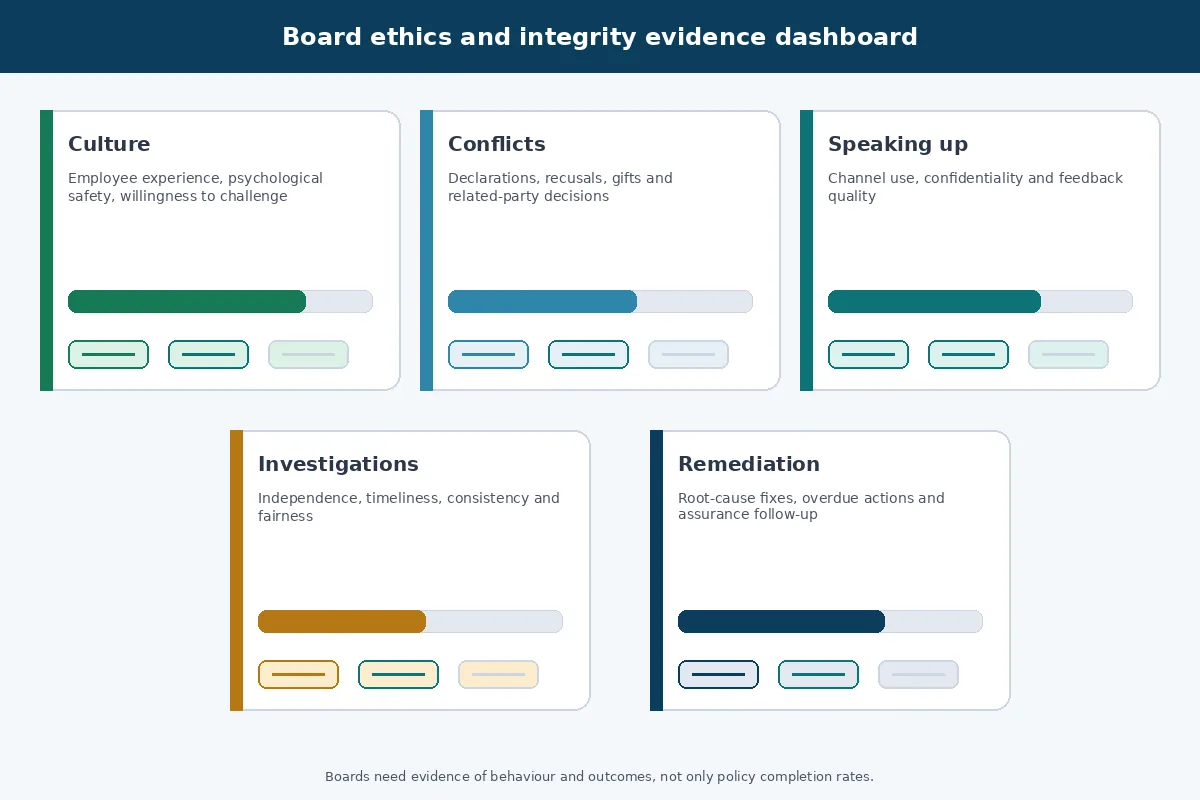
No single metric proves an ethical culture. Boards should triangulate quantitative and qualitative evidence and examine trends, differences between units and the reliability of data.
| Evidence area | Examples | Question for the board |
|---|---|---|
| Leadership and incentives | Promotion decisions, performance objectives, reward adjustments and executive exceptions | Are results rewarded even when conduct is poor? |
| Employee experience | Survey responses, listening groups, turnover, psychological safety and willingness to challenge | Do people believe they can raise concerns safely? |
| Conflicts and third parties | Declarations, recusals, gifts, due-diligence exceptions and related-party decisions | Are conflicts identified early and handled transparently? |
| Speak-up and investigations | Channel use, substantiation, timeliness, retaliation claims and case ageing | Are cases fair, independent and resolved consistently? |
| Remediation and assurance | Repeat findings, overdue actions, culture reviews and internal audit conclusions | Has management changed causes or only closed actions? |
Completion rates for policies and training are inputs, not outcomes. They show that a message was distributed, but not that leaders understood it, employees trust the system or conduct has improved.
Common ethical governance failures
- Policy without practice: the code is polished, but decision papers, targets and consequences ignore it.
- Tone without systems: leaders speak about integrity while incentives and controls encourage excessive risk-taking.
- Compliance-only thinking: teams ask whether an action is permitted but not whether it is fair, transparent or consistent with purpose.
- Protected high performers: commercially successful people receive lighter consequences, undermining trust across the organisation.
- Unchallenged conflicts: declarations are collected but never assessed, mitigated or revisited.
- Retaliation blind spots: formal non-retaliation rules exist, yet careers, workloads or relationships change after concerns are raised.
- Misleading dashboards: boards see aggregated completion statistics without themes, exceptions, data limitations or employee experience.
Develop ethical governance capability
Ethical governance requires directors and managers to work through ambiguity, behavioural evidence and difficult accountability decisions. EPW’s five-day Ethics and Integrity in Corporate Governance Course develops capability in conduct-risk diagnosis, ethical decision-making, conflicts of interest, speak-up arrangements, investigations, culture indicators and board-level ethics assurance. Practical cases connect values and behaviour with incentives, governance systems and continuous improvement.
Explore the wider Auditing, Governance, and Risk Compliance Training Courses portfolio for related capability in governance, internal audit, compliance and enterprise risk.
Frequently asked questions
What is the difference between ethics and integrity?
Ethics provides principles for judging what should be done. Integrity is the consistent application of those principles in decisions and behaviour. A person or organisation may understand an ethical standard but lack integrity if actions repeatedly contradict it.
Is ethical governance the same as legal compliance?
No. Compliance is a necessary part of ethical governance, but law may permit several choices or set only a minimum standard. Ethical governance also considers fairness, stakeholder impact, transparency, consistency and long-term trust.
Who owns ethics in an organisation?
The board sets direction and oversees the system; management is responsible for embedding expectations in operations. Specialist ethics, compliance and human-resources teams support and challenge, while internal audit can provide independent assurance. Every employee remains accountable for their own conduct.
How can a board assess culture?
It should combine surveys, interviews, workforce data, speak-up and investigation themes, customer and supplier evidence, incentive outcomes, control results and independent reviews. Contradictions between sources deserve more attention than a single favourable average.