

AI-generated illustration created to represent the article’s subject. It does not depict an actual EPW course, trainer, participant, client, event or venue.
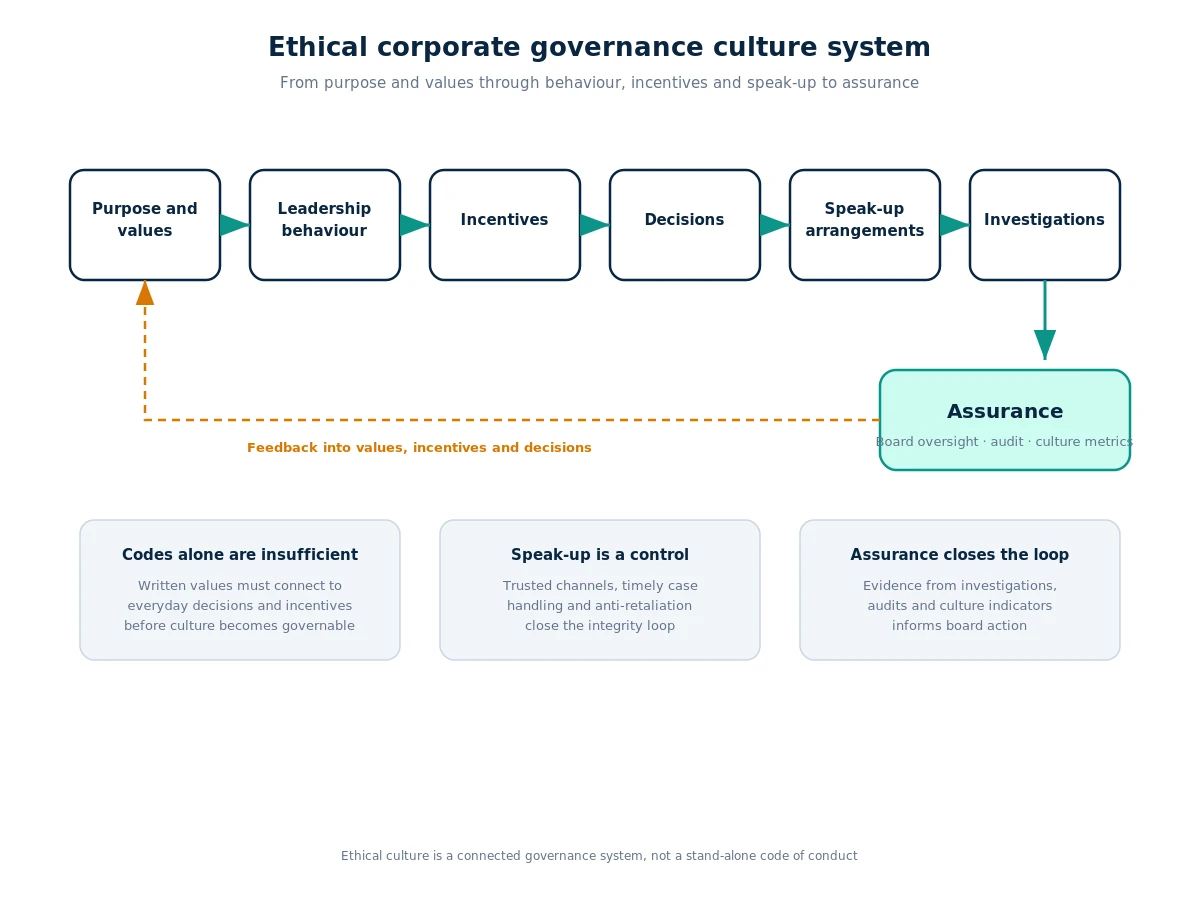
To build an ethical corporate governance culture, a board must turn values into operating expectations: model the required behaviour, align incentives, manage conflicts, protect speaking up, investigate fairly and use evidence to test whether the culture works in practice. A code of conduct matters, but it cannot compensate for rewards, decisions or leadership behaviour that send the opposite message.
This guide presents a practical governance approach for boards, executives, company secretaries, risk leaders, compliance teams and internal auditors. It focuses on the organisational system that makes ethical behaviour more likely—and makes misconduct harder to ignore.
Contents
- What is an ethical corporate governance culture?
- Who is responsible?
- How to build the culture in eight steps
- How boards should measure ethical culture
- Common implementation failures
- How governance training supports implementation
What is an ethical corporate governance culture?
An ethical governance culture is the pattern of values, decisions and behaviours through which an organisation exercises authority responsibly. It is visible in how leaders make trade-offs, how people are rewarded, whether conflicts are disclosed, whether concerns can be raised safely and what happens when standards are breached.
The Financial Reporting Council defines corporate culture as the values, attitudes and behaviours manifested in a company’s operations and stakeholder relationships. Its current culture guidance links purpose, values, strategy, business model and behaviour, and emphasises continuous board attention rather than waiting for a crisis. Review the FRC’s corporate culture guidance.
Ethics and compliance overlap but are not identical. Compliance establishes required boundaries; ethics helps people decide responsibly when rules are incomplete, competing interests exist or discretion is unavoidable. Integrity is the consistency between stated principles and actual conduct. A mature governance system integrates all three.
Who owns ethical culture?
The board remains accountable for governance and should set expectations, challenge management and obtain assurance. Executives translate those expectations into operating decisions. Line managers make them credible—or incredible—in daily work. HR, compliance, risk, legal, internal audit and the company secretariat each provide specialist support, but none can own culture on behalf of leaders.
| Role | Primary responsibility | Evidence the board should expect |
|---|---|---|
| Board | Approve purpose, values and conduct expectations; oversee culture and material conduct risks | Minutes showing challenge, culture dashboard, thematic reviews and tracked remediation |
| Chief executive and executive team | Demonstrate expectations through decisions, resource allocation and consequences | Consistent messages, decision records, incentive changes and timely action |
| Line management | Apply standards to objectives, performance conversations and local decisions | Escalations, team discussions, fair case handling and control ownership |
| HR and compliance | Design conduct standards, training, reporting channels and case processes | Conflict registers, training evidence, case data and policy effectiveness reviews |
| Risk and internal audit | Assess conduct risk and provide independent insight or assurance | Risk assessments, culture audits, root-cause findings and assurance mapping |
Legal duties vary by jurisdiction. In the UK, official Companies House guidance explains that directors must use independent judgement, exercise reasonable care, avoid conflicts and consider the company’s reputation for high standards of business conduct. Delegating work to advisers does not remove directors’ legal responsibility. See the official director duties guidance.
How to build an ethical corporate governance culture
1. Translate purpose and values into observable conduct
Broad words such as “integrity” or “respect” are not self-executing. Define what each value requires in recurring decisions: selecting suppliers, recognising revenue, treating customers, handling data, hiring relatives, accepting hospitality and reporting mistakes. Include examples of acceptable conduct, prohibited conduct and decisions that require escalation.
Test the language with employees in different roles and locations. If people cannot explain what a value changes in their work, the value is still branding rather than governance.
2. Make board and executive behaviour the first control
Employees learn from what leaders tolerate, reward and discuss under pressure. The board should therefore examine whether senior appointments, strategic decisions, meeting conduct and responses to bad news are consistent with its values. “Tone from the top” is necessary, but the decisive question is whether conduct remains consistent when targets are threatened.
The OECD’s business-integrity guidance highlights leadership commitment alongside internal controls, due diligence, training and reporting avenues. Explore the OECD business integrity resources. The practical implication is that leaders must demonstrate integrity through choices, not slogans.
3. Align incentives and consequences
Review remuneration, sales targets, promotion criteria and informal recognition for unintended pressure. A balanced scorecard can include customer outcomes, control performance, collaboration and conduct—not only volume, speed or profit. Introduce risk adjustments or deferrals where short-term results can hide later harm.
Consequences must be credible and proportionate. Similar misconduct should receive comparable treatment regardless of seniority or commercial value. Equally, managers should recognise people who challenge questionable decisions, report errors early or protect stakeholders at a personal cost.
4. Govern conflicts of interest before they become scandals
Create a clear process for identifying, declaring, assessing, recording and managing actual, potential and perceived conflicts. Cover directorships, family interests, gifts, hospitality, political activity, supplier relationships, recruitment and related-party transactions. Define approval thresholds and when recusal is required.
A register is only useful if it prompts action. Review recurring declarations, late disclosures and concentrations around particular functions or third parties. Board members should follow the same or stricter standards as employees.
5. Design speaking-up arrangements people trust
Offer accessible channels, including options outside the management line. Explain confidentiality, anonymity where permitted, triage, investigation, feedback and protection from retaliation. Assess accessibility for contractors, remote workers and people who use different languages.
Reporting volume alone is not a success measure. Very low reporting may indicate fear or ignorance; very high reporting may reflect awareness, serious control weaknesses or both. Boards need context: awareness of channels, willingness to report, substantiation patterns, case ageing, retaliation allegations and employee confidence that concerns lead to fair action.
6. Investigate consistently and independently
Use documented criteria to classify allegations, protect evidence, manage conflicts, select investigators and determine escalation. Serious allegations involving senior leaders require sufficient independence and direct board or committee oversight. Preserve procedural fairness and avoid promising outcomes before facts are established.
Close the loop through root-cause analysis. Ask what target, control gap, leadership behaviour or process weakness made the event possible. Remediation should address the system as well as the individual case.
7. Integrate integrity into third-party governance
Suppliers, agents, distributors and joint-venture partners can expose the organisation to ethical and reputational harm. Apply proportionate due diligence before appointment, contract for required standards, provide role-relevant guidance and monitor changes after onboarding. Escalate unexplained ownership, unusual payment terms, conflicts or resistance to audit rights.
Do not treat due diligence as a one-off document check. Risk changes with ownership, geography, service scope, government touchpoints, adverse information and performance.
8. Obtain assurance and improve continuously
Management should monitor the controls it owns. Compliance and risk functions can provide thematic oversight. Internal audit can independently assess whether culture-related governance, risk management and controls are designed and operating effectively. The board should combine these perspectives instead of relying on one annual employee survey.
The G20/OECD Principles of Corporate Governance 2023 provide an international reference for board responsibilities, disclosure, stakeholder interests and sustainability. The UK Corporate Governance Code 2024 likewise connects board leadership, purpose, culture, risk and internal control. Organisations should apply the sources relevant to their jurisdiction and ownership model.
How boards should measure ethical culture
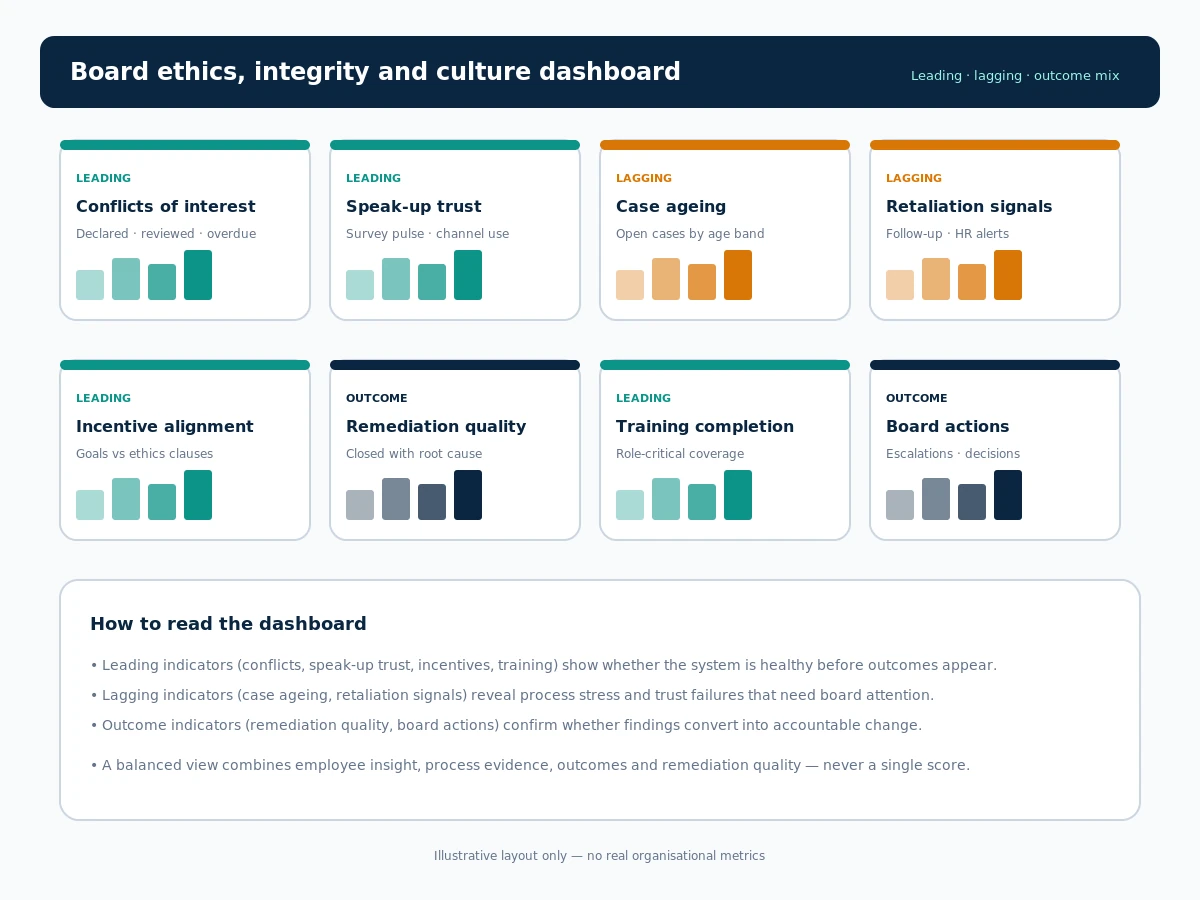
A useful dashboard combines leading indicators, outcome measures and qualitative evidence. Trends, segmentation and root causes are more informative than a single traffic-light rating.
| Indicator group | Examples | Questions for the board |
|---|---|---|
| Leadership and incentives | Risk-adjusted rewards, promotion overrides, control-objective completion | Are commercial and conduct expectations genuinely balanced? |
| Employee voice | Speak-up awareness, willingness to challenge, retaliation concerns | Can people raise difficult information without fear? |
| Conflicts and third parties | Late declarations, exceptions, due-diligence findings, monitored high-risk partners | Are disclosures timely and mitigations effective? |
| Cases and investigations | Allegation mix, ageing, substantiation, seniority, repeat issues | Are cases independent, fair and completed promptly? |
| Learning and remediation | Root causes, overdue actions, recurrence, lessons shared | Does the organisation fix systems or only individual events? |
Segment data by business unit, geography, tenure and seniority while protecting confidentiality. Compare survey responses with hard evidence such as audit findings, customer complaints, staff turnover, exceptions and disciplinary outcomes. Material differences between stated confidence and operational evidence deserve investigation.
Common implementation failures
- Publishing a code without changing systems: targets, promotion and procurement still reward contrary behaviour.
- Delegating culture to compliance: senior leaders avoid ownership while a specialist function becomes the messenger.
- Measuring training completion only: attendance proves exposure, not understanding or behavioural change.
- Celebrating zero reports: silence is interpreted as integrity without testing trust and awareness.
- Applying consequences selectively: commercially valuable or senior people receive exceptions that undermine credibility.
- Reporting averages: enterprise-level scores hide serious local pockets of misconduct risk.
- Closing cases without learning: individual discipline replaces root-cause analysis and control improvement.
How governance training supports implementation
Organisations need more than generic awareness. Board members and practitioners must be able to diagnose conduct risk, handle conflicts, test speaking-up arrangements, oversee investigations and report culture evidence without creating false certainty.
EPW’s five-day Ethics and Integrity in Corporate Governance Course addresses those applied responsibilities. The programme covers governance accountability, culture and conduct risk, ethical decisions, conflicts, speak-up arrangements, investigations, board reporting and continuous improvement. Workshops culminate in an integrity-governance framework that participants can adapt to their organisation.
The course is suited to governance, ethics, compliance, risk, internal audit and senior leadership professionals. It is professional development rather than jurisdiction-specific legal advice; participants should combine its methods with applicable law, regulation and organisational policy.
Frequently asked questions
Can a board create culture directly?
A board cannot control every behaviour, but it can shape the conditions: leadership appointments, incentives, accountability, information, challenge and consequences. It can also require reliable evidence about how culture operates below senior management.
How long does cultural change take?
Some controls can change quickly, such as conflict declarations or case triage. Trust and behavioural norms take longer because employees judge repeated decisions over time. Use staged objectives and monitor whether credibility improves.
Should ethics sit under HR, legal or compliance?
The reporting line depends on the organisation. What matters is clear accountability, independence for sensitive escalation, access to the board and coordination across people, legal, risk and assurance functions.
What is the best single culture metric?
There is no reliable single measure. A balanced view combines employee voice, incentives, conflicts, case handling, customer outcomes, control exceptions and remediation quality.
Build an integrity system the board can govern
An ethical corporate governance culture emerges when purpose, leadership, incentives, decisions, reporting and assurance reinforce one another. Start with observable conduct, remove contradictory pressures, protect challenge and give the board evidence that supports action.
For connected programmes in internal audit, governance and risk, explore EPW’s Auditing, Governance, and Risk Compliance Training Courses.
Ready to strengthen integrity oversight in practice? Review the Ethics and Integrity in Corporate Governance Course, check current locations and dates, or contact EPW to discuss an in-house programme.
Sources and references
- EPW Training. Ethics and Integrity in Corporate Governance Course. Accessed 13 September 2026.
- Financial Reporting Council. Corporate Culture. Accessed 13 September 2026.
- Financial Reporting Council. UK Corporate Governance Code 2024. Published 22 January 2024; application information accessed 13 September 2026.
- Organisation for Economic Co-operation and Development. Business Integrity. Accessed 13 September 2026.
- Organisation for Economic Co-operation and Development. G20/OECD Principles of Corporate Governance 2023. 11 September 2023.
- Companies House. Being a Company Director. Updated 11 September 2026; accessed 13 September 2026.