
To coordinate vendors across the project life cycle, establish one accountable owner, translate every contract into measurable deliverables and decision dates, integrate vendor dependencies into the project schedule, agree a shared reporting cadence, and control risks, changes, acceptance and closeout through recorded evidence. The method must be proportionate: a critical systems integrator needs more governance than a low-risk commodity provider.
Vendor coordination sits where project management, procurement and contract management meet. It does not replace the contract or the supplier’s own management system. It creates the practical interfaces through which the buyer, project team and vendors can deliver the agreed outcome without conflicting instructions, hidden dependencies or late surprises.
Key takeaways
- Start coordination before mobilisation by clarifying outcomes, interfaces, authority and acceptance evidence.
- Give each vendor one buyer-side coordination owner and one clear route for decisions and escalation.
- Connect contractual milestones to the integrated project schedule rather than maintaining an isolated vendor plan.
- Measure outcomes, quality, timeliness and risk—not meeting attendance or report volume.
- Control changes formally and plan transition, knowledge transfer and final acceptance from the beginning.
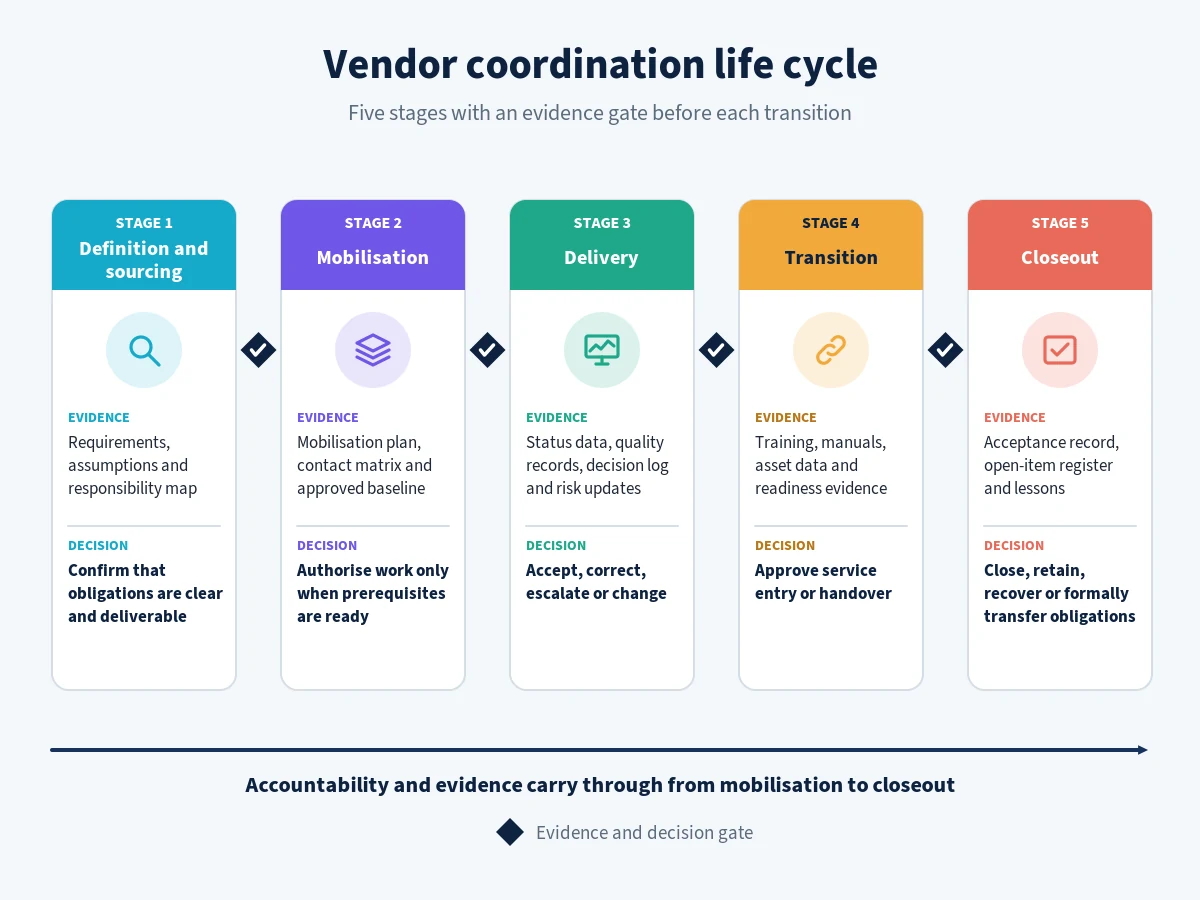
Vendor coordination across the life cycle at a glance
| Life-cycle point | Coordination priority | Essential evidence | Decision or control |
|---|---|---|---|
| Definition and sourcing | Outcome, scope, interfaces and market capability | Requirements, assumptions and responsibility map | Confirm that obligations are clear and deliverable |
| Award and mobilisation | People, governance, access, data and initial plan | Mobilisation plan, contact matrix and approved baseline | Authorise work only when prerequisites are ready |
| Delivery | Dependencies, performance, risks and decisions | Status data, quality records, decision log and risk updates | Accept, correct, escalate or change |
| Transition | Operational readiness, support and knowledge transfer | Training, manuals, asset data and readiness evidence | Approve service entry or handover |
| Closeout | Final acceptance, commercial closure and learning | Acceptance record, open-item register and lessons | Close, retain, recover or formally transfer obligations |
How to coordinate vendors in eight practical steps
1. Classify the vendor and define the delivery outcome
Begin with the project outcome rather than the supplier’s activity list. State what must be usable, by whom, under which acceptance conditions and by what decision date. Then classify the relationship by delivery criticality, complexity, substitutability, information sensitivity, safety or regulatory exposure, and the number of interfaces with other parties.
This classification determines the intensity of coordination. The UK Groceries Code Adjudicator’s supplier-relationship guidance recommends segmenting suppliers by value and risk, with closer collaboration for high-value or high-risk relationships. The same proportional principle is useful in projects: governance effort should follow exposure, not vendor size alone. See the GCA’s supplier relationship management guidance.
2. Establish roles, authority and one route for instruction
Name a buyer-side vendor coordination owner and the vendor’s accountable counterpart. Clarify who may approve scope, accept deliverables, instruct work, agree technical interpretations, authorise changes and release payments. A simple responsibility matrix should cover the sponsor, project manager, procurement lead, contract manager, technical owner, quality lead and end user.
Avoid giving vendors instructions through multiple workstreams. Technical specialists may discuss options, but any direction affecting scope, time, cost, risk or contractual obligations should follow the authorised route. UK government guidance for new contract managers emphasises agreed roles, a contract management plan, mobilisation tracking and cross-functional relationships. These are described in the Contract Management Professional Standards guidance.
3. Translate the contract into a coordination control plan
Extract the contract’s operational controls into a working plan. Include deliverables, milestone dates, dependencies, service levels, key performance indicators, acceptance criteria, reporting obligations, warranties, change rules, invoice evidence, remedies and exit duties. Reference the governing clause rather than copying fragments that may become inconsistent with the signed agreement.
For each control, record the owner, evidence source, review frequency, tolerance and action when performance is outside tolerance. The World Bank’s 2025 procurement regulations require a contract management plan with KPIs and milestone events for identified contracts, followed by performance monitoring and timely reporting. This supports a wider lesson: performance measures are useful only when connected to ownership and decisions. See the World Bank Procurement Regulations for IPF Borrowers.
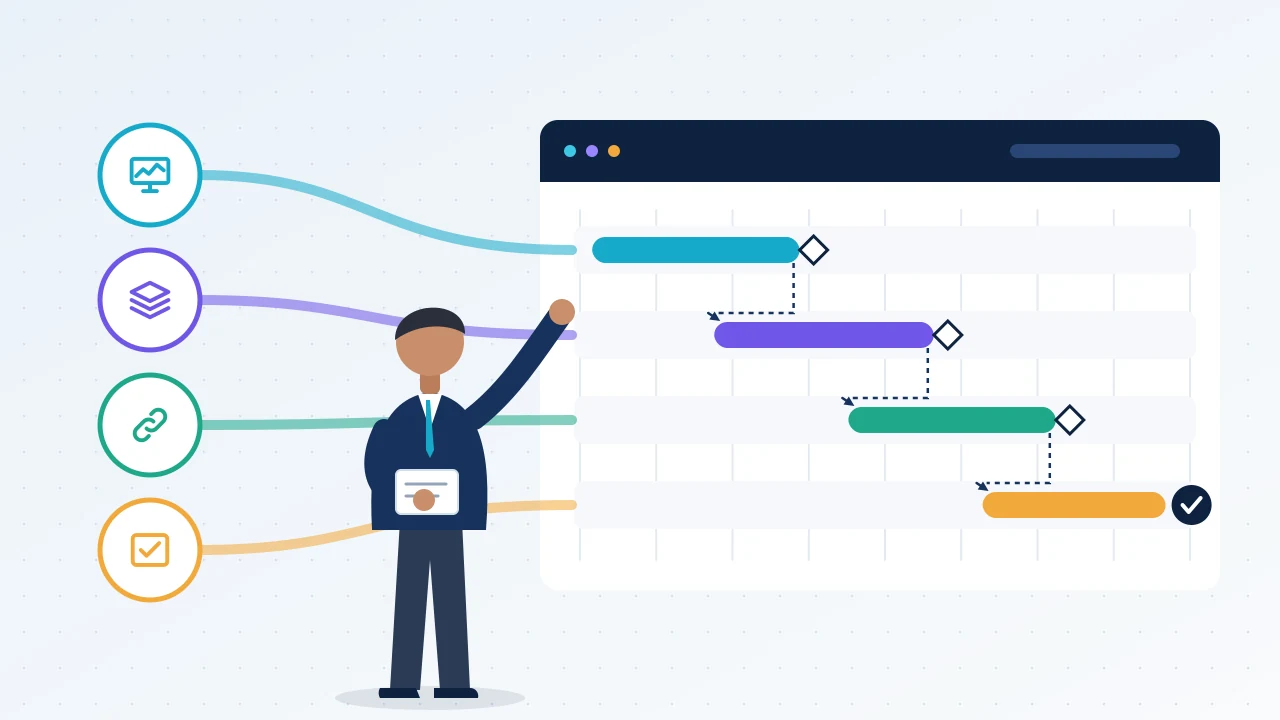
4. Integrate vendor work into the project schedule
Build vendor activities into the integrated project schedule at the level needed to manage interfaces. Include buyer-provided information, access, approvals and decisions as well as vendor production, review, correction, delivery and acceptance. Link dependencies between vendors so that a delay in one workstream produces visible consequences elsewhere.
Use interface milestones with unambiguous definitions: “design complete” is weak if nobody knows whether it means submitted, reviewed or approved. A stronger milestone names the required state and evidence, such as “interface design approved by the technical authority”. EPW’s Advanced Project Planning and Control Techniques course develops the planning and control discipline needed to maintain these links.
5. Agree one information and meeting cadence
Define what each forum is for. A short operational meeting may remove delivery blockers; a technical review may resolve design questions; a commercial review may examine performance, change and payment; an executive forum may decide escalated issues. Do not combine every topic into one oversized status meeting.
Use one controlled source for current plans, actions, decisions, risks, deliverables and approved documents. Agree data cut-off dates, reporting definitions and version rules. EPW’s Project Communication and Reporting Techniques course provides a useful development route for project teams that need clearer status evidence and decision-ready reporting.
6. Monitor performance, risks and interfaces together
Review performance against the contract and project need. A vendor can meet a narrow reporting KPI while an unresolved interface still threatens the outcome. Combine lagging measures, such as accepted deliverables and defect levels, with leading indicators, such as overdue decisions, forecast milestone movement, resource gaps, repeat quality observations and ageing actions.
UK government contract-management principles recommend using KPIs and data to manage contracts proactively, while balancing hard performance data with customer satisfaction and relationship measures. They also advise reviewing measures as the contract evolves. See the official contract management principles.
7. Control issues, decisions and changes
Separate four records: actions describe work to do; issues describe present problems; risks describe uncertain future events; and changes alter an approved baseline or obligation. Give every item an owner, due date, status and escalation threshold. Record material decisions with the options considered, authority, date and consequences.
Do not let urgent delivery pressure create informal scope. Assess the schedule, cost, quality, risk, operational and contractual effects before approving a change. Government guidance explicitly advises planning for change through joint work with suppliers while retaining strong change control and senior assurance. Project teams can strengthen this discipline through EPW’s Project Risk Management and Mitigation Strategies course.
8. Manage acceptance, transition and closeout deliberately
Plan closeout requirements during mobilisation, not in the final week. Define acceptance tests, defect treatment, documentation, data and asset handover, training, support, warranties, intellectual property, access removal, final accounts and unresolved claims. Assign the future owner of any obligation that continues after project closure.
Government guidance groups contract management around mobilisation, service provision and supplier relationship management, while its professional standards include delivery, exit and transition. The practical implication is that closing a purchase order is not the same as proving operational readiness or completing knowledge transfer. See the GCA’s contract lifecycle overview.
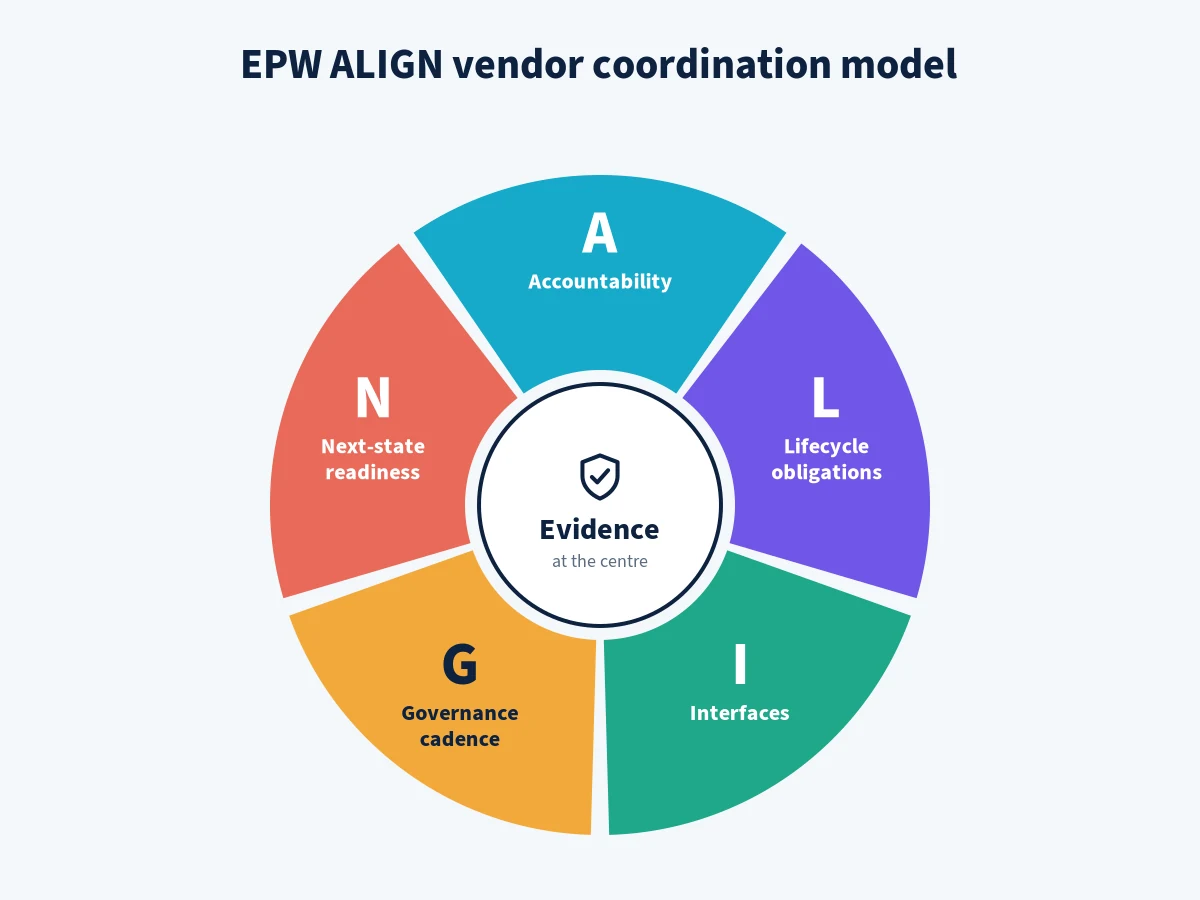
The EPW ALIGN vendor coordination model
Use ALIGN as a compact control when a project has several vendors or complicated interfaces:
| Element | Management question | Minimum evidence |
|---|---|---|
| A — Accountability | Who may instruct, decide, accept and escalate? | Governance and responsibility matrix |
| L — Lifecycle obligations | What must happen from mobilisation to exit? | Contract control plan |
| I — Interfaces | Which party needs what from whom, and when? | Interface register and integrated schedule links |
| G — Governance cadence | Where are performance, risks and decisions reviewed? | Meeting map, reporting calendar and decision log |
| N — Next-state readiness | What proves acceptance, transition and closure? | Readiness, handover and closeout checklist |
Worked example: coordinating three vendors for a system rollout
Consider a project in which one vendor supplies software, another migrates data and a third provides user training. The software vendor cannot complete configuration until the client approves the process design. The migration vendor needs a stable data model, while the training vendor needs an approved system and realistic scenarios.
The project manager maps these dependencies in one schedule and creates three interface milestones: data model approved, test environment accepted and training release authorised. The contract manager maps each milestone to acceptance evidence and payment conditions. Weekly operational reviews address blockers; a fortnightly integration review examines cross-vendor dependencies; and only the authorised change board may approve baseline changes.
When the software configuration slips, the team does not simply ask all vendors to “work faster”. It analyses the affected interfaces, protects migration validation, changes the training sequence, records commercial consequences and obtains an authorised decision. Coordination turns one vendor’s forecast into an integrated project response.
Common vendor coordination mistakes
- Starting after award: define interfaces, acceptance and governance while requirements and contracts are being developed.
- Multiple instruction channels: separate technical discussion from authorised direction.
- Vendor-only schedules: include buyer actions, approvals and cross-vendor dependencies.
- Too many KPIs: select a small balanced set linked to outcomes and management action.
- Meeting without evidence: use controlled data, named owners and recorded decisions.
- Informal change: assess and approve baseline effects before work proceeds.
- Late transition planning: define readiness and handover evidence during mobilisation.
Vendor coordination completion checklist
- The delivery outcome and acceptance conditions are unambiguous.
- Vendor criticality and coordination intensity are proportionate to risk.
- Instruction, approval, acceptance and escalation authority are documented.
- Contract deliverables, KPIs, milestones and evidence have named owners.
- Buyer, vendor and cross-vendor dependencies appear in one integrated schedule.
- Forums have distinct purposes, inputs, decisions and records.
- Risks, issues, actions, decisions and changes are controlled separately.
- Transition, knowledge transfer, access, warranties and closure are planned.
Develop project procurement and coordination capability
Vendor coordination requires commercial judgement as well as project control. Professionals can compare related development routes through EPW’s Project Management Training Courses and its broader Procurement and Supply Chain Management Training Courses.
Ready to apply a disciplined vendor coordination method to live projects? Explore EPW’s Project Procurement and Vendor Coordination course, review available dates and locations, or request tailored in-house training.
Conclusion
Effective vendor coordination connects the commercial agreement to the delivery system. It makes authority visible, integrates dependencies, turns performance data into decisions and carries acceptance evidence through to transition and closeout. When the approach is proportionate and well documented, the project team can collaborate constructively without weakening accountability or contractual control.
Sources and References
- Groceries Code Adjudicator. Supplier relationship management: how to manage supplier relationships effectively. 17 October 2025. https://www.gca.gov.uk/news/procurement-essentials-supplier-relationship-management-how-to-manage-supplier-relationships-effectively/
- UK Cabinet Office and Government Commercial Function. Initial guidance and signposting for new-in-role contract managers. Updated 13 August 2026. https://www.gov.uk/government/publications/civil-service-helping-you-with-managing-suppliers-and-contracts/initial-guidance-and-signposting-for-new-in-role-contract-managers-html
- World Bank. Procurement Regulations for IPF Borrowers, seventh edition. September 2025. https://thedocs.worldbank.org/en/doc/c84273d1b230aeb2b0b8134de5dc8cd7-0290012025/original/Procurement-Regulations-7th-Edition-Sep-2025.pdf
- UK Cabinet Office. Contract management principles. Updated 12 December 2025. https://www.gov.uk/government/publications/commercial-capability-contract-management-standards/contract-management-principles
- International Organization for Standardization. ISO 44001:2017 — Collaborative business relationship management systems. Accessed 8 September 2026. https://www.iso.org/standard/72798.html