

AI-generated illustration created to represent the article’s subject. It does not depict an actual EPW course, trainer, participant, client, event or venue.
An executive communication process converts strategic intent into a message that the right people understand, trust and act upon—and then tests whether the intended action occurred. It is more than writing a speech or sending an announcement. It is an end-to-end management process with evidence, ownership, decision gates and feedback.
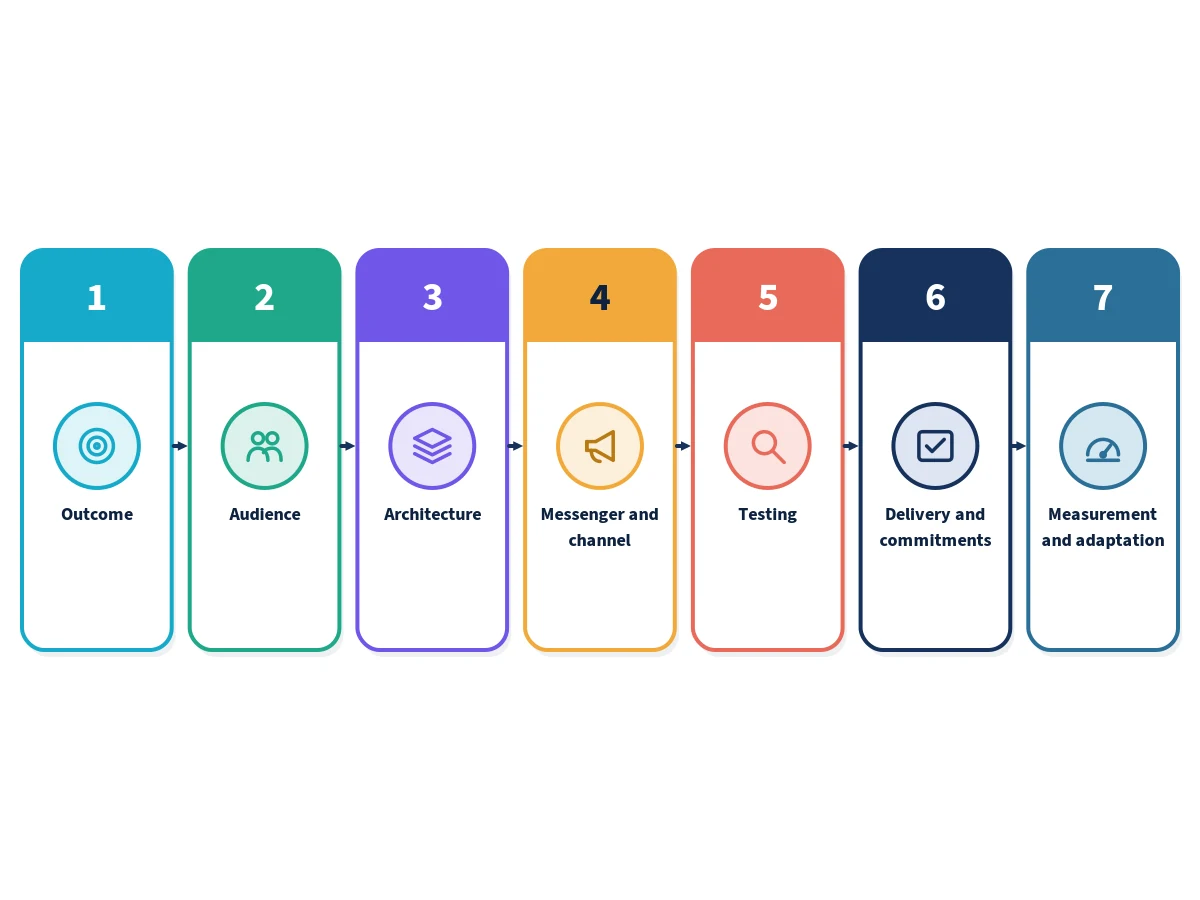
The process below has seven stages: define the action outcome; analyse the audience and context; build the evidence and message architecture; choose messenger, channel and timing; test the communication; deliver and enable dialogue; and measure action, learn and adapt. The stages are sequential enough to create control, but iterative enough to respond to new evidence.
The seven-stage executive communication process
- Define the action outcome.
- Analyse the audience and context.
- Build the evidence and message architecture.
- Choose the messenger, channel and timing.
- Test for clarity, credibility and risk.
- Deliver, listen and secure commitments.
- Measure action, learn and adapt.
This approach is consistent with the outcome-led discipline in the UK Government Communication Service’s OASIS framework: objectives, audience and insight, strategy and ideas, implementation, and scoring and evaluation. The EPW process adapts that logic to executive communication, where the leader’s authority, behaviour and follow-through form part of the message.
Stage 1: Define the action outcome
Begin with the organisational action required, not the sentence the executive wants to say. An outcome such as “employees understand the strategy” is too vague to manage. Specify what people should decide, stop, start, continue or escalate, by when and within which constraints.
Separate three levels of result:
- Communication output: what is delivered, such as a briefing, town hall or manager pack.
- Audience response: what people understand, believe or intend to do.
- Organisational outcome: the observable decision or behaviour that supports the strategy.
The executive sponsor owns the organisational outcome, even when a communication team manages production. At the first decision gate, the sponsor should be able to complete this sentence: “After this communication, this audience will take this action by this date, evidenced by this measure.”
Stage 2: Analyse the audience and context
“All staff” is a distribution list, not an audience analysis. Identify groups by their relationship to the required action: decision-makers, implementers, people affected, trusted intermediaries, likely advocates and those with legitimate concerns. Examine what each group already knows, what they may lose or gain, what evidence they trust and what prevents action.
Use direct evidence where possible: interviews, employee questions, customer feedback, operational data, previous campaign results and manager observations. The GOV.UK Service Manual’s guidance on learning user needs reinforces a useful principle: design around what people need to achieve, not around what the organisation wants to broadcast.
The output is a short audience-and-context brief that records evidence, uncertainties and accessibility needs. The decision gate asks whether important groups have been represented by evidence rather than assumption.
Stage 3: Build the evidence and message architecture
Construct a message architecture before writing channel-specific copy. At its centre is one proposition: the change, why it matters now and the action required. Support it with no more than three evidence pillars, each grounded in facts that can be verified. Then add the implications for each audience, known trade-offs, questions that need an honest answer and matters that remain undecided.
A useful architecture has five layers:
- the one-sentence strategic proposition;
- the required action and deadline;
- the evidence and reasoning;
- the audience-specific implications; and
- the route for questions, challenge or escalation.
The Government Functional Standard GovS 011 states that communication should be open, transparent, informative and based on established facts. For executives, that means distinguishing evidence from aspiration and acknowledging uncertainty without surrendering direction.
Stage 4: Choose the messenger, channel and timing
Select the messenger according to trust, authority and proximity to action. The chief executive may establish strategic importance, but a line manager may be better placed to explain what changes on Monday morning. Technical, legal or community voices may be needed where credibility depends on specialist or local knowledge.
Choose channels for their function. A live forum supports explanation and challenge; a written record preserves accuracy; a manager conversation translates the message into local action; and a dashboard shows progress. Major communication normally needs a sequence rather than one event: prepare intermediaries, announce, discuss, reinforce, remind and report results.
Timing should reflect decision readiness, operational capacity and information risk. Do not communicate a call to action before managers have tools to implement it. Equally, silence creates a vacuum when employees already know change is coming. The output is a channel-and-sequence plan with named owners.
Stage 5: Test for clarity, credibility and risk
Test the draft with a small, representative group who have permission to be candid. Ask them to explain the message in their own words and state what they would do next. Agreement is not the test; accurate interpretation and actionable understanding are.
Use four checks:
- Clarity: Can people identify the decision, rationale, action and deadline?
- Credibility: Does the evidence support the claim, and does executive behaviour align with it?
- Inclusion: Can people with different roles, language proficiency and access needs use the communication?
- Risk: Could wording create legal, security, reputational or operational harm?
Clear language is a control, not a cosmetic preference. The Office for National Statistics’ plain-language guidance advises putting user needs first, using active voice and being concise and consistent. The stage gate requires approval of facts, material risks and accessibility—not endless polishing by committee.
Stage 6: Deliver, listen and secure commitments
Delivery begins before the executive speaks. Brief managers and other intermediaries, publish supporting material, prepare answers and establish a route for unresolved questions. During delivery, make the decision and requested action unmistakable. Explain what is fixed, what is open to influence and when the next update will come.
Dialogue must produce information the organisation can use. Capture questions by theme, identify emerging risks and assign owners and response dates. Where the communication seeks a decision, record the commitment, owner and deadline. Where it seeks behaviour change, make the first action easy to perform and visible to the relevant team.
Executive presence matters here because people read pace, tone and willingness to answer difficult questions as evidence. EPW’s Developing Leadership Presence and Influence course addresses this connection between leadership behaviour and impact.
Stage 7: Measure action, learn and adapt
Measure beyond reach. Attendance, opens and views show exposure, but not whether people understood or acted. Track a linked chain of evidence: outputs, audience interpretation, commitments, behaviour and organisational effect. The Government Communication Service’s Evaluation Cycle distinguishes inputs, outputs, outtakes, outcomes, impact, and learning and innovation. It treats evaluation as an ongoing loop rather than an end-of-campaign report.
Choose a small set of measures before delivery. These might include the percentage of managers able to explain the decision accurately, the number of teams completing the required action, exception rates, service performance and recurring questions. Review both positive and adverse effects. Adapt the message, channel, support or even the implementation plan when evidence shows a barrier.
The process closes only when the owner has decided what to continue, change or stop—and has communicated that decision back to the people who contributed feedback.
Inputs, owners, outputs and controls
| Stage | Essential input | Accountable owner | Output and control |
|---|---|---|---|
| 1. Outcome | Strategic decision and delivery need | Executive sponsor | Measurable action statement approved |
| 2. Audience | Stakeholder and operational evidence | Communication lead | Audience brief; assumptions challenged |
| 3. Architecture | Verified facts, rationale and trade-offs | Sponsor with subject owner | Core message and evidence signed off |
| 4. Sequence | Trust, channel and readiness analysis | Communication lead | Messenger and channel plan confirmed |
| 5. Test | Draft materials and representative users | Content owner | Clarity, inclusion and risk checks passed |
| 6. Deliver | Briefed messengers and support tools | Executive and line managers | Questions and commitments logged |
| 7. Learn | Baseline, measures and feedback | Outcome owner | Adaptation decision and feedback closed |
End-to-end example: announcing a new operating model
Imagine an executive team introducing a new operating model that gives regional teams more customer authority while centralising risk controls. The initial request—“announce the model at the town hall”—is an output, not an outcome.
At Stage 1, the sponsor defines the result: within four weeks, each regional director will nominate decision owners and confirm three mandated controls. At Stage 2, interviews reveal that regions welcome greater autonomy but fear that central approval will remain unchanged. Stage 3 therefore makes the division of rights explicit, explains the evidence behind the model and acknowledges which detailed procedures are still being designed.
At Stage 4, the chief executive introduces the rationale, the risk director explains controls and regional directors hold local decision workshops. Stage 5 testing shows that the phrase “empowered regions” is interpreted as freedom to change controls, so it is replaced by a precise statement of scope. During Stage 6, questions are logged publicly and each workshop ends with named commitments. Stage 7 measures confirmed ownership, control readiness and decision cycle time. Where one control causes delay without reducing risk, the design team revises it and reports the change.
The communication succeeds because it connects words to governance, capability and feedback—not because the launch event is polished.
Decision gates that prevent avoidable failure
- Outcome gate: Do we know the observable action and its owner?
- Evidence gate: Are material claims verified, and are uncertainties explicit?
- Audience gate: Have affected groups shaped the analysis?
- Readiness gate: Can managers and systems support the requested action?
- Release gate: Have clarity, inclusion and material risks been tested?
- Closure gate: Have results, questions and adaptations been reported?
Gates should be proportionate. A routine update may pass them in one short meeting; a major restructuring, crisis or regulatory change needs formal evidence and approvals. The purpose is to stop communication outrunning organisational readiness.
Common process failures
- Starting with a channel. “We need a town hall” displaces the question of what must change.
- Treating distribution as understanding. Delivery metrics cannot prove correct interpretation.
- Leaving managers unprepared. Local leaders become a bottleneck when they lack answers or authority.
- Hiding uncertainty. Overconfidence damages trust when details later change.
- Collecting feedback without closure. People stop contributing when questions disappear into a system.
- Measuring sentiment alone. People can dislike a decision yet understand and implement it—or approve of it without acting.
Executive communication process checklist
- State the required action, owner, deadline and measure in one sentence.
- Segment audiences according to their role in the action.
- Verify facts and distinguish decisions from proposals.
- Define the core message, evidence, implications and escalation route.
- Choose messengers for trust and proximity as well as seniority.
- Sequence channels around operational readiness.
- Test comprehension with representative people.
- Check accessibility, inclusion and material risks.
- Record questions, commitments, owners and response dates.
- Measure understanding, behaviour and organisational outcome.
- Adapt the communication or implementation when evidence requires it.
- Close the loop by reporting what changed.
Build communication as a leadership system
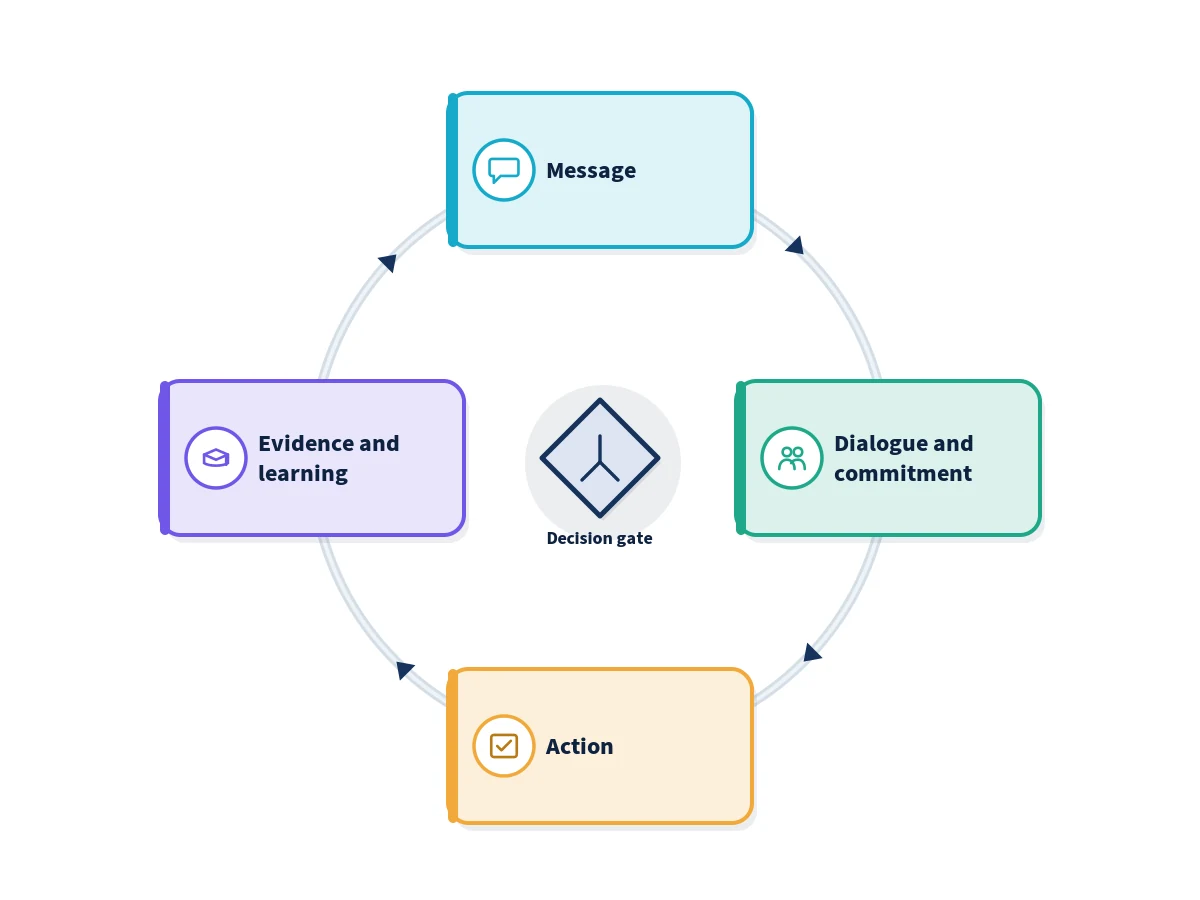
The strongest executive communication is not a performance added after a decision. It is the system through which leaders clarify intent, expose assumptions, mobilise coordinated action and learn from consequences. That system improves when communication, operations, policy, people and risk specialists share responsibility for the outcome.
Senior leaders can develop related capabilities through EPW’s Strategic Influence and Persuasion and Change Leadership in Government and Private Sectors courses. Further options are available in EPW’s Management and Leadership Training Courses portfolio.
Ready to apply executive communication in your organisation? Explore EPW’s Leadership Communication for Senior Executives, review available dates and locations, or request tailored in-house training.
Sources and references
- UK Government Communication Service, OASIS: Planning Government Communications, published 13 March 2020, accessed 4 September 2026.
- UK Civil Service, Government Functional Standard GovS 011: Communication, updated 30 November 2023, accessed 4 September 2026.
- UK Government Communication Service, Evaluate and Learn: The Evaluation Cycle, accessed 4 September 2026.
- Government Digital Service, Start by Learning User Needs, accessed 4 September 2026.
- Office for National Statistics, Plain Language, accessed 4 September 2026.