

AI-generated illustration created to represent the article’s subject. It does not depict an actual EPW course, trainer, participant, client, event or venue.
To build leadership presence and influence at work, make your judgement visible, communicate with purpose, listen before advocating, adapt to stakeholders, and practise consistently under real pressure. Presence is not a fixed personality trait or a performance of confidence. It is the repeated experience others have of your credibility, clarity and constructive impact.
This seven-step method is for managers, project leaders and specialists who must gain commitment without relying solely on formal authority. The outcome is not to dominate a room; it is to help people understand, trust and act on a sound direction.
What you need before you start
- A real leadership situation: choose an upcoming decision, meeting or stakeholder conversation with a meaningful outcome.
- A clear organisational purpose: know what result matters and why, rather than treating visibility as the goal.
- Specific feedback: ask two trusted colleagues what you do that builds or weakens confidence.
- A practice window: allow 30 days to test observable behaviours and review evidence.
The UK Civil Service Leadership Statement frames effective leadership as inspiring, confident and empowering. Those qualities are useful behavioural outcomes: leaders provide purpose, make decisions with appropriate confidence, and enable others to contribute. They are not instructions to appear charismatic.
Seven steps to build leadership presence and influence
1. Define the value you must contribute
Write one sentence that describes the value your role should add in the chosen situation. For example: “I will help the steering group distinguish the service risk from the implementation inconvenience, then secure a decision on ownership.” This prevents presence from becoming self-promotion.
Identify the evidence, experience and organisational perspective you can contribute. If the decision sits outside your expertise, your value may be asking the question that exposes an assumption or connecting the right specialists.
2. Align your words, decisions and behaviour
Credibility falls when a leader’s message and conduct conflict. If you ask for open challenge, allow time for dissent and respond without punishment. If you emphasise customer outcomes, make trade-offs using customer evidence rather than internal convenience.
The Center for Creative Leadership describes authenticity as alignment between internal values and external behaviour. Applied at work, this means being consistent enough to be trusted while remaining willing to revise a view when evidence changes.
3. Prepare a concise point of view
Before an important interaction, prepare four elements: the outcome, the relevant evidence, your recommendation and the decision or contribution required from others. Lead with the outcome, not a long history. State uncertainty explicitly where it affects the decision.
A useful opening is: “We need to decide X today because Y outcome is at risk. The evidence indicates Z. I recommend A, subject to this assumption. I need B from this group.” This structure makes your judgement legible without overstating certainty.
4. Regulate your delivery under pressure
Slow down enough to finish sentences, pause after important points and keep your physical behaviour congruent with the situation. Calm delivery is not passivity. You can state a firm boundary in an even tone and explain the consequence.
Use a short reset before entering the room: breathe, name the intended outcome, identify the stakeholder you most need to understand, and decide what you will not do—for example, interrupt or fill every silence. Remote meetings require the same discipline: look at the camera for key points, remove distractions and invite named contributions.
5. Listen for interests, constraints and emotion
Influence begins with an accurate model of the other person’s position. Ask one open question, listen to the full answer, summarise the underlying concern and check your interpretation before proposing a solution. The International Coaching Federation’s 2025 Core Competencies treats active listening as attention to words, emotions, body language and what is not being said.
Listening does not require agreement. It lets you address the actual barrier. A finance director concerned about control needs different evidence from an operations manager concerned about workload, even when both initially say “the proposal is too risky”.
6. Match your influence approach to the situation
| Situation | Approach | Observable behaviour |
|---|---|---|
| Authority and evidence are clear | Direct | State the decision, rationale, boundaries and review point |
| Expert knowledge is distributed | Consultative | Ask for evidence, test options and explain how input affects the decision |
| Commitment across functions is required | Coalition-building | Surface interests, identify shared outcomes and secure reciprocal commitments |
| Trust is low or history is contested | Listening-led | Acknowledge impact, verify concerns and agree a small credible next step |
| Urgency is high but uncertainty remains | Bounded experiment | Set a short action, owner, safeguards, evidence threshold and stop rule |
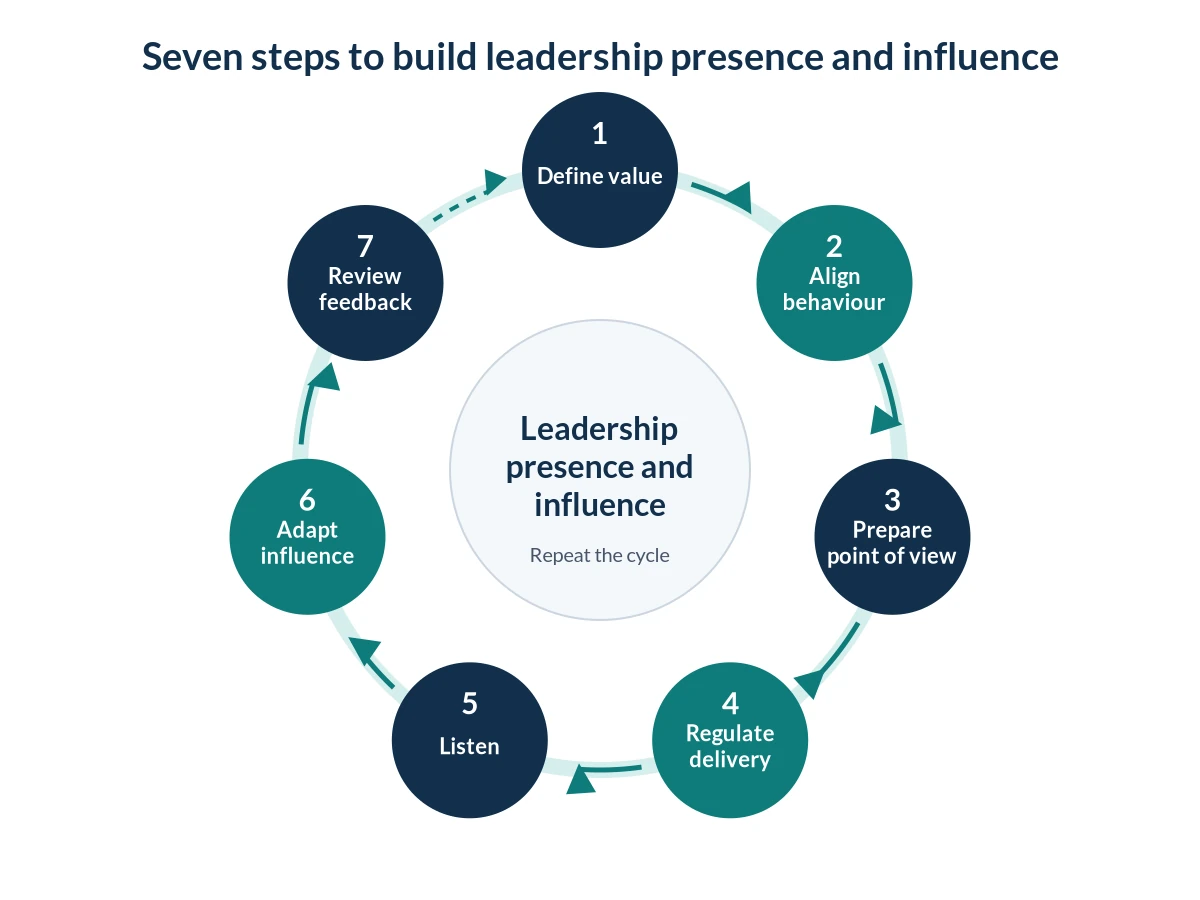
7. Review evidence and repeat
After the interaction, record what happened rather than grading yourself as “strong” or “weak”. Did the group understand the outcome? Were material concerns surfaced? Was a decision made? Did people know their commitments? Ask one observer for a specific behaviour to retain and one to adjust.
Repeat the same behaviour across different settings. Presence is built through consistency under varied conditions, not one polished presentation. Review patterns every week and select one adjustment for the next practice cycle.
Decision points that prevent overplaying presence
- If you lack evidence, name the gap and commission the right analysis rather than projecting certainty.
- If the stakeholder has formal authority, frame options and consequences; do not disguise advocacy as a decision already made.
- If the group is silent, create a safer way to contribute before interpreting silence as agreement.
- If emotions are high, acknowledge the impact and slow the process before pressing for commitment.
- If urgency is genuine, narrow the immediate decision and set a review point instead of abandoning consultation entirely.
Leaders who need to improve message structure alongside delivery may also find EPW’s Leadership Communication for Senior Executives course relevant. For complex stakeholder negotiations, Strategic Influence and Persuasion training develops a broader range of influence choices.
Worked example: influencing a delayed decision
An operations manager needs a cross-functional board to approve a pilot before a regulatory deadline. Her previous updates have been detailed but inconclusive. She defines her value as converting operational evidence into a controlled decision.
She opens with the required outcome and deadline, presents two verified constraints, recommends a limited pilot and asks the board to approve an owner and safeguard. When the risk lead objects, she does not repeat the presentation. She asks which exposure is unacceptable, summarises the concern and proposes a stop rule linked to that exposure.
The board approves the bounded pilot. Her presence came from clarity, evidence, composure and responsive listening—not greater volume. Her influence improved because she changed the decision design after understanding the real constraint.

Common errors and corrections
- Copying a dominant style: replace volume and certainty with clarity, evidence and appropriate confidence.
- Focusing on personal visibility: define the organisational value you must add before choosing how to speak.
- Over-rehearsing words: prepare the decision structure, then leave capacity to listen and adapt.
- Using one influence method: select direct, consultative, coalition, listening-led or experimental approaches according to the situation.
- Seeking vague feedback: ask what specific behaviour increased or reduced confidence and what happened as a result.
- Treating appearance as the whole of presence: professional presentation matters, but judgement, integrity and follow-through determine whether trust lasts.
A 30-day leadership presence practice plan
- Days 1–5: collect behavioural feedback, choose one situation and write your leadership-value sentence.
- Days 6–10: practise the four-part point of view in two low-risk meetings and review whether the requested outcome was clear.
- Days 11–15: focus on listening: ask, summarise and verify before advocating.
- Days 16–20: use the situation table to select two different influence approaches.
- Days 21–25: practise calm delivery in one higher-pressure interaction and obtain observer feedback.
- Days 26–30: compare evidence, retain one effective behaviour and set the next development goal.
Completion checklist
- I can state the value I need to add in one sentence.
- My recommendation links evidence, outcome and a clear request.
- My conduct matches the standards I ask of others.
- I can summarise a stakeholder’s concern accurately before responding.
- I choose an influence approach deliberately rather than by habit.
- I remain composed enough to think and listen under pressure.
- I seek feedback on observable behaviour and outcomes.
- I follow through on commitments and explain changes transparently.
Develop leadership presence through deliberate practice
Leadership presence becomes more reliable when managers receive structured practice, challenge and feedback. The goal is a credible approach that works across presentations, decisions, difficult conversations and cross-functional relationships.
Ready to apply leadership presence and influence in your organisation? Explore EPW’s Developing Leadership Presence and Influence, review available dates and locations, or request tailored in-house training.
Conclusion
You can build leadership presence by treating it as a set of observable, repeatable behaviours. Define your contribution, align conduct with values, communicate a clear point of view, regulate delivery, listen deeply, adapt your influence method and review evidence. Confidence then becomes a consequence of preparation and practice rather than an act.
Review EPW’s wider Management and Leadership Training Courses for related development. To practise this method with structured feedback, explore the Developing Leadership Presence and Influence training course and review dates, locations or in-house delivery options.
Sources and references
- UK Cabinet Office and Civil Service. Civil Service Leadership Statement. Published 12 February 2015; page updated 25 August 2016.
- Center for Creative Leadership. What Is Authentic Leadership, and Why Does It Matter?. Accessed 2 September 2026.
- Center for Creative Leadership. Executive Leadership Presence Training. Accessed 2 September 2026.
- International Coaching Federation. 2025 ICF Core Competencies. Accessed 2 September 2026.
- UK Civil Service. 5 Leadership Tips. Published 4 August 2015.